The Effectiveness of Mindfulness-Based Cognitive Therapy on Social Anxiety and Psychological Hardiness in Depressed Adolescents
DOI:
https://doi.org/10.61838/kman.jayps.5012Keywords:
mindfulness-based cognitive therapy, social anxiety, psychological hardiness, depressed adolescentsAbstract
Objective: The objective of this study was to examine the effectiveness of mindfulness-based cognitive therapy in reducing social anxiety and enhancing psychological hardiness among adolescents with depression.
Methods and Materials: The present study employed a quasi-experimental design with a pretest–posttest control group. The statistical population consisted of adolescents diagnosed with depressive disorder who referred to counseling centers in Tehran in 2024. Using convenience sampling, 30 adolescents who demonstrated high levels of social anxiety and low levels of psychological hardiness were selected and randomly assigned to an experimental group (n = 15) and a control group (n = 15). Participants in the experimental group received eight 2-hour sessions of mindfulness-based cognitive therapy, while the control group did not receive any psychological intervention during the study period. Data were collected using the Social Anxiety Scale for Adolescents and the Ahvaz Psychological Hardiness Inventory. The data were analyzed using descriptive statistics and analysis of covariance in SPSS version 26, with pretest scores entered as covariates.
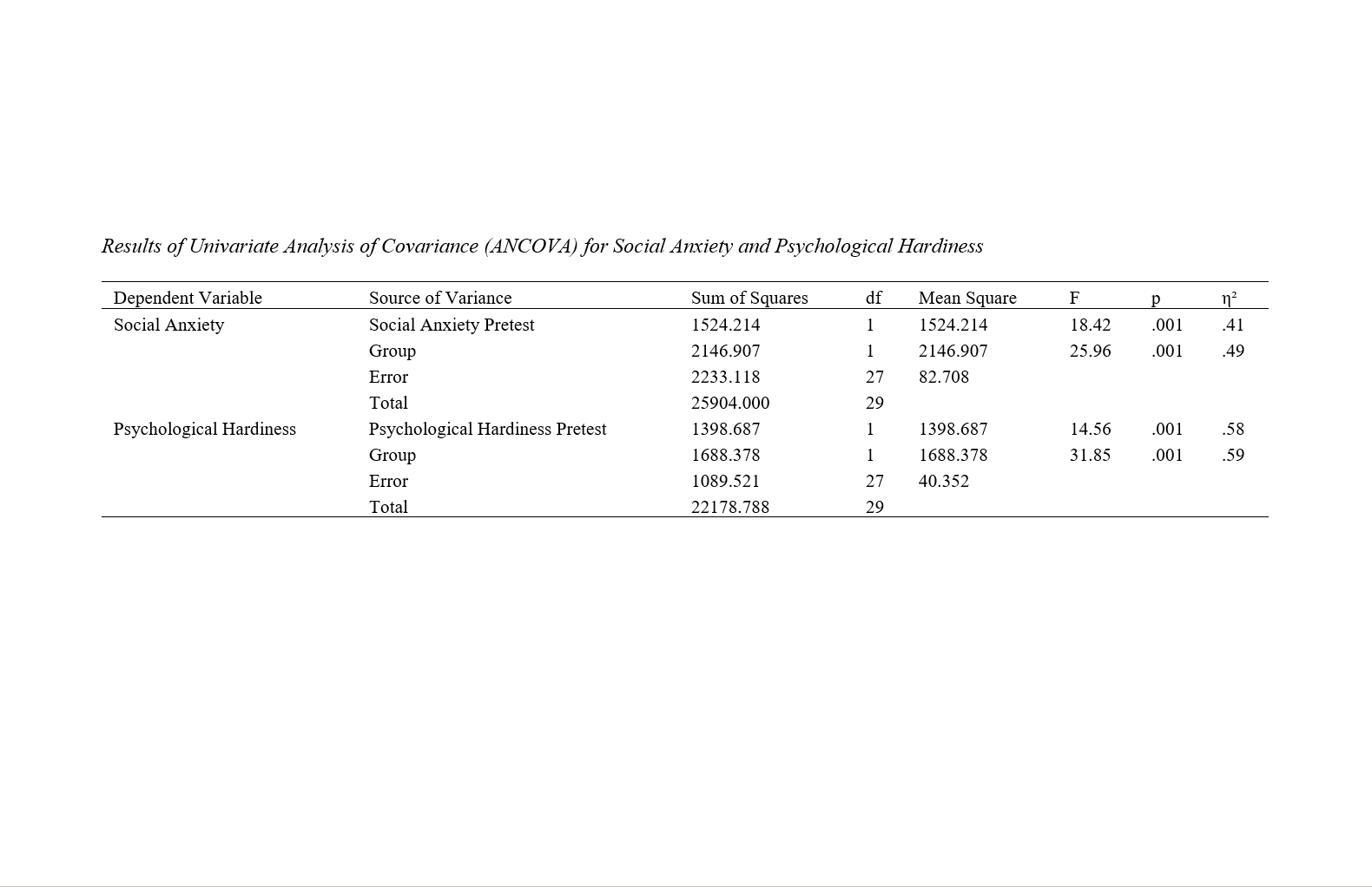
Findings: Inferential analysis indicated a significant group effect after controlling for pretest scores, showing that mindfulness-based cognitive therapy significantly reduced social anxiety in the experimental group compared with the control group. In addition, a significant increase in psychological hardiness was observed among adolescents who participated in the intervention. The effect sizes associated with group differences were large, indicating a substantial impact of the intervention on both outcome variables.
Conclusion: The findings suggest that mindfulness-based cognitive therapy is an effective intervention for simultaneously reducing social anxiety and strengthening psychological hardiness in adolescents with depression, highlighting its potential as a comprehensive and resilience-oriented therapeutic approach in adolescent mental health services.
Downloads
References
Abarkar, Z., Ghasemi, M., Mazhari Manesh, E., Mehdibeygi Sarvestani, M., Moghbeli, N., Rostamipoor, N., Seifi, Z., & Bakhshi Ardakani, M. (2023). The effectiveness of adolescent-oriented mindfulness training on academic burnout and social anxiety symptoms in students: experimental research. Annals of medicine and surgery, 85(6), 2683-2688. https://doi.org/10.1097/MS9.0000000000000811
Abbasi, M. E., Golmohammadian, M., & Kakabraee, K. (2023). Enhancing Psychological Hardiness and Distress Tolerance in Mothers of Hard of Hearing Children: The Efficacy of Mindfulness Integrated With Spiritual Therapy. Journal of Clinical Research in Paramedical Sciences, 12(2). https://doi.org/10.5812/jcrps-138109
Akbari, R., & Khalatbari, A. (2025). The Mediating Role of Perceived Social Support and Mindfulness in the Relationship between Psychological Hardiness and Distress Tolerance Among Students. Journal of Adolescent and Youth Psychological Studies, 6(2), 79-89. https://doi.org/10.61838/kman.jayps.6.2.10
Ansari, M. (2019). Suicide: Causes, prevalence, and prevention strategies among youth and adolescents. Nasle Roshan Publications.
Bartone, P. T., & Homish, G. G. (2020). Influence of hardiness, avoidance coping, and combat exposure on depression in returning war veterans: A moderated-mediation study. Journal of affective disorders, 265, 511-518. https://doi.org/10.1016/j.jad.2020.01.127
Darvishzadeh, M., & Maghderi, N. (2018). Investigating the effectiveness of group cognitive-behavioral therapy on reducing social anxiety in children.
Ghassami Tabegh, F., Torabi Zanooz, S., Mahmoud Alilu, M., & Pak, R. (2021). The relationship between symptoms of social anxiety disorder and psychological well-being with the mediation of fear of negative evaluation and quality of life. Behavioral Sciences, 47, 69-90. https://sanad.iau.ir/Journal/sbq/Article/935965/FullText
Hayatipoor, S., Bavi, S., Khalafi, A., Dasht Bozorgi, Z., & Gatezadeh, A. (2024). Effects of stress management training on cognitive avoidance and emotion regulation strategies in Female students with social anxiety disorder: A mindfulness and emotional schema therapy approach. International Journal of School Health, 11(1), 40-49. https://intjsh.sums.ac.ir/article_49774_72e6bcdffab20078c0a87db2764f8a36.pdf
Hazrati, Y., & Abdi, H. (2024). The effect of mindfulness-based cognitive behavioral therapy on social anxiety, self-efficacy, and quality of life in adults with stuttering with a language psychology approach. Journal of Behavioral Sciences Research, 22(1), 15-27. https://rbs.mui.ac.ir/browse.php?a_id=1750&sid=1&slc_lang=en
MahmoudiTabar, M., Alimohammadi, A., Borujen, K., Pirzadeh, F., AhmadiPour, F., Jafari, M., & Salehi, F. (2022). The spiritual effectiveness of mindfulness-based stress therapy on spontaneous negative thoughts and irritability in people with social anxiety. Islamic Life J. http://islamiclifej.com/article-1-1276-en.html
Öztekin, G. G. (2024). The Effects of Social Anxiety on Subjective Well-Being Among Adolescents: The Mediating Roles of Mindfulness and Loneliness. Iğdır Üniversitesi Sosyal Bilimler Dergisi(36), 220-236. https://doi.org/10.54600/igdirsosbilder.1433959
Phungsoonthorn, T., & Charoensukmongkol, P. (2022). How Does Mindfulness Help University Employees Cope With Emotional Exhaustion During TheCOVID‐19 Crisis? The Mediating Role of Psychological Hardiness and the Moderating Effect of Workload. Scandinavian journal of psychology, 63(5), 449-461. https://doi.org/10.1111/sjop.12826
Salehi Ashtarani, Z. (2023). The Effectiveness of Mindfulness-Based Therapy on Resilience and Psychological Hardiness of Orphaned and Neglected Students Master's Thesis in School Counseling, Islamic Azad University, Tiran Branch].
Salmani, R., Roshni Khiyavi, N., & Esmaeili, S. (2023). Investigating the effectiveness of mindfulness-based cognitive therapy on academic motivation and social adjustment in students with social anxiety. School Psychology and Education, 12(1), 46-61. https://jsp.uma.ac.ir/article_2468.html
Seyed Ali Tabar, S. H., & Zadhasn, Z. (2023). Effectiveness of Mindfulness-Based Cognitive Therapy on Mental Pain, Distress Tolerance and Psychological Hardiness in Breast Cancer Patients. Health Nexus, 1(1), 56-63. https://doi.org/10.61838/hn.1.1.9
Shibani, H., Mikaeili, N., & Narimani, M. (2020). Comparing the effectiveness of cognitive-behavioral therapy and emotion regulation training on irritability, depression, anxiety, stress, and emotional regulation in adolescents with disruptive mood dysregulation disorder. Clinical Psychology, 12(2), 41-50. https://jcp.semnan.ac.ir/article_4721_0.html
Sloan, E., Hall, K., Moulding, R., Bryce, S., Mildred, H., & Staiger, P. K. (2017). Emotion regulation as a transdiagnostic treatment construct across anxiety, depression, substance, eating and borderline personality disorders: A systematic review. Clinical psychology review, 57, 141-163. https://doi.org/10.1016/j.cpr.2017.09.002
Štánerová, E., Zelenayová, V., & Rajčáni, J. (2025). Mindfulness-based interventions for cancer patients in standard treatment: A meta-analysis of effects on depression, anxiety, and quality of life. Journal of psychosomatic research, 196, 112312. https://doi.org/10.1016/j.jpsychores.2025.112312
Sukmawati, Y., Lestari, R., & Wardhani, V. (2023). The Effectiveness of Giving Cognitive Behavior Therapy (CBT) and Mindfulness Therapy on Adolescents' Social Anxiety Levels. Jurnal Aisyah Jurnal Ilmu Kesehatan, 8(1). https://doi.org/10.30604/jika.v8i1.1668
Sun, H., & Huang, H. (2019). The Efficacy of Cognitive Behavioral Therapy to Treat Depression and Anxiety and Improve Quality of Life Among Early-Stage Breast Cancer Patients. Integrative Cancer Therapies, 18, 100-109. https://doi.org/10.1177/1534735419829573
Taheri, H. (2025). The effectiveness of mindfulness-based cognitive therapy on social anxiety and loneliness in adolescents. Ethics Committee in Research. https://ethics.atu.ac.ir/article_18969.html
Tarkhan, M. (2019). The impact of group cognitive-behavioral interventions based on promoting social behavior on reducing anxiety in elementary school students. Social Cognition Quarterly, 5(10), 92.
Yahyaei-Lahkaei, M., Khushkonesh, A., & Asghar Nejad Farid, A. A. (2022). The effectiveness of mindfulness techniques training on emotional awareness and social anxiety based on brain-behavior systems. Journal of Psychological Sciences, 21(120), 2487-2499. https://doi.org/10.52547/JPS.21.120.2487
Zhai, Y. (2025). The Clinical Intervention Effect of Mindfulness Painting Art Therapy on Adolescent Depression Patients. Schizophrenia Bulletin, 51(Supplement_1), S5-S6. https://doi.org/10.1093/schbul/sbaf007.009
Downloads
Additional Files
Publication Timeline
- Submitted
- Revised
- Accepted