Predicting Adolescent Depressive Symptom Severity from Rumination, Sleep Variability, and Heart-Rate Variability Using Multimodal Deep Learning
DOI:
https://doi.org/10.61838/kman.jayps.5214Keywords:
Adolescent Depression, Rumination, Sleep Variability, Heart-Rate Variability, Multimodal Deep LearningAbstract
Objective: The objective of this study was to develop and evaluate a multimodal deep learning architecture capable of predicting adolescent depressive symptom severity by dynamically integrating static cognitive rumination scores with continuous, time-series sequences of sleep variability and heart-rate variability.
Methods and Materials: A two-week prospective observational study was conducted involving adolescents (ages ) from urban and semi-urban districts of Lagos, Nigeria. Baseline cognitive vulnerability and depressive symptoms were assessed via self-report using the Ruminative Responses Scale (RRS) and the Patient Health Questionnaire for Adolescents (PHQ-A). Continuous physiological data, specifically nocturnal sleep variability (standard deviation of total sleep time) and heart-rate variability (HRV; specifically RMSSD), were collected continuously using wrist-worn actigraphy and photoplethysmography (PPG) devices. Data analysis was executed using a hybrid multimodal deep learning architecture featuring late fusion, which utilized Long Short-Term Memory (LSTM) networks to process the physiological time-series data and a Multilayer Perceptron (MLP) for the static cognitive data. The model was trained using the Adam optimizer to minimize Mean Squared Error and evaluated utilizing -fold cross-validation.
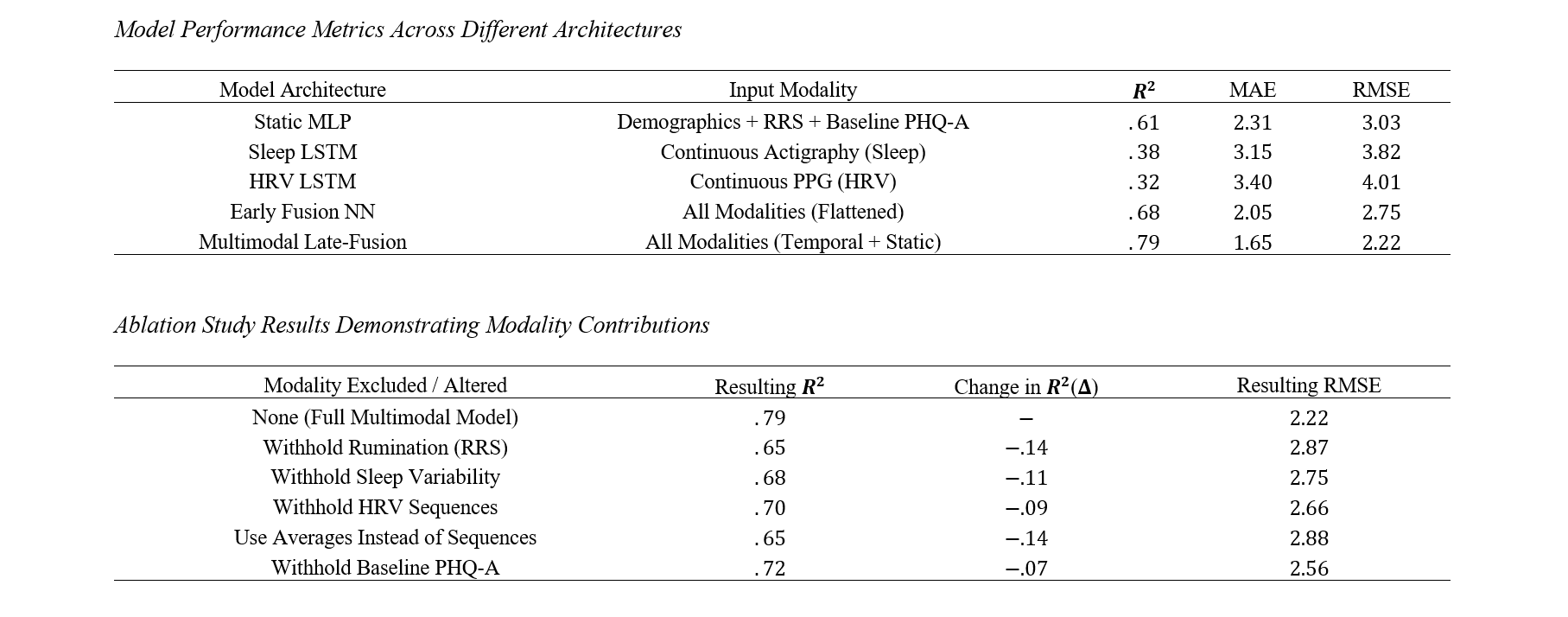
Findings: The final sample had a mean age of years ( ), with baseline PHQ-A scores of ( ) and baseline RRS scores of . Bivariate analyses indicated that follow-up depression severity was significantly predicted by rumination ( ), sleep variability ( ), and nocturnal RMSSD ( ). The multimodal late-fusion network demonstrated exceptional predictive accuracy ( , ), substantially outperforming all isolated unimodal models (Static MLP ; Sleep LSTM ; HRV LSTM ). Ablation studies confirmed the necessity of all modalities and temporal dynamics; excluding the rumination feature caused a significant performance drop ( ), and replacing the time-series physiological sequences with aggregated -day averages resulted in an identical loss of predictive power ( ).
Conclusion: Fusing objective, time-series physiological biomarkers with cognitive vulnerability profiles via multimodal deep learning provides a highly accurate and transformative computational framework for the proactive risk stratification and early clinical intervention of adolescent depression.
Downloads
References
Abdolmohamadi, K., & Ghadiri, F. (2023). Executive Functions and Sluggish Cognitive Tempo in People with Depressive Disorder and Normal. Psychology of Exceptional Individuals, 13(49), 208-232. https://doi.org/10.22054/jpe.2023.70975.2512
Bakhtiyarovich, M. J., Alamir, H. T. A., Abdul-Hameed, A., Jasim, H. H., Rasla, N. M., Saud, A., Amir, A. A., & Karim, M. M. (2023). Relationship between Different Psychological Coping Strategies and Anxiety and Depression Levels in Heart Attack Patients: Psychological coping strategies and anxiety and depression level. International Journal of Body, Mind and Culture, 11(Special Issue), 143-155. https://doi.org/10.22122/ijbmc.v10iSpecial Issue.482
Dong, K., Qi, H., & Zhao, G. (2025). The Relationship Between Co-rumination and Depressive Symptoms: A Systematic Review and Meta-Analysis. Journal of youth and adolescence, 1-19. https://doi.org/10.1007/s10964-025-02140-9
Fan, Y., Ho, M.-H. R., & Shen, B.-J. (2023). Loneliness predicts physical and mental health-related quality of life over 9 months among patients with coronary heart disease. Applied Psychology: Health and Well-Being, 15(1), 152-171. https://doi.org/10.1111/aphw.12403
Freedland, K. E., Carney, R. M., Rich, M. W., Steinmeyer, B. C., & Rubin, E. H. (2015). Cognitive Behavior Therapy for Depression and Self-Care in Heart Failure Patients: A Randomized Clinical Trial. JAMA internal medicine, 175(11), 1773-1782. https://doi.org/10.1001/jamainternmed.2015.5220
Goldstein, B. I., Carnethon, M. R., Matthews, K. A., McIntyre, R. S., Miller, G. E., Raghuveer, G., Stoney, C. M., Wasiak, H., & McCrindle, B. W. (2015). Major depressive disorder and bipolar disorder predispose youth to accelerated atherosclerosis and early cardiovascular disease: a scientific statement from the American Heart Association. Circulation, 132(10), 965-986.
Hare, D. L., Toukhsati, S. R., Johansson, P., & Jaarsma, T. (2014). Depression and cardiovascular disease: a clinical review. European Heart Journal, 35(21), 1365-1372. https://doi.org/10.1093/eurheartj/eht462
He, K., Chen, L., Fan, H., Sun, L., Yang, T., Liu, H., & Wang, K. (2025). Effects of Rumination and Emotional Regulation on Non-Suicidal Self-Injury Behaviors in Depressed Adolescents in China: A Multicenter Study. Psychology research and behavior management, 18, 271-279. https://doi.org/10.2147/PRBM.S483267
Jiang, H., Ding, C., Liu, Y., & Yu, J. (2025). Good sleep quality shields older adults from depressive symptoms linked to isolation: Comparing online and in-person social connections. Geriatric Nursing, 62, 51-57. https://doi.org/10.1016/j.gerinurse.2025.01.035
Kandeğer, A., Odabaş Ünal, Ş., Ergün, M. T., & Yavuz Ataşlar, E. (2024). Excessive mind wandering, rumination, and mindfulness mediate the relationship between ADHD symptoms and anxiety and depression in adults with ADHD. Clinical Psychology & Psychotherapy, 31(1), e2940. https://doi.org/10.1002/cpp.2940
Lai, H., Mei, X., Huang, S., Wu, X., Liang, J. Q., Zhou, L., & Ye, Z. J. (2025). The Relationship Between Smartphone Addiction and Sleep Quality in Older Adults: The Mediating Role of Loneliness and Depression. BMC Nursing, 24(1). https://doi.org/10.1186/s12912-025-02883-7
Langenecker, S. A., Schreiner, M. W., Bessette, K. L., Roberts, H., Thomas, L., Dillahunt, A., Pocius, S. L., Feldman, D. A., Jago, D., Farstead, B., & Pazdera, M. (2024). Rumination-focused cognitive behavioral therapy reduces rumination and targeted cross-network connectivity in youth with a history of depression: replication in a preregistered randomized clinical trial. Biol Psychiatry Glob Open Sci, 4(1), 1-10. https://doi.org/10.1016/j.bpsgos.2023.08.012
Li, G. X., Liu, L., Wang, M. Q., Li, Y., & Wu, H. (2024). The longitudinal mediating effect of rumination on the relationship between depressive symptoms and problematic smartphone use in Chinese university students: A three-wave cross-lagged panel analysis. Addict Behav, 150, 107907. https://doi.org/10.1016/j.addbeh.2023.107907
Liu, Y., Tong, Y., Huang, G., & et al. (2025). Physical exercise moderates the mediating effect of depressive symptoms between sleep quality and suicidal ideation among college students. Scientific reports, 15, 21925. https://doi.org/10.1038/s41598-025-07767-z
Lo, B. C. Y., & Cheng, S. K. L. (2024). Emotional Risk Factors, Rumination, and Self-Criticism in Relation to Suicidal Ideation Among Chinese Depressive Outpatients. Behavioral Sciences, 14(11), 1111. https://doi.org/10.3390/bs14111111
Luo, S., Luo, B., Wei, Z., & Xin, L. (2025). Chain Mediation of Rumination and Anxiety State Between Mindfulness and Depressed Mood in Infertile Women. Scientific reports, 15(1). https://doi.org/10.1038/s41598-025-99147-w
Masuya, J., Kikkawa, M., Ono, M., Morishita, C., Ito, S., Nibuya, R., Tamada, Y., Takashio, O., Honyashiki, M., & Inoue, T. (2025). Effects of Parental Nurturing Attitudes, Peer Victimization, and Depressive Rumination on Anxiety in Japanese Adults. Psychiatry International, 6(1), 10. https://doi.org/10.3390/psychiatryint6010010
Murray, L., Jaffe, N. M., Tierney, A. O., Pidvirny, K., Balkind, E. G., Abbasi, B. S., & Webb, C. A. (2024). Brain mechanisms of rumination and negative self-referential processing in adolescent depression. Journal of affective disorders, 366, 83-90. https://doi.org/10.1016/j.jad.2024.08.114
Rahmanian, M. (2025). The mediating role of alexithymia in the relationship between anger rumination and unforgiveness with depression in girl students. Journal of Applied Psychological Research. https://doi.org/10.22059/japr.2025.384628.645052
Renani, H. Y., & Zare, T. Y. (2025). Advancing Depression Treatment: A Randomized Controlled Trial of Dynamic Interpersonal Therapy Versus CBT and Pharmacotherapy on Symptoms, Sleep, and Cognition. https://doi.org/10.31219/osf.io/hg8tc_v1
Saeidi-Nejad, N., Forouzandeh, M. A., Besharat, N. M., & Beni-Taba, S. M. (2025). Effectiveness of repetitive transcranial magnetic stimulation on depression and ruminative response in mothers of premature infants. Journal of Health Promotion Management, 14(1), 53-64. http://journal.rums.ac.ir/browse.php?a_id=4305&sid=1&slc_lang=fa&html=1
Wang, J., Chen, H., Xu, H., Cai, R., Zhao, Y., & Tan, S. (2024). Relationship between ruminative style and adolescent depression. Journal of Asian Journal of Psychiatry, 96, 104008. https://doi.org/10.1016/j.ajp.2024.104008
Whitewolf, T. (2025). Prospective Impacts of Co-Rumination on Depression, Anxiety, and Relationship Satisfaction Within Adult Romantic Couples. Journal of Social and Clinical Psychology, 44(6), 504-532. https://doi.org/10.1521/jscp.2025.44.6.504
Yang, P., Tian, L., Xia, Y., Hu, M., Xiao, X., Leng, Y., & Gong, L. (2025). Association of sleep quality and its change with the risk of depression in middle-aged and elderly people: A 10-year cohort study from England. Journal of affective disorders, 373, 245-252. https://doi.org/10.1016/j.jad.2024.12.079
Zhang, Z., Xu, H., Cui, L., Meng, Y., & Wang, Y. (2025). Sleep disorders accelerate biological aging through depressive symptoms: Evidence from NHANES. Journal of Health Psychology. https://doi.org/10.1177/13591053251346366
Downloads
Additional Files
Publication Timeline
- Submitted
- Revised
- Accepted