Designing a Model of Fear of Missing Out (FoMO) Based on Parenting Styles with the Mediating Role of Brain Behavioral Systems in Female University Students Using Virtual Space
DOI:
https://doi.org/10.61838/kman.jayps.5219Keywords:
Parenting styles, Brain behavioral systems, Fear of Missing Out (FoMO)Abstract
Objective: The aim of this study was to design a model of Fear of Missing Out (FoMO) based on parenting styles with the mediating role of brain behavioral systems among female university students who are users of virtual space.
Methods and Materials: The research method was descriptive–correlational and was conducted within the framework of structural equation modeling (SEM). The statistical population consisted of undergraduate female students at the Islamic Azad University, Arak branch, from which 224 participants were selected using convenience sampling. Data were collected using the Baumrind Parenting Styles Questionnaire, the Behavioral Inhibition System and Behavioral Activation System Scales, and the FoMO Scale. Data analysis was performed using SPSS version 27 and AMOS version 24.
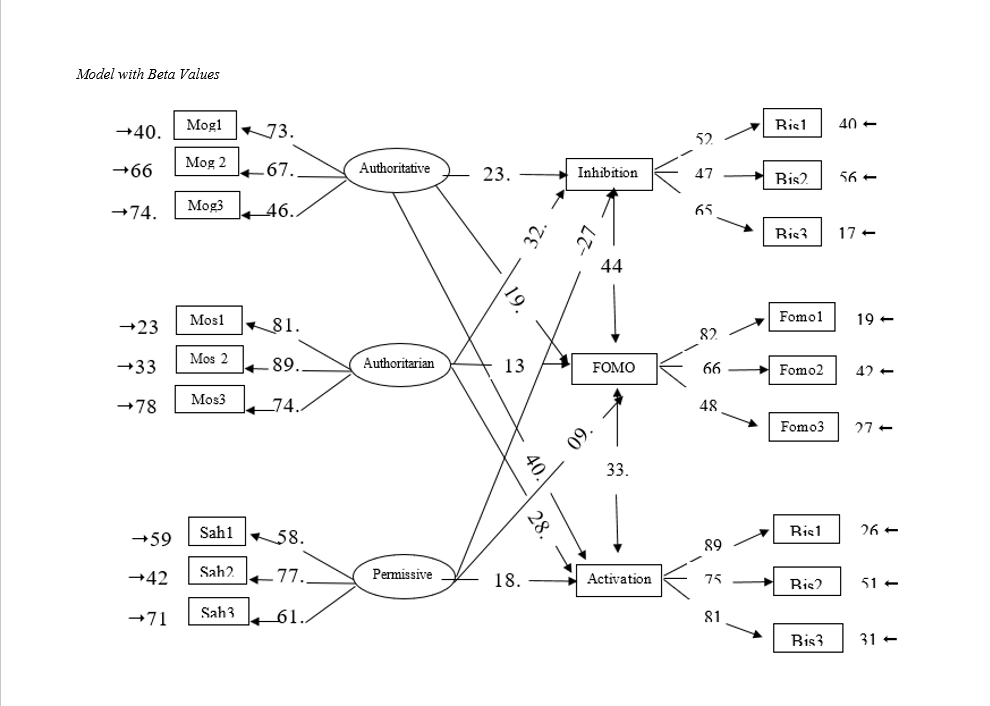
Findings: Model fit indices indicated an acceptable fit to the data (χ²/df > 3, RMSEA = 0.08, AGFI < 0.90, CFI < 0.90). Direct path coefficients showed that the authoritative parenting style had significant relationships with behavioral inhibition, behavioral activation, and FoMO (p ≤ 0.01). Direct effects between the authoritarian parenting style and behavioral inhibition, behavioral activation, and FoMO were also significant (p ≤ 0.01). Additionally, direct relationships between the permissive parenting style and both behavioral inhibition and behavioral activation were significant (p ≤ 0.01), but its relationship with FoMO was not significant (p ≥ 0.05). Indirect effects were significant in all cases.
Conclusion: The findings indicate a significant mediating role of brain behavioral systems in the relationship between parenting styles and FoMO. Overall, the results highlight the importance of parenting styles and brain behavioral systems in explaining the phenomenon of FoMO.
Downloads
References
Anderson, A. J., & Perone, S. (2023). Predicting individual differences in behavioral activation and behavioral inhibition from functional networks in the resting EEG. Biological Psychology, 177. https://doi.org/10.1016/j.biopsycho.2022.108483
Ansari, S., & Nouhi, S. (2024). A structural model of the fear of being marginalized and its relationship with youth dependency on social networks among employees of Mehregan Mashhad Distribution Company. Journal of Disability Studies, 14.
Aref, A., & Jalali Garmroud, R. (2024). Investigating the relationship between parenting style and academic anxiety and stress among students. 7th International Conference on Psychology, Educational Sciences and Social Studies,
Barry, C. T., Sidoti, C. L., Briggs, S. M., Reiter, S. R., & Lindsay, R. (2017). Social media use and mental health: FOMO and depressive symptoms. Journal of Clinical Child & Adolescent Psychology, 46(1), 100-109. https://doi.org/10.1080/15374416.2015.1079268
Blackwell, D., Tramposch, R., Leaman, C., & Osborne, C. (2017). Extraversion, neuroticism, attachment style and fear of missing out as predictors of social media use and addiction. Personality and individual differences, 116, 69-72. https://doi.org/10.1016/j.paid.2017.04.039
Bloemen, N., & De Coninck, D. (2020). Social media and fear of missing out in adolescents: The role of family characteristics. Social Media + Society, 6(4). https://doi.org/10.1177/2056305120965517
Fettes, P., Schulze, L., & Downar, J. (2017). CorticoStriatalThalamic Loop Circuits of the Orbitofrontal Cortex: Promising Therapeutic Targets in Psychiatric Illness. Frontiers in Systems Neuroscience, 11. https://doi.org/10.3389/fnsys.2017.00025
Gomez, R., Watson, S., & Stavropoulos, V. (2020). Associations of behavioral inhibition system with negatively biased social cognitions: moderation by the behavioral approach system. Personality and individual differences, 166.
Heydari, M., & Izadi, F. (2024). Investigating the structural model of the relationship between FoMO syndrome and nomophobia with the mediation of parenting stress in adolescents of Isfahan city. Journal of Clinical Psychology and Personality.
Jiang, Z., & Zhao, X. (2017). Brain behavioral systems, self-control and problematic mobile phone use: The moderating role of gender and history of use. Personality and individual differences, 106, 111-116.
Keles, B., McCrae, N., & Grealish, A. (2020). A systematic review: The influence of social media on depression, anxiety and psychological distress in adolescents. International Journal of Adolescence and Youth, 25(1), 79-93. https://doi.org/10.1080/02673843.2019.1590851
Koca, F., & Saatçı, F. (2022). The mediator role of fear of missing out in the parent–adolescent relationship quality and problematic internet use. International journal of mental health and addiction, 20(3), 1897-1912. https://doi.org/10.1007/s11469-022-00822-0
Moghaddas, A., & Ghasemipour, F. (2021). Investigating the relationship between membership in the Instagram social network and the creation or expansion of FoMO among users: A case study of young people aged 18 to 40 in Mashhad. Biannual Scientific Journal of Media and Culture, 11(1).
Oberst, U., Wegmann, E., Stodt, B., Brand, M., & Chamarro, A. (2017). Negative consequences from heavy social networking in adolescents: The mediating role of fear of missing out. Journal of adolescence, 55, 51-60. https://doi.org/10.1016/j.adolescence.2016.12.008
Pinquart, M. (2016). Associations of parenting styles and dimensions with academic achievement in children and adolescents: A meta-analysis. Educational psychology review, 28, 475-493.
Przybylski, A. K., Murayama, K., DeHaan, C. R., & Gladwell, V. (2013). Motivational, emotional, and behavioral correlates of fear of missing out. Computers in human Behavior, 29(4), 1841-1848. https://doi.org/10.1016/j.chb.2013.02.014
Salehi, F. (2025). Investigating social harms of students based on the FoMO phenomenon and parenting styles in the context of using social networks. Scientific Quarterly of New Research in Education(3).
Schmuck, D. (2021). Following social media influencers in early adolescence: Fear of missing out, social well-being and supportive communication with parents. Journal of Computer-Mediated Communication, 26(5), 245-264. https://doi.org/10.1093/jcmc/zmab008
Stead, H., & Bibby, P. A. (2017). Personality, fear of missing out and problematic internet use and their relationship to subjective well-being. Computers in human Behavior, 76, 534-540.
Tamannaifar, M. R., & Khanshan, M. (2022). Predicting adolescent internet addiction based on parenting styles with the mediation of attachment styles. Scientific, Cultural, and Educational Quarterly of Women and Family, 18.
Tandon, A. (2021). Fear of missing out among youth: A review of literature. Journal of Behavioral Addictions, 10(1), 50-61.
Thomas, K. (2025). Fear of Missing Out (FOMO), emotional distress, and problematic social media use among university students. Journal of Behavioral Sciences, 10(1), 35-47.
Wang, X., Liu, J., & Yang, Y. (2022). The role of social connectedness in fear of missing out: A cross-sectional study. International journal of environmental research and public health, 19(5).
Wolniewicz, C. A., Rozgonjuk, D., & Elhai, J. D. (2020). Boredom proneness and fear of missing out mediate relations between depression and anxiety with problematic smartphone use. Human Behavior and Emerging Technologies, 2(1), 61-70.
Downloads
Additional Files
Publication Timeline
- Submitted
- Revised
- Accepted