Deep Neural Network Modeling of Adolescent Generalized Anxiety Using Attentional Bias, Physiological Arousal, Worry Severity, and Parent–Child Conflict
DOI:
https://doi.org/10.61838/kman.jayps.5235Keywords:
Adolescent Generalized Anxiety, Deep Neural Networks, Worry Severity, Physiological Arousal, Parent-Child Conflict, Attentional BiasAbstract
Objective: To develop and evaluate a Deep Neural Network model capable of accurately predicting generalized anxiety in adolescents by integrating multimodal cognitive, neurocognitive, physiological, and environmental features.
Methods and Materials: This cross-sectional study included adolescents from Chile. Participants completed a comprehensive, multimodal assessment protocol comprising the Generalized Anxiety Disorder Assessment- (GAD- ) to classify anxiety severity, the Penn State Worry Questionnaire for Children to measure conscious worry severity, and the Conflict Behavior Questionnaire to assess parent-child conflict. Implicit neurocognitive attentional bias to threat was quantified using a computerized dot-probe task. Concurrently, continuous electrocardiography and electrodermal activity recordings were utilized to capture objective physiological arousal, specifically heart rate variability and skin conductance responses. A Deep Neural Network architecture was subsequently constructed, trained, and tested to model the complex, non-linear relationships among these disparate variables and predict adolescent generalized anxiety classification.
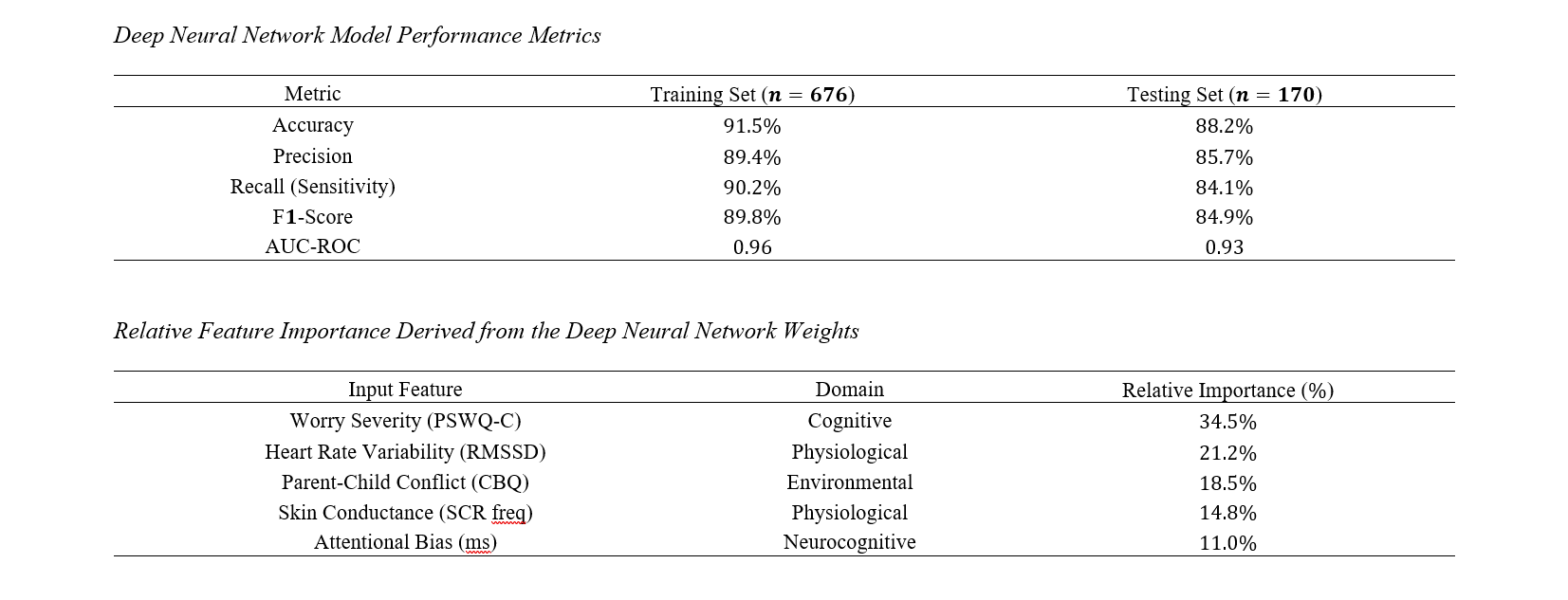
Findings: The trained Deep Neural Network demonstrated exceptional predictive performance, achieving an overall classification accuracy of and an Area Under the Receiver Operating Characteristic Curve of on unseen testing data. Feature importance analysis derived from the network’s weights revealed that physiological arousal constituted the largest broad predictive domain ( total; comprising for heart rate variability and for skin conductance responses). Conscious worry severity emerged as the strongest individual predictor, accounting for of the model’s predictive capacity. Furthermore, environmental and neurocognitive factors contributed significantly to the predictive architecture, with parent-child conflict accounting for and attentional bias to threat accounting for of the model’s weight.
Conclusion: Multimodal deep learning architectures provide a highly accurate and comprehensive framework for predicting adolescent generalized anxiety, highlighting the critical, synergistic interplay of somatic hyperarousal, severe cognitive worry, and familial discord.
Downloads
References
Casares, M. Á., Díez-Gómez, A., Pérez-Albéniz, A., Lucas-Molina, B., & Fonseca-Pedrero, E. (2024). Screening for anxiety in adolescents: Validation of the Generalized Anxiety Disorder Assessment-7 in a representative sample of adolescents. Journal of affective disorders. https://doi.org/10.1016/j.jad.2024.03.047
Curran, T., Worwood, J., & Smart, J. (2019). Cognitive Flexibility and Generalized Anxiety Symptoms: The Mediating Role of Destructive Parent-Child Conflict Communication. Communication Reports, 32(2), 57-68. https://doi.org/10.1080/08934215.2019.1587485
Dehshiri, G. (2023). Effectiveness of cognitive-behavioral therapy on anxiety and worry in individuals with generalized anxiety disorder. Clinical Psychology, 4(2), 19-27. https://jcp.semnan.ac.ir/article_2085.html
Draisey, J., Halldorsson, B., Cooper, P., & Creswell, C. (2020). Associations between family factors, childhood adversity, negative life events and child anxiety disorders: an exploratory study of diagnostic specificity. Behavioural and Cognitive Psychotherapy, 48(3), 253-267. https://doi.org/10.1017/S1352465819000717
Dugas, M. J., Marchal, K. G., Cormier, S., Bouchard, S., Gouin, J.-P., & Shafran, R. (2023). Pain Catastrophizing and Worry About Health in Generalized Anxiety Disorder. Clinical Psychology & Psychotherapy. https://doi.org/10.1002/cpp.2843
Ebrahimi, Z., Makvand Hosseini, S., & Tabatabai, S. M. (2023). Predicting generalized anxiety disorder based on attachment styles mediated by maladaptive schemas in adolescents. Journal of Psychological Achievements, 30(2). https://psychac.scu.ac.ir/article_18479.html
Geng, S., Wang, J., Liang, G., & Lin, Y. (2023). Predicting Generalized Anxiety Disorder Among Chinese Depressed Adolescents: An Explanable Machine Learning Approach (Preprint). https://doi.org/10.2196/preprints.51463
Gerdan, G. (2025). Exploring the Role of Contrast Avoidance, Worry, and Rumination in the Relationship Between Intolerance of Uncertainty, Generalized Anxiety Disorder, and Panic Disorder Symptoms in a Clinical Sample. Current Psychology. https://doi.org/10.1007/s12144-025-07641-1
Ghandi Zadeh, M., & Rafiee Honar, H. (2022). Children's Compliance with Parents Suffering from Generalized Anxiety Disorder. Islamic Jurisprudence and Family Law (Neday Sadegh), 27(77), 225-252. https://sid.ir/paper/1039124/fa
Kajastus, K., Haravuori, H., Kiviruusu, O., Marttunen, M., & Ranta, K. (2024). Associations of generalized anxiety and social anxiety with perceived difficulties in school in the adolescent general population. Journal of adolescence, 96(2), 291-304. https://doi.org/10.1002/jad.12275
Kim, D. H., & Kim, Y. (2024). Factors associated with generalized anxiety disorder in adolescents with cultural diversity: secondary data analysis. BMC public health, 24(1), 2562. https://doi.org/10.1186/s12889-024-20078-8
Kim, H., Newman, Michelle G. (2023). Worry and rumination enhance a positive emotional contrast based on the framework of the Contrast Avoidance Model. Journal of anxiety disorders, 94(no), 102671. https://doi.org/10.1016/j.janxdis.2023.102671
Krygsman, A., & Vaillancourt, T. (2022). Elevated social anxiety symptoms across childhood and adolescence predict adult mental disorders and cannabis use. Comprehensive Psychiatry, 115, 152302. https://doi.org/10.1016/j.comppsych.2022.152302
Lawrence, P. J., Murayama, K., & Creswell, C. (2019). Systematic review and meta-analysis: Anxiety and depressive disorders in offspring of parents with anxiety disorders. Journal of the American Academy of Child & Adolescent Psychiatry, 58(1), 46-60. https://doi.org/10.1016/j.jaac.2018.07.898
Mohler-Kuo, M., Dzemaili, S., Foster, S., Werlen, L., & Walitza, S. (2021). Stress and Mental Health among Children/Adolescents, Their Parents, and Young Adults during the First COVID-19 Lockdown in Switzerland. International journal of environmental research and public health, 18(9).
Nordahl, H., Strand, E. R., Hjemdal, O., & Nordahl, H. M. (2024). Is meta-worry relevant to interpersonal problems? Testing the metacognitive model of generalized anxiety disorder in an analogue- and a clinical sample of GAD. Cognitive behaviour therapy, 53(5), 455-466. https://doi.org/10.1080/16506073.2024.2331191
Rahmani, P., & Moheb, N. (2019). Investigating parenting styles and family emotional atmosphere of children with generalized anxiety and children without anxiety. Educational Sciences, 4(13), 67-78. https://www.sid.ir/paper/183389/
Tajik, F., Isa Zadegan, A., & Zeinali, S. (2022). Predicting Generalized Anxiety Disorder Symptoms Based on Worry, Experiential Avoidance, and BIS/BAS Brain-Behavior Systems. Clinical Psychology and Personality, 20(2), 91-104. https://doi.org/10.22070/cpap.2022.15353.1160
Xiao, H., Shen, Y., Zhang, W., & Lin, R. (2023). Applicability of the cognitive model of generalized anxiety disorder to adolescents' sleep quality: A cross-sectional and longitudinal analysis. International Journal of Clinical and Health Psychology, 23(4), 100406. https://doi.org/10.1016/j.ijchp.2023.100406
Yaffe, Y. (2025). Parents' Generalized and Separation Anxieties and Early Adolescents' Anxiety Disorders: The Mediating Role of Overparenting. Family Relations. https://doi.org/10.1111/fare.13203
Ye, H., Li, Y., Huang, Y., Zhang, Y., Zhang, J., Wang, J., Liu, K., Yao, Y., Shi, X., Liu, Y., & Fan, F. (2025). Bidirectional Relationships Between Intolerance of Uncertainty and Generalized Anxiety Among Adolescents: Insights From Cross-Lagged Panel Network Analysis. Child and adolescent psychiatry and mental health, 19(1). https://doi.org/10.1186/s13034-025-00912-6
Downloads
Additional Files
Publication Timeline
- Submitted
- Revised
- Accepted