A Multimodal Machine Learning Approach to Adolescent Loneliness Using Social Disconnection, Parasocial Relationships, Emotional Inhibition, Family Cohesion, and Digital Isolation
DOI:
https://doi.org/10.61838/kman.jayps.5464Keywords:
Adolescent Loneliness, Multimodal Machine Learning, Digital Isolation, Social Disconnection, Parasocial Relationships, Emotional Inhibition, Family Cohesion, Mental Health, Social Media, Predictive ModelingAbstract
Objective: The present study aimed to develop and evaluate a multimodal machine learning model for predicting adolescent loneliness based on social disconnection, parasocial relationships, emotional inhibition, family cohesion, and digital isolation among adolescents in the United States.
Methods and Materials: The study employed a cross-sectional predictive correlational design using multimodal machine learning techniques. The statistical population consisted of adolescents aged 13 to 18 years enrolled in secondary schools across the United States during the 2025–2026 academic year. Using stratified multistage sampling, 1,248 adolescents were recruited, of whom 1,182 participants were included in the final analysis after data screening. Data collection involved standardized psychological instruments assessing loneliness, social disconnection, parasocial relationships, emotional inhibition, and family cohesion, alongside objective digital behavioral indicators including screen time, passive scrolling duration, nocturnal device usage, and solitary online activity. Data were analyzed using Python-based machine learning libraries and included Random Forest, Support Vector Machine, XGBoost, Multilayer Perceptron Neural Network, and a multimodal ensemble learning model. Model evaluation indices included accuracy, precision, recall, F1-score, and AUC-ROC values. SHAP-based explainable artificial intelligence analysis was additionally employed to determine feature importance.
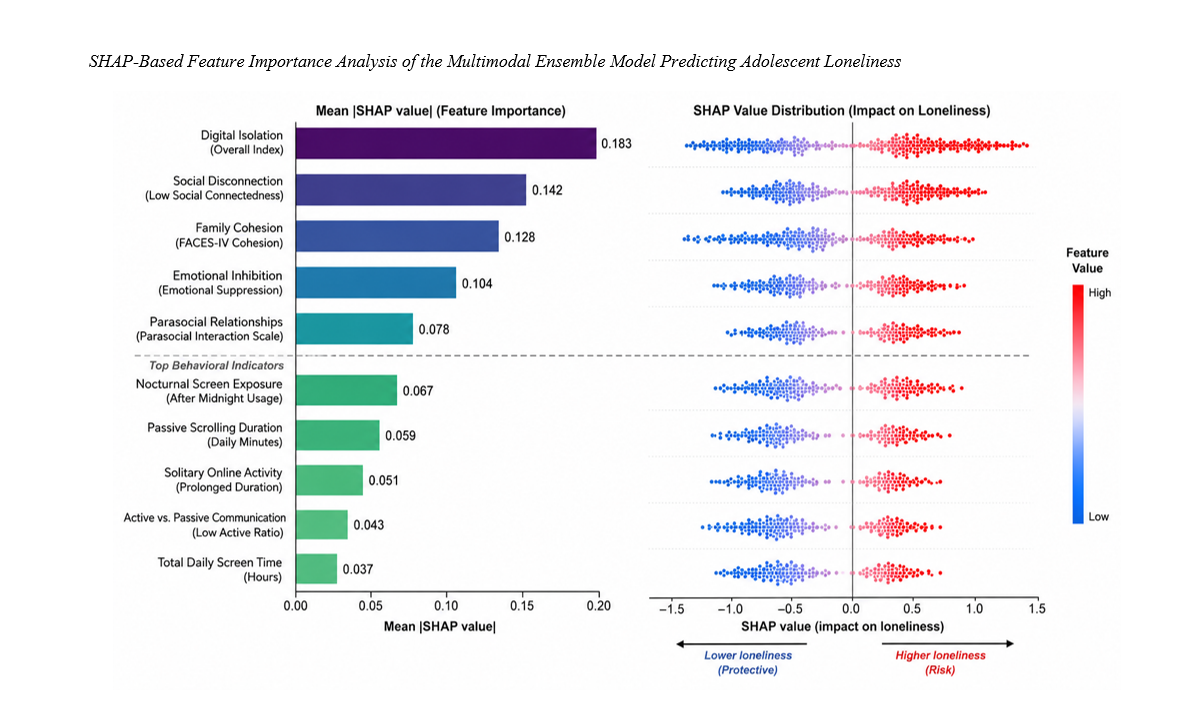
Findings: The findings indicated significant positive relationships between adolescent loneliness and social disconnection, emotional inhibition, parasocial relationships, and digital isolation, while family cohesion demonstrated a significant negative association with loneliness. The multimodal ensemble model achieved the highest predictive performance compared to all other machine learning models, with an accuracy of 0.94 and an AUC-ROC value of 0.97. SHAP feature importance analysis revealed that digital isolation was the strongest predictor of adolescent loneliness, followed by social disconnection, family cohesion, emotional inhibition, and parasocial relationships. Hierarchical regression analysis further demonstrated that the predictor variables collectively explained 71% of the variance in loneliness scores.
Conclusion: The findings suggest that adolescent loneliness is a multidimensional phenomenon shaped by the interaction of emotional, social, familial, and digital behavioral factors. Multimodal machine learning approaches integrating psychosocial measures with objective digital behavior indicators may provide highly accurate and interpretable predictive models for identifying adolescents at risk for loneliness. Strengthening family cohesion, improving emotional communication, and promoting healthier patterns of digital engagement may contribute significantly to reducing loneliness and improving adolescent mental health outcomes.
Downloads
References
Ahmed, M. (2023). Psychological Impact of Social Media Addiction on Interpersonal Relationships in Pakistan. International journal of psychology, 8(4), 53-65. https://doi.org/10.47604/ijp.2421
Balcombe, L., & Leo, D. D. (2023). The Impact of YouTube on Loneliness and Mental Health. Informatics, 10(2), 39. https://doi.org/10.3390/informatics10020039
Blum, R. W., Lai, J., Martínez, M., & Jessee, C. (2022). Adolescent Connectedness: Cornerstone for Health and Wellbeing. bmj, 379, e069213. https://doi.org/10.1136/bmj-2021-069213
Breaux, R., Cash, A. R., Lewis, J., Garcia, K. M., Dvorsky, M. R., & Becker, S. P. (2023). Impacts of COVID-19 Quarantine and Isolation on Adolescent Social Functioning. Current opinion in psychology, 52, 101613. https://doi.org/10.1016/j.copsyc.2023.101613
Cataldo, I., Lepri, B., Neoh, M. J. Y., & Esposito, G. (2021). Social Media Usage and Development of Psychiatric Disorders in Childhood and Adolescence: A Review. Frontiers in Psychiatry, 11. https://doi.org/10.3389/fpsyt.2020.508595
Charmaraman, L., Delcourt, C. G., Durrani, S., Kapoor, J., Richer, A. M., & Xiao, L. F. (2022). The Role of Parents, Other Adults, Peers and Informal Learning Communities in Shaping Positive Social Media Use in Adolesent Girls. Information and Learning Sciences, 123(7/8), 399-420. https://doi.org/10.1108/ils-03-2022-0034
Charmaraman, L., Hernandez, J. M., & Hodes, R. (2022). Marginalized and Understudied Populations Using Digital Media. 188-214. https://doi.org/10.1017/9781108976237.011
Charmaraman, L., Smucker, R., Theran, S. A., Dam, S. P. v., & Anthony, J. C. (2025). The Benefits and Challenges of the Parental Monitoring of YouTube in Adolescents’ Lives: A Qualitative Study of Emotion and Sleep Regulation. Behavioral Sciences, 15(6), 805. https://doi.org/10.3390/bs15060805
Ehrenreich, S. E. (2022). Peer Relationship Processes in the Context of Digital Media. 85-103. https://doi.org/10.1017/9781108976237.007
Ehrenreich, S. E., George, M. J., Burnell, K., & Underwood, M. K. (2021). Importance of Digital Communication in Adolescents’ Development: Theoretical and Empirical Advancements in the Last Decade. Journal of Research on Adolescence, 31(4), 928-943. https://doi.org/10.1111/jora.12643
Ferreira, D. B. B., Santos, R. M. S., Machado, M. C. L., Rezende, V. H. M., Marco, P. D., Romano‐Silva, M. A., & Miranda, D. M. d. (2025). Suicidality and Self-Harm in Adolescents Before and After the COVID-19 Pandemic: A Systematic Review. Frontiers in Psychiatry, 16. https://doi.org/10.3389/fpsyt.2025.1643145
Garagiola, E. R., Lam, Q., Wachsmuth, L. S., Tan, T. Y., Ghali, S., Asafo, S. M., & Swarna, M. (2022). Adolescent Resilience During the COVID-19 Pandemic: A Review of the Impact of the Pandemic on Developmental Milestones. Behavioral Sciences, 12(7), 220. https://doi.org/10.3390/bs12070220
Garrett, S. L., Burnell, K., Armstrong‐Carter, E., Prinstein, M. J., & Telzer, E. H. (2023). Linking Video Chatting, Phone Calling, Text Messaging, and Social Media With Peers to Adolescent Connectedness. Journal of Research on Adolescence, 33(4), 1222-1234. https://doi.org/10.1111/jora.12871
Haddock, A., Ward, N. L., Yu, R., & O’Dea, N. (2022). Positive Effects of Digital Technology Use by Adolescents: A Scoping Review of the Literature. International journal of environmental research and public health, 19(21), 14009. https://doi.org/10.3390/ijerph192114009
Hall, J. A. (2024). Loneliness and Social Media. Annals of the New York Academy of Sciences, 1543(1), 5-16. https://doi.org/10.1111/nyas.15275
Hamilton, J. L., Nesi, J., & Choukas‐Bradley, S. (2021). Reexamining Social Media and Socioemotional Well-Being Among Adolescents Through the Lens of the COVID-19 Pandemic: A Theoretical Review and Directions for Future Research. Perspectives on Psychological Science, 17(3), 662-679. https://doi.org/10.1177/17456916211014189
Harasgama, K., & Jayathilaka, K. M. M. M. (2023). A Conceptual Framework on Predictors of Cyberbullying Victimization. Sri Lanka Journal of Social Sciences and Humanities, 3(2), 79-86. https://doi.org/10.4038/sljssh.v3i2.102
Huang, H. Y., Li, H., & Hsu, Y. C. (2022). Coping, COVID Knowledge, Communication, and HBCU Student's Emotional Well‐being: Mediating Role of Perceived Control and Social Connectedness. Journal of Community Psychology, 50(6), 2703-2725. https://doi.org/10.1002/jcop.22824
Huang, S., & Li, M. (2023). Consumer Loneliness: A Systematic Review and Research Agenda. Frontiers in psychology, 14. https://doi.org/10.3389/fpsyg.2023.1071341
Kaufman, M. R., Levine, D., Casella, A., & DuBois, D. L. (2021). E-Mentoring to Address Youth Health: A Systematic Review. Adolescent Research Review, 7(1), 63-78. https://doi.org/10.1007/s40894-021-00172-3
Khalaf, A. M., Alubied, A. A., Khalaf, A., & Rifaey, A. A. (2023). The Impact of Social Media on the Mental Health of Adolescents and Young Adults: A Systematic Review. Cureus. https://doi.org/10.7759/cureus.42990
Klimanska, M., Haletska, I., Klymanska, L., Herasym, H., Savka, V., Shchudlo, S., Mirchuk, I., Зелена, О., & Ostaszewski, K. (2023). Problematic Internet Activities Among Ukrainian Adolescents: Gender And Psychosocial Differences. Alcoholism and Drug Addiction, 36(3), 147-166. https://doi.org/10.5114/ain.2023.134667
Lafton, T., Holmarsdottir, H. B., Kapella, O., Sisask, M., & Zinoveva, L. V. (2022). Children’s Vulnerability to Digital Technology Within the Family: A Scoping Review. Societies, 13(1), 11. https://doi.org/10.3390/soc13010011
Liu, X., Liu, J., Flores, D. D., & McDonald, C. C. (2024). Family Factors Related to Adolescent Screen Media Use and Mental Health Outcomes: A Systematic Review and Recommendation for Practices. Journal of adolescence, 96(7), 1401-1427. https://doi.org/10.1002/jad.12367
Lopatovska, I., Garg, R., Turpin, O., Yoon, J. H., Vroom, L., & Brown, D. (2022). The Kids Are Alright: Adolescents’ Experiences During COVID-19 Disruption. Information and Learning Sciences, 123(9/10), 529-554. https://doi.org/10.1108/ils-11-2021-0096
Ma, X. (2025). Bridging Early Adolescents' Online and In‐Person Experiences: Qualitative Explorations of Emotional and Relational Well‐Being in the Post‐COVID‐19 Era. Journal of adolescence. https://doi.org/10.1002/jad.70090
Magis‐Weinberg, L., Gys, C. L., Berger, E., Domoff, S. E., & Dahl, R. E. (2021). Positive and Negative Online Experiences and Loneliness in Peruvian Adolescents During the COVID‐19 Lockdown. Journal of Research on Adolescence, 31(3), 717-733. https://doi.org/10.1111/jora.12666
Pfetsch, J., Schultze‐Krumbholz, A., & Lietz, K. (2022). Can Acting Out Online Improve Adolescents’ Well-Being During Contact Restrictions? A First Insight Into the Dysfunctional Role of Cyberbullying and the Need to Belong in Well-Being During COVID-19 Pandemic-Related Contact Restrictions. Frontiers in psychology, 12. https://doi.org/10.3389/fpsyg.2021.787449
Prochnow, T., Senthil, R., Poulos, A., Patterson, M. S., Blake, J. J., & Massey, P. M. (2025). Virtual Bonds; Real Emotions: Systematic Review Exploring Online Social Connections and Adolescent Mental Health. Cyberpsychology Behavior and Social Networking, 28(10), 658-671. https://doi.org/10.1177/21522715251377377
Pum, K., Salama, R., Lin, R., Kirschmann, J. M., Johnston, C. A., & Hendel, K. R. (2025). Combatting the Loneliness Epidemic Through Social Connectedness. American Journal of Lifestyle Medicine. https://doi.org/10.1177/15598276251359116
Ramsey, N., Obeidallah, M., & Abraham, A. (2023). Impact of COVID-19 on Adolescent Health and Use of Social Media. Current opinion in pediatrics, 35(3), 362-367. https://doi.org/10.1097/mop.0000000000001248
Woznicki, N., Arriaga, A. S., Caporale-Berkowitz, N., & Parent, M. C. (2021). Parasocial Relationships and Depression Among LGBQ Emerging Adults Living With Their Parents During COVID-19: The Potential for Online Support. Psychology of Sexual Orientation and Gender Diversity, 8(2), 228-237. https://doi.org/10.1037/sgd0000458
Downloads
Additional Files
Publication Timeline
- Submitted
- Revised
- Accepted