Dimensions of Coping in Individuals Facing Long-Term Unemployment
DOI:
https://doi.org/10.61838/kman.jayps.4352Keywords:
Long-term unemployment, coping strategies, social supportAbstract
Objective: This study aimed to explore and categorize the dimensions of coping strategies employed by individuals facing long-term unemployment in Morocco.
Methods and Materials: A qualitative research design was adopted, utilizing a phenomenological approach to capture the lived experiences of participants. Twenty-seven individuals (14 males, 13 females), aged between 23 and 54 years, who had been unemployed for a minimum of 18 consecutive months, were purposively sampled from both urban and rural regions of Morocco. Data collection was conducted through semi-structured, in-depth interviews, either face-to-face or via secure online platforms, depending on participants’ preferences. All interviews were transcribed verbatim and analyzed using thematic analysis in NVivo 14 software, following an inductive coding process to identify categories, subcategories, and concepts.
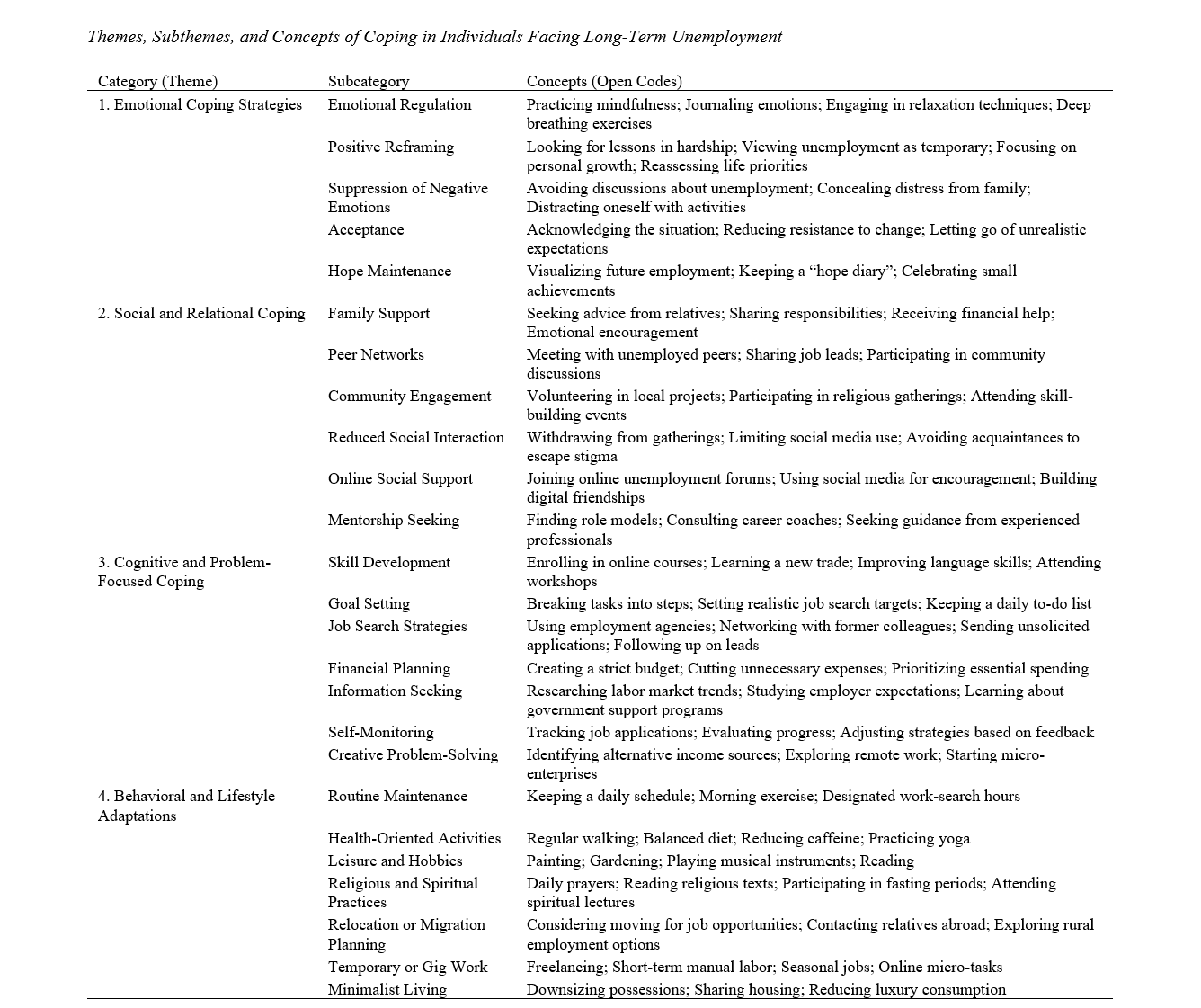
Findings: Analysis revealed four main dimensions of coping: emotional coping strategies, social and relational coping, cognitive and problem-focused coping, and behavioral and lifestyle adaptations. Emotional coping encompassed subthemes such as emotional regulation, positive reframing, suppression of negative emotions, acceptance, and hope maintenance. Social and relational coping included family support, peer networks, community engagement, reduced social interaction, online social support, and mentorship seeking. Cognitive and problem-focused coping involved skill development, goal setting, job search strategies, financial planning, information seeking, self-monitoring, and creative problem-solving. Behavioral and lifestyle adaptations comprised routine maintenance, health-oriented activities, leisure and hobbies, religious and spiritual practices, relocation or migration planning, temporary or gig work, and minimalist living.
Conclusion: Effective support interventions should integrate skill-building, emotional well-being enhancement, and community-based resources to address both the immediate and long-term needs of unemployed individuals.
Downloads
References
Abarientos, K., Ancho, I., Recto, F. B., Saguiguit, S. L. C., & Pelegrina, D. (2025). Breaking in or Breaking Down?: Culture Shock Among Filipino Freshmen Students in a State University. Psychology Evaluation and Technology in Educational Research, 7(2). https://doi.org/10.33292/petier.v7i2.241
Anda, R., Nuraini, N., & Surbakti, A. (2025). The Role of Social Support in Enhancing Psychological Well-Being: The Mediating Effect of Self-Esteem in First-Year University Students. Al-Ishlah Jurnal Pendidikan, 17(1). https://doi.org/10.35445/alishlah.v17i1.5824
Awan, H. K., Nosheen, D. N., & Ajaz, N. (2025). Exploring and Understanding the Subjective Experiences of ‘Home’ Feeling Away Students Living in Hostel. RJS, 3(1), 345-356. https://doi.org/10.59075/rjs.v3i1.72
Beri, N., & Thakur, K. (2024). Social Support and Academic Support as Predictors of Well-Being Among Indian and International University Students. E3s Web of Conferences, 556, 01040. https://doi.org/10.1051/e3sconf/202455601040
Bersia, M., Charrier, L., Zanaga, G., Gaspar, T., Moreno-Maldonado, C., Grimaldi, P., Koumantakis, E., Dalmasso, P., & Comoretto, R. I. (2024). Well-Being Among University Students in the Post-Covid-19 Era: A Cross-Country Survey. Scientific reports, 14(1). https://doi.org/10.1038/s41598-024-69141-9
Damayanti, A. R. (2025). Hubungan Dukungan Sosial Dan Kesejahteraan Subjektif Pada Mahasiswa. Wissen, 3(1), 239-248. https://doi.org/10.62383/wissen.v3i1.563
Deocades, A., Chiva, Y. D., Lumbayan, J. I., Gange, C. A., Moneva, J., & Pedroso, J. E. P. (2025). Adjustment Problems and Coping Strategies of State University Students Living Away From Home. Eiki Journal of Effective Teaching Methods, 3(2). https://doi.org/10.59652/jetm.v3i2.374
Kachroo, W. Q., & Ramanathan, G. (2023). Well-Being and Perceived Social Support Among Kashmiri College Students. Morfai Journal, 3(1), 45-52. https://doi.org/10.54443/morfai.v3i1.768
katoch, P., & Lone, Z. A. (2024). Effect of Social Support on Aggression and Homesickness Among Students Living in the Hostels. Eatp. https://doi.org/10.53555/kuey.v30i4.3027
Kaur, R., & Sharma, S. (2023). Relationship Analysis of Interpersonal Support With Well-Being Index Among University Students. International Journal of Bio-Resource and Stress Management, 14(Aug, 8), 1116-1126. https://doi.org/10.23910/1.2023.3597a
Matochová, J. (2025). Well-Being at Universities. R&e-Source, 208-214. https://doi.org/10.53349/re-source.2025.is1.a1393
Mohaiyuddin, N., Astuti, B., Rachmawati, I., Mumpuni, S. D., & Kurniasari, M. (2024). Religious Factors and Emotional Well-Being Among University Students in Asian Countries. Global Journal Al-Thaqafah, 14(2), 45-56. https://doi.org/10.7187/gjat122024-4
Mpofu, M., & Patil, G. G. (2025). A Study on Psychosocial Impact of Parental Absence on International Youth Adolescents Studying in Parul University. International Journal for Multidisciplinary Research, 7(2). https://doi.org/10.36948/ijfmr.2025.v07i02.40580
Park, H. J. (2025). The Influence of Subjective Well-Being Among Nursing Students. Korean Assoc Learner-Centered Curric Instr, 25(1), 23-34. https://doi.org/10.22251/jlcci.2025.25.1.23
Penrattanahiran, R. (2023). Adjusting to University Life: Guidelines and Strategies for First-Year Students. j.faa, 16(2), 1-17. https://doi.org/10.14416/j.faa.2023.19.007
Shamsuddin, N., Nik Sarina Nik Md, S., Zin, S. M., Hamid, R., Zulqernain, N. S., & Tanjung, H. (2024). Bridging Success and Well-Being: Insights From B40 University Students. Environment-Behaviour Proceedings Journal, 9(28), 109-114. https://doi.org/10.21834/e-bpj.v9i28.5783
Vaidya, H., Agarwal, N., Kotipalli, S., Anand, A. A., & S, V. L. (2024). A Study on the Impact of COVID-19 on the Mental Health of Undergraduate Students. Asian Journal of Management and Commerce, 5(1), 256-262. https://doi.org/10.22271/27084515.2024.v5.i1d.264
Widiyastuti, & Hardita, K. (2024). Familial Social Support and Psychological Well-Being Among Indonesian University Students. Journal of Islamic and Muhammadiyah Studies, 6(1). https://doi.org/10.21070/jims.v6i1.1597
Wu, Y., Lin, R. C., Kong, W., & Xi, X. (2024). Between Comfort and Challenge: The Role of Social Support in Shaping College Students' Happiness and Stress. Jetp, 1(4), 15-23. https://doi.org/10.62177/jetp.v1i4.93
Ye, J. H., Zhang, M., Yang, X., & Wang, M. (2023). The Relation Between Intergroup Contact and Subjective Well-Being Among College Students at Minzu Universities: The Moderating Role of Social Support. International journal of environmental research and public health, 20(4), 3408. https://doi.org/10.3390/ijerph20043408
Yuan, Y., Bakar, A. A., Selamat, T., Jingcheng, S., Hui, R. Y., & Yang, Y. (2024). Exploring the Mechanisms Behind Well-Being: Social Support and Basic Psychological Needs. European Journal of Humanities and Social Sciences, 4(1), 35-39. https://doi.org/10.24018/ejsocial.2024.4.1.511
Downloads
Additional Files
Publication Timeline
- Submitted
- Revised
- Accepted
Issue
Section
License

This work is licensed under a Creative Commons Attribution-NonCommercial 4.0 International License.