Feature Contribution Analysis of Youth Life Satisfaction Using Psychological Capital and Social Connectedness
DOI:
https://doi.org/10.61838/kman.jayps.4992Keywords:
Youth well-being, life satisfaction, psychological capital, social connectedness, explainable artificial intelligence, feature contribution analy, machine learning, adolescent mental healthAbstract
Objective: The objective of this study was to develop an explainable predictive model of youth life satisfaction by quantifying the individual and combined contributions of psychological capital components and social connectedness.
Methods and Materials: A cross-sectional correlational design was employed with a sample of 684 Moroccan adolescents and emerging adults recruited from secondary schools, vocational institutes, and universities. Participants completed standardized measures of life satisfaction, psychological capital, and social connectedness. Advanced machine learning models including Elastic Net Regression, Random Forest, and Gradient Boosting Machine were trained using ten-fold cross-validation. Explainable artificial intelligence techniques based on SHAP values and permutation feature importance were applied to interpret model predictions, identify dominant predictors, and examine nonlinear interactions among psychological and social variables.
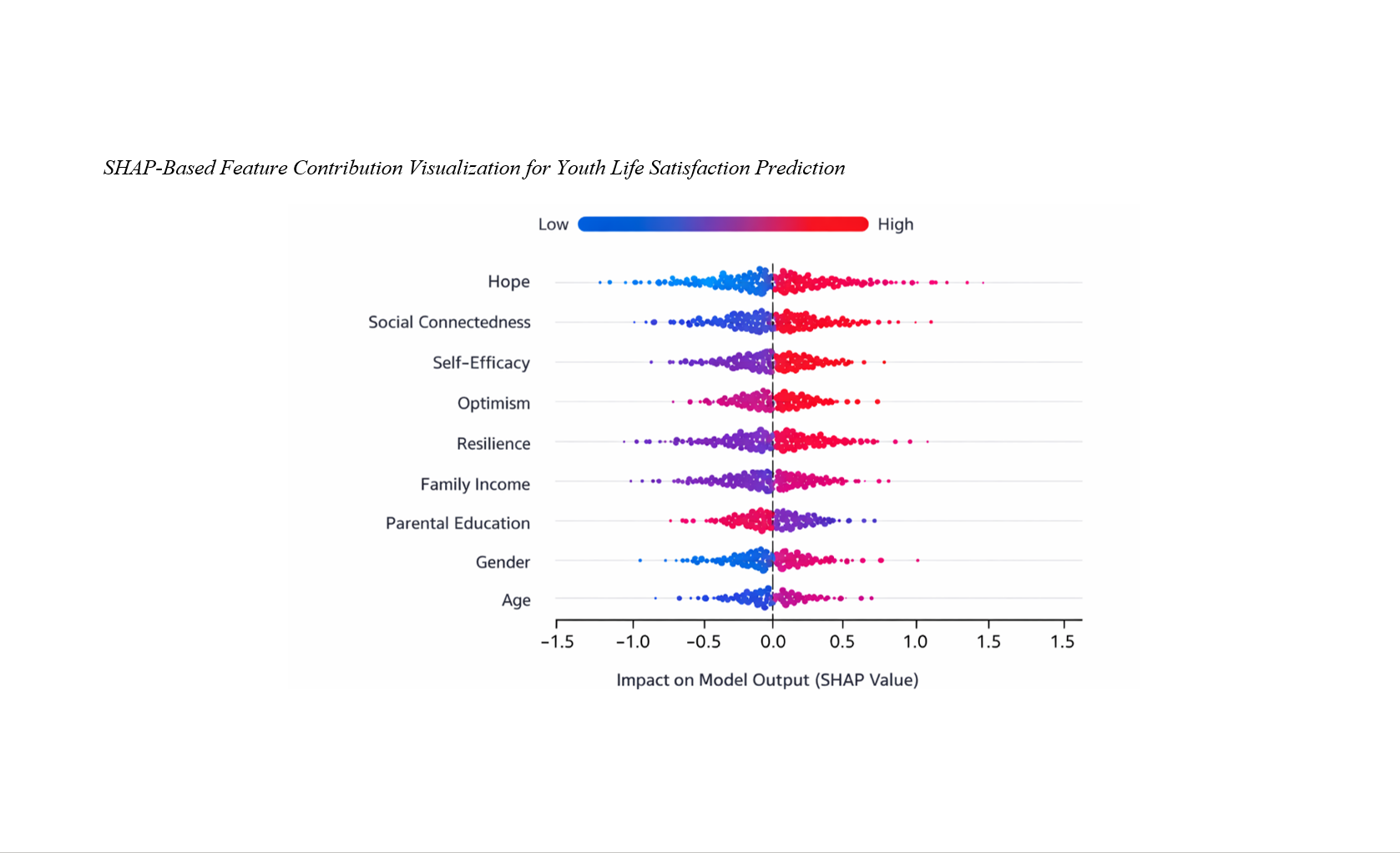
Findings: The Gradient Boosting Machine demonstrated superior predictive performance (R² = .76, RMSE = 2.78, MAE = 2.19). Feature contribution analysis revealed that hope was the strongest predictor of life satisfaction, followed by social connectedness and self-efficacy. Optimism and resilience showed moderate but substantial contributions, whereas demographic variables such as age and gender exerted comparatively minor influence. Interaction effects indicated that high social connectedness amplified the positive effects of psychological capital components on predicted life satisfaction.
Conclusion: Youth life satisfaction is primarily driven by dynamic psychological and social resources rather than static demographic characteristics. Explainable machine learning provides a powerful framework for uncovering complex predictive structures and offers actionable insight for designing personalized youth well-being interventions focused on strengthening psychological capital and social integration.
Downloads
References
Al-Adhami, M., Berglund, E., Wångdahl, J., & Salari, R. (2022). A Cross-Sectional Study of Health and Well-Being Among Newly Settled Refugee Migrants in Sweden–The Role of Health Literacy, Social Support and Self-Efficacy. PLoS One, 17(12), e0279397. https://doi.org/10.1371/journal.pone.0279397
Cao, F., Zhang, L. f., Li, M., & Xie, Z. (2024). Subjective Well-Being Among PhD Students in Mainland China: The Roles of Psychological Capital and Academic Engagement. Frontiers in psychology, 15. https://doi.org/10.3389/fpsyg.2024.1354451
Chen, L., Li, Y., Lu, X. R., Miao, Q., & Zheng, Z. (2025). The Role of Self-Esteem Between Perceived Social Support and Positive Psycap in Middle School Students Based on Network Analysis and Mediation Model. Scientific reports, 15(1). https://doi.org/10.1038/s41598-025-19279-x
Choi, D.-H. (2024). Impact of Social Media Use on the Life Satisfaction of Adolescents in South Korea Through Social Support and Social Capital. Sage Open, 14(2). https://doi.org/10.1177/21582440241245010
Diržytė, A., & Patapas, A. (2022). Positive Organizational Practices, Life Satisfaction, and Psychological Capital in the Public and Private Sectors. Sustainability, 14(1), 488. https://doi.org/10.3390/su14010488
Diržytė, A., Patapas, A., & Perminas, A. (2022). Associations Between Leisure Preferences, Mindfulness, Psychological Capital, and Life Satisfaction. International journal of environmental research and public health, 19(7), 4121. https://doi.org/10.3390/ijerph19074121
Fang, L., Yuen, M., Zhang, J., Ho, E. Y., Chan, S., Wu, F. K., & Xie, N. (2023). A Network Analysis of Positive Developmental Assets of Hong Kong School-Age Children During the Covid-19 Pandemic. Current Psychology, 43(13), 12188-12197. https://doi.org/10.1007/s12144-023-04287-9
Fernando Henrique de Lima, S., Waikamp, V., Freitas, L. H. M., & Baeza, F. L. C. (2022). Mental Health Outcomes in Syrian Refugees: A Systematic Review. International Journal of Social Psychiatry, 68(5), 933-953. https://doi.org/10.1177/00207640221099404
Hu, J., Yao, J., & Xiong, C. (2023). A Study on Livelihood Capital, Social Adaptation, and Life Satisfaction—empirical Analysis Based on Ecological Migration in the Kalajun World Natural Heritage Site. Frontiers in Environmental Science, 11. https://doi.org/10.3389/fenvs.2023.1181923
Huang, L., & Zhang, T. (2021). Perceived Social Support, Psychological Capital, and Subjective Well-Being Among College Students in the Context of Online Learning During the COVID-19 Pandemic. The Asia-Pacific Education Researcher, 31(5), 563-574. https://doi.org/10.1007/s40299-021-00608-3
Huang, P., Lin, Z.-J., Wang, B. C., & Du, Z. (2025). A Mixed Methods Exploration of the Interrelationships Among Self-Compassion, Stress Management, Psychological Capital, and Life Satisfaction in Chinese University Students. Frontiers in psychology, 16. https://doi.org/10.3389/fpsyg.2025.1510987
Karatepe, H. K., Şen, H. T., & Türkmen, E. (2022). Predicting Work Performance and Life Satisfaction of Nurses and Physicians: The Mediating Role of Social Capital on Self‐efficacy and Psychological Resilience. Perspectives in psychiatric care, 58(4), 2542-2551. https://doi.org/10.1111/ppc.13092
Ke, Y., Zhang, T., Xu, J., & Chai, X. (2023). How Social Connectedness Contributes to Life Satisfaction Among Chinese Nurses: Testing Potential Moderated Mediation Pathways. International Nursing Review, 70(3), 315-321. https://doi.org/10.1111/inr.12845
Kim, G. M., Jeong, E. J., Lee, J. Y., & Yoo, J. H. (2022). Role of Social Capital in Adolescents’ Online Gaming: A Longitudinal Study Focused on the Moderating Effect of Social Capital Between Gaming Time and Psychosocial Factors. Frontiers in psychology, 13. https://doi.org/10.3389/fpsyg.2022.931134
Lee, S., Moon, H., Ko, J., Çankaya, B., Caine, E. D., & You, S. (2023). Social Connectedness and Mental Health Before and During the COVID-19 Pandemic in a Community Sample in Korea. PLoS One, 18(10), e0292219. https://doi.org/10.1371/journal.pone.0292219
Leonti, R. M., & Turliuc, M. N. (2024). Better and Healthier Together? The Mediation Effect of Positive Psychological Capital on the Relationship Between Perceived Social Support and Health-Related Quality of Life Among Older Adults. The International Journal of Aging and Human Development, 100(4), 502-526. https://doi.org/10.1177/00914150241268178
Li, A., Wang, S., Cai, M., Sun, R., & Liu, X. (2021). Self-Compassion and Life-Satisfaction Among Chinese Self-Quarantined Residents During COVID-19 Pandemic: A Moderated Mediation Model of Positive Coping and Gender. Personality and individual differences, 170, 110457. https://doi.org/10.1016/j.paid.2020.110457
Li, Y., Zhang, X., Chen, Z. Y., Ma, L., Wang, Z., & Shao, J. (2024). Social Media Use and Life Satisfaction Among Chinese Older Adults: A Moderated Mediation Model. Journal of Applied Gerontology, 44(9), 1483-1494. https://doi.org/10.1177/07334648241309483
Mehrpour, A., Hoffman, A., Widmer, É., & Staerklé, C. (2024). Social Ties and Social Identification: Influences on Well-Being in Young Adults. Journal of Social and Personal Relationships, 41(10), 3085-3108. https://doi.org/10.1177/02654075241263239
Parviniannasab, A. M., Bijani, M., & Dehghani, A. (2022). The Mediating Role of Psychological Capital in Relations Between Spiritual Well-Being and Mental Health Among Nursing Students. BMC psychology, 10(1). https://doi.org/10.1186/s40359-022-00935-0
Preston, A. J., Rew, L., & Young, C. C. (2021). A Systematic Scoping Review of Psychological Capital Related to Mental Health in Youth. The Journal of School Nursing, 39(1), 72-86. https://doi.org/10.1177/10598405211060415
Shan, H., Ishak, Z., & Fan, L. (2022). The Higher the Life Satisfaction, the Better the Psychological Capital? Life Satisfaction and Psychological Capital: A Moderated Mediation Model. Frontiers in psychology, 12. https://doi.org/10.3389/fpsyg.2021.772129
Shek, D. T. L., Zhao, L., Dou, D., Zhu, X., & Xiao, C. (2021). The Impact of Positive Youth Development Attributes on Posttraumatic Stress Disorder Symptoms Among Chinese Adolescents Under COVID-19. Journal of Adolescent Health, 68(4), 676-682. https://doi.org/10.1016/j.jadohealth.2021.01.011
Shereda, H. M. A., Alhazmi, R., Kasemy, Z. A., Dawood, E., Singh, E. S. J., Alkhalaf, I., Alshehri, B., & Alanazi, T. D. M. (2025). Life Satisfaction and Psychological Wellbeing Among Medical Students: The Mediating Role of Psychological Capital. Frontiers in psychology, 16. https://doi.org/10.3389/fpsyg.2025.1614803
Song, J., Corcoran, J., & Zahnow, R. (2024). The Resettlement Journey: Understanding the Role of Social Connectedness on Well-Being and Life Satisfaction Among (Im)migrants and Refugees: A Systematic Review. Journal of Racial and Ethnic Health Disparities, 12(4), 2128-2144. https://doi.org/10.1007/s40615-024-02036-7
Turliuc, M. N., & Candel, O. S. (2021). The Relationship Between Psychological Capital and Mental Health During the Covid-19 Pandemic: A Longitudinal Mediation Model. Journal of Health Psychology, 27(8), 1913-1925. https://doi.org/10.1177/13591053211012771
Wang, Q., Sun, W., & Wu, H. (2022). Associations Between Academic Burnout, Resilience and Life Satisfaction Among Medical Students: A Three-Wave Longitudinal Study. BMC Medical Education, 22(1). https://doi.org/10.1186/s12909-022-03326-6
Wang, S., Li, H., Chen, X., Yan, N., & Wen, D. (2023). The Mediating Role of Psychological Capital in the Association Between Life Satisfaction and Depressive and Anxiety Symptoms Among Chinese Medical Students During the COVID-19 Pandemic: A Cross-Sectional Study. BMC psychiatry, 23(1). https://doi.org/10.1186/s12888-023-04894-7
Xu, N., Li, R., Li, F., & Liang, M. (2024). Path Analysis of the Effect of Positive Psychological Capital on Health-Promoting Lifestyle in Patients With COPD After Pulmonary Rehabilitation: An Observational Study. Medicine, 103(33), e39204. https://doi.org/10.1097/md.0000000000039204
Downloads
Additional Files
Publication Timeline
- Submitted
- Revised
- Accepted