Machine Learning Detection of Online Social Exclusion and Its Association with Adolescent Loneliness
DOI:
https://doi.org/10.61838/kman.jayps.5087Keywords:
Adolescent loneliness, online social exclusion, cyber-ostracism, machine learning, digital mental health, computational psychologyAbstract
Objective: The present study aimed to examine whether machine learning–detected online social exclusion predicts adolescent loneliness and whether computationally derived exclusion indicators provide incremental explanatory power beyond self-reported perceived exclusion.
Methods and Materials: A cross-sectional correlational design was employed with a sample of 718 adolescents aged 13–17 years recruited from secondary schools in central Mexico. Participants completed the Spanish-adapted UCLA Loneliness Scale and a validated self-report measure of online social exclusion. In addition, anonymized digital interaction data from the previous 30 days were collected and processed using natural language processing techniques. A supervised transformer-based machine learning model was trained to classify exclusionary linguistic and interactional patterns within 96,438 message entries. Individual-level online exclusion probability scores were computed based on linguistic markers, response latency asymmetry, and unanswered message ratios. Hierarchical regression analyses and structural equation modeling were conducted to test direct and indirect associations between machine learning–detected exclusion, perceived exclusion, and loneliness.
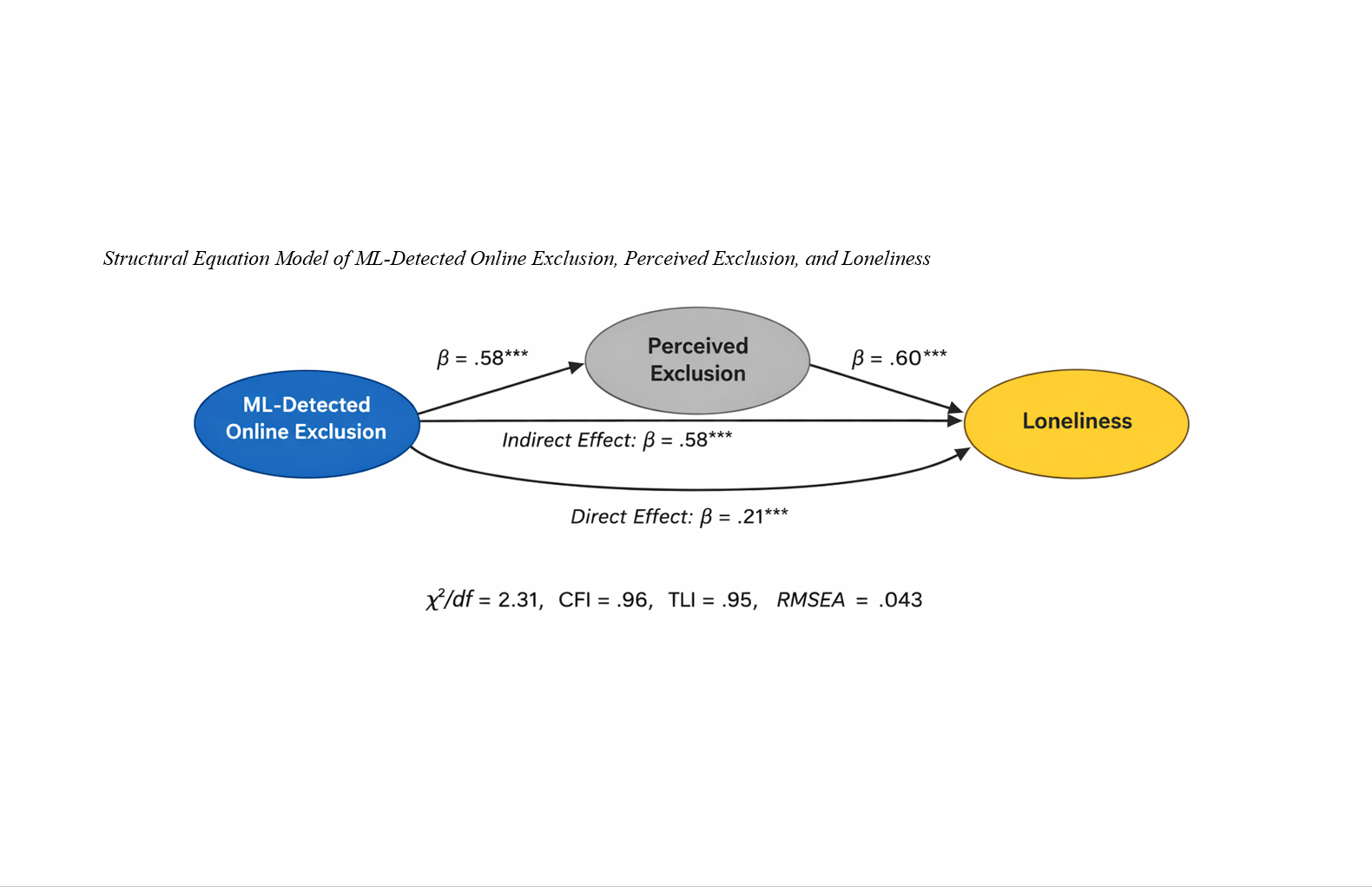
Findings: Machine learning–detected online social exclusion was positively and significantly associated with adolescent loneliness (p < 0.001). Hierarchical regression analysis demonstrated that computationally detected exclusion predicted loneliness above and beyond demographic variables and self-reported exclusion (ΔR² = 0.06, p < 0.001). Structural equation modeling indicated acceptable model fit and revealed that perceived exclusion partially mediated the relationship between machine learning–detected exclusion and loneliness (indirect effect p < 0.001), while the direct path remained significant (p < 0.001).
Conclusion: The findings indicate that algorithmically detected online exclusionary patterns constitute a significant and independent predictor of adolescent loneliness. Integrating machine learning–based behavioral analytics with psychosocial assessment enhances the precision of loneliness risk identification and offers promising avenues for early detection and prevention strategies in digitally mediated youth environments.
Downloads
References
Alanko, K., Söderberg, P., Lagerström, M., Laakso, M. J., & Junttila, N. (2025). The Association Between Social Outsiderhood and School Absence Is Mediated by Internalizing Symptoms. School Mental Health, 17(3), 1041-1053. https://doi.org/10.1007/s12310-025-09793-8
Arslan, G., & Yıldırım, M. (2021). Psychological Maltreatment and Loneliness in Adolescents: Social Ostracism and Affective Experiences. Psychological Reports, 125(6), 3028-3048. https://doi.org/10.1177/00332941211040430
Au, A., Hilario, C., Meherali, S., & Salma, J. (2024). Unveiling Social Belonging: Exploring the Narratives of Immigrant Muslim Older Women. Health & Social Care in the Community, 2024(1). https://doi.org/10.1155/2024/5598247
Boon, S. D., & Brown, J. (2020). Associations Between Perceived Injustice, Unforgiveness, and Psychological Well-Being Among Ex-Communicants. Journal of Social and Personal Relationships, 37(6), 1991-2011. https://doi.org/10.1177/0265407520914878
Boykina, E. E., Radchikov, A. S., Romanova, N. M., Pyatykh, G. A., & Kiselev, K. A. (2024). Teenager in Closed Institutions of the Educational System and the Federal Penitentiary Service of Russia: Ostracism Experience, Loneliness, Motives of Affiliation, Meaning and Life Orientations. Bulletin of Psychological Practice in Education, 20(4), 106-118. https://doi.org/10.17759/bppe.2023200410
Boykina, E. E., Чиркина, Р. В., Radchikov, A. S., Pyatykh, G. A., & Anisimova, E. V. (2023). Ostracism Experience Scale (Adolescent, Youth), OES-AY (In Russ.). Psychology and Law, 13(4), 132-149. https://doi.org/10.17759/psylaw.2023130410
Bruneel, S. (2025). Exploring the Mediating Role of Social Media and Gaming in the Relationship Between Adolescents’ Feelings of Loneliness, Ostracism and Internalizing and Externalizing Symptoms. https://doi.org/10.21203/rs.3.rs-7944252/v1
Burger, C., & Bachmann, L. (2021). Perpetration and Victimization in Offline and Cyber Contexts: A Variable- And Person-Oriented Examination of Associations and Differences Regarding Domain-Specific Self-Esteem and School Adjustment. International journal of environmental research and public health, 18(19), 10429. https://doi.org/10.3390/ijerph181910429
Carter, A. D., & Shienko, L. (2023). From Loneliness to Belonging Post Pandemic. 209-232. https://doi.org/10.4018/978-1-6684-5190-8.ch011
Charmaraman, L., Zhang, A., Wang, K., & Chen, B. (2024). Sexual Minorities and Loneliness: Exploring Sexuality Through Social Media and Gender–Sexuality Alliance (GSA) Supports. International journal of environmental research and public health, 21(3), 300. https://doi.org/10.3390/ijerph21030300
Ding, H., Zhu, L., Hua, W., Geng, J., Huang, F., & Lei, L. (2022). The Relationship Between Cyber-Ostracism and Adolescents’ Non-Suicidal Self-Injury: Mediating Roles of Depression and Experiential Avoidance. International journal of environmental research and public health, 19(19), 12236. https://doi.org/10.3390/ijerph191912236
Dreslin, B., & Hedrick, M. E. (2023). Finding Friends: The Role of Loneliness on the Formation of Online Friendships Among Adolescents. Journal of Student Research, 12(3). https://doi.org/10.47611/jsrhs.v12i3.5087
Heiman, T., & Olenik‐Shemesh, D. (2022). Cyber-Victimization Experience Among Higher Education Students: Effects of Social Support, Loneliness, and Self-Efficacy. International journal of environmental research and public health, 19(12), 7395. https://doi.org/10.3390/ijerph19127395
Jiang, T., Yin, Y., Yuan, W., Hao, C., Du, Y., Xu, Z., & Hicks, J. A. (2023). Alone but Not Lonely: Awe Fosters Positive Attitudes Toward Solitude. https://doi.org/10.21203/rs.3.rs-3261143/v1
Kaarakainen, S.-S., Helenius, J., & Laakso, M. (2025). Exploring Loneliness Among Young People: Thematic Analysis of Loneliness Experiences on Finnish YouthNet Discussion Forum. Youth & Society, 57(5), 852-877. https://doi.org/10.1177/0044118x241313475
Khararbakhova, M. A., Musatova, O. A., & Shpagina, E. M. (2021). Internet and Loneliness of Adolescents. Psychology and Law, 11(4), 2-13. https://doi.org/10.17759/psylaw.2021110401
Kiran, P. M., & Thiruchelvi, A. (2020). A Study on Role of Big 5 Personality Traits on Social Ostracism. Shanlax International Journal of Management, 8(2), 103-107. https://doi.org/10.34293/management.v8i2.3430
Kiuru, N., Salmela‐Aro, K., Laursen, B., Vasalampi, K., Beattie, M., Tunkkari, M., & Junttila, N. (2024). Profiles of Loneliness and Ostracism During Adolescence: Consequences, Antecedents, and Protective Factors. Child Psychiatry & Human Development, 56(6), 1637-1657. https://doi.org/10.1007/s10578-024-01664-8
Lutz, S., & Schneider, F. M. (2020). Is Receiving Dislikes in Social Media Still Better Than Being Ignored? The Effects of Ostracism and Rejection on Need Threat and Coping Responses Online. https://doi.org/10.31234/osf.io/328j4
Miao, Y., Jasim, N., Guha, C., Sluiter, A., Owen, K., Yudianto, B., Lim, M. H., Smith, B. J., & Manera, K. (2024). Experiences of Loneliness and Social Isolation Among Young People With Chronic Physical Conditions: A Thematic Synthesis of Qualitative Studies. Journal of adolescence, 97(3), 593-608. https://doi.org/10.1002/jad.12445
Murphy, P. N. (2021). Tactile Warmth Reduces Loneliness, but Visual Warmth Does Not. Individual Differences Research, 19. https://doi.org/10.65030/idr.19004
Olutola, B., & Whitehouse, C. (2024). Cyberbullying Among School Going Adolescents. What Are the Associated Factors? Jayps, 5(11), 132-143. https://doi.org/10.61838/kman.jayps.5.11.16
ÖZİŞLİ, Ö. (2022). The Effect of Workplace Ostracism on Organizational Silence and Workplace Loneliness a Study on Healthcare Workers. International Journal of Health Services Research and Policy, 7(3), 300-308. https://doi.org/10.33457/ijhsrp.1131522
Pangestika, V. W., Jati, S., & a, V. N. (2024). Comparative Study of Loneliness in Indonesian and Malaysian Students. Psikoislamedia Jurnal Psikologi, 9(1), 16-26. https://doi.org/10.22373/psikoislamedia.v9i1.22743
Pu, J., & Gan, X. (2025). The Potential Roles of Social Ostracism and Loneliness in the Development of Dark Triad Traits in Adolescents: A Longitudinal Study. Journal of personality, 94(1), 81-93. https://doi.org/10.1111/jopy.13018
Razzaq, A. (2025). Cyberbullying, Loneliness and Use of Social Media Among College Students. Contemporary Journal of Social Science Review, 3(4), 158-166. https://doi.org/10.63878/cjssr.v3i4.1729
Risco, S., & Mills, D. J. (2025). Interpersonal and Gaming Behaviors: Contrasting Players With and Without Parasocial Relationships With Fictional Characters. https://doi.org/10.31234/osf.io/9wfsd_v1
Sakız, H., Mert, A., & Sarıçam, H. (2020). Self-Esteem and Perceived Social Competence Protect Adolescent Students Against Ostracism and Loneliness. Journal of Psychologists and Counsellors in Schools, 31(1), 94-109. https://doi.org/10.1017/jgc.2020.25
Sluiter, A., Cazzolli, R., Jauré, A., Scholes‐Robertson, N., Craig, J. C., Johnson, D. W., González, A. M., Sautenet, B., Smith, B. J., & Manera, K. (2024). Experiences of Social Isolation and Loneliness in Chronic Kidney Disease. Clinical Journal of the American Society of Nephrology, 19(11), 1405-1416. https://doi.org/10.2215/cjn.0000000000000529
Stavrova, O., Ren, D., & Pronk, T. (2021). Low Self-Control: A Hidden Cause of Loneliness? Personality and Social Psychology Bulletin, 48(3), 347-362. https://doi.org/10.1177/01461672211007228
Tang, T.-C., Chi, L. C., & Tang, E. (2023). Office Islands: Exploring the Uncharted Waters of Workplace Loneliness, Social Media Addiction, and the Fear of Missing Out. Current Psychology, 43(17), 15160-15175. https://doi.org/10.1007/s12144-023-05445-9
Tunkkari, M. (2025). Adolescents’ Loneliness and Ostracism: Teacher and Family Support as Protective Factors. European journal of public health, 35(Supplement_4). https://doi.org/10.1093/eurpub/ckaf161.637
Tunkkari, M., Kiuru, N., Junttila, N., Paakkari, L., & Lyyra, N. (2025). The Role of Loneliness and Ostracism in Adolescents’ Psychological Well‐Being and Substance Use: Family and Teacher Support as Moderators. Journal of adolescence, 98(2), 371-382. https://doi.org/10.1002/jad.70067
Wang, Y., Hawk, S. T., Wong, N., & Zhang, Y. (2023). Lonely, Impulsive, and Seeking Attention: Predictors of Narcissistic Adolescents’ Antisocial and Prosocial Behaviors on Social Media. International Journal of Behavioral Development, 47(6), 540-547. https://doi.org/10.1177/01650254231198034
Webster, D., Dunne, L., & Hunter, R. F. (2020). Association Between Social Networks and Subjective Well-Being in Adolescents: A Systematic Review. Youth & Society, 53(2), 175-210. https://doi.org/10.1177/0044118x20919589
Yin, Y., Yuan, W., Hao, C., Du, Y., Xu, Z., Hicks, J. A., & Jiang, T. (2024). Awe Fosters Positive Attitudes Toward Solitude. Nature Mental Health, 2(6), 717-727. https://doi.org/10.1038/s44220-024-00244-y
Downloads
Additional Files
Publication Timeline
- Submitted
- Revised
- Accepted