Dynamic Bayesian Networks of Self-Esteem Fluctuations and Social Feedback Sensitivity
DOI:
https://doi.org/10.61838/kman.jayps.5315Keywords:
State self-esteem, social feedback, dynamic Bayesian networks, ecological momentary assessment, rejection sensitivity, affective dynamicsAbstract
Objective: The present study aimed to model the dynamics of state self-esteem fluctuations and social feedback sensitivity using Dynamic Bayesian Networks.
Methods and Materials: A quantitative intensive longitudinal design was implemented with 287 university students from Slovenia who completed a 21-day ecological momentary assessment protocol. Participants responded to five semi-random prompts per day assessing state self-esteem, perceived social feedback valence, and negative affect, yielding 26,874 momentary observations. Baseline measures included trait self-esteem, rejection sensitivity, depressive symptoms, and social anxiety. Data were person-mean centered and preprocessed to ensure stationarity. A multilevel vector autoregressive model was first estimated to identify preliminary lagged associations. Subsequently, Dynamic Bayesian Networks were constructed using a two-time-slice framework with hill-climbing structure learning and Bayesian Information Criterion scoring. Bootstrapped model averaging (1,000 resamples) ensured stability of directed edges. Hierarchical Bayesian extensions examined moderation by trait rejection sensitivity, and predictive accuracy was evaluated via 10-fold cross-validation.
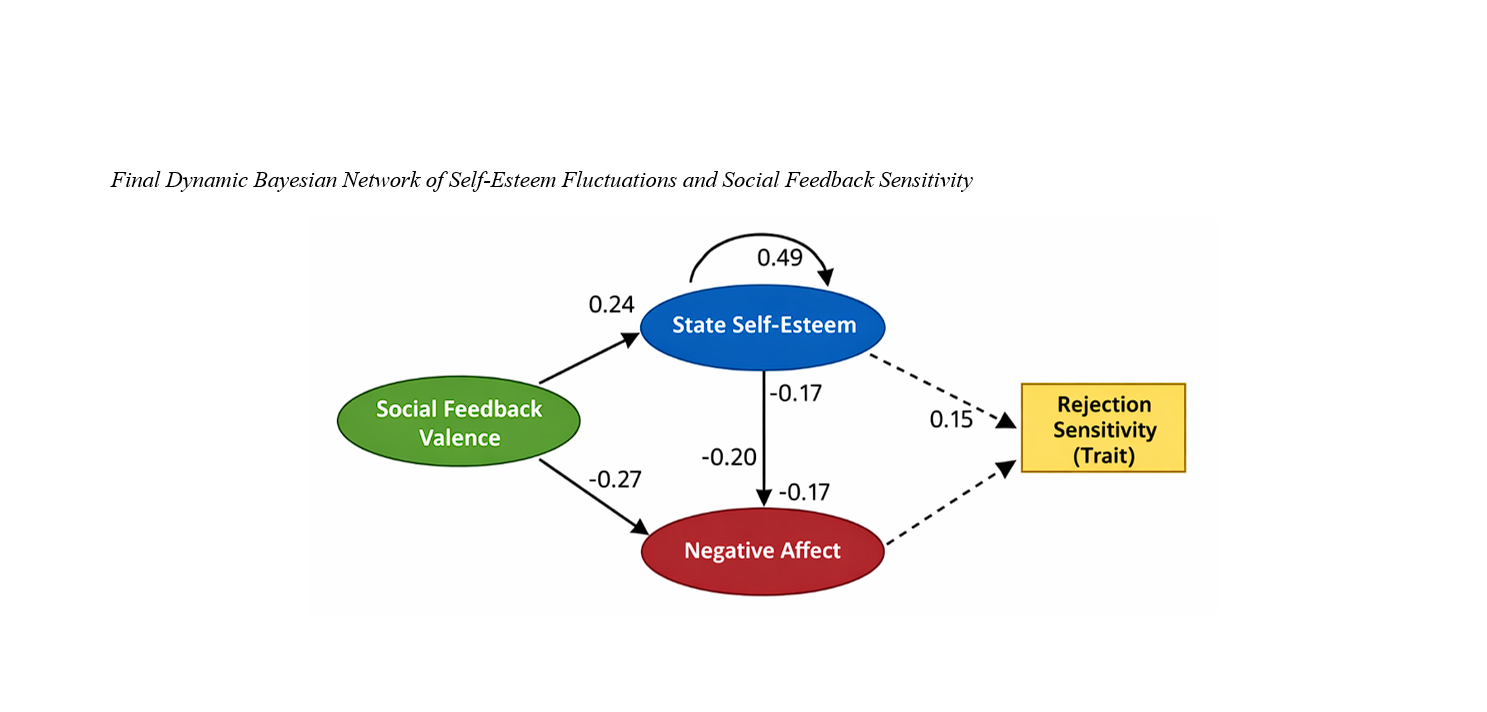
Findings: State self-esteem demonstrated significant autoregressive stability (β ≈ 0.50, p < 0.001). Positive social feedback prospectively predicted increases in subsequent state self-esteem (β ≈ 0.24, credible intervals excluding zero), whereas negative affect predicted decreases (β ≈ -0.20, p < 0.001). Reciprocal effects between self-esteem and negative affect formed a significant feedback loop. Trait rejection sensitivity significantly moderated the feedback-to-self-esteem pathway, amplifying evaluative reactivity (posterior mean ≈ 0.15, credible intervals excluding zero). Bootstrapped inclusion probabilities for key edges exceeded 90%, and cross-validated predictive performance demonstrated satisfactory out-of-sample accuracy (RMSE ≈ 0.41).
Conclusion: Self-esteem operates as a dynamically regulated state embedded within a probabilistic network of social and affective processes, where social feedback functions as a central driver and individual differences in rejection sensitivity shape the magnitude of evaluative updating across time.
Downloads
References
Amey, R. C., Leitner, J. B., Liu, M., & Forbes, C. E. (2022). Neural Mechanisms Associated With Semantic and Basic Self-Oriented Memory Processes Interact Moderating Self-Esteem. Iscience, 25(2), 103783. https://doi.org/10.1016/j.isci.2022.103783
Bueno, J. O., & Moisés, A. P. (2023). The Socio-Musical Brain: Study of a Music Education Experience. https://doi.org/10.36315/2023v2end048
Charalampous, A., & Δάρρα, Μ. (2024). The Impact of Teacher Feedback on Non-Cognitive Aspects of Student's Performance in Higher Education: A Review of Research. International Research in Education, 12(2), 13. https://doi.org/10.5296/ire.v12i2.22001
Chen, Y. A. (2025). A Comparative Study of State Self-Esteem Responses to Social Media Feedback Loops in Adolescents and Adults. Frontiers in psychology, 16. https://doi.org/10.3389/fpsyg.2025.1625771
Dhingra, R., & Parashar, B. (2022). Validation on Social Media and Adolescents: A Matter of Self Esteem. Jett, 13(4). https://doi.org/10.47750/jett.2022.13.04.017
Ding, Y., Oba, K., Ishibashi, R., & Sugiura, M. (2025). Domain-Specific Neural Correlates of Self-Evaluation: Links to Sense of Acceptance and Rejection. https://doi.org/10.31234/osf.io/7ds3f_v1
Dores, A. R., Peixoto, M., Fernandes, C., Marques, A., & Barbosa, F. (2025). The Effects of Social Feedback Through the “Like” Feature on Brain Activity: A Systematic Review. Healthcare, 13(1), 89. https://doi.org/10.3390/healthcare13010089
Ehrenreich, S. E. (2022). Peer Relationship Processes in the Context of Digital Media. 85-103. https://doi.org/10.1017/9781108976237.007
Elder, J., Davis, T., & Hughes, B. (2023). A Fluid Self-Concept: How the Brain Maintains Coherence and Positivity Across an Interconnected Self-Concept While Incorporating Social Feedback. Journal of Neuroscience, 43(22), 4110-4128. https://doi.org/10.1523/jneurosci.1951-22.2023
Funkhouser, C. J., Auerbach, R. P., Kujawa, A., Morelli, S. A., Phan, K. L., & Shankman, S. A. (2020). Social Feedback Valence Differentially Modulates the Reward Positivity, P300, and Late Positive Potential. Journal of Psychophysiology, 34(4), 255-267. https://doi.org/10.1027/0269-8803/a000253
Gregorova, K. (2025). Adolescents With Borderline Personality Disorder Do Not Learn They Are Liked and Show Altered Self-Esteem Reactivity to Social Feedback. https://doi.org/10.31234/osf.io/3tacd_v3
Kortink, E. D., Weeda, W. D., Verkuil, B., Topel, S., & Melle, J. W. v. d. M. (2021). Follow Your Heart? Examining Heart Rate Variability as a Predictor of Neural Reactivity to Social Rejection - A Network Approach to Individual Differences in Social Threat Sensitivity. https://doi.org/10.31234/osf.io/2dfpa
Li, X., Si, W., & Chan, K. W. (2023). Virtual Agents That Flatter You: Moderating Effects of Self‐esteem and Customization Target in E‐customization Services. Psychology and Marketing, 41(2), 344-363. https://doi.org/10.1002/mar.21943
Liu, B., Tian, L., Yang, S., Wang, X., & Luo, J. (2022). Effects of Multidimensional Self-Esteems on Health Promotion Behaviors in Adolescents. Frontiers in Public Health, 10. https://doi.org/10.3389/fpubh.2022.847740
Lu, Z., He, X., Yi, D., & Sui, J. (2024). Temporal Properties of Self-Prioritization. Entropy, 26(3), 242. https://doi.org/10.3390/e26030242
Mastorci, F., Vienna, A., & Pingitore, A. (2021). A Modern Framework of Adolescence Health Programs. Health, 13(07), 685-693. https://doi.org/10.4236/health.2021.137052
Mi, Y., Duan, H., Xu, Z., & Lei, X. (2023). The Impact of Sleep Deprivation on Brain Networks in Response to Social Evaluation Tasks. Brain Sciences, 13(8), 1122. https://doi.org/10.3390/brainsci13081122
Miller, J. G., Shrestha, S. B., Reiss, A. L., & Vrtička, P. (2020). Neural Bases of Social Feedback Processing and Self–other Distinction in Late Childhood: The Role of Attachment and Age. Cognitive Affective & Behavioral Neuroscience, 20(3), 503-520. https://doi.org/10.3758/s13415-020-00781-w
Mishra, S. S. (2024). The Paradox of Social Media: Self-Esteem Among Young Adults in India. International Journal for Research in Applied Science and Engineering Technology, 12(7), 1552-1561. https://doi.org/10.22214/ijraset.2024.63818
Morales, L. (2025). Identifying the Role of Digital Self-Presentation in Adolescent Identity Formation. Jayps, 6(11), 1-8. https://doi.org/10.61838/kman.jayps.4746
Nadia, A. J. D. B. d. V., Valkenburg, P. M., Janssen, L., Wal, A. v. d., Keijsers, L., & Beyens, I. (2023). Social Media Self-Effects on Adolescents’ Self-Esteem: A 100-Day Diary Study. https://doi.org/10.31234/osf.io/qre85
Özel, P. (2024). Dynamic Neural Network States During Social and Non-Social Cueing in Virtual Reality Working Memory Tasks: A Leading Eigenvector Dynamics Analysis Approach. Brain Sciences, 15(1), 4. https://doi.org/10.3390/brainsci15010004
Pagliaccio, D., Kumar, P., Kamath, R. A., Pizzagalli, D. A., & Auerbach, R. P. (2022). Neural Sensitivity to Peer Feedback and Depression Symptoms in Adolescents: A 2‐year Multiwave Longitudinal Study. Journal of Child Psychology and Psychiatry, 64(2), 254-264. https://doi.org/10.1111/jcpp.13690
Parfanovych, I., Kyrychenko, V., Petrochko, Z., Нечерда, В., Koropetska, O., & Lavrentieva, I. (2022). Peculiarities of Assertiveness Development and Ways of Socialization of Personality in Adolescence. Brain Broad Research in Artificial Intelligence and Neuroscience, 13(4), 163-181. https://doi.org/10.18662/brain/13.4/381
Parrish, M. H., Dutcher, J. M., Muscatell, K. A., Inagaki, T. K., Moieni, M., Irwin, M. R., & Eisenberger, N. I. (2022). Frontostriatal Functional Connectivity Underlies Self-Enhancement During Social Evaluation. Social Cognitive and Affective Neuroscience, 17(8), 723-731. https://doi.org/10.1093/scan/nsab139
Ribeiro, I. D. S., Ribeiro, I. D. S., & Thaís Vieira Góis dos, S. (2023). Self-Esteem, Self-Concept and Self-Image. Health and Society, 3(02), 92-111. https://doi.org/10.51249/hs.v3i02.1289
Rouault, M., Will, G. J., Fleming, S. M., & Dolan, R. J. (2021). Low Self-Esteem and the Formation of Global Self-Performance Estimates in Emerging Adulthood. https://doi.org/10.31234/osf.io/d8ns2
Rudolph, K. D., Davis, M. M., Modi, H. H., Skymba, H. V., Finnegan, M., Haigler, K., Clapham, R., Ye, Z., Dodson, J. F., & Telzer, E. H. (2025). Emotional Trade-Offs of Neural Sensitivity to Social Threat and Reward in Adolescent Girls. Social Cognitive and Affective Neuroscience, 20(1). https://doi.org/10.1093/scan/nsaf048
Schie, C. C. v., Cook, J., Elzinga, B. M., & Ly, V. (2022). A Boost in Self-Esteem After Positive Social Evaluation Predicts Social and Non-Social Learning. https://doi.org/10.31234/osf.io/9zukr
Schindler, S., Höhner, A., Moeck, R., Bruchmann, M., & Straube, T. (2021). Let’s Talk About Each Other: Neural Responses to Dissenting Personality Evaluations Based on Real Dyadic Interactions. Psychological Science, 32(7), 1058-1072. https://doi.org/10.1177/0956797621995197
Stendel, M., Guthrie, T. D., Williamson, V. G., & Chavez, R. S. (2023). Self-Esteem Modulates the Brain-to-Brain Similarity of the Representation of the Self in the Brains of Others. https://doi.org/10.31234/osf.io/tvdme
Stendel, M., Guthrie, T. D., Williamson, V. G., & Chavez, R. S. (2024). Self-Esteem Modulates the Similarity of the Representation of the Self in the Brains of Others. Communications Psychology, 2(1). https://doi.org/10.1038/s44271-024-00148-8
Sytnık, S., Резнікова, О., Bilotserkivska, Y. O., & Балла, Л. (2024). The Influence of Social-Psychological Training on the Self-Assessment of Higher Education Acquires. Scientific Herald of Sivershchyna Series Education Social and Behavioural Sciences, 2024(1), 243-254. https://doi.org/10.32755/sjeducation.2024.01.243
Tompson, S., Falk, E. B., O’Donnell, M. B., Cascio, C. N., Bayer, J., Vettel, J. M., & Bassett, D. S. (2020). Response Inhibition in Adolescents Is Moderated by Brain Connectivity and Social Network Structure. Social Cognitive and Affective Neuroscience. https://doi.org/10.1093/scan/nsaa109
Wagner, J., Wieczorek, L. L., & Brandt, N. D. (2023). Boosting Yourself? Associations Between Momentary Self-Esteem, Daily Social Interactions, and Self-Esteem Development in Late Adolescence and Late Adulthood. https://doi.org/10.31234/osf.io/rzbq9
Wagner, J., Wieczorek, L. L., & Brandt, N. D. (2024). Boosting Yourself? Associations Between Momentary Self-Esteem, Daily Social Interactions, and Self-Esteem Development in Late Adolescence and Late Adulthood. Journal of personality and social psychology, 126(2), 332-345. https://doi.org/10.1037/pspp0000481
Will, G. J., Moutoussis, M., Womack, P. M., Bullmore, E. T., Goodyer, I., Fonagy, P., Jones, P. B., Rutledge, R. B., & Dolan, R. J. (2020). Neurocomputational Mechanisms Underpinning Aberrant Social Learning in Young Adults With Low Self-Esteem. Translational psychiatry, 10(1). https://doi.org/10.1038/s41398-020-0702-4
Xiong, Y., Yu, R., Wang, X., Liang, S., Ran, J., Li, X., & Xu, Y. (2025). Hemispheric Asymmetries and Network Dysfunctions in Adolescent Depression: A Neuroimaging Study Using Resting-State Functional Magnetic Resonance Imaging. World journal of psychiatry, 15(2). https://doi.org/10.5498/wjp.v15.i2.102412
Zahra, N. H. (2025). Perilaku Bullying Terhadap Self-Esteem Remaja. Jurnal Riset Rumpun Ilmu Kesehatan, 4(2), 574-584. https://doi.org/10.55606/jurrikes.v4i2.5859
Downloads
Additional Files
Publication Timeline
- Submitted
- Revised
- Accepted