Testing a Structural Model of Social Media Addiction, Sleep Quality, Academic Burnout, and Psychological Well-Being among High School Students
DOI:
https://doi.org/10.61838/kman.jayps.5421Keywords:
Social media addiction, Sleep quality, Academic burnout, Psychological well-being, High school students, Structural equation modelingAbstract
Objective: This study aimed to test a structural model explaining the direct and indirect relationships among social media addiction, sleep quality, academic burnout, and psychological well-being among high school students in Canada.
Methods and Materials: This cross-sectional correlational study was conducted among 718 high school students from Ontario, Canada, during the 2025–2026 academic year. Participants were selected through multistage cluster sampling from public high schools and completed standardized self-report questionnaires. Social media addiction was measured using the Bergen Social Media Addiction Scale, sleep quality was assessed using the Pittsburgh Sleep Quality Index, academic burnout was measured using the Maslach Burnout Inventory–Student Survey, and psychological well-being was assessed using Ryff’s Psychological Well-Being Scale. Data were analyzed using SPSS version 29 and AMOS version 29. Descriptive statistics, Pearson correlation coefficients, confirmatory factor analysis, and structural equation modeling were used. Model fit was evaluated using χ²/df, CFI, TLI, GFI, RMSEA, and SRMR. Indirect effects were examined through bootstrapping with 5,000 resamples.
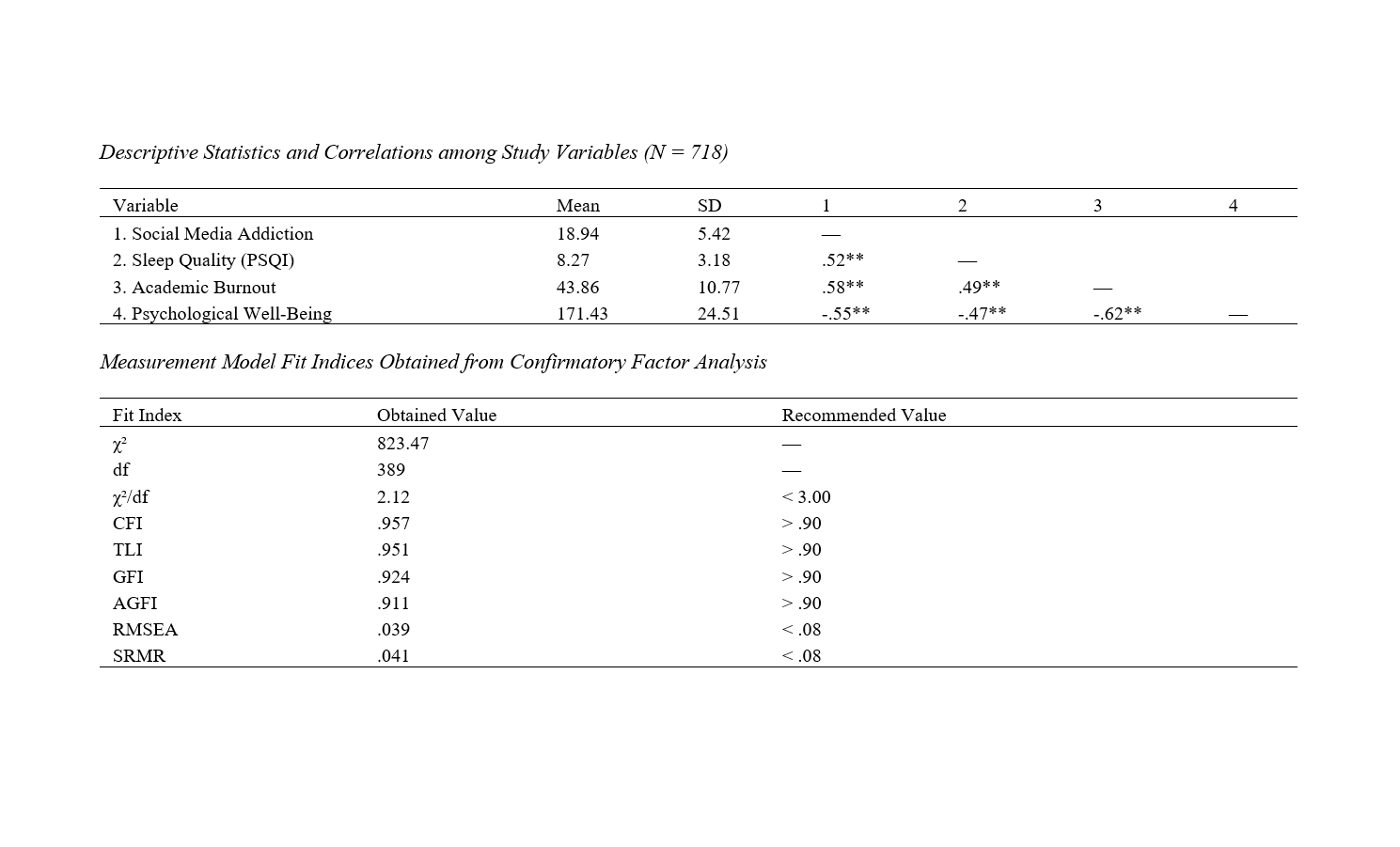
Findings: The structural model showed acceptable fit to the data (χ²/df = 2.12, CFI = .957, TLI = .951, GFI = .924, RMSEA = .039, SRMR = .041). Social media addiction significantly predicted poorer sleep quality (β = .52, p < .001), higher academic burnout (β = .39, p < .001), and lower psychological well-being (β = -.24, p < .001). Poor sleep quality significantly predicted academic burnout (β = .31, p < .001) and psychological well-being (β = -.18, p < .001). Academic burnout was the strongest direct predictor of psychological well-being (β = -.49, p < .001). Bootstrapping confirmed significant indirect effects through sleep quality, academic burnout, and the serial pathway from sleep quality to academic burnout.
Conclusion: The findings indicate that social media addiction undermines psychological well-being among high school students both directly and indirectly through impaired sleep quality and increased academic burnout. School-based interventions should integrate digital behavior regulation, sleep hygiene education, and burnout prevention strategies.
Downloads
References
Al-Muslim, M., Alghafli, G. A., Alghafli, I. A., Alyousef, S., Aldossary, G., Alsaigh, B., Mousa, O., & Al-Sayedahmed, H. (2025). Association Between Digital Burnout and Sleep Quality Among King Faisal University Students. https://doi.org/10.21203/rs.3.rs-6105207/v1
Cao, X.-X., Fu, Y., Wang, N.-D., & Lian, S.-L. (2024). Mobile Phone Addiction and Academic Burnout: The Mediating Role of Technology Conflict and the Protective Role of Mindfulness. Frontiers in Psychiatry, 15. https://doi.org/10.3389/fpsyt.2024.1365914
Chong, L. Z., Foo, L. K., & Chua, S.-L. (2025). Student Burnout: A Review on Factors Contributing to Burnout Across Different Student Populations. Behavioral Sciences, 15(2), 170. https://doi.org/10.3390/bs15020170
David, L., Ismaiel, A., Foucambert, P., Leucuța, D.-C., Popa, S. L., Stănculete, M. F., & Dumitraşcu, D. L. (2024). Mental Disorders, Social Media Addiction, and Academic Performance in Romanian Undergraduate Nursing Students. Journal of clinical medicine, 13(15), 4475. https://doi.org/10.3390/jcm13154475
Feher, A., Fejes, É., Fehér, G., Horváth, L., & Tibold, A. (2025). Association of Problematic Usage of the Internet With Burnout, Depression, Insomnia and Quality of Life Among Hungarian Recreational Esports Players: A Cross Sectional Study. Frontiers in Public Health, 13. https://doi.org/10.3389/fpubh.2025.1619810
Feher, A., Fejes, É., Kapus, K., Jancsák, C., Nagy, G. D., Horváth, L., Tibold, A., & Fehér, G. (2023). The Association of Problematic Usage of the Internet With Burnout, Depression, Insomnia, and Quality of Life Among Hungarian High School Students. Frontiers in Public Health, 11. https://doi.org/10.3389/fpubh.2023.1167308
Feng, T., Wang, B., Mi, M., Ren, L., Wu, L., Wang, H., Liu, X., & Wang, X. (2025). The Relationships Between Mental Health and Social Media Addiction, and Between Academic Burnout and Social Media Addiction Among Chinese College Students: A Network Analysis. Heliyon, 11(3), e41869. https://doi.org/10.1016/j.heliyon.2025.e41869
He, S., & Chen, I. H. (2024). Internet Addiction Among Teachers: A Systematic Review. Environment and Social Psychology, 9(6). https://doi.org/10.54517/esp.v9i6.2513
Jiang, Y. (2021). Problematic Social Media Usage and Anxiety Among University Students During the COVID-19 Pandemic: The Mediating Role of Psychological Capital and the Moderating Role of Academic Burnout. Frontiers in psychology, 12. https://doi.org/10.3389/fpsyg.2021.612007
Liu, R. (2023). The Influence of Social Media on Adolescent Sleeping Duration and Quality. SHS Web of Conferences, 180, 02016. https://doi.org/10.1051/shsconf/202318002016
Luo, A., Kong, W., He, H., Li, Y., & Xie, W. (2022). Status and Influencing Factors of Social Media Addiction in Chinese Medical Care Professionals: A Cross-Sectional Survey. Frontiers in psychology, 13. https://doi.org/10.3389/fpsyg.2022.888714
Magomedova, A., & Fatima, G. (2025). Mental Health and Well-Being in the Modern Era: A Comprehensive Review of Challenges and Interventions. Cureus. https://doi.org/10.7759/cureus.77683
Maksniemi, E., Hietajärvi, L., Ketonen, E., Lonka, K., Puukko, K., & Salmela‐Aro, K. (2022). Intraindividual Associations Between Active Social Media Use, Exhaustion, and Bedtime Vary According to Age—A Longitudinal Study Across Adolescence. Journal of adolescence, 94(3), 401-414. https://doi.org/10.1002/jad.12033
Mu, H.-L., Jiang, Q., Xu, J., & Chen, S. (2022). Drivers and Consequences of Short-Form Video (SFV) Addiction Amongst Adolescents in China: Stress-Coping Theory Perspective. International journal of environmental research and public health, 19(21), 14173. https://doi.org/10.3390/ijerph192114173
Naga, J. F., & Ebardo, R. (2025). Social Network Sites (SNS) an Archetype of Techno-Social Stress: A Systematic Review. Heliyon, 11(1), e41119. https://doi.org/10.1016/j.heliyon.2024.e41119
Pohl, M., Fehér, G., Kapus, K., Feher, A., Nagy, G. D., Kiss, J., Fejes, É., Horváth, L., & Tibold, A. (2021). The Association of Internet Addiction With Burnout, Depression, Insomnia, and Quality of Life Among Hungarian High School Teachers. International journal of environmental research and public health, 19(1), 438. https://doi.org/10.3390/ijerph19010438
Qin, L., Chen, S., Luo, B.-A., & Chen, Y.-W. (2022). The Effect of Learning Burnout on Sleep Quality in Primary School Students: The Mediating Role of Mental Health. Healthcare, 10(10), 2076. https://doi.org/10.3390/healthcare10102076
Rogowska, A. M., & Lechowicz, O. (2025). The Relationship Between Problematic TikTok Use and Depression in University Students: The Mediating Role of Insomnia. Journal of clinical medicine, 14(13), 4652. https://doi.org/10.3390/jcm14134652
Samek, D. R., Crumly, B., Akua, B. A., Dawson, M., & Duke‐Marks, A. (2023). Microaggressions, Perceptions of Campus Climate, Mental Health, and Alcohol Use Among First‐year College Students of Color. Journal of Research on Adolescence, 34(1), 96-113. https://doi.org/10.1111/jora.12897
Seema, R., Väljas, J., & Oppi, P. (2024). Symptoms of Digital Addiction of Estonian Primary School Students. https://doi.org/10.20944/preprints202405.1954.v1
Sl, A. S., Aziz, A. R., & Huda, N. (2023). The Relationship Between the Intensity of the Use of the Tiktok Application and the Mental Health of Nursing Students. Jetish Journal of Education Technology Information Social Sciences and Health, 2(2), 1678-1688. https://doi.org/10.57235/jetish.v2i2.889
Song, T. Z., Zhu, H., Yang, K., Chang, W., & Ni, J. (2025). How Mobile Phone Addiction Leads to College Students’ Learning Burnout: The Role of Depression as a Mediator and Fear of Missing Out as a Moderator. Frontiers in Psychiatry, 16. https://doi.org/10.3389/fpsyt.2025.1569340
Song, W., Wang, Z., & Zhang, R. (2022). Classroom Digital Teaching and College Students’ Academic Burnout in the Post COVID-19 Era: A Cross-Sectional Study. International journal of environmental research and public health, 19(20), 13403. https://doi.org/10.3390/ijerph192013403
Tasijawa, F. A., Madiuw, D., & Leutualy, V. (2024). Smartphone Addiction Among Nursing and Health Students. The Malaysian Journal of Nursing, 15(03), 186-198. https://doi.org/10.31674/mjn.2024.v15i03.021
Tomaszek, K., & Muchacka-Cymerman, A. (2021). Be Aware of Burnout! The Role of Changes in Academic Burnout in Problematic Facebook Usage Among University Students. International journal of environmental research and public health, 18(15), 8055. https://doi.org/10.3390/ijerph18158055
Tomaszek, K., & Muchacka-Cymerman, A. (2022). Face the Burnout! Link Between Academic Burnout, Facebook Use Motives and Importance, and Facebook Intrusion: A Longitudinal Study. Roczniki Psychologiczne, 25(3), 251-270. https://doi.org/10.18290/rpsych2022.0017
Vazsonyi, A. T., Javakhishvili, M., Lobo‐Dos‐Santos, T. A., Özdemir, Y., & Sağkal, A. S. (2024). Developmental Changes in School Burnout: The Importance of Sleep and Problematic Internet Use. Journal of adolescence, 96(5), 1091-1101. https://doi.org/10.1002/jad.12319
Ye, S., Wang, R., Pan, H., Zhao, F., Li, W., Xing, J., & Wu, J. (2023). Development and Validation of a Prediction Nomogram for Academic Burnout Among Chinese Adolescents: A Cross-Sectional Study. BMJ open, 13(5), e068370. https://doi.org/10.1136/bmjopen-2022-068370
Ye, X., Li, Y., Liu, Y., Zheng, Q., Lin, Z. W., Yin-hua, Z., Lin, Z., Zhu, T., Chen, X., Chen, L., & Liu, T. (2023). Effect of Fear of Missing Out on Learning Burnout in Medical Students: A Moderated Mediation. Frontiers in Psychiatry, 14. https://doi.org/10.3389/fpsyt.2023.1289906
Yu, D. J., Wing, Y. K., Li, T. M. H., & Chan, N. Y. (2024). The Impact of Social Media Use on Sleep and Mental Health in Youth: A Scoping Review. Current psychiatry reports, 26(3), 104-119. https://doi.org/10.1007/s11920-024-01481-9
Yu, L., Chen, Z., Huang, X., Tao, X., & Lv, Y. (2025). The Relationship Between Physical Activity and Mobile Phone Addiction in College Students: A Systematic Review and Meta-Analysis. Behavioral Sciences, 15(10), 1325. https://doi.org/10.3390/bs15101325
Zhong, Y., Ma, H., Liang, Y., Liao, C., Zhang, C., & Jiang, W. (2022). Prevalence of Smartphone Addiction Among Asian Medical Students: A Meta-Analysis of Multinational Observational Studies. International Journal of Social Psychiatry, 68(6), 1171-1183. https://doi.org/10.1177/00207640221089535
Zhu, X., Zheng, T., Ding, L., Zhang, X., Li, Z., & Jiang, H. (2023). Exploring Associations Between Social Media Addiction, Social Media Fatigue, Fear of Missing Out and Sleep Quality Among University Students: A Cross-Section Study. PLoS One, 18(10), e0292429. https://doi.org/10.1371/journal.pone.0292429
Downloads
Additional Files
Publication Timeline
- Submitted
- Revised
- Accepted