A Multigroup Structural Equation Model of Family Functioning, Identity Development, and Risk-Taking Behaviors among Adolescents
DOI:
https://doi.org/10.61838/kman.jayps.5427Keywords:
Family functioning, Identity development, Risk-taking behaviors, AdolescentsAbstract
The present study aimed to examine the structural relationships among family functioning, identity development, and risk-taking behaviors among Canadian adolescents and to determine whether these relationships differ between male and female adolescents using a multigroup structural equation modeling approach.
Methods and Materials: This cross-sectional correlational study was conducted among 842 adolescents aged 14–18 years recruited from secondary schools in Ontario, British Columbia, and Alberta, Canada. The sample consisted of 421 males and 421 females selected through multistage cluster sampling. Data were collected using the Family Assessment Device (FAD), the Dimensions of Identity Development Scale (DIDS), and the Adolescent Risk-Taking Questionnaire (ARQ). Descriptive statistics, reliability analyses, confirmatory factor analysis, and structural equation modeling were performed using SPSS 29 and AMOS 29. Multigroup structural equation modeling was employed to examine the invariance of the proposed model across gender groups. Model fit was evaluated using χ²/df, Comparative Fit Index (CFI), Tucker–Lewis Index (TLI), Goodness-of-Fit Index (GFI), Incremental Fit Index (IFI), and Root Mean Square Error of Approximation (RMSEA). Direct, indirect, and total effects were estimated, and mediation effects were tested using bias-corrected bootstrap procedures with 5,000 resamples.
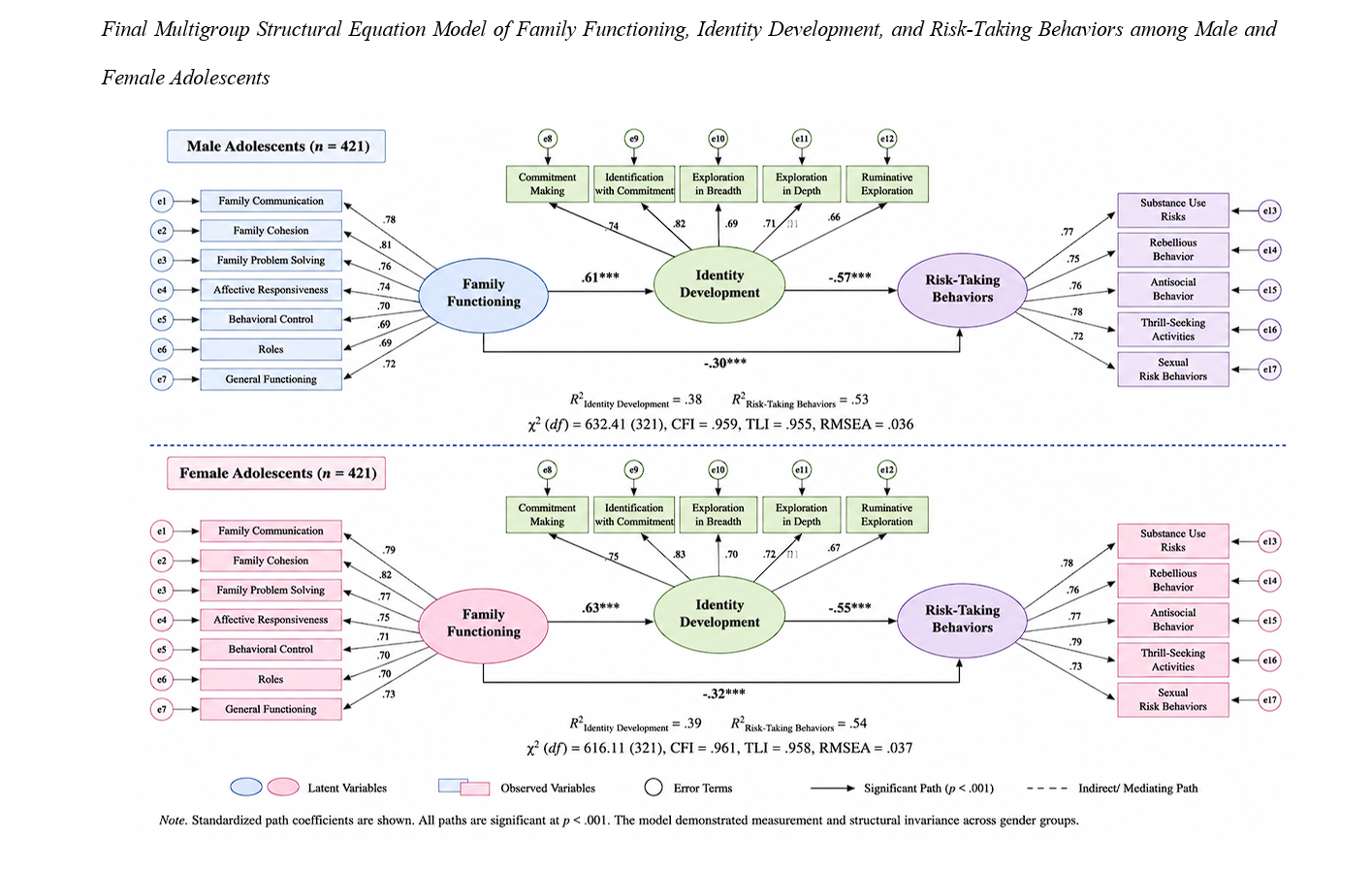
Findings: The measurement model demonstrated excellent fit to the data (χ²/df = 2.10, CFI = .961, TLI = .957, RMSEA = .036). Structural equation modeling revealed that family functioning positively predicted identity development (β = .62, p < .001), while identity development negatively predicted risk-taking behaviors (β = -.56, p < .001). Family functioning also exerted a significant direct negative effect on risk-taking behaviors (β = -.31, p < .001). Bootstrap analyses confirmed a significant indirect effect of family functioning on risk-taking behaviors through identity development (β = -.35, p < .001), indicating partial mediation. The model explained 38% of the variance in identity development and 54% of the variance in risk-taking behaviors. Multigroup analyses supported configural, metric, scalar, and structural invariance across male and female adolescents, indicating that the proposed relationships operated similarly across gender groups.
Conclusion: The findings demonstrate that family functioning is a significant protective factor against adolescent risk-taking behaviors both directly and indirectly through its positive influence on identity development. Adolescents who experience supportive, cohesive, and effectively functioning family environments are more likely to develop stable and adaptive identities, which in turn reduces their likelihood of engaging in maladaptive risk behaviors. The invariance of the model across genders suggests that these developmental processes are broadly consistent for male and female adolescents. These findings highlight the importance of family-centered and identity-focused interventions in promoting healthy adolescent development and preventing behavioral risk outcomes.
Downloads
References
Agustina, M. W., & Auliya, E. (2024). The Influence of Father Involvement on Adolescent Sexual Self-Concept. Proceeding of International Conference on Healthy Living (Incoheliv), 1(1), 40-51. https://doi.org/10.24123/incoheliv.v1i1.6552
Barrett, A.-M. (2022). Developmental Opportunities in Adolescence. https://doi.org/10.31234/osf.io/6ywvq
Bhave, S., Sovani, A., & Shah, S. R. (2022). Role of Psychologist in Adolescent Medicine. Pediatric Clinics of North America, 69(5), 847-864. https://doi.org/10.1016/j.pcl.2022.05.001
Borrell, S. R., & Albertos, A. (2023). Potential Connection Between Positive Frustration in Family Leisure Time and the Promotion of Adolescent Autonomy. Frontiers in psychology, 14. https://doi.org/10.3389/fpsyg.2023.1258748
Borum, R. (2025). Developmental Considerations for Assessing the Risk of Extremist Violence in Adolescents. Journal of Threat Assessment and Management. https://doi.org/10.1037/tam0000248
Branch, R., & Berman, S. L. (2023). Risk Propensity as a Function of Personality and Identity. Youth, 3(2), 526-540. https://doi.org/10.3390/youth3020036
Chao, K. Y. (2022). The Quarter-Life Crisis: The Lack of Identity Development Support in Adolescents. Journal of Student Research, 11(4). https://doi.org/10.47611/jsrhs.v11i4.3049
Dai, J., Kwon, S. J., Prinstein, M. J., Telzer, E. H., & Lindquist, K. A. (2023). Neural Similarity in Nucleus Accumbens During Decision‐making for the Self and a Best Friend: Links to Adolescents' Self‐reported Susceptibility to Peer Influence and Risk Taking. Human Brain Mapping, 44(10), 3972-3985. https://doi.org/10.1002/hbm.26317
Doležalová, P., Červenka, K., & Vojtová, V. (2022). Adverse Childhood Experiences and Aggressive Behavior of Adolescents in Residential Educational Programs in the Czech Republic. Kontakt, 24(4), 339-345. https://doi.org/10.32725/kont.2022.038
Ferguson, G. M., Causadías, J. M., & Simenec, T. S. (2023). Acculturation and Psychopathology. Annual Review of Clinical Psychology, 19(1), 381-411. https://doi.org/10.1146/annurev-clinpsy-080921-080622
Guyer, A. E., Beard, S. J., & Venticinque, J. S. (2023). Brain Development During Adolescence and Early Adulthood. 21-37. https://doi.org/10.1037/0000298-002
Hernández, N. J., Miranda, J. C., & Pascual, I. R. (2021). Abordaje De Los Estilos De Crianza Como Herramienta Para El Médico Familiar Durante La Atención Del Adolescente. Atención Familiar, 28(2), 139. https://doi.org/10.22201/fm.14058871p.2021.2.78805
Hess, A. C., Dodds, S., Jaud, D. A., Garnier, C., & Gergaud, O. (2025). Curbing Adolescents’ Risky Drinking Behavior With Authenticity. Journal of Public Policy & Marketing, 44(2), 276-298. https://doi.org/10.1177/07439156241291476
Jecce, E. (2023). Mediating Role of Self-Concept in Moral Development and Risk-Taking Behaviours Among Children. Journal of Early Childhood Care and Education (Jecce), 3. https://doi.org/10.30971/jecce.v3i.483
Opara, I., Abrams, J. A., Cross, K., & Amutah‐Onukagha, N. (2021). Reframing Sexual Health for Black Girls and Women in HIV/STI Prevention Work: Highlighting the Role of Identity and Interpersonal Relationships. International journal of environmental research and public health, 18(22), 12088. https://doi.org/10.3390/ijerph182212088
Parfanovych, I., Kyrychenko, V., Petrochko, Z., Нечерда, В., Koropetska, O., & Lavrentieva, I. (2022). Peculiarities of Assertiveness Development and Ways of Socialization of Personality in Adolescence. Brain Broad Research in Artificial Intelligence and Neuroscience, 13(4), 163-181. https://doi.org/10.18662/brain/13.4/381
Quintigliano, M., Carone, N., Speranza, A. M., Tanzilli, A., Baiocco, R., Barone, L., Pastorelli, C., & Lingiardi, V. (2022). Adolescent Development and the Parent–Adolescent Relationship in Diverse Family Forms Created by Assisted Reproduction. International journal of environmental research and public health, 19(24), 16758. https://doi.org/10.3390/ijerph192416758
Rogers, C. R., & Morgan, D. D. (2024). Identifying the Role of Siblings in Adolescent Decision‐making: A Developmental Processes Approach. Journal of Research on Adolescence, 35(1). https://doi.org/10.1111/jora.13027
Saladino, V., Mosca, O., Petruccelli, F., Hoelzlhammer, L., Lauriola, M., Verrastro, V., & Cabras, C. (2021). The Vicious Cycle: Problematic Family Relations, Substance Abuse, and Crime in Adolescence: A Narrative Review. Frontiers in psychology, 12. https://doi.org/10.3389/fpsyg.2021.673954
Sznitman, G. A., Antonietti, J. P., Petegem, S. V., Schwartz, S. J., Baudat, S., & Zimmermann, G. (2022). Trajectories of Perceived Parenting Across an Educational Transition: Associations With Psychosocial Adjustment and Identity Development Among Swiss Adolescents. Developmental Psychology, 58(8), 1557-1573. https://doi.org/10.1037/dev0001367
Telzer, E. H., Dai, J., Capella, J. J., Sobrino, M., & Garrett, S. L. (2022). Challenging Stereotypes of Teens: Reframing Adolescence as Window of Opportunity. American psychologist, 77(9), 1067-1081. https://doi.org/10.1037/amp0001109
Tian, Y. (2024). Risk Taking in Adolescents and Relevant Factors. Journal of Education Humanities and Social Sciences, 40, 54-59. https://doi.org/10.54097/3kh7q066
Treiber, D. N., & Booysen, L. (2021). Identity (Re)Construction of Female Adolescents With Substance Use Disorders. International journal of environmental research and public health, 18(13), 7022. https://doi.org/10.3390/ijerph18137022
Trekels, J., & Telzer, E. H. (2023). The Swiss Cheese Model of Social Cues - Trekels &Amp;amp; Telzer. https://doi.org/10.31219/osf.io/tvr84
Updegraff, K. A., & Perez‐Brena, N. J. (2023). Studying Families as Systems in Adolescence and Early Adulthood. 177-192. https://doi.org/10.1037/0000298-011
Uzun, G. Ö. (2021). The Storm Perıod ın Psychologıcal and Educatıonal Development: An Overvıew of Adolescence. Revista on Line De Política E Gestão Educacional. https://doi.org/10.22633/rpge.v25iesp.6.16171
Williamson, V. G. (2021). Adolescent Social Cognitive Development. https://doi.org/10.31234/osf.io/qd2vw
Wise, R. (2023). Turkish High School Students’ Susceptibility to Peer Pressure as a Function of Religiosity, Self-Esteem, and Autonomy. Journal of Psychological Perspective, 5(2), 79-90. https://doi.org/10.47679/jopp.526042023
Zhang, J., & Wang, E.-N. (2025). Positive and Negative Risk-Taking Behaviors in Adolescents: Distinct Characteristics, Interrelationships, and Influencing Factors. World journal of psychiatry, 15(6). https://doi.org/10.5498/wjp.v15.i6.106944
Downloads
Additional Files
Publication Timeline
- Submitted
- Revised
- Accepted