Identifying Profiles of Adolescent Flourishing Through Unsupervised Machine Learning and Variables Including Self-Compassion, Meaning in Life, Digital Wellbeing, Gratitude, and Peer Support
DOI:
https://doi.org/10.61838/kman.jayps.5437Keywords:
Adolescent flourishing, unsupervised machine learning, self-compassion, meaning in life, digital wellbeing, gratitude, peer support, cluster analysis, positive psychology, adolescent mental healthAbstract
Objective: The present study aimed to identify distinct profiles of adolescent flourishing using unsupervised machine learning techniques based on self-compassion, meaning in life, digital wellbeing, gratitude, and peer support among Canadian adolescents.
Methods and Materials: This study employed a cross-sectional correlational design with an unsupervised machine learning approach. The statistical population consisted of Canadian high school students enrolled in public secondary schools during the 2025–2026 academic year. Using multistage cluster sampling, 742 adolescents were recruited, and after data screening, 711 participants were retained for final analysis. Data were collected using standardized instruments including the Flourishing Scale, Self-Compassion Scale–Short Form, Meaning in Life Questionnaire, Digital Wellbeing Scale for Adolescents, Gratitude Questionnaire–Six Item Form, and the peer support subscale of the Multidimensional Scale of Perceived Social Support. Data analysis was conducted using Python and SPSS-28. Hierarchical clustering and K-means clustering were applied to identify latent flourishing profiles. Cluster validity was evaluated using silhouette coefficients, Davies–Bouldin index, and Calinski–Harabasz index. Multivariate analysis of variance and Bonferroni post hoc tests were used to compare identified profiles across study variables.
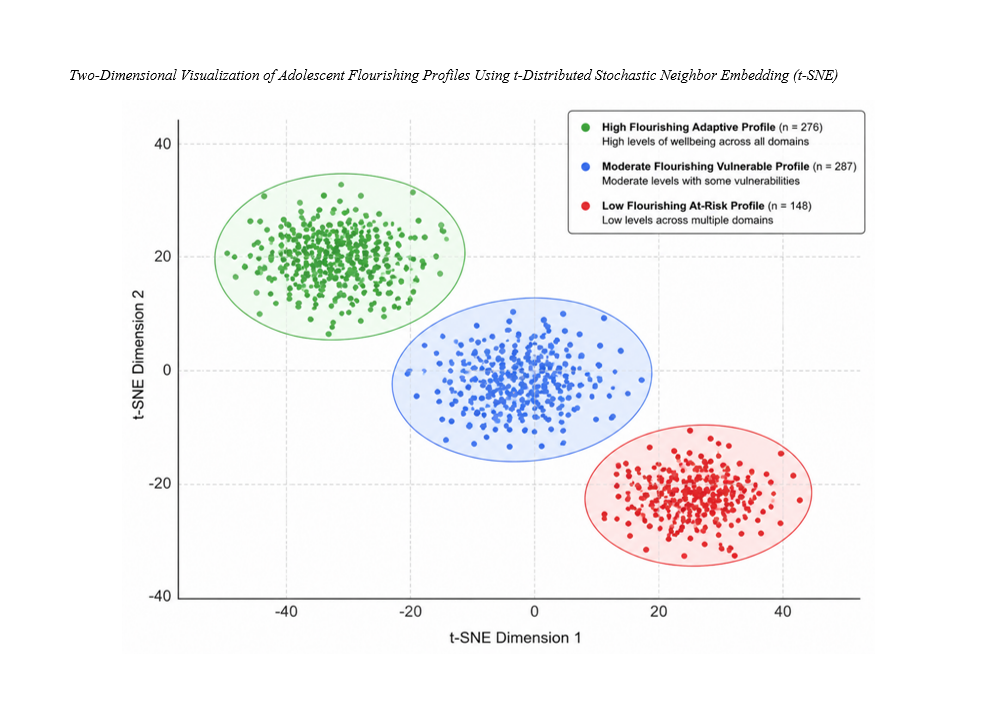
Findings: The findings indicated that the three-cluster solution demonstrated the strongest statistical performance and conceptual interpretability compared to alternative clustering solutions. Three distinct profiles were identified, including the High Flourishing Adaptive Profile, Moderate Flourishing Vulnerable Profile, and Low Flourishing At-Risk Profile. Significant multivariate differences were observed among the profiles across flourishing, self-compassion, meaning in life, digital wellbeing, gratitude, and peer support (p < .001). Adolescents within the High Flourishing Adaptive Profile reported significantly higher scores across all psychological and relational variables compared to the other profiles, whereas the Low Flourishing At-Risk Profile demonstrated consistently lower functioning across all domains. Meaning in life and flourishing produced the largest effect sizes in distinguishing profile membership. Visualization analyses using t-distributed stochastic neighbor embedding additionally confirmed clear separation and structural distinctiveness among the identified flourishing profiles.
Conclusion: The findings suggest that adolescent flourishing is a multidimensional and heterogeneous construct shaped by emotional, existential, relational, and digital wellbeing factors. Self-compassion, meaning in life, gratitude, peer support, and healthy digital engagement appear to function as major protective resources associated with adaptive flourishing. The application of unsupervised machine learning techniques provided a nuanced person-centered understanding of adolescent wellbeing and highlighted the existence of distinct flourishing trajectories among youth populations. These findings support the development of strengths-based and personalized interventions aimed at enhancing flourishing and psychological resilience during adolescence.
Downloads
References
Armenta, C. N., Fritz, M. M., Walsh, L. C., & Lyubomirsky, S. (2022). Satisfied Yet Striving: Gratitude Fosters Life Satisfaction and Improvement Motivation in Youth. Emotion, 22(5), 1004-1016. https://doi.org/10.1037/emo0000896
Bakracheva, M. (2025). Personality Predictors of Flourishing and Learning to Flourish. International Journal of Cognitive Research in Science Engineering and Education, 13(1), 141-156. https://doi.org/10.23947/2334-8496-2025-13-1-141-156
Bastos, M. A. V., Braz, D. F., Porto, A. L. M., Khadija, S. d. S. C., Portella, R. B., & Granger, D. A. (2025). Physiological Attunement and Flourishing: Understanding the Influence of Relationships on Health. Frontiers in Psychiatry, 16. https://doi.org/10.3389/fpsyt.2025.1614379
Bian, Y., & Ji, C. (2024). The Impact of Parental Divorce on Children's Mental Health. Lecture Notes in Education Psychology and Public Media, 34(1), 24-28. https://doi.org/10.54254/2753-7048/34/20231941
Halleyda, N., & Japar, M. (2023). The Gratitude Training to Enhance the Psychological Well-Being Among Adolescents With Single Parents. Humanitas Indonesian Psychological Journal, 174-183. https://doi.org/10.26555/humanitas.v20i2.348
Hatchimonji, D. R., Vaida, E., Linsky, A. C. V., Nayman, S. J., Yuan, M., MacDonnell, M., & Elias, M. J. (2022). Exploring Relations Among Social-Emotional and Character Development Targets: Character Virtue, Social-Emotional Learning Skills, and Positive Purpose. International Journal of Emotional Education, 14(1), 20-37. https://doi.org/10.56300/evip7836
Hussong, A. M., Petrie, R., Richards, A. N., Shelton, R., & Midgette, A. J. (2023). Gratitude Moments as Predictors of Self- And Other-Orientation Indicators in a Racially/Ethnically Diverse Sample of US Young Adolescents During the COVID-19 Pandemic. Youth, 3(1), 362-380. https://doi.org/10.3390/youth3010024
Lee, C. S. (2023). Effects of Depression on Suicidal Ideation of Adolescents: Indirect Effect of Gratitude and Conditional Direct Effect of Mindfulness. Perspectives of Science and Education, 66(6), 347-358. https://doi.org/10.32744/pse.2023.6.20
Liu, A., Wang, W., Wu, X., & Xu, B. (2023). Relationship Between Self-Compassion and Nonsuicidal Self-Injury in Middle School Students After Earthquake: Gender Differences in the Mediating Effects of Gratitude and Posttraumatic Growth. Psychological Trauma Theory Research Practice and Policy, 15(7), 1203-1213. https://doi.org/10.1037/tra0001423
Lusianawati, H., Sulaeman, S., Sianipar, G., & Rasmita, D. (2023). The Impact of Digital Lifestyles on Young People's Health: Social Media Abuse, Physical Inactivity and Psychological Impacts. West Science Interdisciplinary Studies, 1(09), 773-782. https://doi.org/10.58812/wsis.v1i09.211
Neagu, O.-A. (2024). The Impact of Faith and Family in the Development of Resilience in Adolescents During the COVID-19 Pandemic. Logos Universality Mentality Education Novelty Social Sciences, 13(1), 01-18. https://doi.org/10.18662/lumenss/13.1/98
Preston, A. J., Rew, L., & Young, C. C. (2021). A Systematic Scoping Review of Psychological Capital Related to Mental Health in Youth. The Journal of School Nursing, 39(1), 72-86. https://doi.org/10.1177/10598405211060415
Puspita, B. P., & Ayriza, Y. (2022). Gratitude Can Increase Resilience in Adolescents Who Live in Orphanages. Journal Research of Social Science Economics and Management, 1(8), 969-980. https://doi.org/10.59141/jrssem.v1i8.119
Putri, R. D., Mansoer, W. W. D., & Nesi, N. (2023). Resilience as a Predictor of Adolescent Happiness in Orphanages in Jakarta. Kne Social Sciences. https://doi.org/10.18502/kss.v8i19.14357
Sembiring, T. B., & Mokodenseho, S. (2023). The Impact of Online Interactions on Mental Health Among Adolescents in West Java. Esssh, 1(01), 1-9. https://doi.org/10.58812/esssh.v1i01.142
VanderWeele, T. J., & Lee, M. T. (2025). Love and Human Flourishing. https://doi.org/10.31234/osf.io/ndx5z_v1
Verma, R. (2022). Positive Psychology in Schools With Focus on Adolescent Well-Being. JPsSR, 2(3). https://doi.org/10.53902/jpssr.2022.02.000535
West, M., Rice, S., & Vella‐Brodrick, D. (2024). Adolescent Social Media Use Through a Self-Determination Theory Lens: A Systematic Scoping Review. International journal of environmental research and public health, 21(7), 862. https://doi.org/10.3390/ijerph21070862
Wong, Y. J., Pandelios, A. L., Carlock, K., & Thielmeyer, A. M. B. (2024). Stronger Together: Perspectives on Gratitude Social Processes in Group Interventions for Adolescents. Frontiers in psychology, 15. https://doi.org/10.3389/fpsyg.2024.1476511
Wu, N., Mo, J., Wen, A., Ou, H., Gu, W., Qiu, Y., Yuan, L., & Lan, X. (2023). Longitudinal Relationship Between Bullying Victimization and Non-Suicidal Self-Injury Among Chinese Adolescents: The Buffering Roles of Gratitude and Parental Autonomy Support. International journal of environmental research and public health, 20(2), 1440. https://doi.org/10.3390/ijerph20021440
Yang, M., Qu, C., Guo, H., Guo, X., Tian, K., & Wang, G. (2022). Machiavellianism and Learning-Related Subjective Well-Being Among Chinese Senior High School Students: A Moderated Mediation Model. Frontiers in psychology, 13. https://doi.org/10.3389/fpsyg.2022.915235
Zahra, A. C. A., Shanti, P., & Hutagalung, F. (2022). The Influence of Gratitude on Body Image Among Male Adolescents. Kne Social Sciences. https://doi.org/10.18502/kss.v7i1.10197
Zhang, D. (2022). The Relationship Between Gratitude and Adolescents’ Prosocial Behavior: A Moderated Mediation Model. Frontiers in psychology, 13. https://doi.org/10.3389/fpsyg.2022.1024312
Zhang, L., Roslan, S., Zaremohzzabieh, Z., Liu, K., Tang, X., Jiang, Y., & Mohamad, Z. (2023). A Serial Mediation Model of Negative Life Events on School Adjustment of Left-Behind Adolescents in Rural China: The Central Role of Hope and Gratitude. BMC psychiatry, 23(1). https://doi.org/10.1186/s12888-023-05102-2
Zhang, P., Ye, L., Fu, F., & Zhang, L. G. (2021). The Influence of Gratitude on the Meaning of Life: The Mediating Effect of Family Function and Peer Relationship. Frontiers in psychology, 12. https://doi.org/10.3389/fpsyg.2021.680795
Zhou, S., Leng, M., Zhang, J., Zhou, W., Lian, J., & Yang, H. (2024). Parental Emotional Warmth and Adolescent Internet Altruism Behavior: A Moderated Mediation Model. Humanities and Social Sciences Communications, 11(1). https://doi.org/10.1057/s41599-024-02870-4
Downloads
Additional Files
Publication Timeline
- Submitted
- Revised
- Accepted