XGBoost Prediction of Eating Disorder Symptom Severity among Adolescent Girls Using Body Dissatisfaction, Social Comparison, Self-Esteem, and Instagram Use Patterns
DOI:
https://doi.org/10.61838/kman.jayps.5440Keywords:
Eating disorder symptoms, adolescent girls, body dissatisfaction, self-esteem, social comparison, Instagram useAbstract
Objective: The present study aimed to examine the relative contributions of body dissatisfaction, social comparison, self-esteem, and Instagram use patterns in predicting eating disorder symptom severity among adolescent girls using the Extreme Gradient Boosting (XGBoost) machine learning algorithm.
Methods and Materials: This cross-sectional predictive study was conducted among 1,284 adolescent girls aged 13–18 years recruited from secondary schools across Canada. Participants completed a battery of validated self-report measures assessing eating disorder symptom severity, body dissatisfaction, social comparison orientation, self-esteem, and Instagram-related behaviors. Eating disorder symptoms were measured using the Eating Disorder Examination Questionnaire, body dissatisfaction was assessed using the Body Shape Questionnaire, social comparison was evaluated through the Iowa-Netherlands Comparison Orientation Measure, and self-esteem was measured using the Rosenberg Self-Esteem Scale. Instagram use patterns included daily usage duration, appearance-focused content viewing, influencer engagement, photo-editing behaviors, and emotional sensitivity to social feedback. Data preprocessing procedures included missing-value treatment, feature normalization, and quality screening. The dataset was divided into training and testing subsets using an 80:20 ratio. An optimized XGBoost regression model was developed using five-fold cross-validation and hyperparameter tuning. Model performance was evaluated using the coefficient of determination (R²), Root Mean Squared Error (RMSE), Mean Absolute Error (MAE), and Mean Absolute Percentage Error (MAPE). SHapley Additive exPlanations (SHAP) analyses were employed to interpret feature importance and predictor contributions.
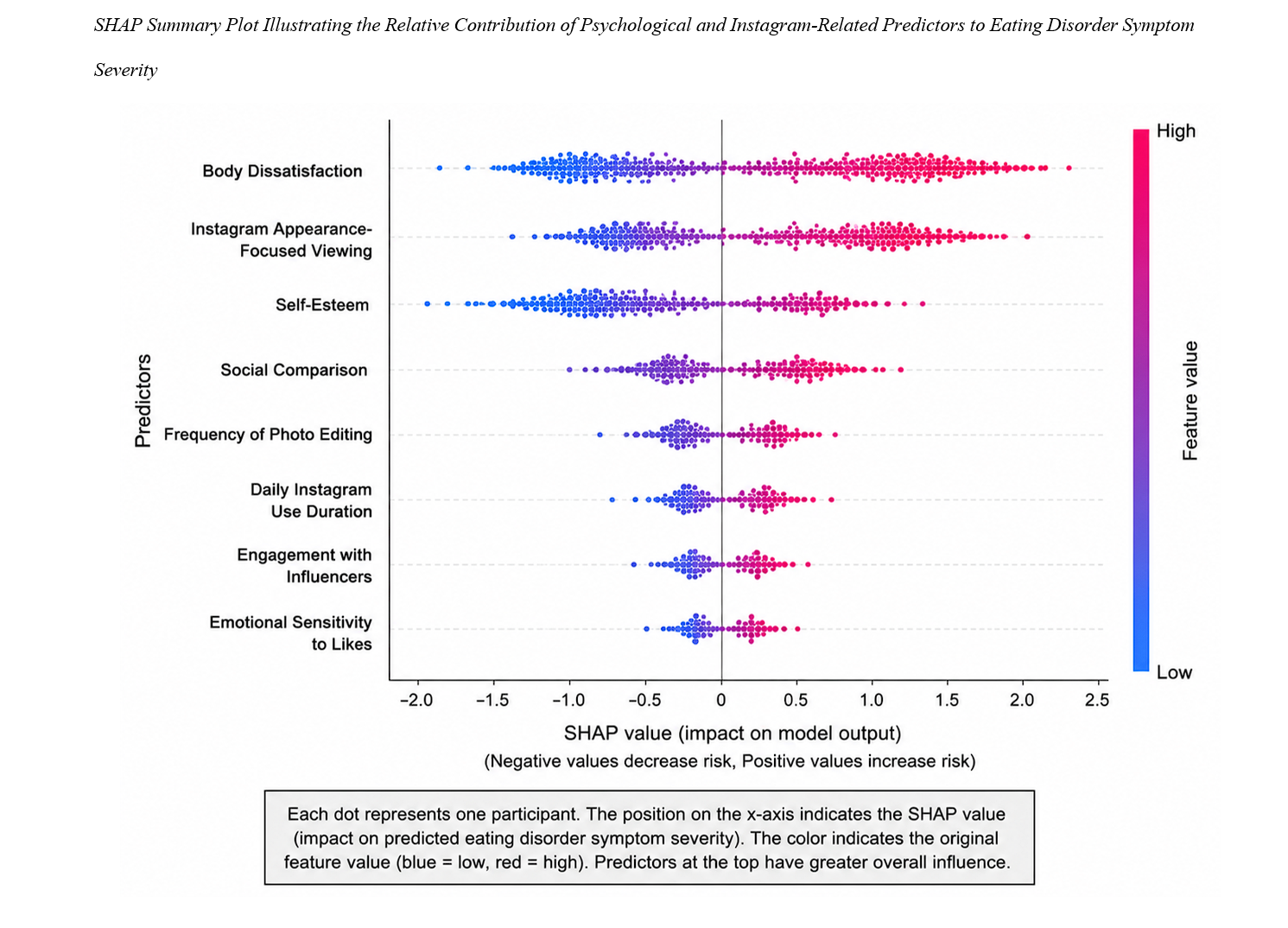
Findings: The XGBoost model demonstrated strong predictive performance, explaining 81.6% of the variance in eating disorder symptom severity within the testing dataset (R² = 0.816). Body dissatisfaction emerged as the strongest predictor, accounting for the largest proportion of predictive gain, followed by appearance-focused Instagram viewing, self-esteem, and social comparison. SHAP analyses indicated that higher levels of body dissatisfaction, greater engagement with appearance-oriented Instagram content, stronger social comparison tendencies, more frequent photo-editing behaviors, longer Instagram use duration, greater influencer engagement, and heightened emotional sensitivity to likes and comments were associated with increased predicted eating disorder symptom severity. In contrast, higher self-esteem exerted a substantial protective effect and was associated with lower predicted symptom severity. The consistency between training and testing performance metrics indicated minimal overfitting and strong model generalizability.
Conclusion: The findings demonstrate that eating disorder symptom severity among adolescent girls can be predicted with high accuracy through the combined assessment of psychological vulnerabilities and Instagram-related behavioral patterns. Body dissatisfaction appears to represent the central risk factor, while appearance-focused social media engagement, social comparison processes, and diminished self-esteem further amplify vulnerability. These results support integrated theoretical models of eating disorder development and highlight the value of machine learning approaches in identifying high-risk individuals. Prevention and intervention programs should simultaneously target body image concerns, self-esteem enhancement, social comparison reduction, and healthy social media engagement to reduce eating disorder risk among adolescent girls.
Downloads
References
Ananta, A., & Suhadianto, S. (2023). Body Dissatisfaction Among Emerging Adulthood Women: What Is the Role of Social Comparison. 22-30. https://doi.org/10.2991/978-2-38476-080-0_4
Barbierik, L., Bačíková-Slešková, M., & Petrovová, V. (2023). The Role of Social Appearance Comparison in Body Dissatisfaction of Adolescent Boys and Girls. Europe’s Journal of Psychology, 19(3), 244-258. https://doi.org/10.5964/ejop.6443
Beos, N., Kemps, E., & Prichard, I. (2025). Relationships Between Social Media, Body Image, Physical Activity, and Anabolic-Androgenic Steroid Use in Men: A Systematic Review. Psychology of Men & Masculinity, 26(1), 105-128. https://doi.org/10.1037/men0000487
Blackburn, M. R., & Hogg, R. (2024). #ForYou? The Impact of Pro-Ana TikTok Content on Body Image Dissatisfaction and Internalisation of Societal Beauty Standards. PLoS One, 19(8), e0307597. https://doi.org/10.1371/journal.pone.0307597
Brown, Z., & Tiggemann, M. (2021). Celebrity Influence on Body Image and Eating Disorders: A Review. Journal of Health Psychology, 27(5), 1233-1251. https://doi.org/10.1177/1359105320988312
Choukas‐Bradley, S., Roberts, S. R., Maheux, A. J., & Nesi, J. (2021). The Perfect Storm: A Developmental–Sociocultural Framework for the Role of Social Media in Adolescent Girls’ Body Image Concerns and Mental Health. https://doi.org/10.31234/osf.io/ju92a
Dane, A., & Bhatia, K. (2023). The Social Media Diet: A Scoping Review to Investigate the Association Between Social Media, Body Image and Eating Disorders Amongst Young People. Plos Global Public Health, 3(3), e0001091. https://doi.org/10.1371/journal.pgph.0001091
Feijoo, B. (2025). The Impact of Social Media Aesthetic Capital on Adolescent Body Image: Microinfluencer and Expert Perspectives on Social Success and Digital Pressures. Psychology of Popular Media. https://doi.org/10.1037/ppm0000637
Flores-Mata, C., & Castellano‐Tejedor, C. (2024). Relationship Between Instagram, Body Satisfaction, and Self-Esteem in Early Adulthood. https://doi.org/10.20944/preprints202406.0420.v1
Gao, M. (2023). Social Media's Influence on Eating Disorders. Modern Economics & Management Forum, 4(4), 107. https://doi.org/10.32629/memf.v4i4.1489
Górska, D., Świercz, K., Majcher, M., Sierpień, M., Majcher, M., Pikulicka, A., Karwańska, A., Kulbat, A., Brzychczy, P., & Kulbat, M. (2023). Influence of Social Media on Developing Body Image Dissatisfaction and Eating Disorders. Journal of Education Health and Sport, 22(1), 56-62. https://doi.org/10.12775/jehs.2023.22.01.005
Henriques, M. L., & Patnaik, D. (2021). Social Media and Its Effects on Beauty. https://doi.org/10.5772/intechopen.93322
K., S. (2024). An Exploration of the Psychological Impact of Instagram Marketing by Fashion, Beauty and Diet Brands on Eating Disorders. International Journal for Multidisciplinary Research, 6(4). https://doi.org/10.36948/ijfmr.2024.v06i04.25886
Levine, M. P. (2021). Do Individuals With Eating Disorders See Their Own External and/or Internal Beauty? https://doi.org/10.5772/intechopen.97508
Liu, L., Yang, J. W., Tan, F., Yang, X., Luo, H., Chen, Y., & Zhao, X. (2025). Digital Interventions for Improving Body Dissatisfaction in Children and Emerging Adults: Systematic Review and Meta-Analysis. Interactive Journal of Medical Research, 14, e72231-e72231. https://doi.org/10.2196/72231
Liu, Y. (2023). Social Media Leads to Eating Disorders and Response Strategies. Advances in Education Humanities and Social Science Research, 5(1), 307. https://doi.org/10.56028/aehssr.5.1.307.2023
López‐Gil, J. F., Chen, S., Jiménez‐López, E., Abellán-Huerta, J., Herrera-Gutiérrez, E., Royo, J. M. P., Mesas, A. E., & López, P. J. T. (2023). Are the Use and Addiction to Social Networks Associated With Disordered Eating Among Adolescents? Findings From the EHDLA Study. International journal of mental health and addiction, 22(6), 3775-3789. https://doi.org/10.1007/s11469-023-01081-3
Marano, G., Lisci, F. M., Rossi, S., Marzo, E. M., Boggio, G., Brisi, C., Traversi, G., Mazza, O., Pola, R., Gaetani, E., & Mazza, M. (2025). Connected but at Risk: Social Media Exposure and Psychiatric and Psychological Outcomes in Youth. Children, 12(10), 1322. https://doi.org/10.3390/children12101322
Papageorgiou, A., Fisher, C., & Cross, D. (2022). “Why Don’t I Look Like Her?” How Adolescent Girls View Social Media and Its Connection to Body Image. BMC Women S Health, 22(1). https://doi.org/10.1186/s12905-022-01845-4
Pérez‐Jiménez, M. Á., Uclés-Torrente, M. d. M., Ruiz-Gamarra, G. E., Vaquero, M., Blancas-Sánchez, I. M., Aparicio‐Martinez, P., & Abellán, M. V. (2025). Social Media Consumption and Risk of Addiction Associated With Adolescent Disordered Eating Behaviour: An Observational Analysis. Nutrients, 17(18), 3017. https://doi.org/10.3390/nu17183017
Riccardo, A. M., Ferrazzi, G., Catellani, S., Gibin, A. M., Nasi, A. M., Marchi, M., Galeazzi, G. M., Thompson, J. K., & Pingani, L. (2024). Validation of an Adapted Italian-Language Version of the Sociocultural Attitudes Toward Appearance Questionnaire-3 (SATAQ-3), Within a Female Population: The Sociocultural Attitudes Toward Appearance Questionnaire - Social Media (SATAQ-SM). Frontiers in psychology, 14. https://doi.org/10.3389/fpsyg.2023.1193062
Roberts, S. R., Maheux, A. J., Ladd, B. A., & Choukas‐Bradley, S. (2022). The Role of Digital Media in Adolescents’ Body Image and Disordered Eating. 242-263. https://doi.org/10.1017/9781108976237.014
Sabol, M. A., & Duell, N. (2024). Effects of Social Media Use on Body Image and Disordered Eating in Adolescents. https://doi.org/10.31234/osf.io/fxh6m
Sharma, A. A., & Vidal, C. (2023a). Associations Between Highly Visual Social Media Use and Eating Disorders and Disordered Eating– A Changing Landscape. https://doi.org/10.21203/rs.3.rs-2758446/v1
Sharma, A. A., & Vidal, C. (2023b). A Scoping Literature Review of the Associations Between Highly Visual Social Media Use and Eating Disorders and Disordered Eating: A Changing Landscape. Journal of eating disorders, 11(1). https://doi.org/10.1186/s40337-023-00898-6
Suhag, K., & Rauniyar, S. (2024). Social Media Effects Regarding Eating Disorders and Body Image in Young Adolescents. Cureus. https://doi.org/10.7759/cureus.58674
Vartanian, L. R., Nicholls, K., & Fardouly, J. (2022). Testing the Identity Disruption Model Among Adolescents: Pathways Connecting Adverse Childhood Experiences to Body Dissatisfaction. Journal of youth and adolescence, 52(1), 134-148. https://doi.org/10.1007/s10964-022-01683-5
Xu, J. (2025). Examining the Varied Effects of Social Media on Body Image Across Genders: An in-Depth Systematic Review. Sage Open, 15(4). https://doi.org/10.1177/21582440251374734
Yang, H., Wang, J. J., Tng, G. Y. Q., & Yang, S. (2020). Effects of Social Media and Smartphone Use on Body Esteem in Female Adolescents: Testing a Cognitive and Affective Model. Children, 7(9), 148. https://doi.org/10.3390/children7090148
Ye, C. (2023). The Influences of Social Media on Eating Disorder Risk. Journal of Education Humanities and Social Sciences, 22, 710-715. https://doi.org/10.54097/ehss.v22i.13340
Yousafzai, A. K., & Fatima, R. (2025). Understanding Body Image Issues Among Young Pakistani Adults in the Age of Social Media. https://doi.org/10.21203/rs.3.rs-7578713/v1
Zaharia, A., & Gonța, I. (2024). The Healthy Eating Movement on Social Media and Its Psychological Effects on Body Image. Frontiers in Nutrition, 11. https://doi.org/10.3389/fnut.2024.1474729
Downloads
Additional Files
Publication Timeline
- Submitted
- Revised
- Accepted