Effectiveness of Mindfulness-Based Cognitive Therapy on Academic Performance and Academic Motivation in Adolescent Girls with Test Anxiety
Keywords:
Mindfulness-Based Cognitive Therapy, Academic Performance, Academic Motivation, Adolescent Girls, Test AnxietyAbstract
Objective: The present study aimed to determine the effectiveness of Mindfulness-Based Cognitive Therapy (MBCT) on academic performance and academic motivation among adolescent girls experiencing test anxiety.
Methods and Materials: This study employed a quasi-experimental design with a pretest–posttest control group. The statistical population consisted of adolescent girls with test anxiety in Juybar, Iran, during the 2025–2026 academic year. Initially, the Spielberger Test Anxiety Questionnaire was administered to 200 students. Thirty participants with the highest levels of test anxiety were selected through convenience sampling and randomly assigned to either an experimental group (n = 15) or a control group (n = 15). Data were collected using the Academic Performance Questionnaire developed by Pham and Taylor (1999), the Academic Motivation Scale based on Harter’s framework (1980), and the Spielberger Test Anxiety Questionnaire. The experimental group received eight 90-minute sessions of Mindfulness-Based Cognitive Therapy, while the control group received no intervention. Following the intervention, both groups completed the posttest assessments.
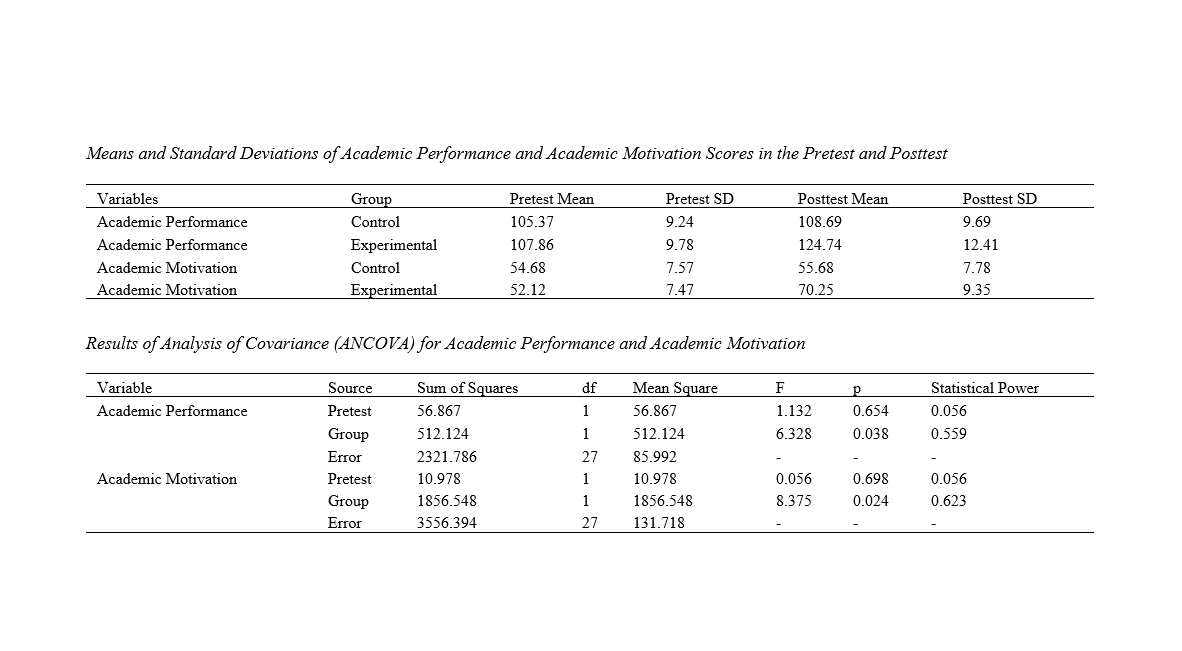
Findings: Analysis of covariance (ANCOVA) revealed significant differences between the experimental and control groups after controlling for pretest scores. For academic performance, the intervention produced a statistically significant effect (F = 6.328, p = 0.038), indicating that students who participated in MBCT demonstrated greater improvements in academic performance than those in the control group. Similarly, a significant effect was found for academic motivation (F = 8.375, p = 0.024), showing that MBCT significantly enhanced students’ motivation toward academic activities. Descriptive findings also indicated notable increases in posttest mean scores for both academic performance and academic motivation in the experimental group compared with their pretest scores, whereas only minimal changes were observed in the control group.
Conclusion: The findings suggest that Mindfulness-Based Cognitive Therapy is an effective intervention for improving academic performance and academic motivation among adolescent girls with test anxiety.
Downloads
References
Ahmadvand, M., Faraji, A., Hosseini Farahani, S. M., & Nouripour, M. A. (2024). The Effect of Short Mindfulness Exercises on Reducing Test Anxiety and Increasing Concentration among Secondary School Students. First International Conference on Applied Studies in Educational Processes, Bandar Abbas.
Arefi, M. (2024). Examining the Effect of Active Teaching Methods, Such as Games and Projects, on Students' Motivation and Academic Performance in Mathematics. First International Conference on Transformative Ideas in Cultural and Educational Studies in Education with Emphasis on Action Research, Lesson Study, and Narrative Research in the Third Millennium,
Bourbour, F., & Jahandefaei, M. (2024). Providing Strategies for Reducing Test Anxiety and Increasing Academic Self-Efficacy among Students. First International Conference on New Developments in Educational Sciences, Psychology, and Education, Urmia.
Brown, K. W., & Ryan, R. M. (2020). The Benefits of Mindfulness: A Meta-Analysis of Randomized Controlled Trials. Journal of Clinical Psychology, 76(3), 385-401.
Calamlam, J. M. M. (2023). Digital Note-Taking: An Effective Self-Regulation Tool in Increasing Academic Achievement of Filipino Students in a Business Mathematics Online Learning Course. Asian Journal for Mathematics Education, 2(1), 91-115.
Çevik Kocagöz, K. (2025). The mediator role of academic motivation in the relationship between mindfulness and academic procrastination Middle East Technical University]. Ankara. https://open.metu.edu.tr/handle/11511/115185
Eskandari Khanqahi, M., Safari Ahangarkolaei, M., Mohammadi Mirzaei, S., & Valian, F. (2024). Academic Performance: Examining Theories and Perspectives. First International Conference on Education with an Approach to Smart Schools, Creative Teachers, and Thinking Students in the 2025 Horizon,
Higgins, N. L., Rathner, J. A., & Frankland, S. (2023). Development of Self-Regulated Learning: A Longitudinal Study on Academic Performance in Undergraduate Science. Research in Science & Technological Education, 41(4), 1242-1266.
Jalilian, H., & Hamidi, F. (2020). The Effectiveness of Mindfulness-Based Cognitive Therapy on Students' Academic Procrastination. Third International Conference on Psychology, Educational Sciences, Social Sciences, and Humanities,
Kangas, M., Henry, J., & Lester, E. (2021). The Effect of Mindfulness-Based Interventions on Anxiety and Depression: A Meta-Analytic Review. Clinical psychology review, 81, 101898.
Kazemi, A. (2020). Examining the Effect of Mindfulness on Reducing Students' Stress. Journal of Behavioral Sciences, 15(1), 30-47.
Khorsand, F. (2024). Examining the Effect of Self-Regulated Learning on Academic Success and Reducing Test Anxiety among Students. First International Conference on Education with an Approach to Smart Schools, Creative Teachers, and Thinking Students in the 2025 Horizon,
Mousavi, R., Gholami, M., & Nazari, B. (2021). Mindfulness and Mental Health: A Review of Research Findings. Iranian Clinical Psychology, 7(4), 12-28.
Panahi, J. (2019). Consequences of Test Anxiety in Students' Education. Journal of Educational Psychology, 14(2), 58-72.
Postchi, M., Sharifi Daramadi, P., Asgari, M., & Kazemi, F. (2022). The Effectiveness of a Mother-Child Interaction Training Program Based on Secure Attachment Style on Attachment Components of Students with Anxiety Disorders. Child Mental Health Quarterly, 9(2).
Ramezani, T. (2021). Mindfulness Training and Its Effect on Academic Stress. Journal of Psychology and Education, 9(4), 10-24.
Ranjbakhsh, M., Mirhashemi, M., & Abolmaali, K. (2021). Structural Relationships between Social-Emotional Skills and Academic Performance: The Mediating Role of Academic Motivation. Research in School and Virtual Learning, 9(1).
Sadighi, R., Fathimi, F. S., & Sadri, I. (2024). The effectiveness of mindfulness training on psychological well-being and academic motivation in students with low academic achievement. Quarterly Journal of Applied Psychological Research, 14(1), 129-144. https://japr.ut.ac.ir/article_92139.html
Shahmiri, N., & Mirzaian, B. (2020). The Effectiveness of Cognitive Group Rehabilitation Training on Academic Procrastination and Academic Engagement in Students. The Journal of Medical Education and Development, 15(2), 87-95.
Zare Bidaki, R., & Dehghan, F. (2023). Educational Games and Their Role in Reducing Anxiety and Increasing Self-Efficacy among Elementary School Students. Journal of Psychological and Educational Sciences Studies, 9(3).
Zhang, S., Rehman, S., Zhao, Y., Rehman, E., & Yaqoob, B. (2024). Exploring the interplay of academic stress, motivation, emotional intelligence, and mindfulness in higher education. BMC psychology, 12, 732. https://doi.org/10.1186/s40359-024-02284-6
Downloads
Additional Files
Publication Timeline
- Submitted
- Revised
- Accepted