Predicting Cyberbullying Victimization Experiences Based on Family Communication Patterns and Inner Self-Talk in Adolescents
DOI:
https://doi.org/10.61838/kman.jayps.5605Keywords:
Cyberbullying Victimization, Family Communication Patterns, Inner Self-Talk, Adolescents, Self-RegulationAbstract
Objective: The present study aimed to predict adolescents’ experiences of cyberbullying victimization based on family communication patterns and dimensions of inner self-talk.
Methods and Materials: This applied correlational study was conducted among high school students in Shiraz, Iran, during the 2026 academic year. The statistical population consisted of adolescents enrolled in secondary schools, from which 200 participants were selected through convenience sampling. Data were collected using the Cyber Bully/Victim Experience Questionnaire, the Family Communication Patterns Questionnaire, and the Inner Self-Talk Questionnaire. After data collection, the responses were analyzed using SPSS version 26. Pearson correlation coefficients were employed to examine relationships among variables, and multiple regression analysis was conducted to determine the predictive power of family communication patterns and inner self-talk dimensions in explaining cyberbullying victimization experiences.
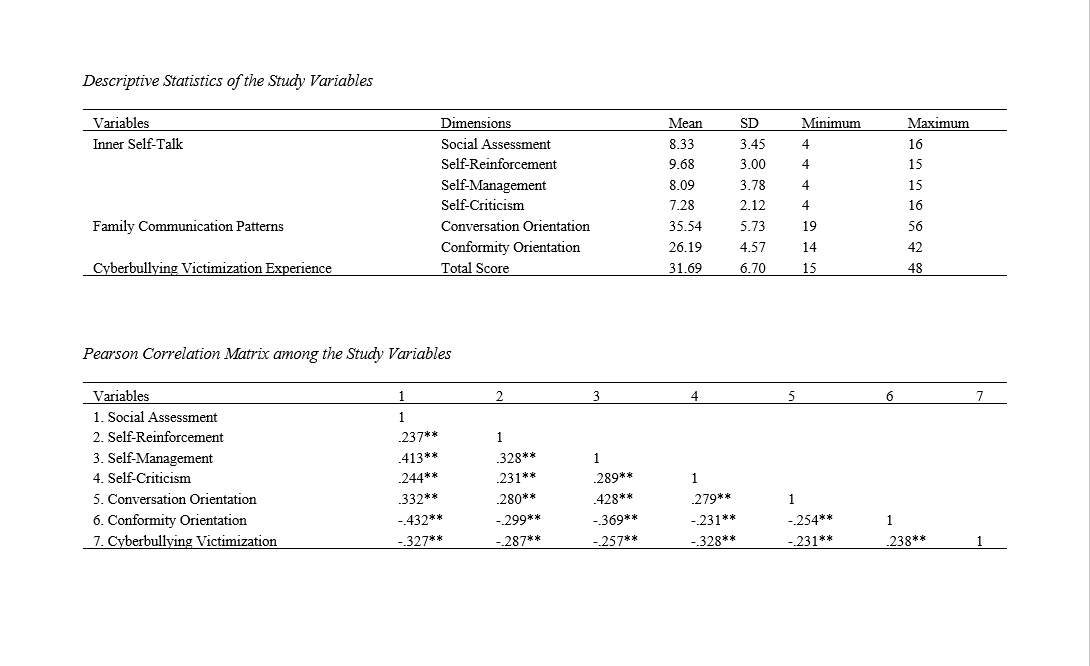
Findings: The results of the multiple regression analysis indicated that the combined dimensions of inner self-talk and family communication patterns explained 31.5% of the variance in cyberbullying victimization experiences. Social assessment emerged as a significant negative predictor of cyberbullying victimization (β = −0.256, p = 0.005), indicating that higher levels of constructive social evaluation were associated with lower victimization experiences. Self-regulation was also a significant negative predictor (β = −0.311, p < 0.001), suggesting that adolescents with stronger self-regulatory inner dialogue reported fewer cyberbullying victimization experiences. Regarding family communication patterns, conversation orientation significantly and negatively predicted cyberbullying victimization (β = −0.298, p < 0.001), whereas conformity orientation significantly and positively predicted victimization experiences (β = 0.303, p < 0.001). These findings demonstrate that both personal cognitive processes and family communication dynamics contribute significantly to adolescents’ vulnerability to cyberbullying victimization.
Conclusion: The findings indicate that inner self-talk and family communication patterns play substantial roles in understanding and predicting cyberbullying victimization among adolescents. Specifically, higher levels of self-regulation, constructive social assessment, and open family conversation are associated with reduced vulnerability to cyberbullying, whereas greater conformity-oriented family communication is linked to increased victimization risk.
Downloads
References
Abbasi-Rad, R., Rostami, C., Fasihi, S., Sarhangi, A., Ahmadboukani, S., & Soleiman, S. (2024). The Relationship between Family Communication Patterns and Risky Behaviors in Adolescents: The Mediating Role of the Big Five Personality Factors. Quarterly Journal of Applied Psychological Research, 15(3), 61-78.
Amanollahi, M., Kakavandi Chaqasfid, J., Hosseini, S., & Fatemeh-Zahra, F. (2025). A Study of Family Communication Pattern Styles and Adolescents' Identity Formation in the Family. Review of Social Issues in Iran, 16(1), 117-134.
Anisti, A., Tambunan, R. M., Sidharta, V., Sampean, S., & Syatir, S. (2023). Family Communication Patterns in the Era Digital Technology. Arrus Journal of Social Sciences and Humanities, 3(6), 750-756. https://doi.org/10.35877/soshum2225
Babaei, A., Vahabi Homabadi, V., & Khaleghipour, K. (2019). The Effectiveness of Integrated Affection and Positive Self-Talk Training on Hostility, Resilience, and Positive Feelings toward the Spouse in Betrayed Women. Positive Psychology Research, 5(2), 47-64.
Baghban, B., & Dana, D. (2026). The Effect of Motivational Self-Talk on Motor Performance with Emphasis on Self-Esteem: An Experimental Test of the Self-Talk Incongruence Hypothesis. Sport Psychology, 17(2), 125-143.
Besharatian, S., Khademi, K., & Jalili, J. (2025). Comparing the Effectiveness of Reality Therapy and Logotherapy on Internal Self-Talk and Health-Promoting Lifestyle in Patients with Diabetes. Journal of Mashhad University of Medical Sciences, 68(4), 1129-1145.
Chaizuran, M., Tahlil, T., & Jannah, S. R. (2020). The Effectiveness of Positive Self-Talk Interventions on Increasing Coping Mechanisms in Preventing Bullying. In Challenges in Nursing Education and Research (pp. 261-269). CRC Press. https://doi.org/10.1201/9781003043973-27
Craig, E. A., Compton, J., & Luurs, G. D. (2022). Cyberbullying and Family Communication Theory and Research. In Handbook of Research on Communication Strategies for Taboo Topics (pp. 200-217). IGI Global Scientific Publishing. https://doi.org/10.4018/978-1-7998-9125-3.ch010
Forouzesh Salami, F., Jomhari, F., Nasrollahi, B., & Nouri, R. (2025). Developing a Structural Model of Cyberbullying Based on Family Communication Patterns and Interpersonal Relationships with the Mediation of Dark Personality Traits in Adolescent Social Network Users. Journal of Psychological Science, 24(153).
Giumetti, G. W., & Kowalski, R. M. (2022). Cyberbullying via Social Media and Well-Being. Current opinion in psychology, 45, 101314. https://doi.org/10.1016/j.copsyc.2022.101314
Khazaei, M., Moradi, A., Yazdanbakhsh, K., & Kamran, K. (2025). The Relationship of Theory of Mind and Executive Functions with Cyberbullying: The Mediating Role of Empathy. Social Psychology Research, 14(56), 161-176.
Kompa, N. A. (2025). Inner Speech and Self-Talk: A Comparison. Theoretical Linguistics, 51(3-4), 283-290. https://doi.org/10.1515/tl-2025-2014
Menin, D., Guarini, A., Mameli, C., Skrzypiec, G., & Brighi, A. (2021). Was That (Cyber) Bullying? Investigating the Operational Definitions of Bullying and Cyberbullying from Adolescents' Perspective. International Journal of Clinical and Health Psychology, 21(2), 100221. https://doi.org/10.1016/j.ijchp.2021.100221
Monjezi, F., Haroun Rashidi, H., Homayoun, A., Kazemian Moghadam, K., & Kobra, K. (2022). The Relationship between Family Communication Patterns and Attitude toward Creativity: The Mediation of Academic Vitality in Students. Thinking and Children, 12(2), 301-320.
Octavia, D., Sari, R. M., Merdekawati, D., Marisdayana, R., & Yuliyana, R. (2022). The Correlation between Parental Communication Pattern, Self-Esteem, and Moral Disengagement with Cyberbullying Behavior in Early Adolescents: A Cross-Sectional Study. Jurnal Ners, 17(1), 42-46. https://doi.org/10.20473/jn.v17i1.24539
Racy, F., & Morin, A. (2024). Relationships between Self-Talk, Inner Speech, Mind Wandering, Mindfulness, Self-Concept Clarity, and Self-Regulation in University Students. Behavioral Sciences, 14(1), 55. https://doi.org/10.3390/bs14010055
Ramazanu, S., Chisale, M. R., Baby, P., Wu, V. X., & Mbakaya, B. C. (2022). Meta-Synthesis of Family Communication Patterns during Post-Stroke Vascular Aphasia: Evidence to Guide Practice. Worldviews on Evidence-Based Nursing, 19(4), 282-296. https://doi.org/10.1111/wvn.12580
Rashidi, A., Mohseni, Z., Zahrasadat, Z., & Golmohammadian, M. (2017). The Role of Family Emotional Climate, Perceived Parenting Style, Family Communication Patterns, and Perceived Family Social Support in Predicting Industrial Psychotropic Substance Abuse among Students. Quarterly Journal of Addiction Research, 11(41), 103-123.
Romano, F., & D'Allura, G. M. (2025). Decoding Succession: Family Communication Patterns and the Flow of Knowledge in Family Businesses. Journal of Strategy and Management, 18(4), 894-911. https://doi.org/10.1108/JSMA-08-2025-0315
Saeidi, S., & Soleimani, M. (2025). Structural Relationships of Cyberbullying with Risky Behaviors in Adolescents: The Mediating Role of Anger Rumination. Clinical Psychology: Innovations in Research and Practice, 17(2), 117-131.
Safari, A., Amini, N., Behrouzi, N., & Jafarinia, A. (2021). Comparing the Effectiveness of Empathy Training and Social Perspective-Taking-Based Training on Emotional Intelligence in Adolescents with Cyberbullying. Journal of Behavioral Sciences Research, 18(4), 553-567.
Temel, V. (2025). The Power of Inner Dialogue: The Impact of Self-Talk Techniques on Athlete Performance. Archives of Clinical and Experimental Orthopaedics, 9(1), 001-003. https://doi.org/10.29328/journal.aceo.1001021
Uhrich, B. B., Rogelberg, S. L., Rogelberg, S. G., Kello, J. E., Williams, E. B., Gur, S. S., & Moffit, M. (2023). The Power of the Inner Voice: Examining Self-Talk's Relationship with Academic Outcomes. American Journal of Education, 130(1), 31-60. https://doi.org/10.1086/727006
Downloads
Additional Files
Publication Timeline
- Submitted
- Revised
- Accepted