The Relationship Between Cyberbullying–Cybervictimization Experiences and Psychological Distress Symptoms Among Iranian Adolescents: The Mediating Role of School Climate
Keywords:
School Climate , Cyberbullying–Cybervictimization Experiences , AdolescentsAbstract
Objective: The present study examined the association between cyberbullying–cybervictimization and psychological distress among Iranian adolescents with particular attention to the mediating role of school climate.
Methods and Materials: This Correlation study was conducted in 2025 among high school students in the Kurdistan province of Iran. A total of 1384 participants (638 girls, 746 boys; mean age = 14.7 years) completed the School Climate and School Identification Questionnaire (SCASIM-St), along with measures of psychopathology (DASS-21), and Cyberbullying–Cybervictimization Experience Questionnaire (CBVEQ).
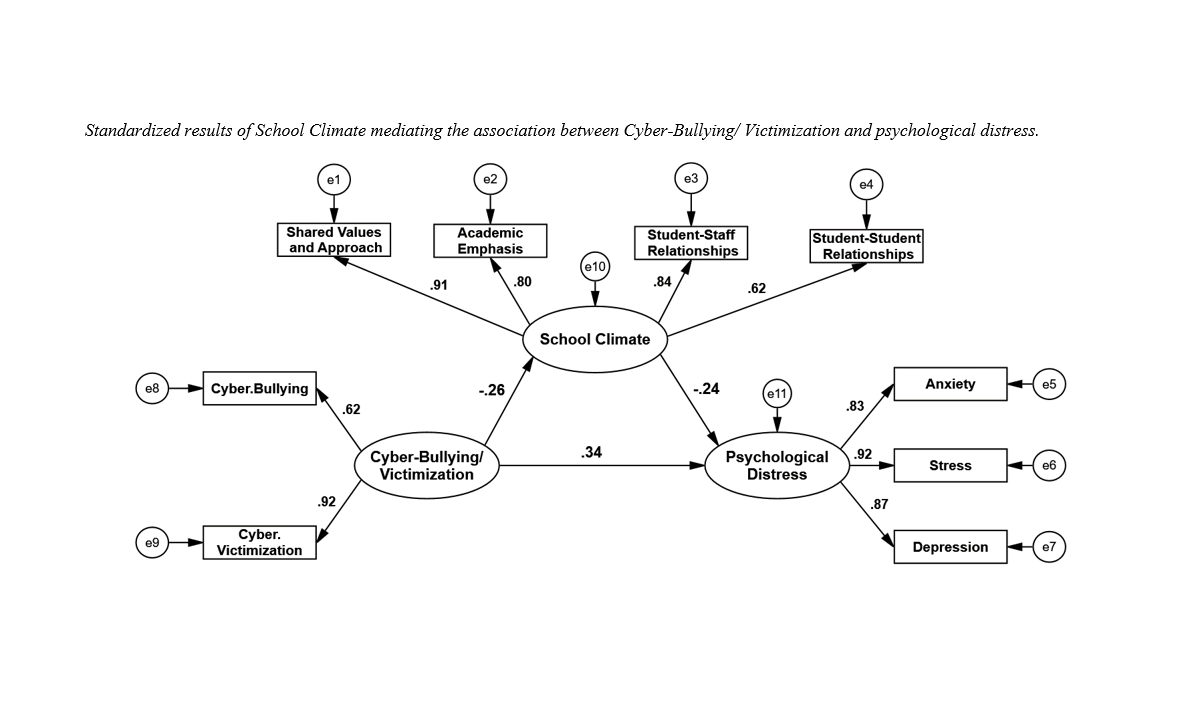
Findings: The results indicated that cyberbullying–cybervictimization positively predicted adolescents’ psychological distress symptoms. Furthermore, school climate partially mediated the relationship between cyberbullying–cybervictimization and psychological distress. These findings suggest that a positive school climate may buffers adolescents against the adverse mental health consequences of cyberbullying and cybervictimization.
Conclusion: Therefore, fostering a supportive and positive school climate should be considered a key protective factor in reducing cyberbullying–cybervictimization experiences and mitigating their negative impact on adolescent mental health.
Downloads
References
Aazami, Y., Khanjani, M., & Sader, M. M. (2017). Confirmatory factor structure of depression, anxiety and stress scale in students. Journal of Mazandaran University of Medical Sciences, 27(154), 94-106.
Aboujaoude, E., Savage, M. W., Starcevic, V., & Salame, W. O. (2015). Cyberbullying: Review of an Old Problem Gone Viral. J Adolesc Health, 57(1), 10-18. https://doi.org/10.1016/j.jadohealth.2015.04.011
Antoniadou, N., & Markos, A. (2016). Development, construct validation and measurement invariance of the Greek cyber-bullying/victimization experiences questionnaire (CBVEQ-G). Computers in Human Behavior, 65, 380-390. https://doi.org/10.1016/j.chb.2016.08.032
Antony, M., Bieling, P., Cox, B., Enns, M., & Swinson, R. (1998). Psychometric properties of the 42-item and 21-item versions of the Depression Anxiety Stress Scales in clinical groups and a community sample. Psychological Assessment, 10, 176-181. https://doi.org/10.1037/1040-3590.10.2.176
Azami, M. S., & Taremian, F. (2020). Victimization in traditional and cyberbullying as risk factors for substance use, self-harm and suicide attempts in high school students. Scandinavian journal of child and adolescent psychiatry and psychology, 8, 101.
Barlett, C., & Coyne, S. (2014). A meta-analysis of sex differences in cyber-bullying behavior: The moderating role of age. Aggressive Behavior, 40. https://doi.org/10.1002/ab.21555
Basharpoor, S., & Zardi, B. (2019). Psychometric properties of cyber-bullying/victimization experiences questionnaire (CBVEQ) in students. Journal of school psychology, 8(1), 43-57.
Biswas, T., Thomas, H. J., Scott, J. G., Munir, K., Baxter, J., Huda, M. M., Renzaho, A. M. N., Cross, D., Ahmed, H. U., Mahumud, R. A., & Mamun, A. A. (2022). Variation in the prevalence of different forms of bullying victimisation among adolescents and their associations with family, peer and school connectedness: a population-based study in 40 lower and middle income to high-income countries (LMIC-HICs). J Child Adolesc Trauma, 15(4), 1029-1039. https://doi.org/10.1007/s40653-022-00451-8
Cao, G., Zhang, L., Deng, J., & Yin, H. (2022). Bullying victimization and suicidal ideation among adolescents: The mediating role of psychological suzhi and the moderating role of perceived school climate. Current Psychology, 42, 17454-17464. https://doi.org/10.1007/s12144-021-02589-4
Cénat, J. M., Hébert, M., Blais, M., Lavoie, F., Guerrier, M., & Derivois, D. (2014). Cyberbullying, psychological distress and self-esteem among youth in Quebec schools. J Affect Disord, 169, 7-9. https://doi.org/10.1016/j.jad.2014.07.019
Chen, C., Yang, C., Chan, M., & Jimerson, S. R. (2020). Association between school climate and bullying victimization: Advancing integrated perspectives from parents and cross-country comparisons. Sch Psychol, 35(5), 311-320. https://doi.org/10.1037/spq0000405
Chen, J.-K. (2020). Cyber victimisation, social support, and psychological distress among junior high school students in Taiwan and Mainland China. Asia Pacific Journal of Social Work and Development, 30, 1-14. https://doi.org/10.1080/02185385.2020.1755994
Chen, J.-K., & Wei, H.-S. (2011). The Impact of School Violence on Self-Esteem and Depression Among Taiwanese Junior High School Students. Social Indicators Research, 100, 479-498. https://doi.org/10.1007/s11205-010-9625-4
Chen, J.-K., & Wei, H.-S. (2013). School violence, social support and psychological health among Taiwanese junior high school students. Child abuse & neglect, 37(4), 252-262. https://doi.org/10.1016/j.chiabu.2013.01.001
Clark, K., Strissel, D., Demaray, M., Ogg, J., Eldridge, M., & Malecki, C. (2022). Victimization and Depressive Symptoms in Early Adolescence: The Role of Perceived School Climate. School Psychology, 37. https://doi.org/10.1037/spq0000511
Duru, E., & Balkis, M. (2018). Exposure to school violence at school and mental health of victimized adolescents: The mediation role of social support. Child Abuse Negl, 76, 342-352. https://doi.org/10.1016/j.chiabu.2017.11.016
Duru, E., & Balkis, M. (2018). Exposure to school violence at school and mental health of victimized adolescents: The mediation role of social support. Child Abuse & Neglect, 76, 342-352. https://doi.org/https://doi.org/10.1016/j.chiabu.2017.11.016
Espelage, D., Low, S., & Jimerson, S. (2014). Understanding School Climate, Aggression, Peer Victimization, and Bully Perpetration: Contemporary Science, Practice, and Policy. School psychology quarterly, 29, 233-237. https://doi.org/10.1037/spq0000090
Felix, E. D., & Green, J. G. (2009). Popular girls and brawny boys: The role of gender in bullying and victimization experiences. In Handbook of bullying in schools (pp. 173-183). Routledge.
Festl, R. (2016). Perpetrators on the internet: Analyzing individual and structural explanation factors of cyberbullying in school context. Computers in Human Behavior, 59, 237-248. https://doi.org/https://doi.org/10.1016/j.chb.2016.02.017
Gage, N., Prykanowski, D., & Larson, A. (2014). School Climate and Bullying Victimization: A Latent Class Growth Model Analysis. School psychology quarterly, 29. https://doi.org/10.1037/spq0000064
Hinduja, S., & Patchin, J. (2008). Cyberbullying: An Exploratory Analysis of Factors Related to Offending and Victimization. Deviant Behavior - DEVIANT BEHAV, 29, 129-156. https://doi.org/10.1080/01639620701457816
Hinduja, S., & Patchin, J. (2012). School Climate 2.0: Preventing Cyberbullying and Sexting One Classroom at a Time. https://doi.org/10.4135/9781506335438
Holfeld, B., & Baitz, R. (2020). The Mediating and Moderating Effects of Social Support and School Climate on the Association between Cyber Victimization and Internalizing Symptoms. Journal of Youth and Adolescence, 49. https://doi.org/10.1007/s10964-020-01292-0
Hooper, D., Coughlan, J., & Mullen, M. (2007). Structural Equation Modeling: Guidelines for Determining Model Fit. The Electronic Journal of Business Research Methods, 6.
Imamgholivand, F., Kadivar, P., & Sharifi, H. P. (2019). Psychometric indexes of dual school climate and school identification questionnaire-student (SCASIM-St). Quarterly of Educational Measurement, 10(35), 107-132.
Jadambaa, A., Thomas, H. J., Scott, J. G., Graves, N., Brain, D., & Pacella, R. (2019). The contribution of bullying victimisation to the burden of anxiety and depressive disorders in Australia. Epidemiol Psychiatr Sci, 29, e54. https://doi.org/10.1017/s2045796019000489
Kee, D., Alanesi, M., & Al-Anesi, S. (2022). Cyberbullying on social media under the influence of COVID‐19. Global Business and Organizational Excellence, 41. https://doi.org/10.1002/joe.22175
Kee, D., Anwar, A., & Vranjes, I. (2024). Cyberbullying victimization and suicide ideation: The mediating role of psychological distress among Malaysian youth. Computers in Human Behavior, 150, 108000. https://doi.org/10.1016/j.chb.2023.108000
Kim, S., Colwell, S. R., Kata, A., Boyle, M. H., & Georgiades, K. (2018). Cyberbullying Victimization and Adolescent Mental Health: Evidence of Differential Effects by Sex and Mental Health Problem Type. J Youth Adolesc, 47(3), 661-672. https://doi.org/10.1007/s10964-017-0678-4
Kowalski, R., Giumetti, G., Schroeder, A., & Lattanner, M. (2014). Bullying in the Digital Age: A Critical Review and Meta-Analysis of Cyberbullying Research Among Youth. Psychological bulletin, 140. https://doi.org/10.1037/a0035618
Le, H., Tran, N., Campbell, M., Gatton, M., Nguyen, H., & Dunne, M. (2019). Mental health problems both precede and follow bullying among adolescents and the effects differ by gender: A cross-lagged panel analysis of school-based longitudinal data in Vietnam. International Journal of Mental Health Systems, 13. https://doi.org/10.1186/s13033-019-0291-x
Leadbeater, B., Sukhawathanakul, P., Thompson, K., & Holfeld, B. (2015). Parent, Child, and Teacher Reports of School Climate as Predictors of Peer Victimization, Internalizing and Externalizing in Elementary School. School Mental Health, 7. https://doi.org/10.1007/s12310-015-9154-z
Lee, E., Reynolds, K. J., Subasic, E., Bromhead, D., Lin, H., Marinov, V., & Smithson, M. (2017). Development of a dual school climate and school identification measure–student (SCASIM-St). Contemporary Educational Psychology, 49, 91-106.
Lee, M. H. L., Kaur, M., Shaker, V., Yee, A., Sham, R., & Siau, C. S. (2023). Cyberbullying, Social Media Addiction and Associations with Depression, Anxiety, and Stress among Medical Students in Malaysia. Int J Environ Res Public Health, 20(4). https://doi.org/10.3390/ijerph20043136
Li, Q. (2006). Cyberbullying in Schools: A Research of Gender Differences. School Psychology International - SCHOOL PSYCHOL INT, 27, 157-170. https://doi.org/10.1177/0143034306064547
Li, S., Wang, X., & Nie, Y. (2022). The Relationship between Parent–Child Attachment, Belief in a Just World, School Climate and Cyberbullying: A Moderated Mediation. International Journal of Environmental Research and Public Health, 19, 6207. https://doi.org/10.3390/ijerph19106207
Lovibond, P. F., & Lovibond, S. H. (1995). The structure of negative emotional states: comparison of the Depression Anxiety Stress Scales (DASS) with the Beck Depression and Anxiety Inventories. Behav Res Ther, 33(3), 335-343. https://doi.org/10.1016/0005-7967(94)00075-u
Martins, M. J. D., Margarida, A., Veiga Simão, A. M., Caetano, A., Freire, I., Matos, A., Vieira, C., Pessoa, T., & Amado, J. (2018). Cyber-Victimization and Cyber-Aggression: Personal and Situational Factors. https://doi.org/10.4018/978-1-5225-7128-5.ch014
McComas, M., & Gil-Rivas, V. (2024). Cyberaggression victimization on anxiety and depression in college students: the role of emotion regulation, social media, social support, and biological sex. J Am Coll Health, 72(8), 2963-2970. https://doi.org/10.1080/07448481.2022.2145895
McField, A. A., Lawrence, T. I., & Okoli, I. C. (2023). Examining the relationships between cyberbullying, relational victimization, and family support on depressive symptoms and substance use among adolescents. Clin Child Psychol Psychiatry, 28(1), 224-236. https://doi.org/10.1177/13591045221110126
Mohseny, M., Zamani, Z., Basti, S. A., Sohrabi, M.-R., Najafi, A., Zebardast, J., & Tajdini, F. (2019). Bullying and victimization among students bears relationship with gender and emotional and behavioral problems. Iranian journal of psychiatry, 14(3), 211.
Molero Jurado, M. D. M., Martos Martínez, Á., Barragán Martín, A. B., Pérez-Fuentes, M., & Gázquez, J. (2022). Anxiety and Depression from Cybervictimization in Adolescents: A Metaanalysis and Meta-regression Study. The European Journal of Psychology Applied to Legal Context, 14, 42-50. https://doi.org/10.5093/ejpalc2022a5
Moreno Ruiz, D., Martínez-Ferrer, B., & Garcia Bacete, F. (2019). Parenting styles, cyberaggression, and cybervictimization among adolescents. Computers in Human Behavior, 93, 252-259. https://doi.org/10.1016/j.chb.2018.12.031
Nickerson, A., Singleton, D., Schnurr, B., & Collen, M. (2014). Perceptions of School Climate as a Function of Bullying Involvement. Journal of Applied School Psychology, 30, 157-181. https://doi.org/10.1080/15377903.2014.888530
Ohayashi, H., & Yamada, S. (2012). Psychological distress: Symptoms, causes and coping.
Ortega-Barón, J., Buelga, S., & Cava, M.-J. (2016). Influencia del clima escolar y familiar en adolescentes, víctimas de ciberacoso= The Influence of School Climate and Family Climate among Adolescents Victims of Cyberbullying. Comunicar: Revista Científica Iberoamericana de Comunicación y Educación= Scientific Journal of Media Education: 46, 1, 2016, 57-65.
Rahman, T., Hossain, M., Bristy, N., Hoque, M. Z., & Hossain, M. (2023). Influence of Cyber-victimization and Other Factors on Depression and Anxiety Among University Students in Bangladesh. Journal of Health Population and Nutrition, 42, 119. https://doi.org/10.1186/s41043-023-00469-0
Schneider, S. K., O'Donnell, L., Stueve, A., & Coulter, R. W. (2012). Cyberbullying, school bullying, and psychological distress: a regional census of high school students. Am J Public Health, 102(1), 171-177. https://doi.org/10.2105/ajph.2011.300308
Schultze-Krumbholz, A., Zagorscak, P., Hess, M., & Scheithauer, H. (2020). The Influence of School Climate and Empathy on Cyberbystanders’ Intention to Assist or Defend in Cyberbullying. International Journal of Bullying Prevention, 2. https://doi.org/10.1007/s42380-019-00040-8
Shaheen, H., Rashid, D., & Aftab, N. (2023). Dealing with feelings: moderating role of cognitive emotion regulation strategies on the relationship between cyber-bullying victimization and psychological distress among students. Current Psychology, 42, 1-9. https://doi.org/10.1007/s12144-023-04934-1
Slonje, R., & Smith, P. (2008). Cyberbullying: Another main type of bullying? Scandinavian journal of psychology, 49, 147-154. https://doi.org/10.1111/j.1467-9450.2007.00611.x
Smith, P., López-Castro, L., Robinson, S., & Goerzig, A. (2018). Consistency of gender differences in bullying in cross-cultural surveys. Aggression and Violent Behavior, 45. https://doi.org/10.1016/j.avb.2018.04.006
Smith, P., & Slonje, R. (2010). Cyberbullying: The nature and extent of a new kind of bullying, in and out of school. Handbook of Bullying in Schools: An International Perspective, 249-262.
Stadler, C., Feifel, J., Rohrmann, S., Vermeiren, R., & Poustka, F. (2010). Peer-victimization and mental health problems in adolescents: are parental and school support protective? Child Psychiatry Hum Dev, 41(4), 371-386. https://doi.org/10.1007/s10578-010-0174-5
Sun, S., Fan, X., & Du, J. (2016). Cyberbullying Perpetration: A Meta-Analysis of Gender Differences. International Journal of Internet Science, 11, 61-81.
Thapa, A., Cohen, J., Guffey, S., & Higgins-D'Alessandro, A. (2013). A Review of School Climate Research. Review of Educational Research, 83, 357-385. https://doi.org/10.3102/0034654313483907
Triantoro, S., & Suyono, H. (2020). The role of parent-child relationship, school climate, happiness, and empathy to predict cyberbullying behavior. International Journal of Evaluation and Research in Education (IJERE), 9, 548. https://doi.org/10.11591/ijere.v9i3.20299
Uddin, M., & Rahman, J. (2022). Cyber Victimization and Cyber Aggression among High School Students: Emotion Regulation as a Moderator. Cyberpsychology, 16. https://doi.org/10.5817/CP2022-2-4
Veiga Simão, A. M., Ferreira, P. C., Freire, I., Caetano, A. P., Martins, M. J., & Vieira, C. (2017). Adolescent cybervictimization - Who they turn to and their perceived school climate. J Adolesc, 58, 12-23. https://doi.org/10.1016/j.adolescence.2017.04.009
Wang, H. (2022). The Effects of School Climate, Parent-Child Closeness, and Peer Relations on the Problematic Internet Use of Chinese Adolescents: Testing the Mediating Role of Self-Esteem and Depression. Int J Environ Res Public Health, 19(13). https://doi.org/10.3390/ijerph19137583
Yang, C., Sharkey, J. D., Reed, L. A., Chen, C., & Dowdy, E. (2018). Bullying victimization and student engagement in elementary, middle, and high schools: Moderating role of school climate. School psychology quarterly, 33(1), 54.
Yang, C., Sharkey, J. D., Reed, L. A., & Dowdy, E. (2020). Cyberbullying victimization and student engagement among adolescents: Does school climate matter? Sch Psychol, 35(2), 158-169. https://doi.org/10.1037/spq0000353
Yuchang, J., Junyi, L., Junxiu, A., Jing, W., & Mingcheng, H. (2017). The Differential Victimization Associated With Depression and Anxiety in Cross-Cultural Perspective: A Meta-Analysis. Trauma, Violence, & Abuse, 20, 152483801772642. https://doi.org/10.1177/1524838017726426
Ziari, M., & Charkari, N. M. (2026). Rumor detection and propagation on social networks: A survey. Expert Systems with Applications, 295, 128798.
Downloads
Additional Files
Publication Timeline
- Submitted
- Revised
- Accepted