The Effectiveness of Group-Based Positive Youth Development Training on Attachment to Parents and Alexithymia in Male Adolescents with a Tendency Toward Addiction in Isfahan
DOI:
https://doi.org/10.61838/Keywords:
Positive Youth Development, attachment to parents, attachment to mother, attachment to father, alexithymia, tendency toward addiction, adolescentsAbstract
Objective: This study aimed to determine the effectiveness of group-based Positive Youth Development training on attachment to parents and alexithymia among male adolescents with a tendency toward addiction in Isfahan.
Methods and Materials: This quasi-experimental study used a pretest–posttest–follow-up design with a control group. The statistical population included male lower-secondary students with a tendency toward addiction in Isfahan during the 2023–2024 academic year. Thirty eligible adolescents were selected through purposive sampling and randomly assigned to experimental and control groups. The experimental group received twelve 90-minute weekly sessions of Positive Youth Development training, while the control group remained on a waiting list. Data were collected using the Inventory of Parent and Peer Attachment and the Toronto Alexithymia Scale. Data were analyzed using repeated-measures analysis of variance and Bonferroni post-hoc tests.
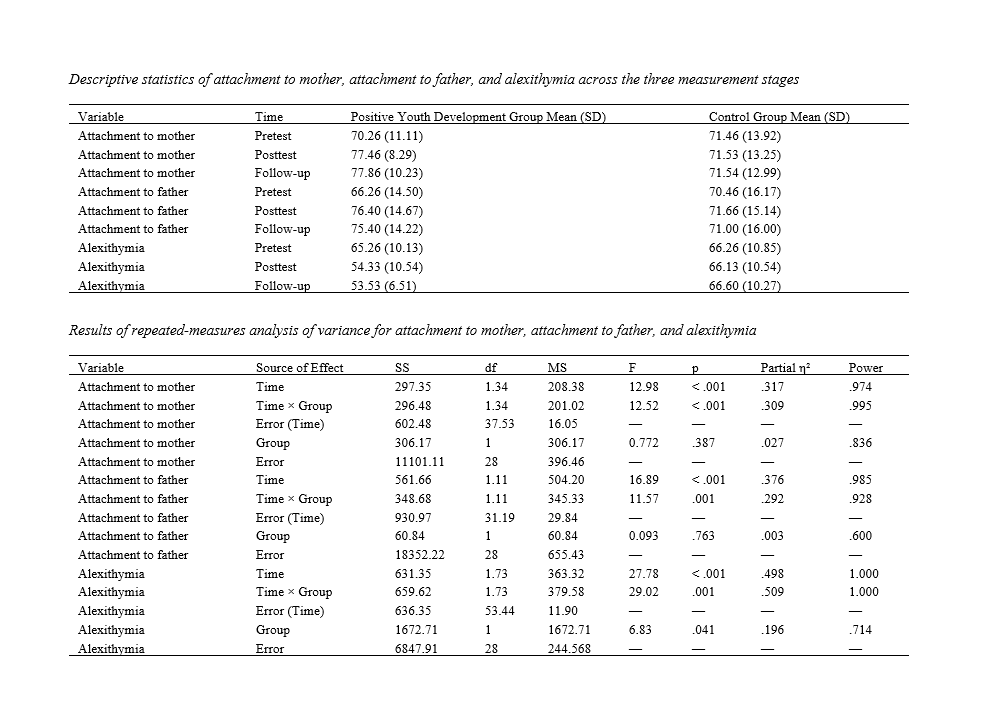
Findings: Repeated-measures ANOVA indicated a significant time effect for attachment to mother, attachment to father, and alexithymia. The results showed that the intervention produced a significant improvement in attachment to mother and a significant reduction in alexithymia from pretest to posttest and follow-up. However, the between-group effect for attachment to father was not significant, and Bonferroni comparisons confirmed that changes in attachment to father were not statistically meaningful. The intervention effects for attachment to mother and alexithymia remained stable at follow-up.
Conclusion: Group-based Positive Youth Development training can be considered an effective preventive and corrective intervention for improving attachment to mothers and reducing alexithymia in male adolescents with a tendency toward addiction. However, improving attachment to fathers may require longer, family-based, or father-inclusive interventions.
Downloads
References
Abbasi, M., Hojjati, M., Emami Al-Agha, S., & Bahrami, E. (2025). The effectiveness of psychological self-care training on cognitive flexibility and distress tolerance in male students with addiction readiness. Scientific Quarterly of Addiction Research, 19(77), 7-30.
Ahmadi, S., & Narimani, M. (2024). Development and validation of a school-based addiction prevention educational package for adolescents and evaluation of its effectiveness on students' tendency toward addiction. Scientific Quarterly of Addiction Research, 18(73), 79-108.
Akbarzadeh, N., & Najafi, M. (2025). The effectiveness of a positive youth development educational program on happiness and hope among students. Child Mental Health Quarterly, 12(4), 18-34.
Asiyanbi, M., Lawal, B. F., Umanhonlen, S. E., & Ogunbowale, I. A. (2025). Early childhood trauma, attachment insecurity, emotional dysregulation, and substance abuse as predictors of delinquent behaviour among adolescents in foster care in Ibadan, Nigeria. Islamic University Journal of Social Sciences, 4(3), 111-122.
Chiang, Y. C., Li, X., Lee, C. Y., Wu, C. C., Chang, H. Y., & Zhang, S. (2022). Effects of social attachment on experimental drug use from childhood to adolescence: An 11-year prospective cohort study. Frontiers in Public Health, 10, 818894. https://doi.org/10.3389/fpubh.2022.818894
Cornella-Font, M. G., Vinas-Poch, F., Juarez-Lopez, J. R., & Malo-Cerrato, S. (2020). Risk of addiction: Its prevalence in adolescence and its relationship with security of attachment and self-concept. Clinical and Health, 31(1), 21-25. https://doi.org/10.5093/clysa2020a1
Esmaeilipour, M., Yousefi, Z., & Farhadi, H. (2024). The effectiveness of acceptance-and-commitment-based hope-in-life training on mature defense mechanisms and competitive anxiety in students with high-risk behaviors. Journal of Health Psychology and Behavioral Disorders, 2(4), 1-15. https://jhpbd.com/index.php/hpbd/article/view/70
Irfan, S., & Zulkefly, N. S. (2023). Parent-peer attachment, negative automatic thoughts and psychological problems among Pakistani adolescents: A moderated mediation model. Current Psychology, 42(3), 1979-1995. https://doi.org/10.1007/s12144-021-01599-6
Khaftan, P., Bahrami, M., Eghlima, M., & Karimi Nasr, N. (2023). The effectiveness of group positive-thinking training on changing attitudes toward drugs among at-risk male adolescents. Scientific Quarterly of Addiction Research, 17(69), 201-216.
Khan, S. A., Karamat, M., & Ali, S. Z. (2025). Relationship between attachment styles, perceived social support and identity development among substance users and non-users. Research Journal for Social Affairs, 3(5), 73-80. https://doi.org/10.71317/RJSA.003.05.0303
Lee, G. Y., & Lee, D. Y. (2021). Structural relationships among adolescents' peer attachment, career-related self-efficacy, parents' attitudes and health risk behaviours. Nursing Open, 8(6), 3315-3324. https://doi.org/10.1002/nop2.1048
Lin, L., & Shek, D. T. (2021). Serving children and adolescents in need during the COVID-19 pandemic: Evaluation of service-learning subjects with and without face-to-face interaction. International journal of environmental research and public health, 18(4), 2114. https://doi.org/10.3390/ijerph18042114
Lindsay, J. E., McGarry, S., Satmukhambetova, A., Raymond, K., Lesheve, A., Jonson, S., Neeno, H., & Williams, C. (2021). Integrating positive youth development: Insights from international youth development programming. Journal of Youth Development, 16(2-3), 55-73. https://doi.org/10.5195/jyd.2021.1037
Meulenbeek, K., Loheide-Niesmann, L., Spagnuolo, F., & Cima, M. J. (2026). Positive youth development and prosocial behavior: A systematic review and multilevel meta-analysis. Journal of adolescence, 98(1), 7-35. https://doi.org/10.1002/jad.70040
Mirzakhanloo, H., Yousefi, Z., & Manshaei, G. (2024). Development of a responsibility-improvement package for adolescents. Psychological Dynamics in Mood Disorders, 3(1), 74-85. https://doi.org/10.61838/kman.pdmd.3.1.7
Mota, C. P., Mateus, D., Relva, I. C., & Costa, M. (2024). Peer attachment and self-control: Implication on social anxiety in young adults. Social Sciences, 13(9), 445. https://doi.org/10.3390/socsci13090445
Nakhoul, L., Obeid, S., Sacre, H., Haddad, C., Soufia, M., Hallit, R., & Hallit, S. (2020). Attachment style and addictions (alcohol, cigarette, waterpipe and internet) among Lebanese adolescents: A national study. BMC psychology, 8(1), 33. https://doi.org/10.1186/s40359-020-00404-6
Safikhani Gholizadeh, M., Haroun Rashidi, H., & Kazemian Moghadam, K. (2024). The effectiveness of compassion-based therapy on oppositional defiant behavior and self-control in students with a substance-dependent parent. Scientific Quarterly of Addiction Research, 18(71), 139-164.
Satan, A., & Kaplaner, K. (2022). The impact of attachment styles and peer pressure on risk taking behavior in adolescents. Cukurova University Faculty of Education Journal, 51(2), 870-884. https://doi.org/10.14812/cuefd.934701
Shahcheraghi, M. A., & Izadi, F. (2025). The effectiveness of dialectical behavior therapy on self-care and rejection sensitivity in adolescents with a substance-dependent parent. Scientific Quarterly of Addiction Research, 19(75), 193-210.
Shek, D. T., Dou, D., & Chau, G. C. (2025). Positive youth development approach. In Promoting Holistic Development in University Students (pp. 119-140). Springer Nature Singapore. https://doi.org/10.1007/978-981-96-0251-3_5
Soheili Salek, Z., Farrokhi, N., & Pooshaneh, K. (2022). The effectiveness of positive youth development training on psychological capital and anxiety among adolescents. Journal of Modern Psychological Research, 17(67), 157-165. https://doi.org/10.22034/jmpr.2022.15315
Soleimani, E., & Chitsaz, M. (2025). The effectiveness of unified transdiagnostic treatment on intolerance of uncertainty and self-control in adolescent boys with addiction vulnerability. Scientific Quarterly of Addiction Research, 19(77), 31-50.
Wu, Y. Q., Chen, P., Li, S. N., Huang, X. Y., & Nie, Y. G. (2026). Parental autonomy granting, peer attachment and problematic internet use among Chinese adolescents: The moderating effect of school climate. Child Psychiatry & Human Development, 57(1), 70-79. https://doi.org/10.1007/s10578-024-01687-1
Yuen, M., Zhang, J., Man, P. K. W., Mak, J., Chung, Y. B., Lee, Q. A. Y., Chan, A. K. C., So, A., & Chan, R. T. H. (2022). A strengths-based longitudinal career intervention for junior secondary school students with special educational needs: A mixed-method evaluation. Applied Research in Quality of Life, 17(4), 2229-2250. https://doi.org/10.1007/s11482-021-10028-6
Downloads
Additional Files
Publication Timeline
- Submitted
- Revised
- Accepted