Comparison of the Effectiveness of Cognitive Behavioral Therapy and Intensive Solution-Focused Therapy on Resilience in Adolescents with Nonsuicidal Self-Injury
Keywords:
Resilience, Cognitive Behavioral Therapy, Intensive Solution-Focused Therapy, Nonsuicidal Self-Injury, AdolescentsAbstract
Objective: This study aimed to compare the effectiveness of cognitive behavioral therapy (CBT) and intensive solution-focused therapy (ISFT) in improving resilience among adolescents engaging in nonsuicidal self-injury (NSSI).
Methods and Materials: This applied experimental study employed a pretest–posttest design with a three-month follow-up. The statistical population consisted of female students aged 12–18 years with a history of nonsuicidal self-injury who were referred to school counselors in Neyshabur, Iran, in 2024. Participants were recruited through convenience sampling and randomly assigned to either the CBT or ISFT group. The final sample comprised 44 adolescents, with 22 participants in each intervention group. Resilience was assessed using the Adolescent Resilience Scale developed by Oshio et al. (2002). The CBT intervention consisted of eight 90-minute sessions, whereas the intensive solution-focused intervention consisted of six 90-minute sessions, implemented over six to eight weeks. Data were collected at pretest, posttest, and three-month follow-up and analyzed using repeated-measures analysis of variance.
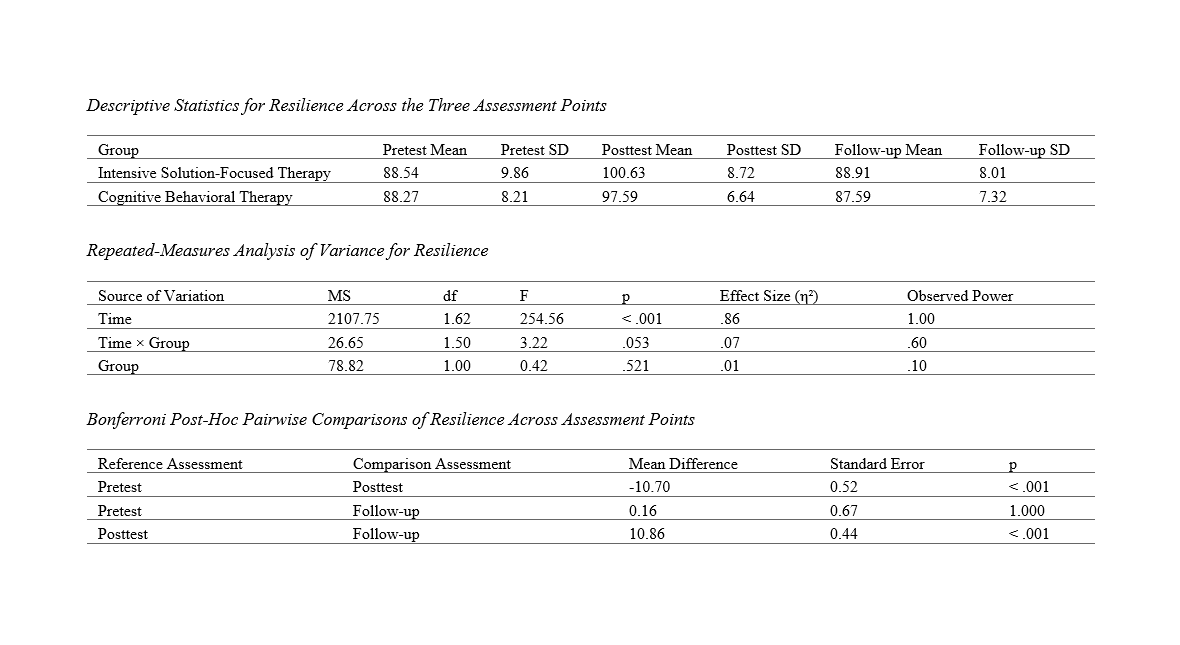
Findings: Repeated-measures analysis of variance revealed a significant main effect of time on resilience (p < .001), indicating significant changes in resilience scores across the pretest, posttest, and follow-up assessments. However, neither the main effect of group nor the time × group interaction was statistically significant, demonstrating that the pattern of change in resilience did not differ significantly between the CBT and ISFT groups. Both interventions significantly increased resilience from pretest to posttest; however, the improvements were not fully maintained at the three-month follow-up (p < .05). Furthermore, no significant difference was found between CBT and ISFT in their overall effectiveness in enhancing resilience.
Conclusion: Both cognitive behavioral therapy and intensive solution-focused therapy appear effective in improving resilience among adolescents with nonsuicidal self-injury, with neither intervention demonstrating superior effectiveness. Nevertheless, the attenuation of treatment gains at follow-up suggests that booster sessions or maintenance-oriented interventions may be necessary to sustain improvements over time.
Downloads
References
Akbaş, E., & Yiğitoğlu, G. T. (2022). The Effect of Solution-Focused Approach on Anger Management and Violent Behavior in Adolescents: A Randomized Controlled Trial. Archives of Psychiatric Nursing, 41, 166-174. https://doi.org/10.1016/j.apnu.2022.07.029
Bakhshipour, B., & Ramezanzadeh, S. (2016). The Effect of Solution-Focused Brief Therapy on Aggression in Children and Adolescents. Psychological studies, 12(3), 141-156.
Banibensu, A. A. (2025). The Effect of Solution-Focused Brief Therapy and Cognitive Behaviour Therapy on Psychological Functioning of Trainee-Nurses in Ledzokuku Greater-Accra University of Education, Winneba].
Bolton, K. W., Hall, J. C., Blundo, R., & Lehmann, P. (2017). The Role of Resilience and Resilience Theory in Solution-Focused Practice. Journal of systemic therapies, 36(3), 1-15. https://doi.org/10.1521/jsyt.2017.36.3.1
Brailovskaia, J., Teismann, T., & Margraf, J. (2020). Positive Mental Health, Stressful Life Events, and Suicide Ideation. Crisis. https://doi.org/10.1027/0227-5910/a000652
Brown, R. C., & Plener, P. L. (2017). Non-Suicidal Self-Injury in Adolescence. Current psychiatry reports, 19, 1-8. https://doi.org/10.1007/s11920-017-0767-9
Cheraghi, M. A., Ebadi, A., Gartland, D., Ghaedi, Y., & Fomani, F. K. (2017). Translation and Validation of "Adolescent Resilience Questionnaire" for Iranian Adolescents. Asian Journal of Psychiatry, 25, 240-245. https://doi.org/10.1016/j.ajp.2016.12.001
Clear, S. J., Gardner, A. A., Webb, H. J., & Zimmer-Gembeck, M. J. (2020). Common and Distinct Correlates of Depression, Anxiety, and Aggression: Attachment and Emotion Regulation of Sadness and Anger. Journal of Adult Development, 27, 181-191. https://doi.org/10.1007/s10804-019-09333-0
Creswell, C., Violato, M., Fairbanks, H., White, E., Parkinson, M., Abitabile, G., Leidi, A., & Cooper, P. J. (2017). Clinical Outcomes and Cost-Effectiveness of Brief Guided Parent-Delivered Cognitive Behavioural Therapy and Solution-Focused Brief Therapy for Treatment of Childhood Anxiety Disorders: A Randomised Controlled Trial. The Lancet Psychiatry, 4(7), 529-539. https://doi.org/10.1016/S2215-0366(17)30149-9
Esposito, C., Bacchini, D., & Affuso, G. (2019). Adolescent Non-Suicidal Self-Injury and Its Relationships with School Bullying and Peer Rejection. Psychiatry research, 274, 1-6. https://doi.org/10.1016/j.psychres.2019.02.018
Firoozmokhtar, M., Arefi, M., & Golparvar, M. (2024). The Effectiveness of Cognitive-Behavioral Therapy on Resilience in High School Students. Iranian Evolutionary Educational Psychology Journal, 6(1), 153-163.
Franklin, C. (2015). An Update on Strengths-Based, Solution-Focused Brief Therapy. Oxford University Press.
Franklin, C., Zhang, A., Froerer, A., & Johnson, S. (2017). Solution-Focused Brief Therapy: A Systematic Review and Meta-Summary of Process Research. Journal of marital and family therapy, 43(1), 16-30. https://doi.org/10.1111/jmft.12193
Glenn, C. R., Esposito, E. C., Porter, A. C., & Robinson, D. J. (2019). Evidence Base Update of Psychosocial Treatments for Self-Injurious Thoughts and Behaviors in Youth. Journal of Clinical Child & Adolescent Psychology, 48(3), 357-392. https://doi.org/10.1080/15374416.2019.1591281
Hooley, J. M., Fox, K. R., & Boccagno, C. (2020). Nonsuicidal Self-Injury: Diagnostic Challenges and Current Perspectives. Neuropsychiatric Disease and Treatment, 16, 101-112. https://doi.org/10.2147/NDT.S198806
Joubert, J., & Guse, T. (2022). Implementing Solution-Focused Brief Therapy to Facilitate Hope and Subjective Well-Being Among South African Trauma Survivors: A Case Study. Counselling and Psychotherapy Research, 22(1), 147-156. https://doi.org/10.1002/capr.12416
Kim, J. S., & Franklin, C. (2015). Understanding Emotional Change in Solution-Focused Brief Therapy: Facilitating Positive Emotions. Best Practices in Mental Health, 11(1), 25-41. https://doi.org/10.70256/167814cunsta
Lim, K. S., Wong, C. H., McIntyre, R. S., Wang, J., Zhang, Z., Tran, B. X., Tan, W., Ho, C. S., & Ho, R. C. (2019). Global Lifetime and 12-Month Prevalence of Suicidal Behavior, Deliberate Self-Harm and Non-Suicidal Self-Injury in Children and Adolescents Between 1989 and 2018: A Meta-Analysis. International journal of environmental research and public health, 16(22), 4581. https://doi.org/10.3390/ijerph16224581
Olusola, J. A. F., Fehintola, J. O., & Falaye, A. O. (2024). Cognitive Behavioural and Solution-Focused Therapies on Marital Stability Among Christian Couples in Ibadan Metropolis. International Journal of Innovative Education Research, 12(3), 103-113.
Ougrin, D., Tranah, T., Stahl, D., Moran, P., & Asarnow, J. R. (2015). Therapeutic Interventions for Suicide Attempts and Self-Harm in Adolescents: Systematic Review and Meta-Analysis. Journal of the American Academy of Child & Adolescent Psychiatry, 54(2), 97-107. https://doi.org/10.1016/j.jaac.2014.10.009
Plener, P. L., Kaess, M., Schmahl, C., Pollak, S., Fegert, J. M., & Brown, R. C. (2018). Nonsuicidal Self-Injury in Adolescents. Deutsches Ärzteblatt International, 115(3), 23. https://doi.org/10.3238/arztebl.2018.0023
Robinson, K., Garisch, J. A., & Wilson, M. S. (2021). Nonsuicidal Self-Injury Thoughts and Behavioural Characteristics: Associations with Suicidal Thoughts and Behaviours Among Community Adolescents. Journal of affective disorders, 282, 1247-1254. https://doi.org/10.1016/j.jad.2020.12.201
Sağar, M. E. (2022). The Effect of Solution-Focused Group Counseling on the Resilience of University Students. International Journal of Educational Research, 13(1), 103-117. https://doi.org/10.19160/e-ijer.1034931
Sisto, A., Vicinanza, F., Campanozzi, L. L., Ricci, G., Tartaglini, D., & Tambone, V. (2019). Towards a Transversal Definition of Psychological Resilience: A Literature Review. Medicina, 55(11), 745. https://doi.org/10.3390/medicina55110745
Stewart, J. G., Esposito, E. C., Glenn, C. R., Gilman, S. E., Pridgen, B., Gold, J., & Auerbach, R. P. (2017). Adolescent Self-Injurers: Comparing Non-Ideators, Suicide Ideators, and Suicide Attempters. Journal of psychiatric research, 84, 105-112. https://doi.org/10.1016/j.jpsychires.2016.09.031
Terblanche, N., Rutschmann, R., & Reitz, J. (2026). Comparing GROW, Solution-Focused and CBT Coaching Chatbots: A Self-Determination and Transformative Learning Perspective. Coaching: An International Journal of Theory, Research and Practice. https://doi.org/10.1080/17521882.2026.2625707
Thompson, E. G., Knowles, S. F., & Greasley, P. (2019). Understanding Resilience in Young People with Complex Mental Health Needs: A Delphi Study. Clinical Child Psychology and Psychiatry, 24(3), 405-416. https://doi.org/10.1177/1359104518794789
Yang, Y., Wang, R., Zhang, D., Zhao, X., & Su, Y. (2021). How Loneliness Worked on Suicidal Ideation Among Chinese Nursing Home Residents: Roles of Depressive Symptoms and Resilience. International journal of environmental research and public health, 18(10), 5472. https://doi.org/10.3390/ijerph18105472
Yu, C., Xie, Q., Lin, S., Liang, Y., Wang, G., Nie, Y., Wang, J., & Longobardi, C. (2020). Cyberbullying Victimization and Non-Suicidal Self-Injurious Behavior Among Chinese Adolescents: School Engagement as a Mediator and Sensation Seeking as a Moderator. Frontiers in psychology, 11, 572521. https://doi.org/10.3389/fpsyg.2020.572521
Downloads
Additional Files
Publication Timeline
- Submitted
- Revised
- Accepted