Comparison of the Effectiveness of Cognitive Behavioral Therapy and Acceptance and Commitment Therapy Educational-Therapeutic Packages on Anxiety and Alexithymia in Students with Self-Harming Behaviors
Keywords:
Self-Harming Behaviors, Anxiety, Alexithymia, Cognitive Behavioral Therapy, Acceptance and Commitment Therapy, StudentsAbstract
Objective: This study aimed to compare the effectiveness of educational-therapeutic packages based on Cognitive Behavioral Therapy (CBT) and Acceptance and Commitment Therapy (ACT) in reducing anxiety and alexithymia among students with self-harming behaviors.
Methodology: This quasi-experimental study employed a pretest-posttest design with two intervention groups and a control group. The statistical population consisted of upper-secondary school students in Kermanshah, Iran. Using convenience sampling and screening with the Sansone et al. (1998) Self-Harm Inventory, 45 eligible students were selected and assigned to CBT, ACT, and control groups. Participants completed the Beck Anxiety Inventory (1990) and the Toronto Alexithymia Scale (1994) at pretest and posttest. The two experimental groups received educational-therapeutic interventions based on CBT and ACT, whereas the control group received no intervention during the study period. Data were analyzed using univariate and multivariate analyses of covariance (ANCOVA and MANCOVA) in SPSS version 26, with pretest scores controlled in the inferential analyses.
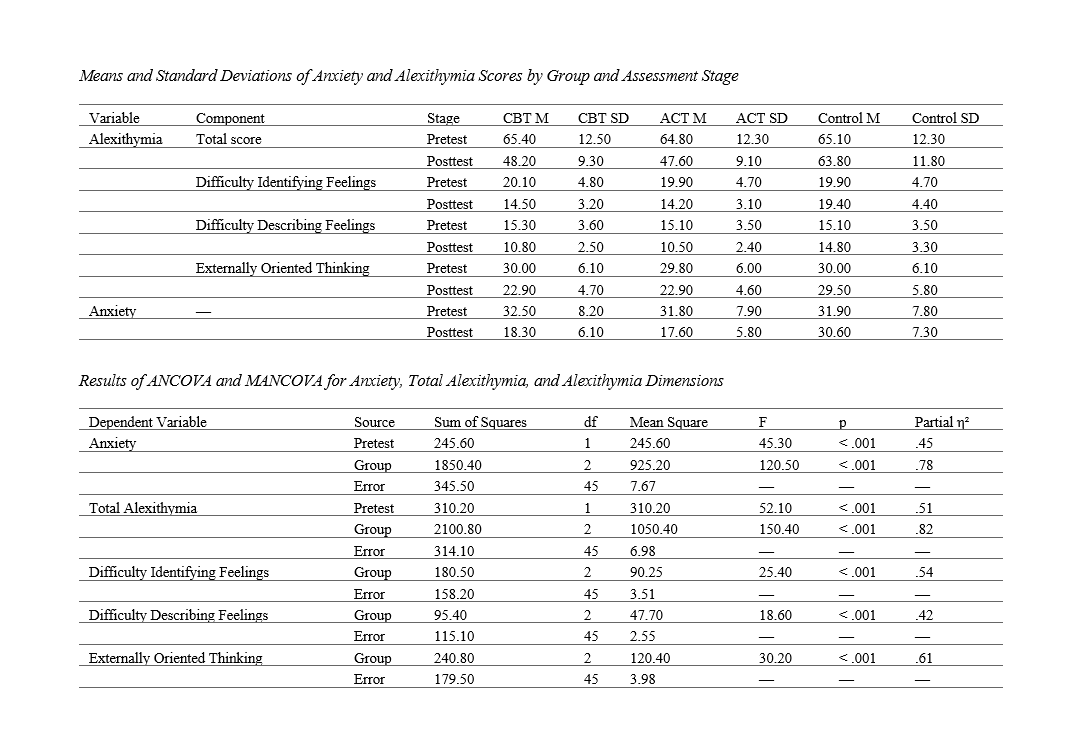
Findings: Univariate ANCOVA indicated a statistically significant group effect on posttest anxiety after controlling for pretest scores, with group membership accounting for approximately 78% of the variance in anxiety. A significant intervention effect was also found for total alexithymia, indicating a substantial reduction attributable to the therapeutic interventions. Multivariate covariance analysis of alexithymia dimensions revealed significant between-group differences in difficulty identifying feelings, difficulty describing feelings, and externally oriented thinking, with the largest effect observed for externally oriented thinking. Bonferroni post-hoc comparisons demonstrated that both CBT and ACT significantly reduced anxiety, total alexithymia, and its dimensions compared with the control group. However, no statistically significant differences were observed between CBT and ACT in their effects on anxiety or alexithymia.
Conclusion: Both CBT- and ACT-based educational-therapeutic packages appear to be effective interventions for reducing anxiety and alexithymia among students exhibiting self-harming behaviors. The absence of significant differences between the two approaches suggests that either intervention may be incorporated into school-based psychological and counseling programs according to students’ needs and available clinical resources.
Downloads
References
Abdollahi, A., Koosha, M., Bozorgchenani, A., Bahmani, M., Rafiei, E., & Eslamdoust-Siahestalki, F. (2023). Prevalence of Self-Harm and Deliberate Self-Injury Among High School Students in Northern Iran and Its Relationship with Anxiety, Depression and Stress. Holistic Nursing and Midwifery, 32(3), 169-177. https://doi.org/10.32598/jhnm.32.3.2193
Aghili, M., & Hosseinzadeh, Z. (2024). Effectiveness of Acceptance and Commitment Therapy on Emotional Self-Awareness and Alexithymia in Girls. Anesthesiology and Pain, 15(1), 34-65.
Ahmad Othman, A., Wan Jaafar, W. M. B., & Nor Zainudin, Z. (2023). Effectiveness of Cognitive Behavior Therapy and Acceptance and Commitment Therapy on Depression and Anxiety Among Emerging Adults in Malaysia. Current Psychology, 43(3). https://doi.org/10.1007/s12144-023-05064-4
Asghari, A. (2023). Comparison of Impulsivity, Alexithymia, and Self-Harming Behaviors in Students with Internet Addiction and Normal Students. Strategies in Medical Education, 16(4), 412-420.
Bagheri, F., Fathi-Ashtiani, A., Sovabi, V., Rezaei, H., & Baryaji, S. (2022). The Effectiveness of Acceptance and Commitment Therapy on Anxiety Sensitivity and Alexithymia in Nurses with Chronic Low Back Pain. Toloo-e Behdasht (Yazd), 21(5), 23-54.
Bordalo, F., & Carvalho, I. P. (2022). The Role of Alexithymia as a Risk Factor for Self-Harm Among Adolescents in Depression - A Systematic Review. Journal of affective disorders, 297, 130-144. https://doi.org/10.1016/j.jad.2021.10.029
Ekhlaqi, A. (2023). Investigating the Mediating Role of Loneliness in the Relationship Between Sexual Addiction and Self-Harming Behaviors. Psychological and Educational Studies (Negareh Higher Education Institute), 88(6), 373-381.
Enayati, M., Salehani, Z., & Lessani, S. (2024). Effectiveness of Acceptance and Commitment Therapy on Cognitive Fusion and Social Anxiety in Women with Generalized Anxiety Disorder. Applied Family Therapy, 3(2), 11-28.
Fallahi, F., Parandin, S., & Valizadeh, H. (2024). Comparison of the Effectiveness of Acceptance and Commitment Therapy and Mindfulness-Based Therapy on Death Anxiety and Loneliness in the Elderly. New Psychological Researches, 12(74), 32-43.
Gerili, E., Heydari, S., & Fakhri, M. K. (2023). Comparison of the Effectiveness of Cognitive-Behavioral Training and Acceptance and Commitment-Based Training on Distress Tolerance in Self-Harming Adolescents. Applied Family Therapy, 4(18), 12-29. https://doi.org/10.61838/kman.aftj.4.4.3
Guan, M., Liu, J., Li, X., Cai, M., Bi, J., Zhou, P., & Wang, H. (2024). The Impact of Depressive and Anxious Symptoms on Non-Suicidal Self-Injury Behavior in Adolescents: A Network Analysis. BMC psychiatry, 24(1), 229. https://doi.org/10.1186/s12888-024-05599-1
Hamdan-Mansour, A. M., Alzayyat, A. A., Hamaideh, S. H., Rafaiah, M. Q. B., Al Jammal, O. L., & Hamdan-Mansour, L. A. (2024). Predictors of Deliberate Self-Harm Among University Students. International journal of mental health and addiction.
Holm, M. E., Østergaard, L. D., Aamund, K., Jørgensen, K., Midtgaard, J., Vinberg, M., & Nordentoft, M. (2024). What Methods Are Used in Research of Firsthand Experiences with Online Self-Harming and Suicidal Behavior? A Scoping Review. Nordic journal of psychiatry, 78(3), 165-180. https://doi.org/10.1080/08039488.2024.2306504
Hosseini, S. F., Tanha, Z., Abbasnia, S., & Azizpour, R. (2023). Comparison of the Effectiveness of Acceptance and Commitment Therapy and Mindfulness-Based Cognitive Therapy on Alexithymia in Patients with Gastrointestinal Diseases: An Experimental Study. International Journal of Body, Mind & Culture, 10(3).
Jalali-Azar, R., Ebrahimi, M. A., Hadadi, A., & Yazdi-Ravandi, S. (2024). The Effect of Acceptance and Commitment Therapy on Suicidal Thoughts, Tendency to Self-Harm and Existential Anxiety in Students. Contemporary psychology, 17(1), 12-32. https://doi.org/10.1007/s12144-023-05501-4
Karakuş, S., & Akbay, S. E. (2022). The Mediating Role of Psychological Flexibility in Explaining Authenticity and Life Satisfaction with Alexithymia. Participatory educational research, 9(1), 285-302. https://doi.org/10.17275/per.22.16.9.1
Khajavi Godellou, G., Farshbaf Manisefat, F., & Golmohamadi Gozalbolagh, S. (2025). The Effectiveness of Acceptance and Commitment-Based Therapy on Alexithymia and Mental Health Indicators in Suicide Attempters. Journal of Psychological Science.
Li, X., Laplante, D. P., Paquin, V., Lafortune, S., Elgbeili, G., & King, S. (2022). Effectiveness of Cognitive Behavioral Therapy for Perinatal Maternal Depression, Anxiety and Stress: A Systematic Review and Meta-Analysis of Randomized Controlled Trials. Clinical psychology review, 92, 102129. https://doi.org/10.1016/j.cpr.2022.102129
Mardani, A., Ali-Mohammadi, A., & Mahmoudi-Tabar, A. (2022). Structural Relationship of Emotional Schemas and Experiential Avoidance with Self-Harming Behaviors: The Mediating Role of Smartphone Addiction. Psychological Growth, 11(76), 145-154.
Moussadek, K. (2024). Healthcare Provider Education on the Prevention of Suicide and Self-Harming Behaviors in Adolescents.
Nawaz, R. F., Anderson, J. K., Colville, L., Fraser-Andrews, C., & Ford, T. J. (2024). Interventions to Prevent or Manage Self-Harm Among Students in Educational Settings - A Systematic Review. Child and Adolescent Mental Health, 29(1), 56-69. https://doi.org/10.1111/camh.12634
Oladian, S. (2024). Comparison of the Effectiveness of Cognitive Behavioral Therapy and Acceptance and Commitment Therapy on Interpersonal Sensitivity and Loneliness in Adult Women with Depression in Chalous City. Women's Psychology, 5(11), 54-68.
Ong, C. W., Hayes, S. C., & Hofmann, S. G. (2022). A Process-Based Approach to Cognitive Behavioral Therapy: A Theory-Based Case Illustration. Frontiers in psychology, 13, 1002849. https://doi.org/10.3389/fpsyg.2022.1002849
Rahnama Zadeh, M., Ashayerih, H., Ranjbaripour, T., Kakavand, A., & Meschi, F. (2022). The Effectiveness of Acceptance and Commitment Therapy on Depression, Alexithymia and Hypertension in Patients with Coronary Heart Disease. International Clinical Neuroscience Journal, 9, e15. https://doi.org/10.34172/icnj.2022.15
Sabaghi Renani, M. (2024). The Role of Loneliness and Psychological Distress in Predicting Self-Harming Behaviors in Runaway Girls. Social Psychology, 11(70).
Tighe, J., Nicholas, J., Shand, F., & Christensen, H. (2024). Efficacy of Acceptance and Commitment Therapy in Reducing Suicidal Ideation and Deliberate Self-Harm: Systematic Review. Jmir Mental Health, 5(2), e10732. https://doi.org/10.2196/10732
Tsubaki, K., & Shimizu, E. (2024). Psychological Treatments for Alexithymia: A Systematic Review. Behavioral Sciences, 14(12), 1173. https://doi.org/10.3390/bs14121173
Uysal, B., Gormez, V., Karatepe, H., & Sönmez, D. (2023). Reducing Test Anxiety During the COVID-19 Pandemic: A Comparison of the Effectiveness of Cognitive Behavioral Therapy and Acceptance and Commitment Therapy. Psychological Reports, 127(50), 3329-4123. https://doi.org/10.1177/00332941231174394
Downloads
Additional Files
Publication Timeline
- Submitted
- Revised
- Accepted