The Effect of Gamification in Physical Education on Motivational Indicators and Perceived Competence among Lower Secondary School Students
Keywords:
Gamification, Physical Education, Motivation, Perceived Competence, Self-Regulation, Lower Secondary School StudentsAbstract
Objective: The present study aimed to investigate the effect of gamification-based physical education on motivational indicators and perceived competence among female lower secondary school students.
Methods and Materials: This quasi-experimental study employed a pretest–posttest design with an experimental and a control group. The statistical population consisted of seventh-grade female students enrolled in schools in Tabriz, Iran. Using convenience sampling, two intact classes were selected from one school and then randomly assigned to the experimental group (n = 31) and the control group (n = 25). The experimental group participated in eight 90-minute basketball instructional sessions designed according to gamification principles, whereas the control group received the same basketball content through conventional physical education instruction. Data were collected using the Perceived Competence Questionnaire and the Self-Regulation Questionnaire in Physical Education developed by Goudas et al. (1994). The collected data were analyzed using repeated-measures analysis of variance in SPSS software to examine changes over time and differences between the two instructional conditions.
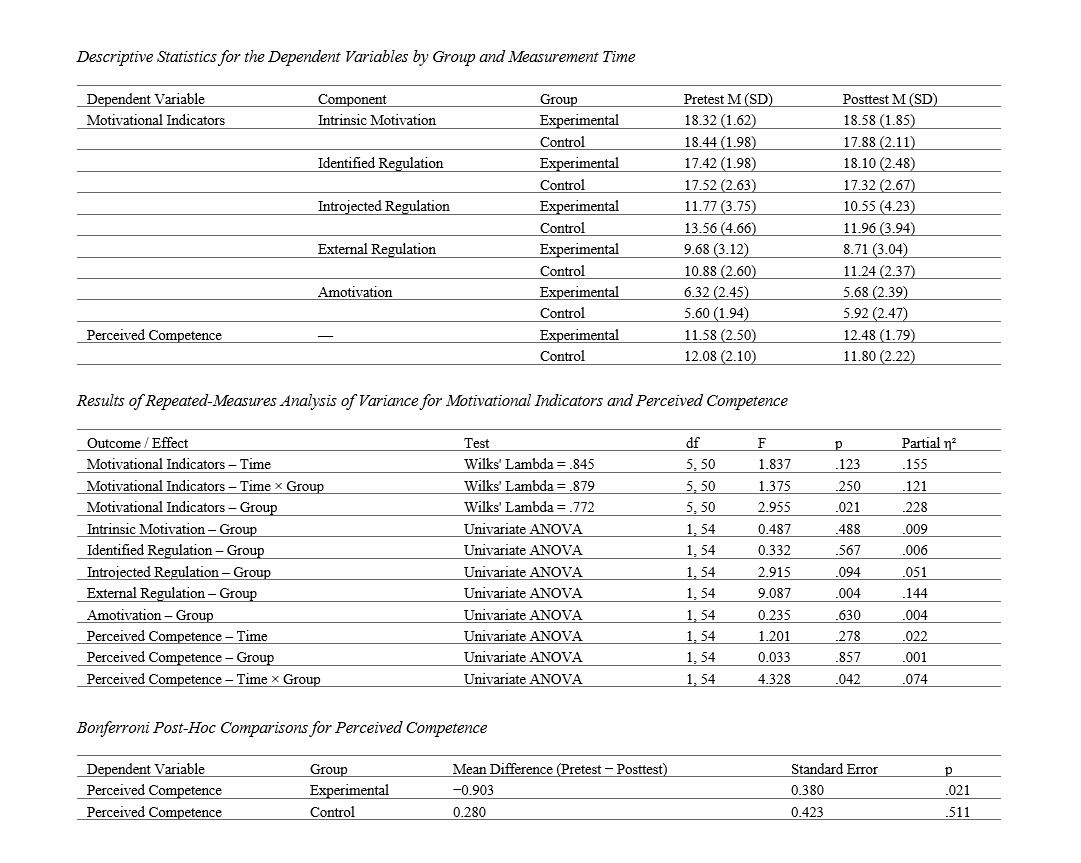
Findings: Inferential analyses indicated that gamification produced a significant reduction in external regulation compared with traditional instruction. However, no statistically significant between-group differences were observed for intrinsic motivation, identified regulation, introjected regulation, or amotivation. The results also demonstrated a significant improvement in perceived competence among students exposed to the gamified instructional approach, whereas the traditional instructional condition did not produce a comparable improvement. Overall, the inferential findings suggest that gamification exerted selective effects on students' motivational regulation while producing a more evident positive effect on perceived competence.
Conclusion: Gamification appears to be a potentially effective instructional approach for enhancing perceived competence and reducing externally regulated motivation in physical education among female lower secondary school students. Nevertheless, its effects may not extend equally to all dimensions of motivational regulation. Accordingly, incorporating appropriately designed game elements into physical education may contribute to creating more competence-supportive and autonomously engaging learning environments.
Downloads
References
Banik, B. G., & Gullapelly, A. (2025). AI-Powered Gamification and Interactive Learning Tools for Enhancing Student Engagement. 283-310. https://doi.org/10.4018/979-8-3693-8292-9.ch013
Behzadnia, B., Ahmadi, M., & Amani, J. (2018). Examining the Factor Structure of the Motivational Self-Regulation Questionnaire in University Physical Education Classes. Research in Sport Management and Motor Behavior, 7(13), 25-34.
Behzadnia, B., Fazeli, H., Rezaei, F., & Moazam, S. (2024). The Relationship Between Motivational Regulations and Intention to Continue Sport in Injured Athletes. Journal of Motor and Control Learning, 6(2), e144545. https://doi.org/10.5812/jmcl-144545
Behzadnia, B., Mollaei Zangi, F., Rezaei, F., & Eskandarnejad, M. (2024). Predicting Students’ Basic Psychological Needs, Motivation, and Wellbeing in Online Physical Education: A Semester-Term Longitudinal Study. International Journal of Sport and Exercise Psychology, 22(7), 1588-1606. https://doi.org/10.1080/1612197X.2023.2237051
Behzadnia, B., Rezaei, F., & Salehi, M. (2022). A Need-Supportive Teaching Approach Among Students with Intellectual Disability in Physical Education. Psychology of Sport & Exercise, 60, 102156. https://doi.org/10.1016/j.psychsport.2022.102156
Davies, K. F., Clarke, S., Martins, R., Rudd, J., & Duncan, M. (2024). The Effect of a Home-Based, Gamified Stability Skills Intervention on 4-5-Year-Old Children’s Physical and Cognitive Outcomes: A Pilot Study. Psychology of Sport and Exercise, 73, 102636. https://doi.org/10.1016/j.psychsport.2024.102636
Diana, R., Kassymova, G. K., Issaliyeva, S., Nursultan, M., & Orynbayeva, A. (2025). Assessing the Influence of Gamification on Student Motivation in English Language Acquisition. Muallim Journal of Social Sciences and Humanities, 1-11. https://doi.org/10.33306/mjssh/304
Dólera-Montoya, S., Valero-Valenzuela, A., Jiménez-Parra, J. F., & Manzano-Sánchez, D. (2021). Improvement of the Classroom Climate Through a Plan of Gamified Coexistence with Physical Activity: Study of Its Effectiveness in Primary Education. Cuadernos del Profesorado, 14(28), 65-77. https://doi.org/10.25115/ecp.v14i28.4420
Fernandez-Rio, J., de las Heras, E., González, T., Trillo, V., & Palomares, J. (2020). Gamification and Physical Education. Viability and Preliminary Views from Students and Teachers. Physical Education and Sport Pedagogy, 25(5), 509-524. https://doi.org/10.1080/17408989.2020.1743253
Fernandez-Rio, J., Zumajo-Flores, M., & Flores-Aguilar, G. (2022). Motivation, Basic Psychological Needs and Intention to Be Physically Active After a Gamified Intervention Programme. European Physical Education Review, 28(2), 432-445. https://doi.org/10.1177/1356336X211052883
Ferriz-Valero, A., Østerlie, O., García Martínez, S., & García-Jaén, M. (2020). Gamification in Physical Education: Evaluation of Impact on Motivation and Academic Performance Within Higher Education. International journal of environmental research and public health, 17(12), 4465. https://doi.org/10.3390/ijerph17124465
Grech, E. M., Briguglio, M., & Said, E. (2024). A Field Experiment on Gamification of Physical Activity–Effects on Motivation and Steps. International Journal of Human-Computer Studies, 184, 103205. https://doi.org/10.1016/j.ijhcs.2023.103205
Liu, T., & Lipowski, M. (2021). Sports Gamification: Evaluation of Its Impact on Learning Motivation and Performance in Higher Education. International journal of environmental research and public health, 18(3), 1267. https://doi.org/10.3390/ijerph18031267
Martín-Moya, R., Ruiz-Montero, P. J., Chiva-Bartoll, Ò., & Capella-Peris, C. (2018). Achievement Motivation for Learning in Physical Education Students. Revista Interamericana de Psicología, 52(2), 273-283. https://doi.org/10.30849/rip/ijp.v52i2.953
Melero-Canas, D., Manzano-Sánchez, D., Navarro-Ardoy, D., Morales-Baños, V., & Valero-Valenzuela, A. (2021). The Seneb's Enigma: Impact of a Hybrid Personal and Social Responsibility and Gamification Model-Based Practice on Motivation and Healthy Habits in Physical Education. International journal of environmental research and public health, 18(7), 3476. https://doi.org/10.3390/ijerph18073476
Quintas-Hijós, A., Peñarrubia-Lozano, C., & Bustamante, J. C. (2020). Analysis of the Applicability and Utility of a Gamified Didactics with Exergames at Primary Schools: Qualitative Findings from a Natural Experiment. PLoS One, 15(4), e0231269. https://doi.org/10.1371/journal.pone.0231269
Quintas, A., Bustamante, J. C., Pradas, F., & Castellar, C. (2020). Psychological Effects of Gamified Didactics with Exergames in Physical Education at Primary Schools: Results from a Natural Experiment. Computers & Education, 152, 103874. https://doi.org/10.1016/j.compedu.2020.103874
Ramezanzadeh, H., Arab Narmi, B., Bandali, E., & Khalilian, F. (2021). Psychometric Properties of the Perceived Motor Competence Questionnaire in Childhood. Motor Behavior, 13(44), 93-124. https://doi.org/10.22089/mbj.2021.10253.195
Roure, C., & Pasco, D. (2022). Exploring the Effects of a Context Personalization Approach in Physical Education on Students’ Interests and Perceived Competence. Journal of Teaching in Physical Education, 42(2), 331-340. https://doi.org/10.1123/jtpe.2021-0283
Ryan, R. M., & Deci, E. L. (2020). Intrinsic and Extrinsic Motivation from a Self-Determination Theory Perspective: Definitions, Theory, Practices, and Future Directions. Contemporary Educational Psychology, 61, 101860. https://doi.org/10.1016/j.cedpsych.2020.101860
Shafiei Sarvestani, M., Mirani Sargazi, N., Hafezi, A., Jami, M., & Mirgol, A. (2025). Explaining the Role of Gamification in Developing Creative Thinking Skills and Research Tendencies in Virtual Education among Medical Sciences Students in Yazd during the Post-Corona Period. Jundishapur Education Development Journal, 16(1), 26-38.
Sotos-Martinez, V. J., Baena-Morales, S., Sanchez-De Miguel, M., & Ferriz-Valero, A. (2024). Playing Towards Motivation: Gamification and University Students in Physical Activity! Education Sciences, 14(9), 965. https://doi.org/10.3390/educsci14090965
Sotos-Martínez, V. J., Ferriz-Valero, A., García-Martínez, S., & Tortosa-Martínez, J. (2024). The Effects of Gamification on the Motivation and Basic Psychological Needs of Secondary School Physical Education Students. Physical Education and Sport Pedagogy, 29(2), 160-176. https://doi.org/10.1080/17408989.2022.2039611
Vasconcellos, D., Parker, P. D., Hilland, T., Cinelli, R., Owen, K. B., Kapsal, N., & Ryan, R. M. (2020). Self-Determination Theory Applied to Physical Education: A Systematic Review and Meta-Analysis. Journal of Educational Psychology, 112(7), 1444-1469. https://doi.org/10.1037/edu0000420
Wibowo, C. (2024). Enhancing Self-Esteem, Satisfaction, and Motor Skills Through Gamification in Elementary Physical Education. Physical Education Theory and Methodology, 24(3), 368-374. https://doi.org/10.17309/tmfv.2024.3.03
Downloads
Additional Files
Publication Timeline
- Submitted
- Revised
- Accepted