Comparison of the Effectiveness of Choice Theory-Based Education and Adolescent-Centered Mindfulness Training on Psychological Capital in Adolescent Football Players
Keywords:
Choice Theory, Mindfulness, Psychological Capital, Adolescent Football Players, Reality TherapyAbstract
Objective: This study aimed to compare the effectiveness of Choice Theory-based education and adolescent-centered mindfulness training in improving psychological capital among adolescent football players.
Methods and Materials: The study employed a quasi-experimental pretest–posttest control-group design with a two-month follow-up. The statistical population included adolescent football players aged 12–18 years in the Shemiranat region during the 2025–2026 academic year. Using purposive sampling, 45 eligible participants were selected and randomly assigned to a Choice Theory-based education group, an adolescent-centered mindfulness group, or a control group, with 15 participants in each group. The Choice Theory intervention was delivered in eight 90-minute sessions, whereas the adolescent-centered mindfulness intervention was conducted in ten 90-minute sessions. The control group received no intervention during the study period. Psychological capital was assessed at pretest, posttest, and follow-up using the Psychological Capital Questionnaire. Data were analyzed in SPSS version 26 using repeated-measures analysis of variance and post-hoc comparisons.
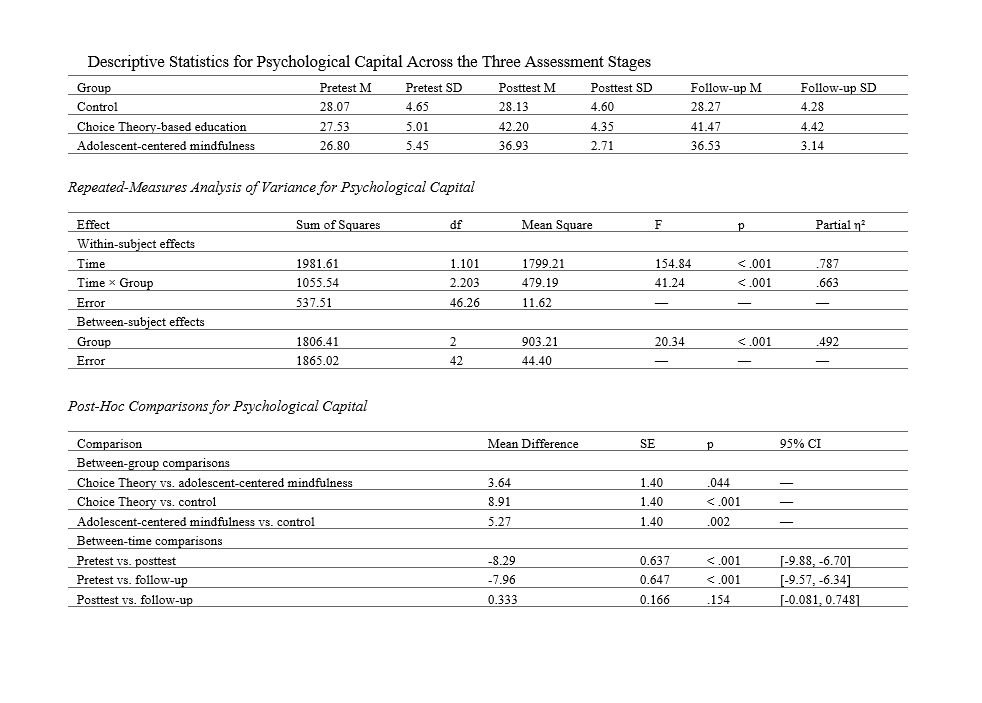
Findings: Repeated-measures analysis showed a significant main effect of time on psychological capital, F(1.101, 46.26) = 154.84, p < .001, partial η² = .787. The time × group interaction was also significant, F(2.203, 46.26) = 41.24, p < .001, partial η² = .663, indicating different patterns of change across the three groups. In addition, the between-group effect was significant, F(2, 42) = 20.34, p < .001, partial η² = .492. Post-hoc comparisons showed that both Choice Theory-based education and adolescent-centered mindfulness training significantly improved psychological capital compared with the control group (p < .01). Choice Theory-based education was significantly more effective than adolescent-centered mindfulness training, MD = 3.64, p = .044. Psychological capital was significantly higher at posttest and follow-up than at pretest (p < .001), whereas the difference between posttest and follow-up was not significant (p = .154), indicating maintenance of intervention effects.
Conclusion: Both Choice Theory-based education and adolescent-centered mindfulness training were effective in improving psychological capital among adolescent football players, with Choice Theory-based education demonstrating greater effectiveness and both interventions showing sustained effects at two-month follow-up.
Downloads
References
Asani, S., Panahali, A., Abdi, R., & Gargari, R. B. (2024). Effectiveness of reality therapy and mindfulness-based cognitive therapy in academic meaning and academic emotions of procrastinating students. Modern Care Journal, 21(2), e137148. https://doi.org/10.5812/mcj-137148
Babaei Motlaq, F., & Tanha, Z. (2023). Comparing the effectiveness of mindfulness-based parenting with choice theory-based parenting in mothers of children diagnosed with oppositional defiant disorder. Research in Child and Adolescent Psychotherapy, 2(2), 21-36.
Gargari, R. Y. (2024). Comparison of the Effectiveness of Mindfulness-Based Cognitive-Behavioral Therapy and Reality Therapy on Emotional Regulation and Self-Efficacy in Women Seeking Divorce. Psychology of Woman Journal, 5(1), 12-22. https://doi.org/10.61838/kman.pwj.5.1.2
Gholamali Lavasani, M., Amirian Farsani, E., & Keshavarz Afshar, H. (2024). The effectiveness of reality therapy in increasing psychological capital and its components and reducing loneliness among single-parent adolescent girls. Clinical Psychology and Counseling Research, 13(2), 161-176.
Grills, C., Villanueva, S., Anderson, M., Corsbie-Massay, C. L., Smith, B., Johnson, L., & Owens, K. (2015). Effectiveness of Choice Theory Connections:A Cross-Sectional and Comparative Analysis of California Female Inmates. International journal of offender therapy and comparative criminology, 59(7), 757-771. https://doi.org/10.1177/0306624x13520129
Long, H. C., An, H. M., Dung, P. T. P., & Quy, N. L. D. (2025). Mindfulness Practice and Work Performance: The Mediating Role of Emotional Intelligence and Psychological Capital. Brain and Behavior, 15(1). https://doi.org/10.1002/brb3.70291
Maarefvand, A., & Shafiabady, A. (2024). Effectiveness of Shafie-Abadi's Multidimensional Model Training on Enhancing Occupational Well-being and Quality of Work Life among Teachers in Qom City. International Journal of Education and Cognitive Sciences, 4(4), 21-30. https://doi.org/10.61838/kman.ijecs.4.4.3
Masan Abadi, M., Heidari, H., Mirmahdi, S. R., & Al-Yasin, S. A. (2015). Effectiveness of Group Counseling Based on Reality Therapy on Self-Control and Resilience in Mothers of Disabled Children in Arak County. International Conference on Humanities, Psychology, and Social Sciences, Tehran: Ilia Capital Idea Managers Institute.
Najafi, M. (2024). Comparison of the effectiveness of positive mindfulness therapy with emotion regulation therapy and mindfulness-based cognitive therapy on emotional capital, cognitive emotion regulation, self-criticism, self-efficacy, self-compassion, and meta-emotion in women with generalized anxiety disorder https://ijpn.ir/browse.php?a_id=2177&sid=1&slc_lang=fa&ftxt=0
Najafi, M., Sajjadian, I., & Manshaee, G. (2024). Comparison the Effectiveness of Emotion Efficacy Therapy and Mindfulness-Based Cognitive Therapy on Affective Capital and Meta Emotion in Women with Generalized Anxiety Disorder. Res Clin Psychol Counsel, 14(1), 199-222.
Nasiri, A., Sharifi, T., Ghazanfari, A., & Cherami, M. (2019). Comparing the effectiveness of schema therapy and reality therapy on the psychological capital of preschool teachers. Quarterly Journal of Applied Psychology, 15(3), 536-511. https://doi.org/10.52547/apsy.2021.222264.1060
Oliveira, S., Cunha, M., Rosado, A., Saraiva, M., & Ferreira, C. (2025). Mindfulness and Psychological Inflexibility in Portuguese Adolescent Athletes: A Novel Framework for Understanding the Link Between Shame and Sports Anxiety. Journal of Clinical Sport Psychology, 19(2), 215-232. https://doi.org/10.1123/jcsp.2023-0041
Salehi-Mobarak, A., Golparvar, M., & Yousefi, Z. (2024). A comparison of the effectiveness of spiritual self-care training and mindfulness-based cognitive therapy on emotional capital in patients undergoing hemodialysis. Experimental and Cognitive Psychology, 1(4), 68–84. https://doi.org/10.61838/qecp.88
Shariati Pour, S., Barabadi, H. A., & Heydarnia, A. (2019). The effectiveness of group reality therapy based on choice theory on the psychological capital of orphaned adolescent girls. Counseling Research, 18(71), 36-59. https://doi.org/10.29252/jcr.18.71.36
Shokri, M., Akbarnetaj Shoub, N., Sadeghi, J., & Khanmohammadi Otagsara, A. (2024). Comparing the Effectiveness of Mindfulness Intervention and Cognitive-Behavioral Play Therapy on Psychological Capital among Adolescent Girls. Journal of Arak University of Medical Sciences, 27(1), 31-38.
Tokhali, N., & Mohammadzadeh Qorbanqoli, M. (2025). The Effectiveness of Mindfulness-Based Therapy on Social Capital and Mental Health of Women with Marital Conflicts Referring to Counseling Centers in Mashhad. Journal Name Not Provided. https://pantajournals.ir/buy.aspx?id=110027&t=1
Yahyavi Gargari, R., Farshbaf Monsef, F., & Etemadnia, M. (2024). Comparing the Effectiveness of Mindfulness-Based Cognitive Behavioral Therapy and Reality Therapy on Emotion Regulation and Self-Efficacy in Women on the Verge of Divorce. Quarterly Journal of Women's Psychology, 5(1), 2-22.
Yang, Y., Du, X., Liu, X., Li, P., He, S., Leng, L., & Huang, J. (2025). Effects of Mindfulness Intervention on Cognitive Function in Athletes: A Systematic Review and Meta-Analysis. Mindfulness, 1-15. https://doi.org/10.1007/s12671-025-02634-4
Zewude, G. T., Natnael, T., Woreta, G. T., & Bezie, A. E. (2025). A Multi- Mediation Analysis on the Impact of Social Media and Internet Addiction on University and High School Students’ Mental Health Through Social Capital and Mindfulness. International journal of environmental research and public health, 22(1), 57. https://doi.org/10.3390/ijerph22010057
Zewude, G. T., Oo, T. Z., Józsa, G., & Józsa, K. (2024). The Relationship among Internet Addiction, Moral Potency, Mindfulness, and Psychological Capital. European Journal of Investigation in Health, Psychology and Education, 14(6), 1735-1756. https://doi.org/10.3390/ejihpe14060115
Zhong, Z., Jiang, H., & Wang, H. (2025). The Association of Mindfulness with Athletes’ Fear of Failure: The Mediating Roles of Perfectionism and Ego-Depletion. Frontiers in Public Health, 13, 1643131. https://doi.org/10.3389/fpubh.2025.1643131
Zhong, Z., Jiang, H., Wang, H., & Liu, Y. (2024). Mindfulness, social evaluation anxiety, and self-regulation: exploring their association on impulsive behavior among athletes. Frontiers in Psychiatry, 15, 1404680. https://doi.org/10.3389/fpsyt.2024.1404680
Zhong, Z. M., Jiang, H., Wang, H., & Liu, Y. (2025). The Association Between Mindfulness and Athletes' Distress Tolerance: The Mediating Roles of Cognitive Reappraisal and Mental Toughness. Behavioral Sciences, 15(3), 298. https://doi.org/10.3390/bs15030298
Downloads
Additional Files
Publication Timeline
- Submitted
- Revised
- Accepted