Structural Modeling of the Relationship Between Family Cohesion and Fear of Marriage: The Mediating Role of Self-Esteem Among University Students Approaching Marriage
Keywords:
Family Cohesion, Fear of Marriage, Self-Esteem, Marriage, University StudentsAbstract
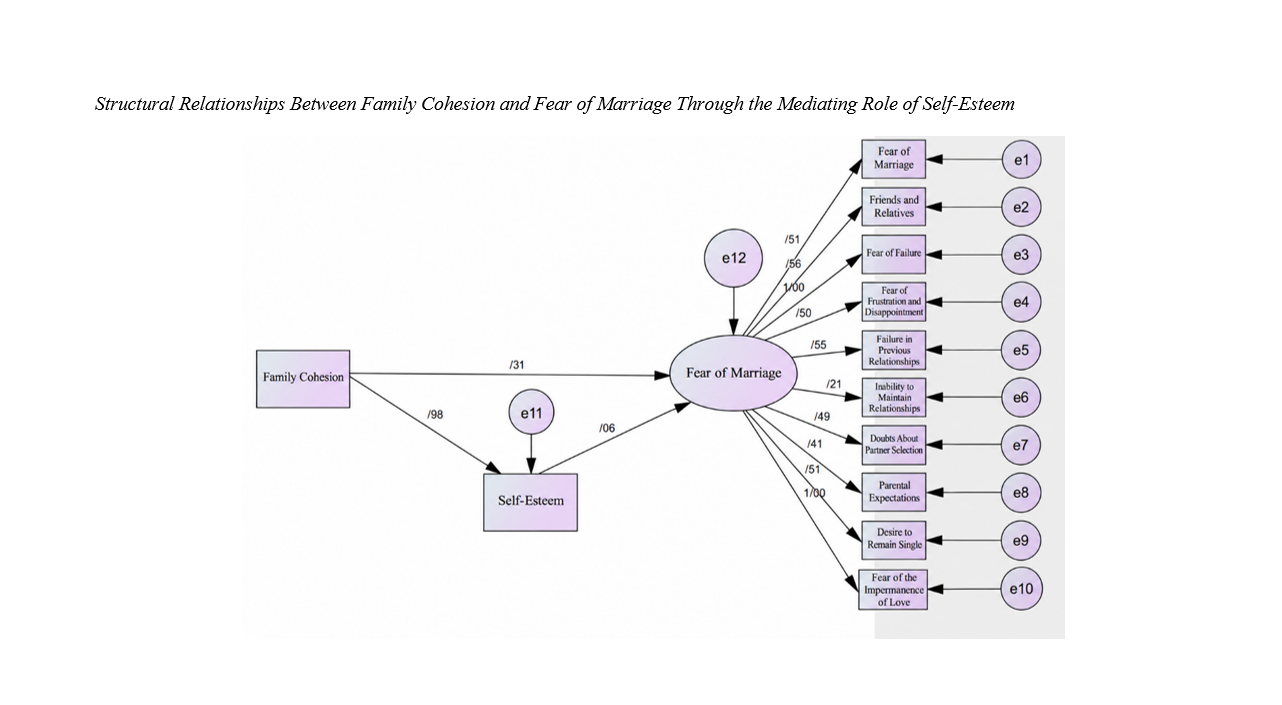
Objective: This study aimed to develop and test a structural model of the relationship between family cohesion and fear of marriage, with self-esteem examined as a potential mediating variable among university students approaching marriage.
Methods and Materials: This descriptive-correlational study employed structural equation modeling (SEM). The statistical population consisted of university students approaching marriage who were enrolled at the Science and Research, North Tehran, and Central Tehran branches of Islamic Azad University during the 2025–2026 academic year. A total of 322 students were selected using convenience sampling. Data were collected using the Fear of Marriage Questionnaire developed by Richard et al. (2007), Olson’s Family Cohesion Questionnaire (1999), and Eysenck’s Self-Esteem Questionnaire (1976). The hypothesized structural model and direct and indirect relationships among the study variables were analyzed using AMOS software and structural equation modeling.
Findings: The proposed structural model demonstrated an acceptable overall fit to the observed data (CMIN/DF = 2.90, RMSEA = 0.099, GFI = 0.940, NFI = 0.930, TLI = 0.910, and IFI = 0.950). Family cohesion had a positive and statistically significant direct effect on self-esteem (β = 0.97, P < 0.001). However, the direct effect of self-esteem on fear of marriage was not statistically significant (β = 0.061, P = 0.846). Similarly, the direct effect of family cohesion on fear of marriage was nonsignificant (β = 0.030, P = 0.328). Bootstrap analysis further indicated that the indirect effect of family cohesion on fear of marriage through self-esteem was not significant (effect = 0.019, P = 0.738, 95% CI [−0.126, 0.200]).
Conclusion: Family cohesion appears to be an important positive predictor of self-esteem among students approaching marriage; however, neither family cohesion nor self-esteem significantly predicted fear of marriage in the proposed structural model. Furthermore, self-esteem did not significantly mediate the relationship between family cohesion and fear of marriage, suggesting that other individual, relational, or sociocultural mechanisms may better explain variations in marriage-related fear.
Downloads
References
Afrooz , G. A., Hosseinian , S., & Shamkhali , L. (2022). The Mediating Role of Locus of Control in the Relationship between Goal Orientations with Self-Esteem In Basij Students. Scientific Journal of Islamic Education, 30(54), 215-238. https://www.magiran.com/paper/2455423
Dafei, M., Jahanbazi, F., Nazari, F., Safdari Dehcheshmeh, F., & Dehghani, A. (2021). The effect of group cognitive-behavioral counseling on optimism and self-esteem of women during the 1st month of marriage that referring to marriage counseling center. J Educ Health Promot, 10, 209. https://doi.org/10.4103/jehp.jehp_1075_20
Fouladiyan, M., BaradaranKashani, Z., & Dayyari, M. (2021). Qualitative study of forming extra marriage affairs (Case Study: Women and men Divorce applicant in Mashhad). Quarterly of Social Studies and Research in Iran, 10(1), 1-37. https://doi.org/10.22059/jisr.2021.294255.977
Khani, S. (2023). Increasing Divorce or Stagnation of Marriage? A Reflection on the Trends in Marriage and Divorce in Iran during the Last 15 Years. Journal of Social Continuity and Change (JSCC), 2(1), 25-43. https://doi.org/10.22034/jscc.2023.19288.1053
Korahng Behshti, F., & Torkaman, S. (2023). Effectiveness of communication skills training on self-esteem, perfectionism and marital burnout in women referring to Isfahan counseling centers. Psychological Models and Methods, 13(50), 151-162. https://doi.org/10.30495/jpmm.2023.29899.3581
Lee, M. A., Song, R., & Park, J. (2025). Does Perceived Gender Conflict Shape Young Koreans' Attitudes Toward Marriage and Childbearing? Journal of marriage and family, 87(4), 1816-1832. https://doi.org/10.1111/jomf.13106
Liu, S., Bracke, P., & Delaruelle, K. (2025). Diverging Family Behaviors: Socioeconomic Gradients in China's First Marriage Age across Cohorts. Journal of Family Issues.
Maurida, N., & Basri, A. A. (2025). The Strengthening Family on Marriage Planning Among Adolescent Women at Rural Area. Jurnal Kesehatan Dr Soebandi, 13(1). https://doi.org/10.36858/jkds.v13i1.795
Mokhtari, S., Yousefi, Z., & Manshaei, G. R. (2022). The Effectiveness of Schema-Based Premarital Education on Fear of Marriage and Schema Modes in Single Girls. Community Health Journal, 16(3), 1-13. https://doi.org/10.22123/chj.2022.282251.1718
Niakani, S. S. (2022). Comparing Love Styles, Marriage Stability, Fear of Intimacy, and Empathy in Traditional and Modern Marriages Master's Thesis, General Psychology, Feyz-al-Islam Higher Education Institute, Faculty of Humanities].
Noor, S., & Za, A. (2025). Early Marriage and Psychological Development: Implications for Emotional Regulation and Marital Adjustment. Journal of Family Studies, 31(1), 55-70.
Ren, J. (2022). Analysis of the psychological factors of contemporary youth's fear of marriage in China. International Journal of Frontiers in Sociology, 4(13), 31-34. https://doi.org/10.25236/IJFS.2022.041305
Sacco, P., & Phares, V. (2001). Partner appraisal and marital satisfaction: The role of self-esteem and depression. Journal of marriage and family, 504-513. https://doi.org/10.1111/j.1741-3737.2001.00504.x
Shackelford, T. K. (2001). Self-Esteem in Marriage. Personality and individual differences, 30, 371-390. https://doi.org/10.1016/S0191-8869(00)00023-4
Wenqing, Y., Panting, H., Wang, Y., & Mengting, L. (2024). Analysis of the Reasons for Contemporary Young Women's Fear of Marriage and Pregnancy—Based on Bengbu. Academic Journal of Humanities & Social Sciences, 7(2). https://doi.org/10.25236/ajhss.2024.070204
Yaghoubnezhad, S., & Khoshbazan, T. (2025). Investigating the contribution of personality traits and family cohesion indicators in explaining the tendency toward emotional infidelity of young people on the eve of marriage. Journal of Family Research, 21(4), 36-54.
Yoon, S. Y., & Park, H. (2025). Gender-Role Attitudes and Marriage Desires among Never-Married Adults in South Korea. Journal of marriage and family, 87(5), 2167-2177. https://papers.iafor.org/wp-content/uploads/papers/acss2026/ACSS2026_104825.pdf
Zhao, M. (2026). The Paradox of Empowerment: How Education and Autonomy in Mate Choice for Marriage Amplify the Impact of Childhood Harsh Parenting on Self-Esteem Among Women in Beijing. Family Sciences, 2(2), 16. https://doi.org/10.3390/famsci2020016
Downloads
Additional Files
Publication Timeline
- Submitted
- Revised
- Accepted