Comparison of the Effectiveness of Positive Thinking Training and Mindfulness-Based Cognitive Therapy on Self-Control Skills among Female Secondary School Students in Tehran Province
Keywords:
Positive Thinking Training, Mindfulness-Based Cognitive Therapy, Self-Control, Female Students, Secondary SchoolAbstract
Objective: The present study aimed to compare the effectiveness of positive thinking training and mindfulness-based cognitive therapy on self-control skills among female secondary school students in Tehran Province.
Methods and Materials: This quasi-experimental study employed a pretest–posttest control group design with two experimental groups. The statistical population consisted of female secondary school students in Tehran Province during the 2025–2026 academic year. Initially, 300 students were screened using the Tangney Self-Control Scale, and 60 students with low self-control scores who met the inclusion criteria were selected and randomly assigned to a positive thinking training group, a mindfulness-based cognitive therapy group, and a control group, with 20 participants in each group. The first experimental group received eight 90-minute sessions of positive thinking training based on Quilliam’s approach, while the second experimental group received eight 90-minute sessions of mindfulness-based cognitive therapy. The control group received no intervention. Data were analyzed using analysis of covariance and Bonferroni-adjusted pairwise comparisons at a significance level of .05.
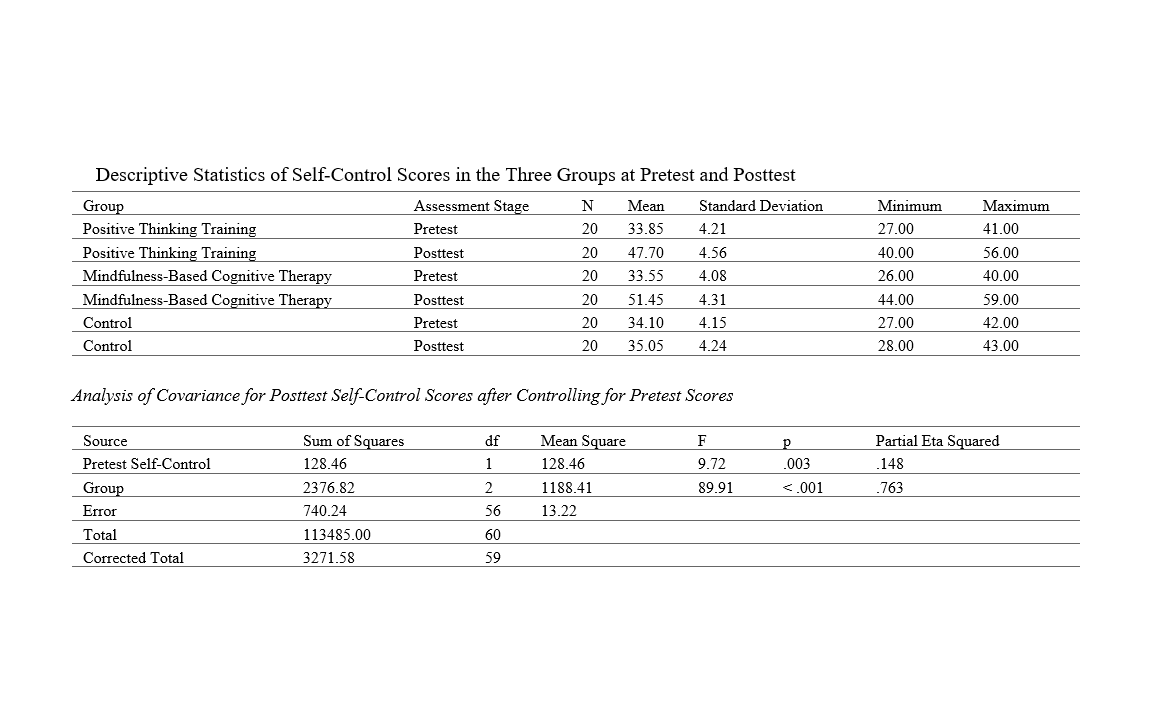
Findings: After controlling for pretest self-control scores, a significant difference was observed among the three groups in posttest self-control, F(2, 56) = 89.91, p < .001, partial η² = .763. Bonferroni comparisons showed that positive thinking training significantly increased self-control compared with the control group (mean difference = 12.58, p < .001). Mindfulness-based cognitive therapy also significantly improved self-control compared with the control group (mean difference = 16.29, p < .001). Furthermore, mindfulness-based cognitive therapy was significantly more effective than positive thinking training (mean difference = 3.71, p = .006).
Conclusion: Both positive thinking training and mindfulness-based cognitive therapy were effective in improving self-control skills among female secondary school students; however, mindfulness-based cognitive therapy demonstrated greater effectiveness and may therefore be considered a more powerful intervention for strengthening self-regulatory capacities in this population.
Downloads
References
Asaseh, M., Karimgholipour, N., & Vakili, S. (2023). The effectiveness of mindfulness training on family cohesion and public health of parents of children with special learning disabilities. Transactions on Data Analysis in Social Science, 5(1), 1-10. https://doi.org/10.47176/TDASS/2023.1
Chen, L., Chen, W., & Cheng, Y. (2025). The Relationship Between Mindfulness and Learning Engagement in Chinese University Students: The Serial Mediating Role of Self-Esteem and Self-Control. Learning and Motivation, 89, 102097. https://doi.org/10.1016/j.lmot.2025.102097
Doostdar Toosi, M. S., Mirzaei, S. H., & Iranmanesh, A. (2024). A comparative study on the effectiveness of storytelling-based positive self-talk training and child-centered mindfulness on the psychological well-being of children with cancer. Transactions on Data Analysis in Social Science, 6(1), 59-67. https://doi.org/10.47176/TDASS.2024.59
Hassan, K., Mozafari, F., Mirzaei, S., & Mohammadkhani, M. (2023). The effectiveness of positive thinking skills training for improving students’ self-control and self-awareness. Positive Psychology Research, 9(2), 65-82.
Hayah Gheibi Haghighi, F., & Bazazian, S. (2023). The effectiveness of schema therapy on emotional adjustment and self-control of married women aged 30 to 40. Transactions on Data Analysis in Social Science, 5(3), 159-170. https://doi.org/10.47176/TDASS/2023.159
Khavari, M., Alizadeh, K. H., Zarei, E., & Dortaj, F. (2024). Effectiveness of mindfulness-based cognitive therapy on psychological distress syndromes, rumination, and self-compassion in students with psychological distress. Journal of Adolescent and Youth Psychological Studies, 5(2), 123-131. https://doi.org/10.61838/kman.jayps.5.2.14
Kodish, I., Rockhill, C., & Varley, C. (2022). Pharmacotherapy for anxiety disorders in children and adolescents. Dialogues in clinical neuroscience, 13(4), 439-452. https://doi.org/10.31887/DCNS.2011.13.4/ikodish
Li, J., Chen, Y., Lu, J., Li, W., Zhen, S., & Zhang, D. (2022). Does self-control promote prosocial behavior? Evidence from a longitudinal tracking study. Children, 9, 854. https://doi.org/10.3390/children9060854
Li, X., Xu, C., Chen, W., & Tian, J. (2025). Physical Exercise and Sleep Quality Among Chinese College Students: The Mediating Role of Self-Control and the Moderating Role of Mindfulness. Behavioral Sciences, 15(2), 232. https://doi.org/10.3390/bs15020232
Mansobi, M. (2023). The effectiveness of emotion regulation training on impulsivity and cognitive emotion regulation in substance abusers in Sanandaj Province. Transactions on Data Analysis in Social Science, 5(4), 219-226. https://doi.org/10.47176/TDASS.2023.219
Mohammad Mahdi, S., Torkzadeh, M. H., Salehi, A., & Ayoub, A. (2022). Effectiveness of acceptance and commitment therapy on psychological flexibility and negative automatic thoughts (NAT) of students at Islamic Azad University. Transactions on Data Analysis in Social Science, 4(3), 147-156. https://doi.org/10.47176/TDASS.2022.147
Moradi, M. (2023). A Bayesian model and Bayesian classification on the data obtained from children's educational activity in the IoT environment. Transactions on Machine Intelligence, 6(3), 126-136. https://doi.org/10.47176/TMI.2023.126
Motalebipour, S. L., Mirzahoseini, H., & Zarghamhajebi, M. (2024). Comparison of the Effectiveness of Mindfulness-Based Therapy with Activation of Spiritual-Islamic Schemas and Emotionally Focused Couple Therapy on Resilience, Self-Control, and Marital Adjustment in Couples with a Child with Disabilities. Iranian Journal of Neurodevelopmental Disorders, 3(3), 139-148.
Saadipour, E., Soltanizadehya, H., & Dortaj, F. (2020). The effectiveness of mindfulness based cognitive therapy on self-control and academic performance of students with high/low level of test anxiety. Quarterly Journal of Child Mental Health, 7(2), 183-194.
Sanagouye Moharer, G., Taheri, S., Mohsenizadeh, S., Montazeri, R., & Haji Abbasi, A. (2023). The relationship between virtual education and perceived stress in high school male students during the Corona era. Transactions on Data Analysis in Social Science, 5(1), 37-42. https://doi.org/10.47176/TDASS/2023.37
Tabernero, C., Caprara, G. V., Gutiérrez-Domingo, T., Cuadrado, E., Castillo-Mayén, R., & Arenas, A. (2021). Positivity and self-efficacy beliefs explaining health-related quality of life in cardiovascular patients. Psicothema, 33(3), 433-441.
Tehrani, H. D., & Yamini, S. (2020). Parenting practices, self-control and anti-social behaviors: Meta-analytic structural equation modeling. Journal of Criminal Justice, 68, 101687. https://doi.org/10.1016/j.jcrimjus.2020.101687
Wardi-Zonna, K., & Wardi, A. (2020). Maternal mental health and mindfulness. Journal of the Motherhood Initiative for Research and Community Involvement, 11(1), 107-193.
Yaghoobi Karimi, R., Azadi, S., & Rahmani Seryasat, O. (2023). Studying the influences of visual neurofeedback below the range of Δ frequency band. Transactions on Machine Intelligence, 6(1), 1-9. https://doi.org/10.47176/TMI.2023.1
Yousefi, R. (2026). The effectiveness of positive thinking on impulsivity and self-control among male upper secondary school students in Shahrekord.
Downloads
Additional Files
Publication Timeline
- Submitted
- Revised
- Accepted