Clustering Adolescent Emotion Regulation Profiles via Gaussian Mixture Models
DOI:
https://doi.org/10.61838/kman.jayps.3744Keywords:
Adolescence, Emotion Regulation, Gaussian Mixture Models, Latent Profile Analysis, Mental Health, Person-Centered ApproachAbstract
Objective: The objective of this study was to identify and characterize the latent profiles of cognitive and habitual emotion regulation strategies among a normative adolescent sample utilizing a person-centered analytical framework.
Methods and Materials: This cross-sectional study involved a sample of Greek adolescents (aged to years) recruited via cluster sampling. Participants completed the validated Greek translations of the Cognitive Emotion Regulation Questionnaire (CERQ) and the Emotion Regulation Questionnaire (ERQ). Data were analyzed using Gaussian Mixture Modeling (GMM) to identify unobserved, multivariate configurations of emotion regulation strategies. Model fit indices, including the Akaike Information Criterion (AIC), Bayesian Information Criterion (BIC), and entropy, were utilized to determine the optimal number of latent profiles (denoted as ).
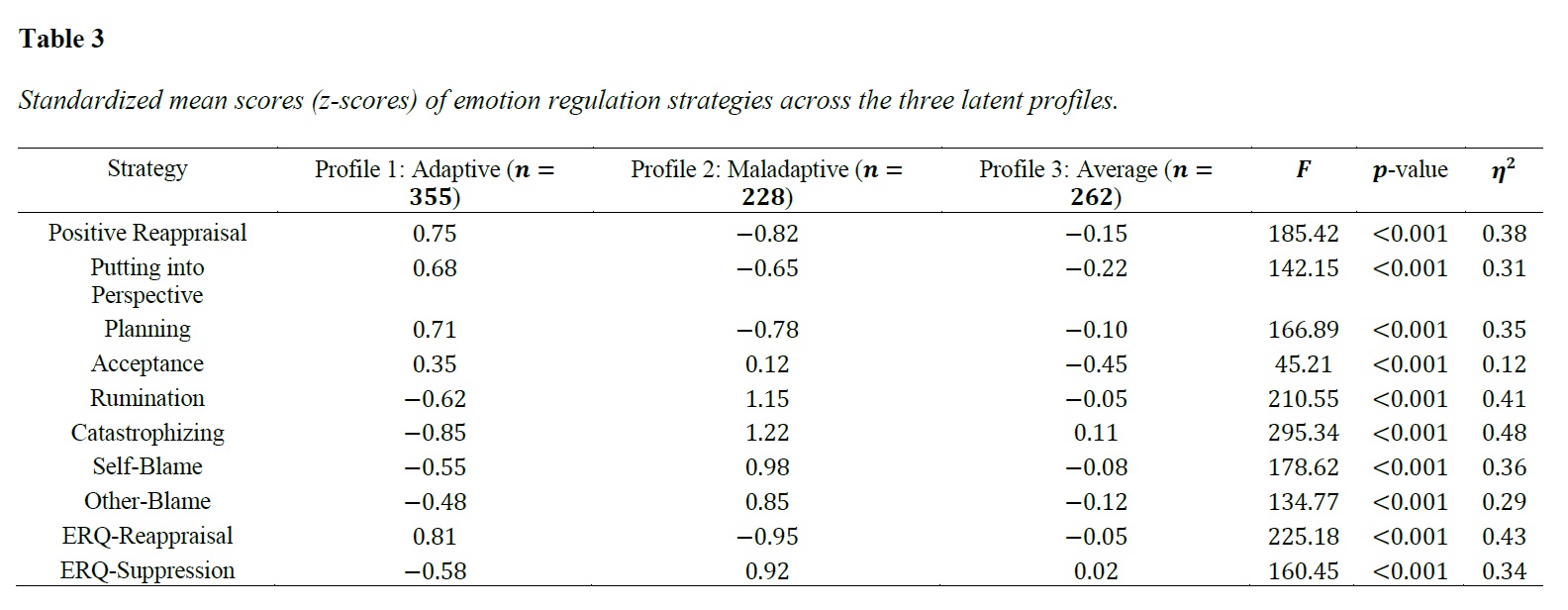
Findings: The GMM analysis revealed a profile solution as optimal. The largest group, labeled Adaptive Regulators ( , ), exhibited high use of constructive strategies (e.g., cognitive reappraisal) and low use of detrimental strategies. Maladaptive Regulators ( , ) were characterized by high levels of catastrophizing, rumination, and expressive suppression, alongside deficits in adaptive coping. The remaining Average Regulators ( , ) demonstrated mean-level scores across all assessed dimensions. Demographic analyses indicated a significant association between biological sex and profile membership ( , ), with females significantly overrepresented in the Maladaptive Regulators profile. No significant differences were observed across early versus late age groups ( , ).
Conclusion: Adolescents do not utilize emotion regulation strategies in isolation but rather deploy complex, distinct multivariate configurations. Identifying these latent profiles highlights the critical vulnerability of the maladaptive subgroup and underscores the necessity for targeted, personalized mental health interventions, such as tailored cognitive-behavioral or socio-emotional therapies, to mitigate psychopathology risk and promote normative developmental trajectories.
Downloads
References
Friedman, G., & Mezulis, A. H. (2025). Adolescent Impulsivity and Emotion Dysregulation: The Moderating Role of Parental Socialization of Negative Emotions. Psychological Reports. https://doi.org/10.1177/00332941241312315
Gao, L., Kong, F., Liu, F., Zhang, Z., & Wang, X. (2025). Shyness and Adolescents' Smartphone Addiction: Roles of Maladaptive Cognitive Emotion Regulation, Experiential Avoidance, and Online Social Support. Psychology in the Schools, 62(3), 864-874. https://doi.org/10.1002/pits.23360
Goagoses, N., Schüürmann, A., Pöchmüller, V., & Hillenbrand, C. (2025). Cognitive Emotion Regulation and Problematic Video Gaming During Adolescence. Zeitschrift Für Entwicklungspsychologie Und Pädagogische Psychologie. https://doi.org/10.1026/0049-8637/a000303
Gómez-León, M. I. (2025). Serious games to support emotional regulation strategies in educational intervention programs with children and adolescents: Systematic review and meta-analysis. Heliyon.
He, K., Chen, L., Fan, H., Sun, L., Yang, T., Liu, H., & Wang, K. (2025). Effects of Rumination and Emotional Regulation on Non-Suicidal Self-Injury Behaviors in Depressed Adolescents in China: A Multicenter Study. Psychology research and behavior management, 18, 271-279. https://doi.org/10.2147/PRBM.S483267
Jesline, J., Romate, J., Diya, E., & Rajkumar, E. (2025). Mediating role of resilience on the relationship between meta emotions and emotional regulation among neglected adolescents. BMC psychology, 13(1), 1-13. https://doi.org/10.1186/s40359-025-02856-0
Kim, J. A., Sankar, A., Marks, R., Carrubba, E., Lecza, B., Quatrano, S., & Blumberg, H. P. (2025). Chronotherapeutic intervention targeting emotion regulation brain circuitry, symptoms, and suicide risk in adolescents and young adults with bipolar disorder: a pilot randomised trial. BMJ Ment Health, 28(1). https://doi.org/10.1136/bmjment-2024-301338
Li, E. (2025). The Impact of Emotion Regulation Strategies on Adolescent Mental Health: Interactions of Family and Society. International Journal of Education and Humanities, 18(1), 180-184. https://doi.org/10.54097/w689dm55
Lin, H. (2025). A Review of Research on the Effects of Mindful Exercises on Emotion Regulation and Mental Health Among Adolescents. Studies in Sports Science and Physical Education, 3(1), 24-35. https://doi.org/10.56397/ssspe.2025.03.03
López-Martínez, L. F., Carretero, E. M., Carrasco, M. A., & Pérez-García, A. M. (2025). Self-Regulation, Emotional Symptomatology, Substance Use, and Social Network Addiction in Adolescent Self-Harm. Behavioral Sciences, 15(3), 257. https://doi.org/10.3390/bs15030257
Naeem, E., Rafique, S., Nazir, R., & Rasool, S. (2025). Relationship Between Emotional Regulation and Video Game Addiction Among Adolescents: Role of Perceived Social Support. Ijss, 3(1), 314-323. https://doi.org/10.59075/ijss.v3i1.643
Nguyen, A., Grummitt, L., Barrett, E. L., Bailey, S., Gardner, L. A., Champion, K. E., & Birrell, L. (2025). The relationship between emotion regulation and mental health in adolescents: Self-compassion as a moderator. Mental Health & Prevention, 38. https://doi.org/10.1016/j.mhp.2025.200430
Nikolić, N., Srećković, M., & Malbaša, J. D. (2025). Risk Factors for Suicidal Tendencies Among Adolescents: The Role of Family System, Emotional Regulation, Cyberbullying,and Sleep Issues. 322-337. https://doi.org/10.46793/girr25.322n
Northrup, J. B. (2025). Improving Emotion Regulation and Executive Function in At-Risk Adolescents via VR. Applied Sciences, 15(3), 1223. https://doi.org/10.3390/app15031223
Omopo, O. E. (2025). Can emotion regulation, peer pressure, and social support shape the impact of childhood trauma on adolescent mental health? A structural equation modelling approach in Oyo State, Nigeria. International Journal of Innovative Psychology & Social Development, 13(3), 56-65. https://www.seahipublications.org/wp-content/uploads/2025/07/IJIJPSD-S-7-2025.pdf
Piguet, C., Celen, Z., Meuleman, B., Schilliger, Z., Smith, M. M., Mendola, E., Pham, E., Jouabli, S., Ivanova, V., Murray, R. J., Klauser, P., & Merglen, A. (2025). Impact of a Mindfulness‐Based Intervention on Symptoms and Emotion Regulation Strategies in Young Adolescents From the General Population: A Randomized Controlled Trial. Depression and Anxiety, 2025(1). https://doi.org/10.1155/da/2679049
Seymour, K. E. (2025). Emotion regulation beyond executive dysfunction in adolescents. Child and adolescent psychiatry and mental health, 19, 12. https://doi.org/10.1186/s13034-025-00898-1
Shadfar, Z., Emami, F., Kojouri, A., Koohestani, F., & Khandehroy Lafmegani, S. (2025). Comparison of Emotion-Focused Therapy Approach and Meta-Diagnostic Protocol on Emotion Regulation in Adolescents with Borderline Personality Disorder. International Journal of Body, Mind & Culture, 12(2). https://search.ebscohost.com
Thoustrup, C. L., & et al. (2024). Emotion dysregulation in youths with obsessive-compulsive disorder: A longitudinal study. Journal of Clinical Child & Adolescent Psychology, 53(4), 567-579. https://doi.org/10.1080/15374416.2024.1876252
Tolan, Ö. Ç., & Dersuneli, Y. (2024). Examining the Relationships Between Emotion Regulation and Non-Suicidal Self-Injury Behavior in Adolescents: A Systematic Review. Turkish Journal of Child and Adolescent Mental Health, 31(2), 110-122. https://doi.org/10.4274/tjcamh.galenos.2022.74936
Türk, F., & Koçyiğit, B. (2025). The Relationship Between Fear of Missing Out and Loneliness Among Adolescents in the Digital Age: The Mediating Roles of Emotion Dysregulation and Social Media Addiction. Malaysian Online Journal of Educational Technology, 13(1), 19-36. https://doi.org/10.52380/mojet.2025.13.1.566
Wang, Z. J., Liu, C. Y., Wang, Y. M., & Wang, Y. (2024). Childhood psychological maltreatment and adolescent depressive symptoms: Exploring the role of social anxiety and maladaptive emotion regulation strategies. Journal of affective disorders, 344, 365-372. https://doi.org/10.1016/j.jad.2023.10.046
Wright, D., Evans, P., & Brown, K. (2024). Emotion regulation and executive function in adolescence: A longitudinal study. Journal of Emotional and Behavioral Disorders, 21(2), 98-110. https://doi.org/10.1111/jebd.2024.21210
Wright, T., Miller, H., & Davis, R. (2024). Emotional regulation and ambiguity tolerance in adolescence. Journal of Behavioral Studies, 38(3), 143-157. https://doi.org/10.3567/jbs.2024.38345
Wu, J., Wang, C., Zheng, Y., Han, X., Guo, J., Cui, Y., Hu, J., Lin, M. P., & You, J. (2025). Intolerance of Uncertainty Predicts Suicidal Ideation Among Adolescents Through Maladaptive Cognitive Emotion Regulation Strategies and Psychache. Suicide and Life-Threatening Behavior, 55(2). https://doi.org/10.1111/sltb.70001
Zhang, Y., Hu, Y., & Yu, M. (2024). Exploring Emotional Support and Engagement in Adolescent EFL Learning: The Mediating Role of Emotion Regulation Strategies. Language Teaching Research. https://doi.org/10.1177/13621688241266184
Zhao, J., Pozzi, E., Lin, S. C., Kehoe, C. E., Havighurst, S. S., & Whittle, S. (2024). Association Between Maternal Emotion Socialization and Emotion Regulation in Adolescents With Elevated Internalizing Symptoms: Insights From Multiple-Informant Discrepancies. https://doi.org/10.31234/osf.io/mqa5u_v1
Zhao, J., Pozzi, E., Lin, S. C., Kehoe, C. E., Havighurst, S. S., & Whittle, S. (2025). Association Between Maternal Emotion Socialization and Emotion Regulation in Early Adolescents With Elevated Internalizing Symptoms: Insights From Multi-Informant Discrepancies. Frontiers in Psychiatry, 16. https://doi.org/10.3389/fpsyt.2025.1497007
Downloads
Additional Files
Publication Timeline
- Submitted
- Revised
- Accepted