Emotionally Unavailable Parenting and Alexithymia: The Mediating Role of Attachment Insecurity
DOI:
https://doi.org/10.61838/kman.jayps.6.6.14Keywords:
Emotionally Unavailable Parenting, Attachment Insecurity, AlexithymiaAbstract
Objective: This study aimed to explore whether attachment insecurity mediates the relationship between emotionally unavailable parenting and alexithymia in young adults.
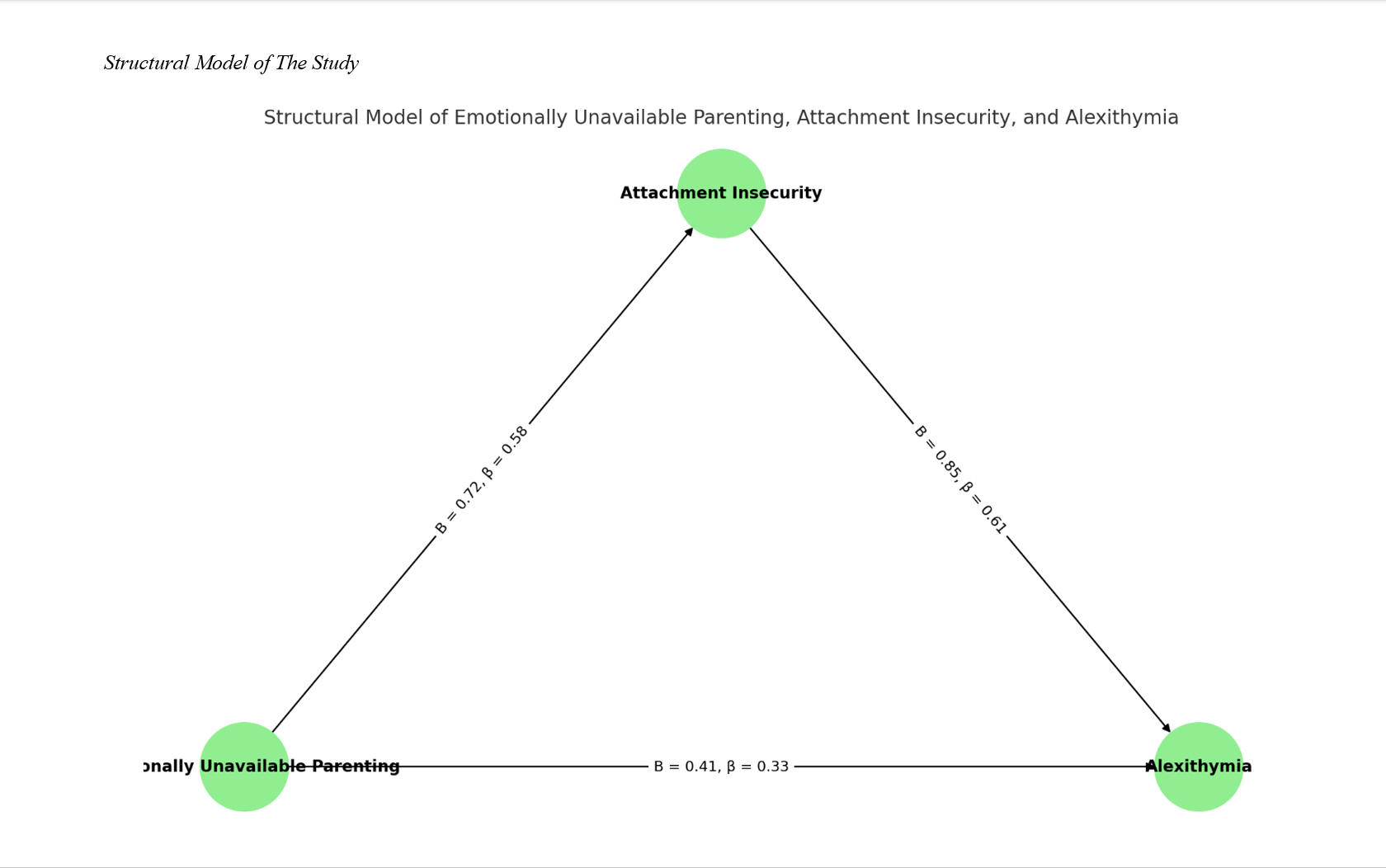
Methods and Materials: The study utilized a descriptive correlational design with a sample of 414 Turkish university students, determined based on the Krejcie and Morgan sample size table. Participants were selected through convenience sampling and completed three standardized self-report instruments: the Parental Bonding Instrument (PBI) to assess emotionally unavailable parenting, the Experiences in Close Relationships–Revised (ECR-R) to evaluate attachment insecurity, and the Toronto Alexithymia Scale-20 (TAS-20) to measure alexithymia. Data were analyzed using SPSS version 27 for descriptive and Pearson correlation analyses, while Structural Equation Modeling (SEM) was performed using AMOS version 21 to test the hypothesized mediational model. Model fit was evaluated using multiple fit indices.
Findings: Results indicated moderate to high levels of emotionally unavailable parenting (M = 56.42, SD = 8.37), attachment insecurity (M = 82.15, SD = 10.92), and alexithymia (M = 61.78, SD = 9.45). Pearson correlations revealed significant positive relationships among all variables: emotionally unavailable parenting and attachment insecurity (r = .58, p < .001), emotionally unavailable parenting and alexithymia (r = .53, p < .001), and attachment insecurity and alexithymia (r = .61, p < .001). SEM confirmed that attachment insecurity significantly mediated the relationship between emotionally unavailable parenting and alexithymia, with strong model fit indices (χ²/df = 2.12, CFI = 0.96, RMSEA = 0.048).
Conclusion: The findings highlight the pivotal role of attachment insecurity in linking emotionally unavailable parenting to alexithymia. These results emphasize the importance of enhancing emotional responsiveness in parenting to support healthier emotional development and attachment in young adults.
Downloads
References
Abbasi, M., & Nejad, M. H. (2025). Positive Parenting as a Moderator of the Association Between Alexithymia and Adolescent Aggression. https://doi.org/10.20944/preprints202505.0966.v1
Alauddin, N. M., & Anbarasu, D. (2023). Alexithymia in Parents of Children With Neurodevelopmental Disorder: A Cross-Sectional Comparative Study. The Indian Journal of Occupational Therapy, 55(4), 107-112. https://doi.org/10.4103/ijoth.ijoth_9_24
Ansari, S. K., & Fatima, A. (2023). Untamed Mental Well-Being of Children From Shadow Parenting Families. https://doi.org/10.5772/intechopen.1002871
Brown, R., Murray, A. L., Stewart, M. E., & Auyeung, B. (2022). Psychometric Validation of a Parent-Reported Measure of Childhood Alexithymia. European Journal of Psychological Assessment, 38(1), 24-31. https://doi.org/10.1027/1015-5759/a000640
Hobson, H., & Neeltje, P. v. d. B. (2021). The Association Between Parent and Child-Report Measures of Alexithymia in Children With and Without Developmental Language Disorder. International journal of environmental research and public health, 18(16), 8309. https://doi.org/10.3390/ijerph18168309
Jarvers, I., Kormann, E., Schleicher, D., Ecker, A., Kandsperger, S., & Brunner, R. (2024). Impact of Alexithymia, Speech Problems and Parental Emotion Recognition on Internalizing and Externalizing Problems in Preschoolers. PLoS One, 19(9), e0310244. https://doi.org/10.1371/journal.pone.0310244
Kosić, R., Petrić, D., Vlašić-Cicvarić, I., & Kosec, T. (2025). Associations Between Parental Alexithymia and Family Dynamics in Autism Spectrum Disorder. Healthcare, 13(4), 373. https://doi.org/10.3390/healthcare13040373
Lester, K. J., McDonald, B., Tunks, A., & Michelson, D. (2024). Intervention for School Anxiety and Absenteeism in Children (ISAAC): Mixed-Method Feasibility Study of a Coach-Assisted, Parent-Focused Online Program. Child Psychiatry & Human Development. https://doi.org/10.1007/s10578-024-01755-6
Li, R., Kajanoja, J., Karlsson, L., Karlsson, H., & Karukivi, M. (2022). Sex‐specific Role of Alexithymia in Associations Between Parental Bonding and Mental Health: A Moderated Mediation Model. Journal of Clinical Psychology, 79(1), 126-142. https://doi.org/10.1002/jclp.23372
Lin, Y., Wang, Y., Lin, C., Ni, Q., Jia, R., Chang, Y., & Qi, Y. (2023). The Mediating Role of Perceived Social Support: Alexithymia and Parental Burnout in Parents of Children With Autism Spectrum Disorder. Frontiers in psychology, 14. https://doi.org/10.3389/fpsyg.2023.1139618
Liu, Q., & Lopez, E. (2024). Research on Parenting Style, Alexithymia and Fear of Intimacy Among College Students. Applied & Educational Psychology, 5(1). https://doi.org/10.23977/appep.2024.050113
Mbutitia, F., & Adeli, S. (2020). Building Resilience: The Invisible Childhood Emotional Neglect. Children and Teenagers, 3(2), p93. https://doi.org/10.22158/ct.v3n2p93
McDonald, B., Tunks, A., Michelson, D., & Lester, K. J. (2024). Intervention for School Anxiety and Absenteeism (ISAAC): Mixed-Method Feasibility Study of a Coach-Assisted, Parent-Focused Online Program. https://doi.org/10.21203/rs.3.rs-4435988/v1
Özdemir, Ö., Ergelen, M., Ozen, B., Akgul, I. F., & Bestepe, E. E. (2022). Alexithymia and Parental Bonding in Women With Genitopelvic Pain/Penetration Disorder. Neuropsychiatric Disease and Treatment, Volume 18, 3023-3033. https://doi.org/10.2147/ndt.s389008
Peeligama, H. M. C. D. K., & Attygalle, U. R. (2022). “Killing a Demon”: The Use of Cultural Symbols in Therapeutic Work With Children- A Case Report. Journal of the University of Ruhuna, 10(1), 25-29. https://doi.org/10.4038/jur.v10i1.7990
Radley, J., Barlow, J., & Johns, L. (2022). The Needs and Experiences of Parents With Psychosis: A Qualitative Interview Study. Journal of Child and Family Studies, 32(8), 2431-2443. https://doi.org/10.1007/s10826-022-02409-8
Romeo, A., Tella, M. D., Ghiggia, A., Tesio, V., Fusaro, E., Geminiani, G., & Castelli, L. (2020). Attachment Style and Parental Bonding: Relationships With Fibromyalgia and Alexithymia. PLoS One, 15(4), e0231674. https://doi.org/10.1371/journal.pone.0231674
Scarzello, D. (2023). The Relationship Between Paternal Alexithymia and Children’s Internalizing and Externalizing Behavioral Problems During Early Childhood. Children, 10(9), 1498. https://doi.org/10.3390/children10091498
Srivastava, P., Bamba, C., Chopra, S., Rohilla, M., Chaudhry, C., Kaur, A., Panigrahi, I., & Mandal, K. (2023). Identification of Genetic Alterations in Couples and Their Products of Conceptions From Recurrent Pregnancy Loss in North Indian Population. Frontiers in Genetics, 14. https://doi.org/10.3389/fgene.2023.1155211
Vlaicu, C., & Haidu, F. A. (2020). Co-Dependency in Intimate Relationship-a Learned Behaviour. International Journal of Theology Philosophy and Science, 4(6), 82-89. https://doi.org/10.26520/ijtps.2020.4.6.82-89
Wang, Z., & Yang, Z. (2024). Mental Imagery in the Relationship Between Alexithymia and Parental Psychological Control. Behavioral Sciences, 14(3), 183. https://doi.org/10.3390/bs14030183
Zhao, W., Yang, Y., Guo, W., & Gong, P. (2023). Polymorphisms and Parental Bonding Modulate Alexithymia: The Main Effects and Interaction. Journal of Pacific Rim Psychology, 17. https://doi.org/10.1177/18344909231154928
Zheng, Q., & Lopez, E. (2024). Parental Psychological Control, Alexithymia, Social Avoidance and Distress, and Coping Style Among Chinese College Students. Applied & Educational Psychology, 5(3). https://doi.org/10.23977/appep.2024.050319
Downloads
Additional Files
Publication Timeline
- Submitted
- Revised
- Accepted
Issue
Section
License

This work is licensed under a Creative Commons Attribution-NonCommercial 4.0 International License.