Algorithmic Identification of Academic Burnout: Integrating Wearable Sensor Data and School Performance Metrics via Gradient Boosted Decision Trees
DOI:
https://doi.org/10.61838/kman.jayps.4174Keywords:
Academic Burnout, Wearable Sensors, Machine Learning, Gradient Boosted Decision Trees, Heart Rate Variability, Educational Data MiningAbstract
Objective: To develop and validate a multimodal machine learning pipeline utilizing Gradient Boosted Decision Trees to accurately identify academic burnout by integrating continuous physiological data from wearable sensors with behavioral school performance metrics.
Methods and Materials: A prospective longitudinal study was conducted with a cohort of undergraduate students enrolled in high-intensity programs in Brazil. Multimodal data collection encompassed continuous physiological monitoring via wrist-worn sensors to capture heart rate variability, electrodermal activity, and sleep architecture, alongside institutional academic registry data tracking lecture attendance, assignment submission latency, and examination scores. Ground-truth burnout classification was established using the Maslach Burnout Inventory-Student Survey. A Gradient Boosted Decision Trees (GBDT) algorithm was trained and optimized to classify students into burnout and non-burnout categories, evaluating performance through accuracy, F1 score, and area under the receiver operating characteristic curve (AUC-ROC).
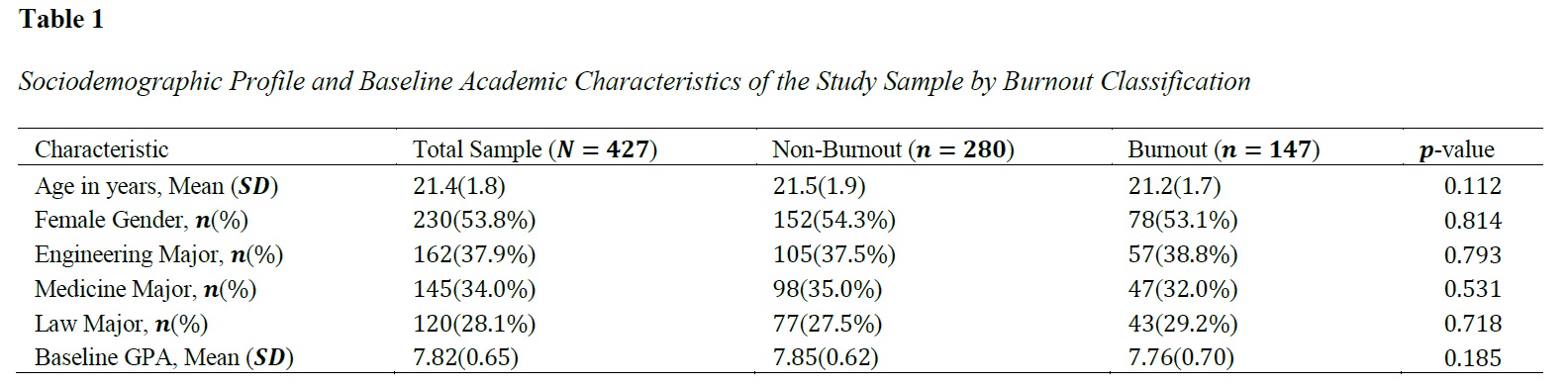
Findings: The demographic analysis revealed a burnout prevalence of ( ) within the sample. The optimized GBDT model demonstrated superior predictive capability, achieving an overall classification accuracy of , an F1 score of , and an AUC-ROC of . Feature importance analysis indicated that physiological indicators of allostatic load, primarily rolling heart rate variability ( relative importance), and behavioral withdrawal metrics, specifically assignment submission latency ( relative importance), were the most significant predictors of the syndrome. Furthermore, the burnout cohort exhibited marked autonomic dysregulation, characterized by severely reduced deep sleep and elevated electrodermal activity peaks, directly mirroring their concurrent academic decline.
Conclusion: The integration of continuous biometric sensor data with institutional academic metrics via gradient boosting algorithms provides a highly accurate, objective framework for the early identification of academic burnout.
Downloads
References
Bahari, A. P., & Salim, A. (2025). Pengaruh Academic Burnout Terhadap Mekanisme Coping Pada Mahasiswa Akhir Di Yogyakarta. Reslaj Religion Education Social Laa Roiba Journal, 7(1). https://doi.org/10.47467/reslaj.v7i1.5967
Bazaz, S. M., & Farhadian, A. (2025). Predicting Academic Burnout Based on School Belongingness, Parenting Styles, and Academic Resilience. Jayps, 6(3), 79-86. https://doi.org/10.61838/kman.jayps.6.3.9
Chang, K. J., Seo, J., Kim, M.-J., Song, H.-Y., & Kim, M. S. (2025). Psychological Mechanism Contributing to Academic Burnout and Depression in College Students: Focus on Evaluation Concern Perfectionism, Academic Procrastination, Fear of Failure, and Self-Handicapping. Korean Assoc Learner-Centered Curric Instr, 25(2), 807-824. https://doi.org/10.22251/jlcci.2025.25.2.807
Chen, J., Liu, X., Xie, J., Yang, Q., Fan, Z., Peng, D., Wang, Y., & Lu, C. (2025). Effects of physical activity on academic burnout among rural left-behind children in China: the chain-mediated roles of loneliness and general self-efficacy. Frontiers in psychology, 16, 1653243. https://doi.org/10.3389/fpsyg.2025.1653243
Feng, T., Wang, B., Mi, M., Ren, L., Wu, L., Wang, H., & Wang, X. (2025). The relationships between mental health and social media addiction, and between academic burnout and social media addiction among Chinese college students: A network analysis. Heliyon, 11(3). https://doi.org/10.1016/j.heliyon.2025.e41869
Gao, J., Tian, X., & Wu, H. (2025). Exploring the Mediating Role of Social Support in Sports Participation and Academic Burnout Among Adolescent Students in China. Frontiers in psychology, 16. https://doi.org/10.3389/fpsyg.2025.1591460
Ibrahim, I. A., Alenezi, A., Hagrass, H. R., & Abdou, H. (2025). Unveiling the Impact of Grit and Learning Agility on Academic Burnout Among Nursing Students: A Cross-Sectional Study. Sage Open Nursing, 11. https://doi.org/10.1177/23779608251346685
Iqbal, A., Yaseen, F. S., & Kashif, M. F. (2025). Impact of Social Media Usage on Academic Burnout of Students among Undergraduate Students. Annals of Human and Social Sciences, 6(3), 142-155. https://ojs.ahss.org.pk/journal/article/view/1024
Mafi, S., Tajvar, N., & Jalalvand, S. (2025). The Role of Emotional Intelligence, Academic Burnout, and Alexithymia in Shaping Academic Outcomes for Dental Students. https://doi.org/10.21203/rs.3.rs-6376846/v1
Niu, J., & Ma, X. (2024). The Impact of Stressful Life Events on Academic Burnout Among College Students: A Moderated Mediation Model. Yixin Publisher, 2(3), 1-9. https://doi.org/10.59825/jet.2024.2.3.1
Nuryana, I. K. D., & Wahyuni, D. (2025). The Role of Learning Motivation in Mediating the Influence of Self-Regulated Learning and Peer Social Support on Academic Burnout in Grade XI Boarding School Students at Madrasah Aliyah, Sleman Regency. Ijems, 2(1), 219-237. https://doi.org/10.61132/ijems.v2i1.451
Park, H. (2025). The Effects of Academic Achievement Pressure of Parents and Parent-Adolescent Communication on Academic Burnout and School Life Adjustment of High School Students. Korean Assoc Learner-Centered Curric Instr, 25(1), 653-670. https://doi.org/10.22251/jlcci.2025.25.1.653
Qiang, J., He, X., Zheng, X., Huang, J., & Xu, C. (2024). The Association Between Intolerance of Uncertainty and Academic Burnout Among University Students: The Role of Self-Regulatory Fatigue and Self-Compassion. Frontiers in Public Health, 12. https://doi.org/10.3389/fpubh.2024.1441465
Rafigh Iranian, S., Narimani, M., & Nokhostin Goldoust, A. (2024). The effectiveness of academic burnout reduction training package on reducing psychological distress and improving academic achievement of female high school students. Journal of School Psychology, 13(2), 1-12. https://jsp.uma.ac.ir/%20http:/jsp.uma.ac.ir/article_3155.html
Rahmani, Z., & Amani, A. (2025). Investigating the relationship between academic burnout and internet addiction through the mediating role of conformity communication pattern among high school students. Social Psychology Research, 15(57), 137-152. https://www.socialpsychology.ir/article_219121.html
Sari, L., Thahir, A., & Adnan Reza, F. (2024). Academic burnout in terms of perfectionism and self-efficacy. Unpublished manuscript. https://civilica.com/doc/1203522/
Souri, A., Aghayousefi, A., & Dortaj, F. (2024). Explaining the phenomenon of students' academic burnout based on the role of academic procrastination and parents' perfectionism (case study of high school students of Qom city). Sociology of Education, 10(3), 98-108. https://www.iase-jrn.ir/article_718757.html?lang=en
Sun, M., Piao, M., & Jia, Z. (2024). The impact of alexithymia, anxiety, social pressure, and academic burnout on depression in Chinese university students: An analysis based on SEM. BMC psychology, 12, 757. https://doi.org/10.1186/s40359-024-02262-y
Supriyanto, A., Imtinan, S., Arikunto, S., Handaka, I. B., & Hartini, S. (2024). Academic Burnout Conditions in Indonesian Students: Physical, Mental, and Emotional. Edu, 80-86. https://doi.org/10.59397/edu.v2i2.26
Tang, X.-l. (2024). The Impact of School Climate on Academic Burnout of Chinese Students: The Mediating Effect of Psychological Capital. Frontiers in Education, 9. https://doi.org/10.3389/feduc.2024.1346347
Wang, S., Wang, Y., & Zhao, L. (2025). Effects of psychological resilience on online learning performance and satisfaction among undergraduates: The mediating role of academic burnout. The Asia-Pacific Education Researcher, 34(1), 395–409. https://doi.org/10.1007/s40299-024-00862-1
Xiaoling, T. (2024). The Impact of School Climate on Academic Burnout of Chinese Students: The Mediating Effect of Psychological Capital. Frontiers in Education, 9. https://doi.org/10.3389/feduc.2024.1346347
Xue, S., Lu, A., Chen, W., Liang, Y., Li, X., Liu, W. C., Zhu, Y. C., Wang, X. J., & Zeng, S. (2025). How to Alleviate Students' Academic Burnout? Using Latent Profile Analysis and Network Analysis to Explore the Positive Impact of School Climate and Achievement Goal Orientation. Psychology in the Schools, 62(6), 1704-1715. https://doi.org/10.1002/pits.23424
Yang, G. H., Cao, X. X., Fu, Y. Y., Wang, N. D., & Lian, S. L. (2024). Mobile phone addiction and academic burnout: the mediating role of technology conflict and the protective role of mindfulness. Frontiers in Psychiatry, 15, 1365914. https://doi.org/10.3389/fpsyt.2024.1365914
Yao, W., Hou, H., Yang, P., & Ni, S. (2025). The co-occurrence of adolescent smartphone addiction and academic burnout: The role of smartphone stress and digital flourishing. Education and Information Technologies, 30(4), 4987-5007. https://doi.org/10.1007/s10639-024-13017-y
Zhang, J., Meng, J., & Wen, X. (2025). The Relationship Between Stress and Academic Burnout in College Students: Evidence From Longitudinal Data on Indirect Effects. Frontiers in psychology, 16. https://doi.org/10.3389/fpsyg.2025.1517920
Zhang, Z., Wang, Y., Wu, H., Zhou, Y., & Peng, C. (2024). Direct and Indirect Effects of Father-Child Attachment on Academic Burnout in College Students. Frontiers in psychology, 15. https://doi.org/10.3389/fpsyg.2024.1345590
Zhao, H., Han, M., Wang, Z., & Liu, B. (2024). School Connectedness and Academic Burnout in Middle School Students: A Multiple Serial Mediation Model. Behavioral Sciences, 14(11), 1077. https://doi.org/10.3390/bs14111077
Zuo, X., Zhao, L., Li, Y., He, W., Yu, C., & Wang, Z. (2024). Psychological mechanisms of English academic stress and academic burnout: the mediating role of rumination and moderating effect of neuroticism. Frontiers in psychology, 15, 1309210. https://doi.org/10.3389/fpsyg.2024.1309210
Downloads
Additional Files
Publication Timeline
- Submitted
- Revised
- Accepted