Comparison of the Effectiveness of Narrative Therapy for Internet Addiction and Cognitive-Behavioral Therapy on Social Anxiety and Rejection Sensitivity in Adolescent Girls with Symptoms of Internet Addiction
DOI:
https://doi.org/10.61838/kman.jayps.4488Keywords:
narrative therapy for internet addiction, cognitive-behavioral therapy, social anxiety, rejection sensitivity, adolescent girlsAbstract
Objective: Internet addiction can create various problems for adolescents. Accordingly, the present study was conducted to compare the effectiveness of narrative therapy for internet addiction with cognitive-behavioral therapy on social anxiety and rejection sensitivity in adolescent girls with symptoms of internet addiction.
Methods and Materials: This research employed a quasi-experimental design with three phases: pre-test, post-test, and follow-up, including a control group. The statistical population consisted of all female students with symptoms of internet addiction in Lenjan County, Isfahan City, during the winter of 2025. From this population, 60 students were purposefully selected and assigned to three groups (20 participants in each group). The Social Anxiety Scale (Connor et al., 2000) and the Rejection Sensitivity Questionnaire (Downey & Feldman, 1996) were used to measure the dependent variables across the three phases. The two treatment groups each received eight sessions of therapy, lasting 75 to 95 minutes per session, while the control group did not receive any intervention. Data were analyzed using repeated measures ANOVA and Bonferroni post-hoc tests through SPSS version 26.
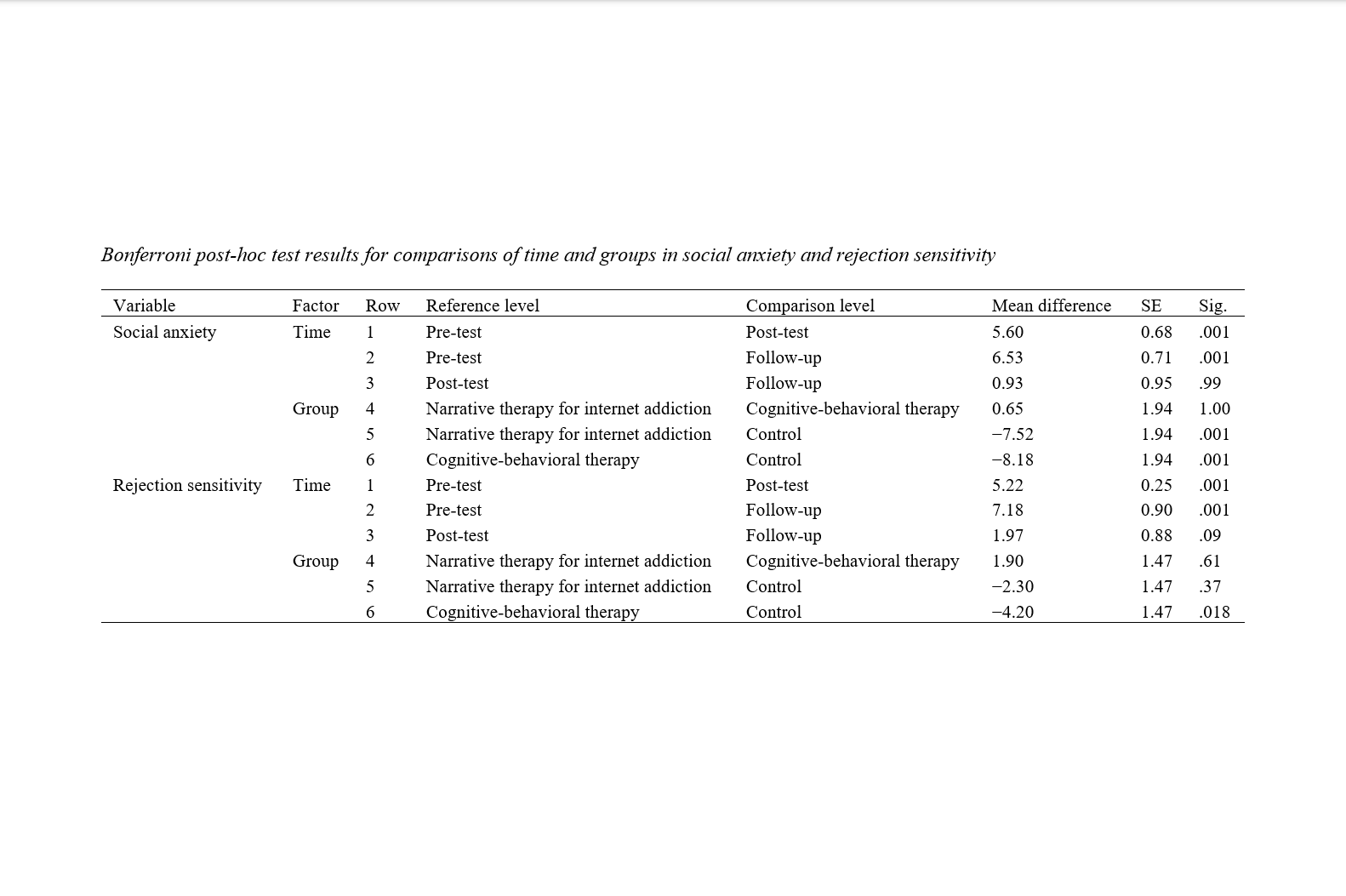
Findings: The results showed that, for social anxiety, there was a significant difference between the narrative therapy for internet addiction group and the cognitive-behavioral therapy for internet addiction group compared with the control group (p < .01). However, there was no significant difference in the effectiveness of the two therapies (p > .01). For the variable of rejection sensitivity, a significant difference was observed only between the cognitive-behavioral therapy for internet addiction group and the control group (p < .01). No significant difference was found between the effectiveness of the two treatments on rejection sensitivity (p > .05).
Conclusion: Given the effectiveness of both narrative therapy for internet addiction and cognitive-behavioral therapy in reducing social anxiety and rejection sensitivity, it is recommended that these two therapies be used in psychotherapy and counseling centers for adolescent girls with symptoms of internet addiction.
Downloads
References
Arafat, D., Jamal, J., Sachs, A., Suchan, B., Juckel, G., & Thoma, P. (2025). Emotion recognition in individuals with elevated internet addiction scores: An event-related potential study. Psychiatry Research. Neuroimaging, 349, 111982. https://doi.org/10.1016/j.psychresns.2025.111982
Chen, M. Y., Jiang, Y. Y., Huang, H. T., Liu, S., Feng, Y., Zhang, X. L., Su, Z., Cheung, T., Ng, C. H., Xiang, Y. T., & Wang, G. (2025). Internet addiction and its association with quality of life in college students: a network perspective. Frontiers in Psychiatry, 16, 1555372. https://doi.org/10.3389/fpsyt.2025.1555372
Cheng, X., Fan, Y., Li, S., Li, X., Jin, S., Zhou, C., & Feng, Y. (2025). Research landscape and trends of internet addiction disorder: A comprehensive bibliometric analysis of publications in the past 20 years. Digital Health, 11, 20552076251336940. https://doi.org/10.1177/20552076251336940
Dafian, F., & Yousefi, Z. (2024). The effectiveness of narrative therapy on emotional regulation and reflective functioning among adolescent girls in Isfahan. Journal of Sabzevar University of Medical Sciences, 31(2), 146-157. https://jsums.medsab.ac.ir/article_1619.html?lang=fa
Deriu, V., Altavilla, D., Adornetti, I., Chiera, A., & Ferretti, F. (2024). Narrative identity in addictive disorders: a conceptual review. Frontiers in psychology, 15, 1409217. https://doi.org/10.3389/fpsyg.2024.1409217
Ding, H., Cao, B., & Sun, Q. (2023). The association between problematic internet use and social anxiety within adolescents and young adults: a systematic review and meta-analysis. Frontiers in Public Health, 11, 1275723. https://doi.org/10.3389/fpubh.2023.1275723
Dong, W., Tang, H., Wu, S., Lu, G., Shang, Y., & Chen, C. (2024). The effect of social anxiety on teenagers' internet addiction: the mediating role of loneliness and coping styles. BMC psychiatry, 24, 395. https://doi.org/10.1186/s12888-024-05854-5
Fontana, A., Callea, A., Casini, E., & Curti, V. (2018). Rejection sensitivity and internet addiction in adolescence: exploring the mediating role of emerging personality disorders. Clinical Neuropsychiatry, 15, 206. https://search.ebscohost.com/login.aspx?direct=true&profile=ehost&scope=site&authtype=crawler&jrnl=17244935&AN=132027384&h=cNk%2Bxm4xNcnUonAwxfqF3HBtCJgIcb2on0K4DN30b6VDes1MBQBK4BRWAWSxvo1SwbhNNm5BLUZzBcPWXhuZCg%3D%3D&crl=c
Gall, J., Borg, W., & Gall, M. D. (2014). Quantitative and qualitative research methods in educational and psychological sciences - Volume 1. Shahid Beheshti University Press and Samt Publications. https://psybooks.ir/product/
Ghavamie, M., Fattahi Zadeh, M., Farahmarzi, S., & Nouri Imamzadeh, A. (2014). The effectiveness of narrative therapy on social anxiety and self-esteem among female middle school students. School Psychology and Education, 3(3), 61-73. https://www.sid.ir/paper/216636/fa
Gong, Y., Gong, N., Zhang, Z., He, Y., & Tang, H. (2022). Effect of narrative therapy-based group psychological counseling on internet addiction among adolescents. Iranian Journal of Public Health, 51(6), 1331-1338. https://doi.org/10.18502/ijph.v51i6.9678
Hashemian, A., Direkvand-Moghadam, A., Delpisheh, A., Direkvand-Moghadam, A., Kolivand, Z., & Abasi, M. (2025). Prevalence of Internet addiction in Iranian high school students; a cross-sectional study. Journal of Basic Research in Medical Science, 1(3), 39-44. https://jbrms.medilam.ac.ir/browse.php?sid=1&a_id=63&slc_lang=en
Horton, E., & Everett, B. (2023). Narrative therapy expressive art group interventions for adolescents with eating disorders in residential treatment. Journal of Professional Counseling: Practice, Theory & Research, 51, 1-16. https://doi.org/10.1080/15566382.2023.2283362
Hosseini Beheshtian, S. M. (2011). A comparison of internet addiction status among male and female students in public universities of Tehran. Women's Research Journal, 2(2), 23-42. https://www.sid.ir/paper/235759/
Jin, Y., & Jiang, S. (2025). Theoretical perspectives on adolescent internet addiction: A comprehensive literature review. Health & Social Care in the Community, 4875332, 1-18. https://doi.org/10.1155/hsc/4875332
Kim, S. H., Yim, H. W., Jo, S. J., Jung, K. I., Lee, K., & Park, M. H. (2018). The effects of group cognitive behavioral therapy on the improvement of depression and anxiety in adolescents with problematic Internet use. Journal of Child & Adolescent Psychiatry, 29(2), 73-79. https://doi.org/10.5765/jkacap.2018.29.2.73
Ksiksou, J., Maskour, L., & Alaoui, S. (2023). Effects of cognitive-behavioral group therapy on reducing levels of Internet addiction, depression, anxiety, and stress among nursing students in Morocco. Iranian journal of psychiatry and behavioral sciences, 17(3), e136425. https://doi.org/10.5812/ijpbs-136425
Lindenberg, K., Kindt, S., & Szász-Janocha, C. (2022). Effectiveness of cognitive behavioral therapy-based intervention in preventing gaming disorder and unspecified Internet use disorder in adolescents: A cluster randomized clinical trial. JAMA Network Open, 5(2), e2148995. https://doi.org/10.1001/jamanetworkopen.2021.48995
Liu, J., Nie, J., & Wang, Y. (2017). Effects of group counseling programs, cognitive behavioral therapy, and sports intervention on Internet addiction in east asia: A systematic review and meta-analysis. International journal of environmental research and public health, 14(12), 1470. https://doi.org/10.3390/ijerph14121470
Nwufo, J. I., Ike, O. O., Nwoke, M. B., Eze, J., Chukwuorji, J. C., & Chineye Kanu, G. (2022). Social anxiety and internet addiction among adolescent students in a sub-Saharan African country: does family functioning make a difference? South African Journal of Psychology, 53(2), 275-285. https://doi.org/10.1177/00812463221140224
Reangsing, C., Wongchan, W., Trakooltorwong, P., Thaibandit, J., & Oerther, S. (2025). Effects of cognitive behavioral therapy (CBT) on addictive symptoms in individuals with internet gaming disorders: A systematic review and meta-analysis. Psychiatry research, 348, 116425. https://doi.org/10.1016/j.psychres.2025.116425
Rousta, A., Hamid, N., Boshlideh, K., & Hashemi, S. I. (2024). A comparison of the effectiveness of positive psychology-based therapy and cognitive-behavioral therapy on internet addiction and risky behaviors among students. New Psychological Research, 19(73), 22-34. https://www.sid.ir/paper/1163078/fa
Sangaran, L. N., Kadir, A. A., & Yaacob, L. H. (2024). Prevalence and associated factors of internet addiction among adolescents during the COVID-19 pandemic in Kota Bharu, Kelantan, Malaysia: A cross-sectional study. Malaysian Family Physician, 19, 59. https://doi.org/10.51866/oa.469
Shakeri, J., Ahmadi, S. M., Maleki, F., Hesami, M. R., Parsa, A., Ahmadzade, A., Shirzadi, M., & Elahi, A. (2020). Effectiveness of group narrative therapy on depression, quality of life, and anxiety in people with amphetamine addiction: A randomized clinical trial. Iranian Journal of Medical Sciences, 45, 91-99. https://pmc.ncbi.nlm.nih.gov/articles/PMC7071554/
Tao, Z., Zhao, X., Wang, Z., Yu, C., & Zhang, W. (2022). Rejection sensitivity mediates the interparental conflict and adolescent Internet addiction: School connectedness as a moderator. Frontiers in psychology, 13, 1038470. https://doi.org/10.3389/fpsyg.2022.1038470
Tom, A., Thomas, B., Sharma, M., & Joseph, A. (2023). Parental rejection and control: Potential risks for excessive Internet usage among adolescents. International Journal of Social Psychiatry, 69(8), 2007-2017. https://doi.org/10.1177/00207640231185450
van Rooij, A., Zinn, M., Schoenmakers, T., & Mheen, D. (2010). Treating Internet addiction with cognitive-behavioral therapy: A thematic analysis of the experiences of therapists. International journal of mental health and addiction, 10, 69-82. https://doi.org/10.1007/s11469-010-9295-0
Yilmaz, M., Üner, M., Sel, S., & Koldaş, G. (2025). Investigation of the relationships between internet addiction, social anxiety and happiness in adolescents (Arnavutkoy Case). Iranian Evolutionary Educational Psychology Journal, 7(1), 1-20. http://ieepj.hormozgan.ac.ir/article-1-874-fa.html
Zarbakhsh Bahri, M.-R., Rashidi, V., & Khademi, M. J. (2012). Loneliness and internet addiction among students. Journal of Health Promotion Management, 2(1), 32-38. https://jhpm.ir/browse.php?a_id=75&sid=1&slc_lang=en
Zheng, M., Wu, X., Chen, P., Si, T., Rao, S., Zhu, H., Su, Z., Cheung, T., & Ng, C. (2025). Prevalence of internet addiction among Chinese adolescents: A comprehensive meta-analysis of 164 epidemiological studies. Asian Journal of Psychiatry, 107, 104458. https://doi.org/10.1016/j.ajp.2025.104458
Downloads
Additional Files
Publication Timeline
- Submitted
- Revised
- Accepted
Issue
Section
License
Copyright (c) 2025 Sholeh Amani (Author); Mohsen Golparvar (Corresponding Author); Zahra Yousefi (Author)

This work is licensed under a Creative Commons Attribution-NonCommercial 4.0 International License.