Comparison of the Effectiveness of Imago Therapy and Schema Therapy on Executive Functions in Students with Academic Burnout
DOI:
https://doi.org/10.61838/kman.jayps.4613Keywords:
Imago therapy, schema therapy, executive functions, academic burnout, emotional regulation, cognitive flexibility.Abstract
Objective: This study aimed to compare the effectiveness of Imago therapy and schema therapy in improving executive functions among university students experiencing academic burnout.
Methods and Materials: The research employed a quasi-experimental design with a pretest–posttest–follow-up structure and a control group. The statistical population consisted of undergraduate students from Shiraz Nonprofit University during the 2024–2025 academic year who met the criteria for academic burnout. Forty-five students were selected using convenience sampling and randomly assigned to three groups: two experimental groups (Imago therapy and schema therapy) and one control group, each comprising 15 participants. The experimental groups received Imago therapy (seven 120-minute modules) and schema therapy (eight 90-minute sessions), while the control group received no intervention. Data were collected at three stages—pretest, posttest, and follow-up—using the Academic Burnout Questionnaire and the Behavior Rating Inventory of Executive Function–Adult Version (BRIEF-A). Data analysis was performed using repeated measures analysis of variance (ANOVA) and Bonferroni post hoc tests with SPSS version 25.
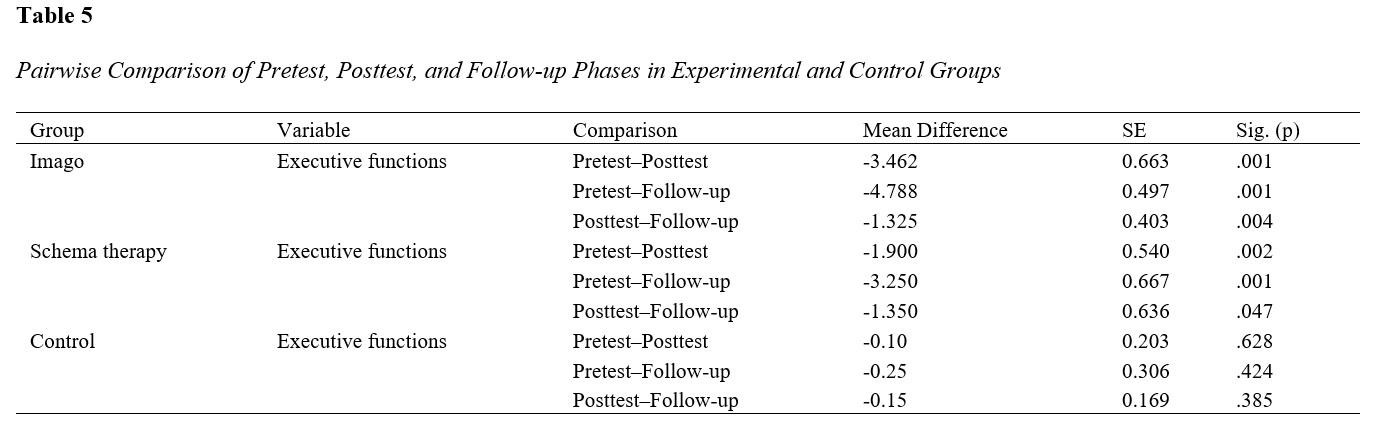
Findings: The results demonstrated that both therapeutic interventions led to statistically significant improvements in executive functions—including working memory, cognitive flexibility, and response inhibition—compared with the control group (p < .001). Additionally, Imago therapy showed significantly greater effectiveness than schema therapy in both the posttest and follow-up stages (F(4,114) = 12.021, p < .001, η² = .297).
Conclusion: These findings highlight the importance of relationship-based and reflective interventions in improving cognitive regulation and reducing academic burnout.
Downloads
References
Bagheri, M., Mohammadi, H., & Ghasemi, F. (2023). Investigating the Effect of Imago Therapy on Cognitive Flexibility and Emotion Regulation in Students. Quarterly Journal of Psychological Research, 25(2), 112-128.
Balideh, M., Ebrahimpour, M., & Sahebdal, H. (2025). Predicting students' academic well-being based on cognitive executive functions and school social climate. Journal of Health and Early Childhood Education, 5(3), 118-128. https://doi.org/10.32592/jeche.5.3.118
Chang, E., Eddins-Folensbee, F., & Coverdale, J. (2020). Survey of the prevalence of burnout, stress, depression, and the use of supports by medical students at one school. Academic Psychiatry, 36(3), 177-182. https://doi.org/10.1176/appi.ap.10010027
Dyrbye, L. N., Thomas, M. R., & Shanafelt, T. D. (2017). Systematic review of depression, anxiety, and other indicators of psychological distress among U.S. and Canadian medical students. Academic Medicine, 81(4), 354-373. https://doi.org/10.1097/00001888-200604000-00009
Ghadampour, S., & Ahmadi, N. (2023). The Effectiveness of Imago Therapy on Cognitive Avoidance and Self-Awareness in Students. Biannual Journal of Applied Psychology, 17(1), 45-60.
McCarthy, C. J., Seraphine, A. E., Matheny, K. B., & Curlette, W. L. (2021). Stress, burnout, and cognitive functioning in college students. College Student Journal, 55(2), 123-135.
Pascual, M., Ruiz-Ariza, A., & Ruiz, J. R. (2019). Executive functions and motor competence in elementary school children. Journal of Physical Education and Sport, 19(3), 1560-1567.
Renner, F., Arntz, A., Leeuw, I., & Huibers, M. J. (2016). Treatment for chronic depression using schema therapy. Clinical Psychology & Psychotherapy, 23(6), 543-553. https://doi.org/10.1002/cpp.1997
Saadati, F., & Mirzamani, S. (2019). Investigating the Validity and Reliability of the Academic Burnout Questionnaire in the University Community. Contemporary Psychological Research, 14(2), 33-48.
Santín, C., Sicilia, A., & Moreno, J. A. (2016). Relationship between physical activity, executive function, and academic performance in adolescents. Revista de psicología del deporte, 25(1), 13-20.
Schäfer, J., Reuter, T., Leuchter, M., & Karbach, J. (2024). Executive functions and problem-solving: The contribution of inhibition, working memory, and cognitive flexibility to science problem-solving performance in elementary school students. Journal of Experimental Child Psychology, 244, 105962. https://doi.org/10.1016/j.jecp.2024.105962
Yao, C., Jun, H., & Dai, G.-S. (2024). Predicting Phonological Awareness: The Roles of Mind-Wandering and Executive Attention. International Journal of Education and Cognitive Sciences, 5(2), 1-7. https://doi.org/10.22034/injoeas.2024.454689.1084
Downloads
Additional Files
Publication Timeline
- Submitted
- Revised
- Accepted