Ranking Adolescent Stressors Linked to Urban Lifestyle and Overexposure
DOI:
https://doi.org/10.61838/kman.jayps.4741Keywords:
Adolescent stress, urban lifestyle, digital overexposure, academic pressure, social comparisonAbstract
Objective: This study aimed to identify and rank key stressors affecting adolescents in urban environments, focusing on how digital exposure, academic competition, environmental overload, and social comparison contribute to mental and emotional distress.
Methods and Materials: The research employed a sequential exploratory mixed-methods design. In the qualitative phase, an extensive literature review was conducted using NVivo 14 software to identify major categories of urban stressors until theoretical saturation was achieved. Eight primary themes emerged—academic pressure, digital overexposure, social comparison, lifestyle imbalance, sensory overload, media-driven anxiety, urban isolation, and spatial constraints. In the quantitative phase, a structured questionnaire derived from these themes was distributed to 200 adolescents (aged 13–18) from urban regions of Hungary. Data were analyzed using SPSS version 26, with descriptive statistics, the Friedman test, and reliability analysis (Cronbach’s α = 0.89) applied to determine the relative significance of stressors.
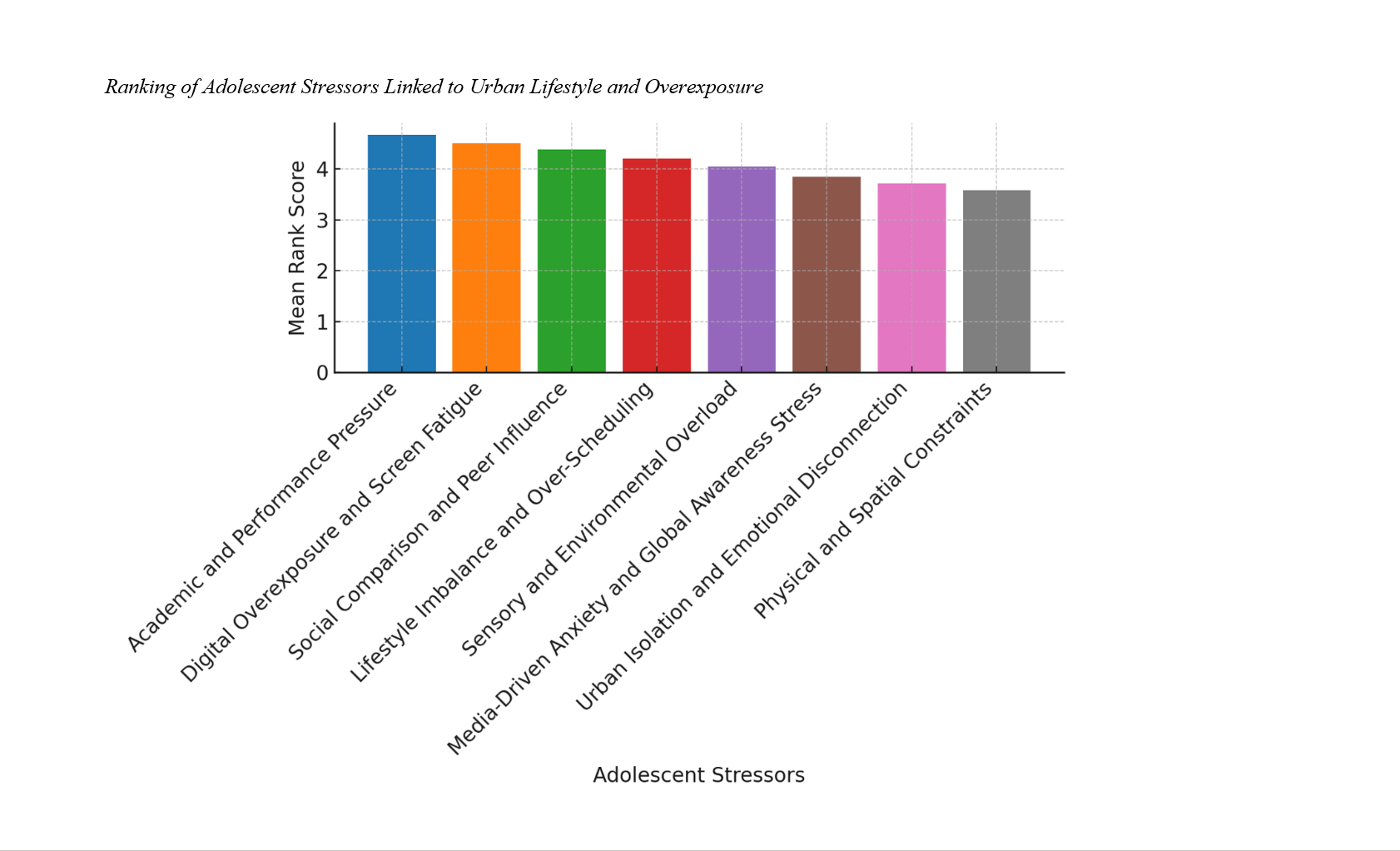
Findings: The Friedman test results indicated statistically significant differences in the mean ranks of stressors (p < 0.001). Academic and performance pressure ranked highest (mean rank = 4.67), followed by digital overexposure (4.51), social comparison (4.38), and lifestyle imbalance (4.21). Environmental and media-related stressors—such as sensory overload and media-driven anxiety—were moderately ranked, while urban isolation and physical constraints had the lowest rankings. These findings suggest that cognitive and social pressures related to performance and technology use are stronger predictors of adolescent distress than physical or environmental factors.
Conclusion: The study demonstrates that the urban adolescent experience is characterized by overlapping academic and digital stressors that operate within a high-demand environment. Understanding the hierarchical structure of these stressors can inform interventions promoting balance, digital mindfulness, and academic reform to mitigate chronic urban stress among youth.
Downloads
References
Aishwarya, C. S., Samanta, I., & Dudeja, P. (2019). Psychosocial Determinants of Stress Among Adolescents in an Urban Slum in a City of Western Maharashtra: A Cross-Sectional Study. International Journal of Adolescent Medicine and Health, 33(2). https://doi.org/10.1515/ijamh-2018-0139
Boyd, D. T., Opara, I., Quinn, C. R., Waller, B., Ramos, S. R., & Duncan, D. T. (2021). Associations Between Parent–Child Communication on Sexual Health and Drug Use and Use of Drugs During Sex Among Urban Black Youth. International journal of environmental research and public health, 18(10), 5170. https://doi.org/10.3390/ijerph18105170
Burrell, D. N. (2025). Exploring the Complex Nature of Cyberpsychology Risks to Children. 161-186. https://doi.org/10.4018/979-8-3373-6207-6.ch007
Compton, K. S., Barr, P. B., Karriker‐Jaffe, K. J., Bares, C. B., Alıev, F., Mustanski, B., Dick, D. M., & Chartier, K. G. (2019). Evaluating Neighborhood, Social, and Genetic Influences on Precursors of Alcohol Use Risk Behavior in African American Adolescents. International journal of environmental research and public health, 16(17), 3078. https://doi.org/10.3390/ijerph16173078
Derryberry, E. P., & Coomes, C. M. (2020). Providing Urban Birds Nutritious Food to Feed Chicks Reduces Urban Versus Rural Breeding Success Disparities. Journal of Animal Ecology, 89(7), 1546-1548. https://doi.org/10.1111/1365-2656.13277
Ertanir, B., Meca, A., Cobb, C. L., Zeledon, I., Unger, J. B., Lorenzo‐Blanco, E. I., Montero‐Zamora, P., Zamboanga, B. L., Báezconde‐Garbanati, L., Soto, D. W., Aksoy, D., Kassis, W., Duque, M., Alpysbekova, A., & Schwartz, S. J. (2024). Disentangling the Directionality Among Cultural Stressors and Psychosocial Outcomes in Recently Immigrated Hispanic Families: A Random Intercept Cross‐lagged Panel Model Approach. Journal of Research on Adolescence, 34(4), 1517-1528. https://doi.org/10.1111/jora.13017
Fayez, M. M., Mohamed, R. H., & Abdel-Rahman, S. M. (2021). Psychiatric Disorders Among Adolescents in the Outpatient Clinics of Al-Mounira General Hospital. The Scientific Journal of Al-Azhar Medical Faculty Girls, 5(2), 456-461. https://doi.org/10.4103/sjamf.sjamf_81_21
Greca, A. M. L., & Burdette, E. T. (2022). Impact of School Transition Stressors on Hispanic Adolescents’ Symptoms of Social Anxiety and Depression: Repetitive Negative Thinking as a Potential Mediator. European journal of education and psychology, 23-41. https://doi.org/10.32457/ejep.v15i2.1968
Ha, T., Iida, M., Quiroz, S. I., Maras, O. R., & Savord, A. (2024). Feeling Loved in Mixed‐gender Adolescent Romantic Relationships in the Face of Daily Stress and Support: A Dyadic Diary Study. Developmental science, 27(6). https://doi.org/10.1111/desc.13511
Kara, B., Scharf, N., McCormack, K. M., Bhreathnach, L., Currie, C., & Symonds, J. (2025). Adolescent Anxiety During the COVID‐19 Pandemic: A Qualitative Systematic Review of Risk and Protective Factors. Journal of adolescence. https://doi.org/10.1002/jad.70038
Leer, J., Hoyle, R. H., & Odgers, C. L. (2025). Direct and Indirect Pathways Linking Gentrification to Adolescent Reading and Math Achievement via Educational Aspirations and Psychological Distress. Developmental Psychology, 61(5), 1004-1018. https://doi.org/10.1037/dev0001812
Malik, V. S., Kumar, K., Behmani, R. K., & Kumar, S. (2023). Stressor of Menstruation in Adolescence, Young Adulthood, and Adulthood. 30-42. https://doi.org/10.4018/978-1-6684-5088-8.ch003
McPherson, P., Alderman, L. L., Temple, J., Lawrence, R., Avila‐Quintero, V. J., Magner, J., Sagrera, C. E., Patterson, J. C., & Murnane, K. S. (2022). Teen Advisory Council Survey's Factors Associated With Self-Harming Thoughts. Frontiers in Psychiatry, 13. https://doi.org/10.3389/fpsyt.2022.851477
Miadich, S. A., Everhart, R. S., Greenlee, J. L., & Winter, M. A. (2020). The Impact of Cumulative Stress on Asthma Outcomes Among Urban Adolescents. Journal of adolescence, 80(1), 254-263. https://doi.org/10.1016/j.adolescence.2019.12.007
Mukherjee, A., Yatirajula, S. K., Kallakuri, S., Paslawar, S., Lempp, H., Raman, U., Essue, B., Sagar, R., Singh, R., Peiris, D., Norton, R., Thornicroft, G., & Maulik, P. K. (2024). Using Formative Research to Inform a Mental Health Intervention for Adolescents Living in Indian Slums: The ARTEMIS Study. Child and adolescent psychiatry and mental health, 18(1). https://doi.org/10.1186/s13034-024-00704-4
Núñez‐Regueiro, F., Jamain, L., Laurent-Chevalier, M., & Nakhili, N. (2022). School Engagement in Times of Confinement: A Stress Process Approach. Journal of youth and adolescence, 51(7), 1257-1272. https://doi.org/10.1007/s10964-022-01621-5
Park, S., Jang, H., & Lee, E.-S. (2018). Major Stressors Among Korean Adolescents According to Gender, Educational Level, Residential Area, and Socioeconomic Status. International journal of environmental research and public health, 15(10), 2080. https://doi.org/10.3390/ijerph15102080
Pearson, I., Chase, E., Kim, C., San, N. M., Ja, H., Hlaing, Z. M., Oo, N., Lae, K., Soe, E. E., Zobrist, B., Zimmerman, C., & Ranganathan, M. (2025). Conflict Exposure and Mental Health: A Survey of Adolescent Girls and Young Women in Myanmar Post the 2021 Coup D’état. Conflict and Health, 19(1). https://doi.org/10.1186/s13031-025-00668-y
Quyen, B. T. T., Pham, C. T. L., Le, A. H., & Pham, D. Q. (2022). The Adverse Impact of Excessive Internet Use During the COVID-19 Pandemic on Adolescents' Coping Skills: A Case Study in Hanoi, Vietnam 2021. Frontiers in Public Health, 10. https://doi.org/10.3389/fpubh.2022.983153
Ralston, A. L., Holt, N. R., Andrews, A. R., Huit, T. Z., Puckett, J. A., Woodruff, N., Mocarski, R., & Hope, D. A. (2024). Mental Health and Marginalization Stress in Transgender and Gender Diverse Adults: Differences Between Urban and Non-Urban Experiences. Psychology of Sexual Orientation and Gender Diversity, 11(1), 165-176. https://doi.org/10.1037/sgd0000595
Silan, M. A. A. (2023). Are the Kids Alright? The Impact of COVID-19 Pandemic on the Mental Health and Psychosocial Wellbeing of Filipino Children in Selected Cities in Metro Manila. https://doi.org/10.31234/osf.io/v2ygm
Sutton, A., Lichter, D. T., & Sassler, S. (2019). Rural–Urban Disparities in Pregnancy Intentions, Births, and Abortions Among US Adolescent and Young Women, 1995–2017. American Journal of Public Health, 109(12), 1762-1769. https://doi.org/10.2105/ajph.2019.305318
Thompson, E. L., Coleman, J. N., O’Connor, K., Farrell, A. D., & Sullivan, T. N. (2020). Exposure to Violence and Nonviolent Life Stressors and Their Relations to Trauma-Related Distress and Problem Behaviors Among Urban Early Adolescents. Psychology of violence, 10(5), 509-519. https://doi.org/10.1037/vio0000264
Uink, B., Modecki, K. L., Barber, B. L., & Correia, H. (2018). Socioeconomically Disadvantaged Adolescents With Elevated Externalizing Symptoms Show Heightened Emotion Reactivity to Daily Stress: An Experience Sampling Study. Child Psychiatry & Human Development, 49(5), 741-756. https://doi.org/10.1007/s10578-018-0784-x
Vrević, E., Malović, P., Bacovic, D., Bojanić, D., & Nokic, A. (2024). Differences in Nutritional Status and Level of Physical Activity Among Adolescents Living in Urban and Rural Areas of Montenegro - National Study. BMC public health, 24(1). https://doi.org/10.1186/s12889-024-18402-3
Wiers, R. W., Marroun, H. E., Bockting, C., & Krugers, H. J. (2025). Debate: Urban Versus Rural Environments – Which Is Better for Mental Health? The One Good Thing About a Small Town…. Child and Adolescent Mental Health, 30(2), 189-191. https://doi.org/10.1111/camh.12771
Yonis, O. B., Khader, Y., Taha, H., Al-Madhwahi, A., Khudair, S. A., Tanaka, E., & Nsour, M. A. (2024). Psychosocial and Emotional Well-Being of Syrian Refugee Children and Adolescents in Jordan: In-Camp Versus Out-of-Camp Comparative Analysis. Narra J, 4(2), e849. https://doi.org/10.52225/narra.v4i2.849
Zehra Habib Sukaina Shaukat, A. (2023). Influence of Stress on Students’ Academic and Social Lives: A Case of a Private College of Karachi. Pakistan Journal of Educational Research, 6(2). https://doi.org/10.52337/pjer.v6i2.795
Zenić, N., Taïar, R., Gilić, B., Blažević, M., Marić, D., Pojskić, H., & Sekulić, D. (2020). Levels and Changes of Physical Activity in Adolescents During the COVID-19 Pandemic: Contextualizing Urban vs. Rural Living Environment. Applied Sciences, 10(11), 3997. https://doi.org/10.3390/app10113997
Zhang, X., Yan, H., Yu, H., Zhao, X., Shah, S., Dong, Z., Yang, G., Zhang, X., Muse, T., Li, J., Jiang, S., Liao, J., Zhang, Y., Chen, Q., Weinberger, D. R., Yue, W., Zhang, D., & Tan, H. Y. (2019). O58. Childhood Urbanization Affects Prefrontal Cortical Responses to Trait Anxiety and Interacts With Polygenic Risk for Depression. Biological Psychiatry, 85(10), S129. https://doi.org/10.1016/j.biopsych.2019.03.323
Zhao, G., Xie, L., Wu, Y., Wang, B., Teng, W., Sun, Z., Kao, Q., Liu, W., Pi, X., & Ma, H. (2023). Effects of Urbanization and Lifestyle Habits on the Intestinal Microbiota of Adolescents in Eastern China. Frontiers in microbiology, 14. https://doi.org/10.3389/fmicb.2023.989303
Downloads
Additional Files
Publication Timeline
- Submitted
- Revised
- Accepted