Feature Sensitivity Mapping of Adolescents’ Identity Development: An Interpretable Machine Learning Study in Brazil
DOI:
https://doi.org/10.61838/kman.jayps.4994Keywords:
Adolescent identity development, feature sensitivity mapping, interpretable machine learning, psychosocial predictorsAbstract
Objective: The objective of this study was to identify and quantify the relative and interactive contributions of psychosocial, relational, cultural, and individual predictors of adolescents’ identity development using feature sensitivity mapping within an interpretable machine learning framework.
Methods and Materials: This cross-sectional study was conducted among 1,032 adolescents aged 14–18 years recruited from public and private secondary schools in three major metropolitan regions of Brazil using multi-stage cluster sampling. Participants completed validated measures assessing identity development dimensions, parental autonomy support, peer attachment quality, emotional self-regulation, future orientation, academic self-efficacy, social competence, and demographic characteristics. Data were analyzed using an ensemble of gradient boosting and random forest models with ten-fold cross-validation and Bayesian hyperparameter optimization. Model interpretability was achieved through SHAP-based feature sensitivity mapping, partial dependence plots, and accumulated local effects analysis to examine nonlinear and interactive predictor effects.
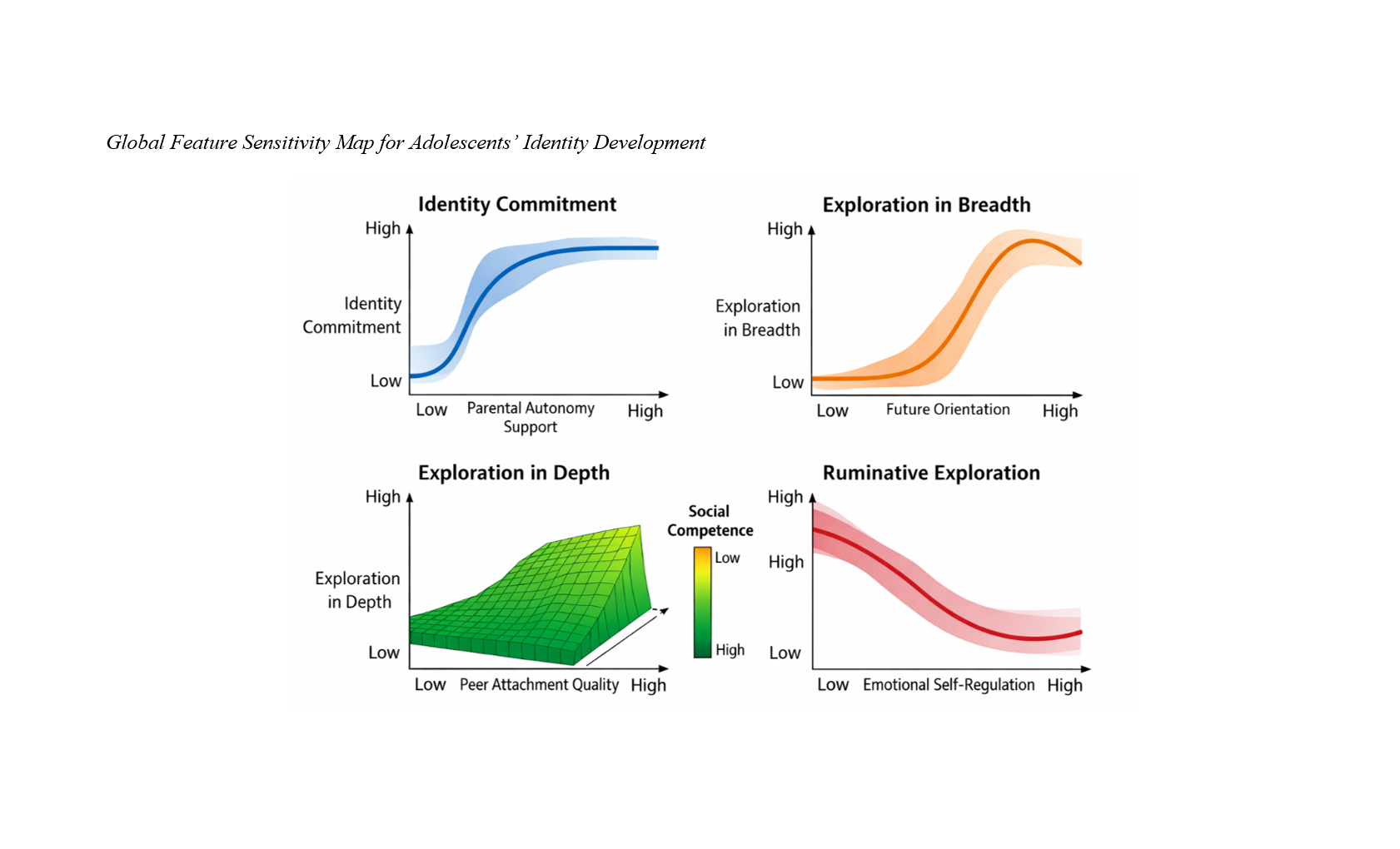
Findings: The machine learning models explained substantial variance in identity outcomes, with the highest performance observed for identity commitment (R² = .61), followed by exploration in breadth (R² = .57), exploration in depth (R² = .55), and ruminative exploration (R² = .49). Parental autonomy support, peer attachment quality, emotional self-regulation, future orientation, academic self-efficacy, and social competence emerged as the most influential predictors across identity dimensions. Emotional self-regulation demonstrated the strongest protective effect against ruminative exploration, while parental autonomy support and peer attachment quality exhibited the highest positive contributions to identity commitment.
Conclusion: Adolescents’ identity development operates as a nonlinear, interactive system in which relational security, self-regulation, and motivational resources play central roles, and interpretable machine learning provides a powerful framework for advancing developmental theory and intervention design.
Downloads
References
Abdullahi, A. K. (2025). Psychosocial and Academic Outcomes of an Ethnic‐racial Identity Intervention in Sweden. Journal of Research on Adolescence, 35(4). https://doi.org/10.1111/jora.70090
Bogaerts, A., Claes, L., Buelens, T., Verschueren, M., Palmeroni, N., Bastiaens, T., & Luyckx, K. (2021). Identity Synthesis and Confusion in Early to Late Adolescents: Age Trends, Gender Differences, and Associations With Depressive Symptoms. Journal of adolescence, 87(1), 106-116. https://doi.org/10.1016/j.adolescence.2021.01.006
Branje, S., Moor, E. L. d., Spitzer, J., & Becht, A. (2021). Dynamics of Identity Development in Adolescence: A Decade in Review. Journal of Research on Adolescence, 31(4), 908-927. https://doi.org/10.1111/jora.12678
Ceccon, C., Schachner, M. K., Umaña‐Taylor, A. J., & Moscardino, U. (2025). Promoting Adolescents’ Cultural Identity Development: A Pilot Study of the Identity Project Intervention in Italy. Cultural diversity & ethnic minority psychology, 31(2), 386-392. https://doi.org/10.1037/cdp0000643
Ding, Y., Sun, C., & Dong, B. (2024). Effect of Parental Rearing Styles on Adolescent Ego Identity: The Mediating Role of Involutionary Attitudes. Frontiers in psychology, 14. https://doi.org/10.3389/fpsyg.2023.1292718
Drapalik, K. N., Zübarioğlu, D. D. T., Rinaldi, M., & Christodulu, K. V. (2025). Camouflaging and Identity Development Among Autistic Female and Gender-Diverse Youth: A Qualitative Exploration. Autism, 29(10), 2535-2549. https://doi.org/10.1177/13623613251345855
Firat, M., & Noels, K. A. (2021). Perceived Discrimination and Psychological Distress Among Immigrants to Canada: The Mediating Role of Bicultural Identity Orientations. Group Processes & Intergroup Relations, 25(4), 941-963. https://doi.org/10.1177/1368430221990082
Frick, M. A., Brandt, A. U., Hellund, S., & Grimell, J. (2025). ADHD and Identity Formation: Adolescents’ Experiences From the Healthcare System and Peer Relationships. Journal of Attention Disorders, 29(7), 541-553. https://doi.org/10.1177/10870547251318484
Gabler, S., Festini, J., Herschmann, L., & Spangler, G. (2025). “Who Am I?”: Identity Development and Psychosocial Adjustment in Foster Adolescents – A Brief Report. Developmental Child Welfare, 7(2-3), 121-136. https://doi.org/10.1177/25161032251324860
Guo, S., Cheung, C. k., Hu, J., & Ning, X. (2021). The Moderation Effect of Identity Exploration and Basic Psychological Needs Satisfaction on Flourishing of Chinese Rural Children. Psicologia Reflexão E Crítica, 34(1). https://doi.org/10.1186/s41155-020-00166-5
Guo, S., & Qu, D. (2021). Flourishing of Rural Adolescents in China: A Moderated Mediation Model of Social Capital and Intrinsic Motivation. International journal of environmental research and public health, 18(15), 8158. https://doi.org/10.3390/ijerph18158158
Hainsworth, S., Toomey, R. B., & Anhalt, K. (2023). Comparing Sexual Orientation Identity Development in Plurisexual Versus Monosexual Latinx Sexual Minority Youth. Journal of adolescence, 95(4), 700-715. https://doi.org/10.1002/jad.12146
Hatano, K., Hihara, S., Nakama, R., Tsuzuki, M., Mizokami, S., & Sugimura, K. (2022). Trajectories in Sense of Identity and Relationship With Life Satisfaction During Adolescence and Young Adulthood. Developmental Psychology, 58(5), 977-989. https://doi.org/10.1037/dev0001326
Herry, E., Rodan, S. M., Martin, M., Sanjak, M. M., & Mulvey, K. L. (2024). White American Transgender Adults' Retrospective Reports on the Social and Contextual Aspects of Their Gender Identity Development. British Journal of Developmental Psychology, 43(2), 233-249. https://doi.org/10.1111/bjdp.12480
Hoffman, A. J., Kurtz‐Costes, B., & Shaheed, J. (2021). Ethnic-Racial Identity, Gender Identity, and Well-Being in Cherokee Early Adolescents. Cultural diversity & ethnic minority psychology, 27(1), 60-71. https://doi.org/10.1037/cdp0000354
Hoffman, A. J., & Umaña‐Taylor, A. J. (2023). The Promise of Leveraging Social Identities in Interventions to Enhance the Well‐being and Lives of Adolescents. Child Development Perspectives, 17(3-4), 129-135. https://doi.org/10.1111/cdep.12486
Hua, J., & Zhou, Y. (2023). Personality Assessment Usage and Mental Health Among Chinese Adolescents: A Sequential Mediation Model of the Barnum Effect and Ego Identity. Frontiers in psychology, 14. https://doi.org/10.3389/fpsyg.2023.1097068
Ji, W., Lan, R., Ma, P., Zhang, H., & Fan, L. (2023). Maternal Positive Coparenting and Adolescent Ego-Identity: The Chain Mediating Role of Fathers’ Marital Satisfaction and Adolescent Peer Relationships. Frontiers in psychology, 14. https://doi.org/10.3389/fpsyg.2023.1227941
Jones, C. M., & Rogers, L. O. (2023). Family Racial/Ethnic Socialization Through the Lens of Multiracial Black Identity: A M(ai)cro Analysis of Meaning-Making. Race and Social Problems, 15(1), 59-78. https://doi.org/10.1007/s12552-023-09387-6
Kaya, B., & GÜNeŞ, S. (2023). The Relationship Between Smartphone Addiction and Identity Development Among Adolescents. Research on Education and Psychology, 7(1), 39-50. https://doi.org/10.54535/rep.1266606
Kim, S. E., Toomey, R. B., & Anhalt, K. (2022). Latinx Sexual Minority Youth's Identity Development and Experiences With Preparation for Bias. Family Relations, 72(3), 948-965. https://doi.org/10.1111/fare.12729
Leung, E. (2021). Thematic Analysis of My “Coming Out” Experiences Through an Intersectional Lens: An Autoethnographic Study. Frontiers in psychology, 12. https://doi.org/10.3389/fpsyg.2021.654946
Maspul, K. A., Bruneton, C., & Popov, R. Y. (2023). Exploring Adolescent Development in Diverse Cultures: Insights and Implications. Peshum, 2(6), 1202-1215. https://doi.org/10.56799/peshum.v2i6.2369
Parent, N. (2023). Basic Need Satisfaction Through Social Media Engagement: A Developmental Framework for Understanding Adolescent Social Media Use. Human development, 67(1), 1-17. https://doi.org/10.1159/000529449
Posa, S., Moola, F. J., McPherson, A. C., & Kontos, P. (2021). Exploring Illness Identity Among Children and Youth Living With Cancer: A Narrative Review. Pediatric Blood & Cancer, 68(11). https://doi.org/10.1002/pbc.29251
Quan, C., Costigan, C. L., & Kobayashi, K. (2022). Ethnic and National Identity Development Processes: The Role of Cultural Behaviors and Gender. Cultural diversity & ethnic minority psychology, 28(1), 1-12. https://doi.org/10.1037/cdp0000475
Rassart, J., Oris, L., Prikken, S., Goethals, E. R., Raymaekers, K., Weets, I., Moons, P., & Luyckx, K. (2021). Illness Identity and Adjusting to Type I Diabetes: A Four-Wave Longitudinal Study. Health Psychology, 40(5), 326-336. https://doi.org/10.1037/hea0001063
Safa, M. D., Long, Y., & Umaña‐Taylor, A. J. (2023). Bicultural Identity and Adjustment Among Ethnoracially Minoritized and Immigrant Adolescents. International Journal of Behavioral Development, 48(3), 269-278. https://doi.org/10.1177/01650254231218284
Safa, M. D., Umaña‐Taylor, A. J., & Martinez‐Fuentes, S. (2024). The Role of Ethnic–racial and National Identities on U.S. Latino Adolescents’ Global Identity Coherence and Adjustment. Cultural diversity & ethnic minority psychology, 30(1), 187-200. https://doi.org/10.1037/cdp0000535
See, A. Y., Klimstra, T. A., Shiner, R. L., & Denissen, J. J. A. (2021). Linking Narrative Identity With Schizotypal Personality Disorder Features in Adolescents. Personality Disorders Theory Research and Treatment, 12(2), 182-192. https://doi.org/10.1037/per0000414
Stašulāne, A. (2021). Identity Multiplicity in an Ethnic and Religious Minority in Latvia: Old Believer Youth. Frontiers in Sociology, 6. https://doi.org/10.3389/fsoc.2021.641622
Vanderhaegen, J., Raymaekers, K., Prikken, S., Claes, L., Laere, E. V., Campens, S., Moons, P., & Luyckx, K. (2024). Personal and Illness Identity in Youth With Type 1 Diabetes: Developmental Trajectories and Associations. Health Psychology, 43(5), 328-338. https://doi.org/10.1037/hea0001366
Wenzing, J. M. C., Schachner, M. K., Karataş, S., & Juang, L. P. (2024). Religious Identity Development and Psychological Adjustment Among Muslim Adolescents: Results From the Identity Project Intervention in Germany. https://doi.org/10.31234/osf.io/7vjd9
Downloads
Additional Files
Publication Timeline
- Submitted
- Revised
- Accepted