Designing a Metacognitive Training Mobile Application and Evaluating Its Effectiveness on Meta-Worry and Metacognitive Beliefs in University Students with Anxiety Symptoms
DOI:
https://doi.org/10.61838/Keywords:
mobile application, metacognition, meta-worry, metacognitive beliefs, anxiety symptomsAbstract
Objective: The present study aimed to design a metacognitive training mobile application and to determine its effectiveness in reducing meta-worry and improving metacognitive beliefs among university students with anxiety symptoms.
Methods and Materials: This study employed a mixed-methods (qualitative–quantitative) design. In the qualitative phase, the content validity of the developed application was evaluated by five experts using the Content Validity Ratio (CVR) and Content Validity Index (CVI), and the application was piloted with a small number of participants prior to the main implementation. In the quantitative phase, a quasi-experimental pretest–posttest design with a control group was used. The population comprised university students diagnosed with anxiety symptoms in universities in Tehran, and 30 students were selected via convenience sampling and randomly assigned to equal experimental and control groups. Data were collected using the Meta-Worry Questionnaire (Wells, 2006) and the Metacognitions Questionnaire (Wells & Cartwright-Hatton, 2004). The experimental group received the metacognitive training application (including instructional content and practice sessions), whereas the control group received no intervention. Content validity indices indicated acceptable validity (CVR = 1.00; CVI > 0.79).
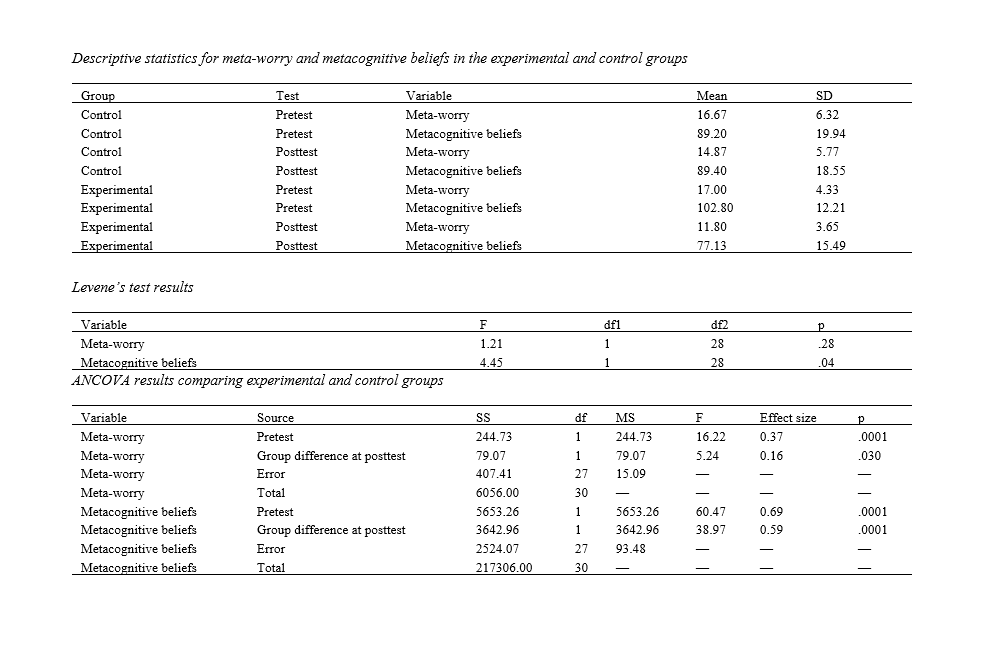
Findings: Descriptive statistics were first reported, and assumptions for univariate and multivariate ANCOVA were examined. Hypothesis testing showed that the metacognitive training application significantly reduced meta-worry (F= 5.24, p<.05) and improved metacognitive beliefs (F = 38.97, p< .01).
Conclusion: The findings suggest that metacognitive processes—particularly meta-worry and negative metacognitive beliefs—play a key role in maintaining and exacerbating anxiety, and that app-based metacognitive training can be used as an accessible and effective intervention.
Downloads
References
Cécillon, F. X., Mermillod, M., Leys, C., Lachaux, J. P., Le Vigouroux, S., & Shankland, R. (2024). Trait Anxiety, Emotion Regulation, and Metacognitive Beliefs: An Observational Study Incorporating Separate Network and Correlation Analyses to Examine Associations with Executive Functions and Academic Achievement. Children, 11(1), 123. https://doi.org/10.3390/children11010123
Farokhzadian, A. (2018). Developing a psychological model of generalized anxiety disorder and examining the effectiveness of the model-based treatment in reducing symptoms of generalized anxiety disorder University of Lorestan].
Fergus, T. A., Bardeen, J. R., & Orcutt, H. K. (2012). Attention control moderates the relationship between activation of the cognitive intentional syndrome and symptoms of psychopathology. Press Individual Different, 53(3), 213-217. https://doi.org/10.1016/j.paid.2012.03.017
Ghabari Bonab, B. (1993). The relationship between forgiveness and anxiety among parents of exceptional and typical children. Hozeh va Daneshgah Journals, 8(31). https://method.rihu.ac.ir/article_632.html?lang=en
Khalilnejad, M., Abbasi, Q., & Hadian Nejad, P. (2024). The Effectiveness of Metacognitive Therapy on the Believability of Thoughts and Anxiety Feelings in Patients with Generalized Anxiety Disorder: A Semi-Experimental Study. Journal of Rafsanjan University of Medical Sciences, 23(3), 250-263. https://doi.org/10.61186/jrums.23.3.150
Kim, S. T., Park, C. I., Kim, H. W., Jeon, S., Kang, J. I., & Kim, S. J. (2021). Dysfunctional Metacognitive Beliefs in Patients With Obsessive–Compulsive Disorder and Pattern of Their Changes Following a 3-Month Treatment [Original Research]. Frontiers in Psychiatry, 12. https://doi.org/10.3389/fpsyt.2021.628985
Mehram, B. (1993). Norming of the Spielberger Anxiety Test in Mashhad. https://elmnet.ir/doc/10715694-11091
Mohammadkhani, S., Akbari, M., West, A., Mazloom, M., & Gezloo, F. (2022). The relationship of metacognition with worry: The mediating role of emotional flexibility and affective style. Journal of Rational-Emotive & Cognitive-Behavior Therapy, 40(3), 493-511. https://doi.org/10.1007/s10942-021-00422-2
Nematollahi, S., Afshari Nia, K., Alsadat Hosseini, S., Kakabraei, K., & Parandin, S. (2023). The Effectiveness of Metacognitive Therapy and Compassion-Based Therapy on Reducing Rumination, Anxiety and Worry in Obsessive-Compulsive Patients. Journal of Psychological Dynamics in Mood Disorders (PDMD), 2(3), 50-61. https://doi.org/10.22034/pdmd.2023.188277
Nordahl, H., Strand, E. R., Hjemdal, O., & Nordahl, H. M. (2024). Is meta-worry relevant to interpersonal problems? Testing the metacognitive model of generalized anxiety disorder in an analogue- and a clinical sample of GAD. Cognitive behaviour therapy, 53(5), 455-466. https://doi.org/10.1080/16506073.2024.2331191
Salmani, B., Hasani, J., Karami, G. R., & MohammadKhani, S. (2013). Effectiveness of meta-cognitive therapy on cognitive attention syndrome and cognitive emotion regulation strategies of patients suffering from Generalized Anxiety Disorder (GAD). Journal of Behavioral Sciences, 7(3), 245-254. https://elmnet.ir/doc/627915-12151
Seow, T. X., Fleming, S. J., & Hauser, T. U. (2025). Metacognitive Biases in Anxiety-Depression and Compulsivity Extend Across Perception and Memory. PLOS Ment Health, 2(3), e0000259. https://doi.org/10.1371/journal.pmen.0000259
Spada, M. M., Nikčević, A. V., Kolubinski, D. C., Offredi, A., Giuri, S., Gemelli, A., Brugnoni, A., Ferrari, A., & Caselli, G. (2021). Metacognitions, rumination, and worry in personality disorder. Journal of affective disorders, 293, 117-123. https://doi.org/https://doi.org/10.1016/j.jad.2021.06.024
Wells, A. (2009). Metacognitive Therapy for Anxiety and Depression. Guilford Press. https://books.google.com/books?id=sWJgx5-1y4AC&source=gbs_navlinks_s
Wells, A. (2025). Metacognitive therapy for anxiety and depression. Arjmand. https://drmohammadkhani.com/
Wells, A., & Cartwright-Hatton, S. (1997). A short form of the Metacognitions Questionnaire: Properties of the MCQ-30. Behavior Research and Therapy, 42(4), 385-396. https://doi.org/10.1016/S0005-7967(03)00147-5
Wells, A., & Matthews, G. (1996). Modelling cognition in emotional disorder: The S-REF model. Behaviour Research and Therapy, 34(11-12), 881-888. https://doi.org/10.1016/S0005-7967(96)00050-2
Yarmohammadi Vasel, M., Zoghi Paydar, M. R., & Pakrovan, S. (2021). The Effect of Metacognitive Strategies Training on Worry and Anxiety in Students. Cognitive Strategies in Learning, 9(17), 183-198. https://doi.org/10.22084/j.psychogy.2021.24397.2325
Yu, H., Shi, Z., & Zhao, M. (2024). The Relationship between Metacognition, Rumination, and Sleep in University Students with a Tendency toward Generalized Anxiety Disorder. Behavioral Sciences, 14(6), 444. https://doi.org/10.3390/bs14060444
Zamanzadeh, M. (2013). Comparing the relationship of spiritual intelligence and metacognitive beliefs with psychological well-being among nurses in Ahvaz Khuzestan Science and Research University].
Downloads
Additional Files
Publication Timeline
- Submitted
- Revised
- Accepted