Predicting Cognitive Distortions in Youth Using Advanced Machine Learning Algorithms
DOI:
https://doi.org/10.61838/kman.jayps.5046Keywords:
Cognitive distortions, machine learning, university students, stress, emotional distress, predictive modelingAbstract
Objective: This study aimed to predict cognitive distortions among undergraduate students using advanced machine learning algorithms and to compare their predictive performance with traditional statistical approaches.
Methods and Materials: The study employed a quantitative, cross-sectional predictive design involving undergraduate students enrolled at universities in Yazd, Iran. Participants completed a battery of standardized self-report instruments assessing cognitive distortions and related psychological variables, including perceived stress, emotional distress, coping styles, and demographic characteristics. Data were preprocessed through screening for missing values, normalization, and partitioning into training, validation, and testing subsets. Multiple machine learning algorithms, including linear, nonlinear, and ensemble-based models, were implemented to predict overall cognitive distortion scores. Hyperparameter tuning and cross-validation procedures were applied to optimize model performance, and feature importance analyses were conducted to enhance interpretability. Model evaluation relied on multiple error-based and variance-explained indices to ensure robust and generalizable prediction.
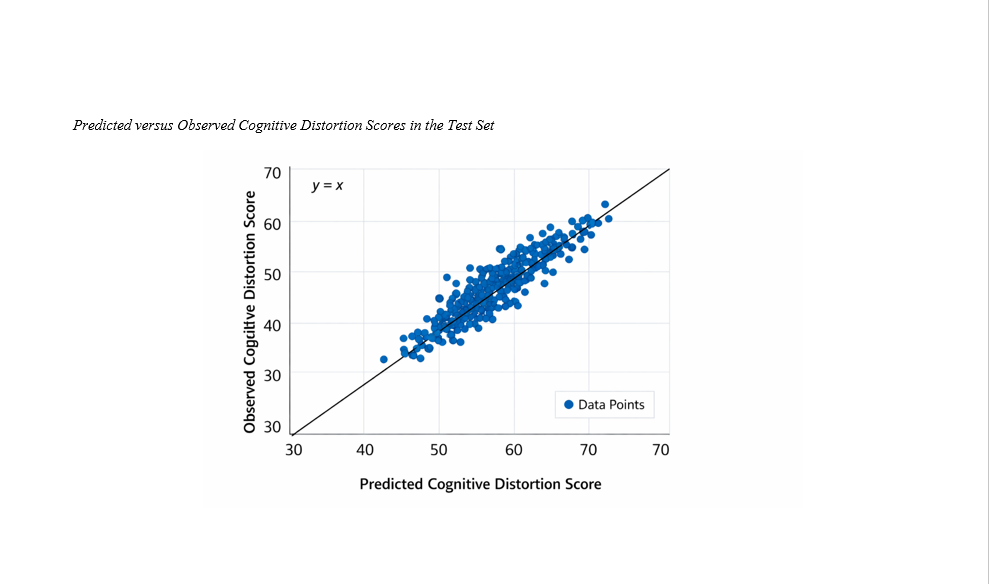
Findings: Advanced machine learning models demonstrated substantially higher predictive accuracy than traditional linear regression, with ensemble-based algorithms achieving the strongest performance. The optimal model explained a large proportion of variance in cognitive distortion scores and maintained stable accuracy across training, validation, and testing datasets, indicating minimal overfitting. Perceived stress, emotional distress, and maladaptive coping emerged as the most influential predictors, while demographic variables contributed comparatively little to model performance. The results confirmed that nonlinear interactions among psychological variables play a critical role in predicting cognitive distortions in youth.
Conclusion: The findings indicate that cognitive distortions in university students can be accurately predicted using advanced machine learning approaches, highlighting the complex and multidimensional nature of distorted cognition.
Downloads
References
Aydın, A., & Malak Akgün, B. (2022). Interpersonal cognitive distortions and family role performances in spouses during COVID-19 pandemic process in Turkey. Perspectives in psychiatric care, 58(1), 189-196. https://doi.org/10.1111/ppc.12795
Badawy, D. W. B. M. (2023). Psychosocial Factors and Cognitive Distortions Contributing to Self-Reported Quality of Life in Female University Students With Irritable Bowel Syndrome. Migration Letters, 21(S1), 72-84. https://doi.org/10.59670/ml.v21is1.5981
Bradshaw, K. (2024). Perspective Chapter: Self-Efficacy and Cognitive Distortion in the Learning Environment. https://doi.org/10.5772/intechopen.113777
Brugman, D., van der Meulen, K., & Gibbs, J. C. (2023). Moral judgment, self-serving cognitive distortions, and peer bullying among secondary school adolescents. Journal of Moral Education, 1-21. https://doi.org/10.1080/03057240.2023.2209289
Büge, B., & Koç, V. (2024). Parenting Style and Anxiety Symptoms a Moderated-Mediation Analysis of Interpersonal Cognitive Distortions and Anxiety Disorder. Yaşam Becerileri Psikoloji Dergisi, 8(16), 83-97. https://doi.org/10.31461/ybpd.1520575
ÇElebİ, G. Y., & Kaya, F. (2022). Interpersonal Cognitive Distortions and Anxiety: The Mediating Role of Emotional Intelligence. International Journal of Psychology and Educational Studies, 9(3), 741-753. https://doi.org/10.52380/ijpes.2022.9.3.769
fard, M. M., Neudehi, M. F., mianroudi, F. J., & Solgi, Z. (2023). The Role of Childhood Trauma, Cognitive Flexibility, and Cognitive Distortions in Predicting Self-Harming Behaviors Among Female Adolescents. Caspian Journal of Health Research, 8(2), 85-92. https://doi.org/10.32598/cjhr.8.2.445.1
Haghiri, S., Molayi, H., & Khosropour, F. (2025). Comparing the Effectiveness of Attachment-Based Therapy and Cognitive-Behavioral Therapy on Cognitive Distortion in Mothers with Elementary School or Preschool Children. Journal of Pediatric Nursing, 11(2), 10-20. https://jpen.ir/browse.php?a_id=762&sid=1&slc_lang=en
Haryadi, R., Aminah, A., & Hayati, S. A. (2022). Cognitive Distortion While Attending Online Class: Study on Banjar College Student. Psychocentrum Review, 4(2), 190-201. https://doi.org/10.26539/pcr.42994
Huang, L. S., Molenberghs, P., & Mussap, A. J. (2023). Cognitive distortions mediate relationships between early maladaptive schemas and aggression in women and men. Aggressive Behavior, 49(4), 418-430. https://doi.org/10.1002/ab.22083
Jones, D., & Patel, S. (2022). Cognitive distortions and ADHD: A review. ADHD Research & Treatment, 2022, 345678.
Kaya, M. D., Kaya, F., & Eroğlu, Y. (2023). Interpersonal Cognitive Distortions: What Is the Role of Childhood Trauma and Attachment? Journal of Education in Science Environment and Health, 292-309. https://doi.org/10.55549/jeseh.1381214
Kurtoğlu, M. B., Yücel, D., Katar, K. S., & Akdoğan, H. İ. (2024). The Role of Self-Compassion and Social Anxiety in the Relationship Between Cognitive Distortions and Emotional Eating. Journal of Cognitive Psychotherapy, 39(1), 92-103. https://doi.org/10.1891/jcp-2023-0048
Lorzangeneh, S., & Soleimani, E. (2022). Investigating the Structure of Structural Relationships between Childhood Trauma and Cognitive Distortions with Narcissistic Personality Disorder: Mediated by Early maladaptive Schemas. Clinical Psychology Studies, 13(48), 85-108. https://doi.org/10.22054/jcps.2023.58635.2508
Mayer, S. J., Green, K. L., & Patel, R. (2023). The role of emotional dysregulation in suicidal behaviors: A mediation model involving cognitive distortions. Journal of Behavioral Medicine, 46(4), 589-601. https://doi.org/10.1007/s10865-022-00345-7
Norouzi, R., & Heydari, A. (2024a). The Role of Ambivalence in Emotional Expression and Cognitive Distortions in Suicidal Behaviors. Journal of Psychological Research, 10(2), 67-82.
Norouzi, R., & Heydari, A. (2024b). The role of cognitive distortions in suicidal behaviors and the effectiveness of cognitive interventions. Journal of Psychological Research, 10(2), 67-82.
Ouhmad, N., Deperrois, R., El Hage, W., & Combalbert, N. (2024). Cognitive distortions, anxiety, and depression in individuals suffering from PTSD. International Journal of Mental Health, 53(4), 336-352. https://doi.org/10.1080/00207411.2023.2219950
Özdemir, İ., & Kuru, E. (2023). Investigation of Cognitive Distortions in Panic Disorder, Generalized Anxiety Disorder and Social Anxiety Disorder. Journal of clinical medicine, 12(19), 6351. https://doi.org/10.3390/jcm12196351
Pourali, E., Soltani Shal, R., & Abolghasemi, A. (2024). A Comparison of Cognitive Distortions and Emotion Regulation Difficulties in Students With and Without Pornography Addiction. Royesh Psychology, 13(2), 13-24. https://frooyesh.ir/article-1-4899-en.pdf
Ruiz Santos, P., Barey, A. F., & Pautassi, R. M. (2024). Cognitive distortions associated with alcohol and marijuana use in Uruguayan citizens. Substance Use & Misuse, 59(5), 680-689. https://doi.org/10.1080/10826084.2023.2294971
Sibarani, B. E., Anggreani, C., Artasya, B., & Harahap, D. A. P. (2024). Unraveling the impact of self-efficacy, computer anxiety, trait anxiety, and cognitive distortions on learning mind your own business: The student perspective. Aptisi Transactions on Technopreneurship, 6(1), 29-40. https://doi.org/10.34306/att.v6i1.377
Suriá-Martínez, R., García-Castillo, F., López-Sánchez, C., Villegas, E., & Carretón, C. (2024). Online games and cognitive distortions: a comparative analysis in students with and without disabilities. European Journal of Investigation in Health, Psychology and Education, 14(7), 1868-1880. https://doi.org/10.3390/ejihpe14070123
Topalalioğlu, S. (2025). Role of Interpersonal Sensitivity and Cognitive Distortions in the Development of Psychopathologies. Psikiyatride Guncel Yaklasimlar - Current Approaches in Psychiatry, 17(2), 261-271. https://doi.org/10.18863/pgy.1484640
Wolfe, S. E., McLean, K., Alpert, G. P., & Rojek, J. (2024). Us versus them? The problem of cognitive distortions in policing. Police Quarterly, 27(4), 532-560. https://doi.org/10.1177/10986111241234310
Yazici-Celebiİ, G., Yılmaz, M., Karacoskun, M. E., & ŞAhİN, A. İ. (2024). Examination of the Mediating Role of Attachment Dimensions in the Link Between Suicide Probability and Cognitive Distortions About Relationships in University Students. Journal of Education in Science Environment and Health, 60-68. https://doi.org/10.55549/jeseh.1419349
Yücel, D., & Kurtoğlu, M. B. (2024). The Mediating Role of Cognitive Distortions in the Relationship of Self-Compassion With Social Anxiety Disorder Symptoms. İnönü Üniversitesi Sağlık Hizmetleri Meslek Yüksek Okulu Dergisi, 12(1), 1-13. https://doi.org/10.33715/inonusaglik.1288306
Zimmerman, M., Morgan, T. A., & Stanton, K. (2022). The severity of psychiatric disorders and cognitive distortions. Psychiatric Services, 73(5), 456-463. https://doi.org/10.1176/appi.ps.202100199
Downloads
Additional Files
Publication Timeline
- Submitted
- Revised
- Accepted