Comparison of Personality Traits in Gifted Students with the Highest and Lowest Levels of Creativity
DOI:
https://doi.org/10.61838/kman.jayps.5057Keywords:
Gifted students; Creativity; Personality traits; Assertiveness; IntroversionAbstract
Objective: The objective of this study was to compare the personality traits of gifted students with high creativity and those with low creativity.
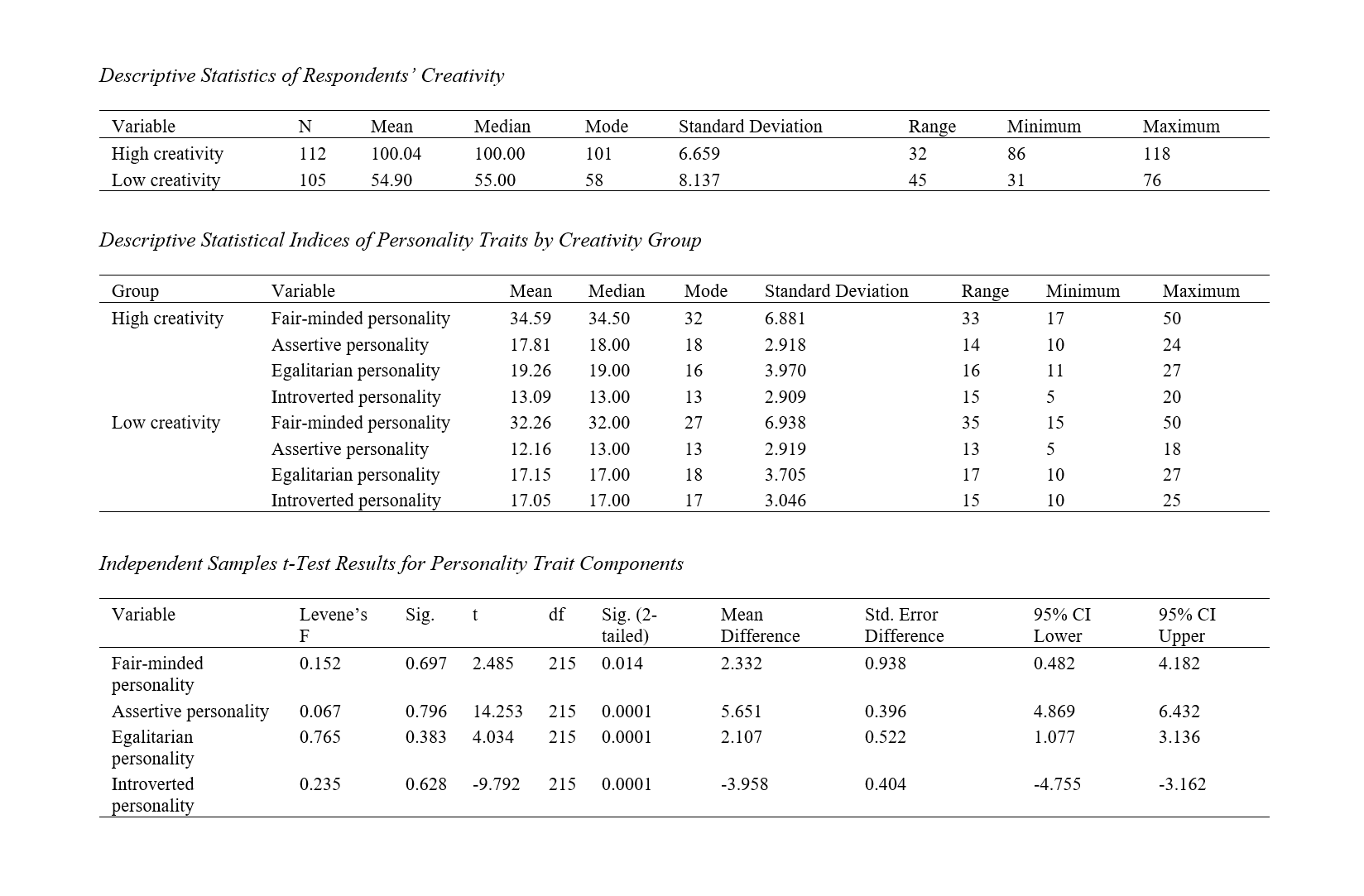
Methods and Materials: This applied study employed a causal–comparative design. The statistical population consisted of all gifted secondary school students in the city of Isfahan during the 2022–2023 academic year. From this population, 217 students were selected through simple random sampling based on Cochran’s formula. Data were collected using Abedi’s standardized Torrance Creativity Questionnaire and the Personality Traits Questionnaire developed by Buss and colleagues, which assesses fair-minded, assertive, egalitarian, and introverted personality traits. Questionnaires were administered electronically after obtaining the necessary permissions and informed consent. Descriptive statistics were used to summarize the data, and independent samples t-tests were conducted to examine differences in personality traits between students with high and low creativity. All analyses were performed using SPSS version 27 with a significance level of 0.05.
Findings: Inferential analysis revealed statistically significant differences between gifted students with high and low creativity across all personality traits. Students with high creativity scored significantly higher in fair-minded personality, assertive personality, and egalitarian personality. In contrast, students with low creativity demonstrated significantly higher levels of introverted personality. The results of Levene’s tests confirmed the homogeneity of variances, and the t-test results indicated that all observed differences were statistically significant at the 0.05 level or lower.
Conclusion: The findings indicate that creativity level among gifted students is associated with distinct personality profiles, suggesting that personality traits play a meaningful role in the expression of creativity. Recognizing these differences can contribute to more effective identification, counseling, and educational interventions aimed at fostering creativity in gifted learners.
Downloads
References
Afrooz, G., & Sadeghi, M. (2023). The Effectiveness of a Creativity-Based Educational Program with Therapist-Centered and Family-Centered Approaches on the Critical Thinking of Gifted Students. Journal of Empowering Exceptional Children, 14(2), 34-40. https://www.magiran.com/p2666777
Akkanat, Ç., & Gökdere, M. (2018). The Effect of Academic Involvement and School Climate as Perceived by Gifted Students in Terms of Talent, Creativity, and Motivation in Science. Universal Journal of Educational Research, 6(6), 1167-1174. https://doi.org/10.13189/ujer.2018.060606
Al-Shamy, H. (2020). Relation of Creative Problem Solving With Efficient Working Memory in A Sample of Gifted Students at King Faisal University in Saudi Arabia. Humanities and Management Sciences - Scientific Journal of King Faisal University, 21(1). https://doi.org/10.37575/h/edu/2048
Brandon, L., Reis, S. M., & McGuire, C. (2021). Perceptions of talented university students related to opportunities and autonomy for creative productivity. Gifted Education International. https://doi.org/10.1177/0261429421994335
Carman, C. A. (2011). Adding Personality to Gifted Identification: Relationships Among Traditional and Personality-Based Constructs. Journal of Advanced Academics, 22(3), 412-446. https://doi.org/10.1177/1932202x1102200303
Chen, X., & Cheng, L. (2023). Emotional Intelligence and Creative Self-Efficacy Among Gifted Children: Mediating Effect of Self-Esteem and Moderating Effect of Gender. Journal of Intelligence, 11(1), 17. https://doi.org/10.3390/jintelligence11010017
Cramond, B., Kim, K. H., Chiang, T., Higuchi, T., Iwata, T., Ma, M., & Palaniappan, A. K. (2021). Trends and challenges of creativity development among selected asian countries and regions: China, hong kong/macau, japan, malaysia, and south korea. handbook of giftedness and talent development in the asia-pacific, 1107-1133.
Davaei, M., Kashani Vahid, L., & Ajarlou, E. (2021). The Effectiveness of Creative Problem-Solving Training on Emotional Management and Resilience in Mothers of Gifted Students. Cognitive Science Advances, 23(1), 106-115. https://www.noormags.ir/view/en/articlepage/2062960
Ermakov, S. S. (2016). Analysis of Personality Characteristics of Intellectually Gifted Students, Causing Difficulties in Their Process of Preschool and School Education. Journal of Modern Foreign Psychology, 5(3), 41-49. https://doi.org/10.17759/jmfp.2016050304
Eyni, S., Ebadi, M., Saadatmand, S., & Torabi, N. (2021). The role of creative thinking, mindfulness and emotional intelligence in predicting the academic stress of gifted students. Thinking and Children, 11(2), 183-210. https://fabak.ihcs.ac.ir/m/article_6214.html?lang=en
Güler, E. K., & Ulusoy, F. (2025). A Gifted High School Student’s Abstraction Process of Divisibility Rules. Kastamonu Eğitim Dergisi, 33(1), 1-16. https://doi.org/10.24106/kefdergi.1628219
Hemingway, S. (2023). Referral, Identification, and Retention of Underrepresented Gifted Students. International Journal for Talent Development and Creativity, 10(1-2), 205-216. https://doi.org/10.7202/1099953ar
Kashani-Vahid, L., Afrooz, G., Shokoohi-Yekta, M., Kharrazi, K., & Ghobari, B. (2017). Can a creative interpersonal problem solving program improve creative thinking in gifted elementary students? Thinking Skills and Creativity, 24, 175-185. https://doi.org/10.1016/j.tsc.2017.02.011
Kazemi Haghighi, N. (2007). The hexahedral paradigm of creative Personality:“A review of sixty years of literature for the 21st century”. World Council for Gifted and Talented Children, 17th Biennial World Conference,
Keleş, T. (2022). A comparison of creative problem solving features of gifted and non-gifted high school students. Pegem Journal of Education and Instruction, 12(2), 18-31. https://mail.pegegog.net/index.php/pegegog/article/view/1526
Mamqani, J., Afrooz, G., Ghabari-Bonab, B., & Ghasemzadeh, S. (2019). Predicting Creativity in Gifted Adolescents Based on Intellectual Abilities, Parenting Styles, Spiritual Vitality, and Family Popularity. Women and Family Studies, 12(44), 85-107. https://sanad.iau.ir/en/Journal/jwsf/Article/673388?jid=673388&lang=fa
Mattaa, M., Grittia, E. S., & Lang, M. (2019). Personality assessment of intellectually gifted adults: A dimensional trait Approach. Learning and Individual Differences, 80. https://doi.org/10.1016/j.paid.2018.05.009
Muneera, R., Diab, A., & Al-Abbasi, A. (2023). Overexcitabilities as Predictors of Creative Personality Among Gifted and Ordinary Students in the State of Kuwait. Jordan Journal of Educational Sciences, 19(2), 423-447. https://doi.org/10.47015/19.2.10
Rashidi, B., Abedi, A., & Norouzi, G. (2022). A Creativity Training Model Based on the SEM Enrichment Model for Gifted Students: A Qualitative Study. Analytical-Cognitive Psychology Quarterly. https://journals.iau.ir/article_696834.html?lang=en
Safaei Rad, I., Gholamali Lavasani, M., & Afrooz, G. (2019). Investigating the Structural Pattern of Relationship between Personality Characteristics and Creativity by Mediating Role of Marital Satisfaction, Social Adjustment, and Mental Health. childmh, 6(1), 223-238. https://doi.org/10.29252/jcmh.6.1.19
Saygili, G. (2014). Problem-Solving Skills Employed by Gifted Children and Their Peers in Public Primary Schools in Turkey. Social Behavior and Personality an International Journal, 42(1), 53S-63S. https://doi.org/10.2224/sbp.2014.42.0.s53
Shaidenko, N. A., Kipurova, S., Sergeeva, A. V., Filatova, M. V., & Shelispanskaya, E. (2021). Development of Creativity of a Future Teacher as a Condition for Their Effective Work With Gifted Students. SHS Web of Conferences, 117, 06005. https://doi.org/10.1051/shsconf/202111706005
Sharifian Motlaq, A., & Mohammadi, T. (2025). The effectiveness of mindfulness training on psychological capital and emotional regulation in gifted students. Journal of Psychology Growth, 14(1), 94-85. http://frooyesh.ir/browse.php?a_id=4708&sid=1&slc_lang=fa
Sisk, D. (2021). Managing the Emotional Intensities of Gifted Students with Mindfulness Practices. Education Sciences, 11(11).
Subotnik, R. F., Olszewski-Kubilius, P., & Worrell, F. C. (2022). Channeling gifted abilities into transformative creative productivity. In Palgrave handbook of transformational giftedness for education (pp. 373-386). Palgrave-Macmillan. https://doi.org/10.1007/978-3-030-91618-3_19
Downloads
Additional Files
Publication Timeline
- Submitted
- Revised
- Accepted