Comparison of the Effectiveness of Cognitive Behavioral Therapy and Schema Therapy on Perseverative Thinking in Young Adults with Depressive Symptoms
DOI:
https://doi.org/10.61838/kman.jayps.5063Keywords:
Cognitive Behavioral Therapy, Schema Therapy, Perseverative Thinking, Rumination, Depression, Young AdultsAbstract
Objective: The present study aimed to compare the effectiveness of Cognitive Behavioral Therapy and Schema Therapy on reducing perseverative thinking in young adults with depressive symptoms.
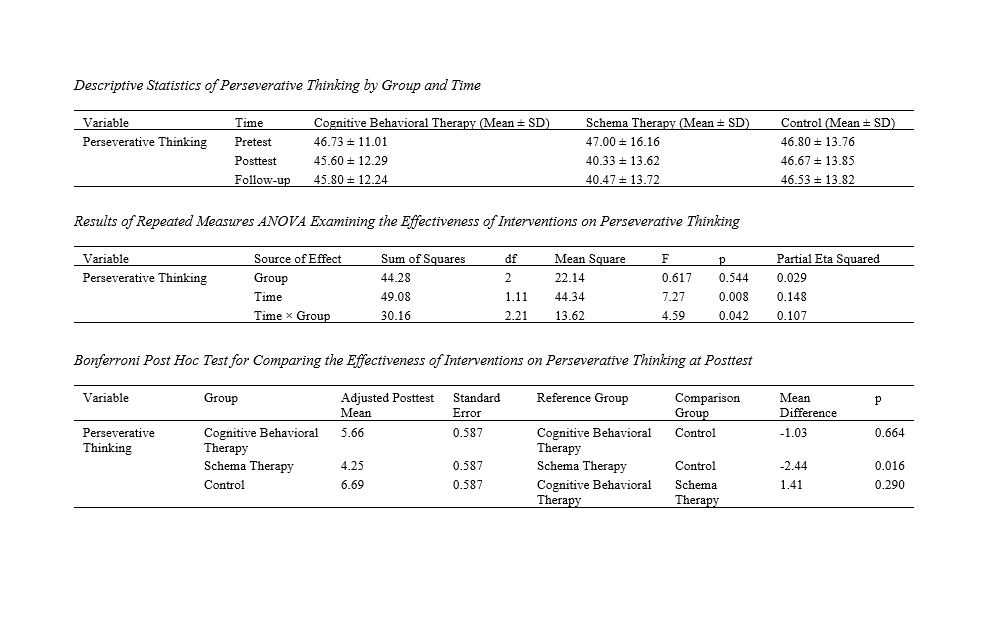
Methods and Materials: This applied study employed a quasi-experimental design with a pretest–posttest control group and a two-month follow-up. The statistical population consisted of young adults with depressive symptoms who referred to counseling and psychological clinics in District 1 of Tehran between December 2024 and June 2025. From this population, 45 participants who met inclusion criteria were selected using purposive sampling and randomly assigned to three groups: Cognitive Behavioral Therapy (n = 15), Schema Therapy (n = 15), and control (n = 15). The experimental groups received eight structured group sessions based on established CBT and Schema Therapy protocols, while the control group received no intervention during the study period. Perseverative thinking was assessed at pretest, posttest, and follow-up using the Perseverative Thinking Questionnaire. Data were analyzed using descriptive statistics, mixed-design repeated measures ANOVA, multivariate analysis of variance, and Bonferroni post hoc tests in SPSS software.
Findings: Repeated measures analysis indicated no significant main effect of group; however, the main effect of time was statistically significant, demonstrating overall changes in perseverative thinking across measurement points. Importantly, the interaction effect between time and group was statistically significant, indicating differential patterns of change among groups. Bonferroni post hoc comparisons revealed that Schema Therapy produced a significant reduction in perseverative thinking compared to the control group at posttest, whereas Cognitive Behavioral Therapy did not significantly differ from the control group. Within-group analyses showed that Schema Therapy led to significant reductions from pretest to posttest and from pretest to follow-up, with maintained effects over time, while no significant changes were observed in the CBT and control groups.
Conclusion: The findings suggest that Schema Therapy is more effective than Cognitive Behavioral Therapy in reducing perseverative thinking among young adults with depressive symptoms, with effects sustained over a two-month follow-up period.
Downloads
References
Akers, N., Berry, K., & Taylor, C. D. J. (2025). Do Cognitive Behavioural Therapy Interventions Lead to Schema Change in People With Psychosis? A Systematic Review and Meta‐Analysis. Clinical Psychology & Psychotherapy, 32(2). https://doi.org/10.1002/cpp.70049
Ali, F. (2024). cognitive behavioral therapy: transforming negative thinking and promoting mental health. Scientific Research reports, 1(01), 1-11. https://healthtimes.co.zw/navigating-the-midlife-crisis-understanding-its-impact-on-mental-health-and-strategies-for-resilience/
Asadi, A., Sadeghi, J., Farashzadeh Jaloudar, R., & Araei, O. (2025). Comparison of the effectiveness of cognitive-behavioral therapy and schema therapy in reducing exam anxiety and improving academic performance. International Maher Publications, 2(2). http://193.36.85.187:9110/index.php/ecp/article/view/220
Ebrahimi, S., Moheb, N., & Vafa, M. A. (2024). Comparison of the Effectiveness of Cognitive-Behavioral Therapy and Acceptance and Commitment Therapy on Cognitive Distortions and Rumination in Adolescents With Social Anxiety Disorder. Practice in Clinical Psychology, 12(1), 81-94. https://doi.org/10.32598/jpcp.12.1.922.1
Ehring, T., Zetsche, U., Weidacker, K., Wahl, K., Schönfeld, S., & Ehlers, A. (2011). The Perseverative Thinking Questionnaire (PTQ): Validation of a content-independent measure of repetitive negative thinking. Journal of Behavior Therapy and Experimental Psychiatry, 42(2), 225-232. https://www.sciencedirect.com/science/article/pii/S000579161000114X
Eisma, M. C., de Lang, T. A., & Boelen, P. A. (2020). How thinking hurts: Rumination, worry, and avoidance processes in adjustment to bereavement. Clinical Psychology & Psychotherapy, 27(4), 548-558. https://doi.org/10.1002/cpp.2440
Int-Veen, I. (2025). Cognitive Appraisal Modulates Theta Burst Stimulation Effects on Stress-Reactive Rumination and Affect. Cognitive Affective & Behavioral Neuroscience. https://doi.org/10.3758/s13415-025-01314-z
Joshua, P. R., Lewis, V., Kelty, S. F., & Boer, D. P. (2025). Applications of schema therapy in young people: a systematic review. Cognitive behaviour therapy, 1-23. https://doi.org/10.1080/16506073.2025.2522375
Ke, T., & Barlas, J. (2020). Thinking about feeling: Using trait emotional intelligence in understanding the associations between early maladaptive schemas and coping styles. Psychology and Psychotherapy: Theory, Research and Practice, 93(1), 1-20. https://doi.org/10.1111/papt.12202
Khayatan, F., Hadian, S., & Golparvar, M. (2025). A Comparison of the Effectiveness of Emotion-Focused Schema Therapy, Compassion-Focused Forgiveness Therapy, and Cognitive-Behavioral Therapy on Emotional Capital and Its Dimensions in Women Victims of Domestic Violence. Yazd Health Dawn, 23(6), 92-108. https://tbj.ssu.ac.ir/browse.php?a_id=3704&sid=1&slc_lang=en&html=1
Langenecker, S. A., Schreiner, M. W., Bessette, K. L., Roberts, H., Thomas, L., Dillahunt, A., Pocius, S. L., Feldman, D. A., Jago, D., Farstead, B., & Pazdera, M. (2024). Rumination-focused cognitive behavioral therapy reduces rumination and targeted cross-network connectivity in youth with a history of depression: replication in a preregistered randomized clinical trial. Biol Psychiatry Glob Open Sci, 4(1), 1-10. https://doi.org/10.1016/j.bpsgos.2023.08.012
Malekzadeh, l., Emadi, S. Z., & naghsh, z. (2024). The Effectiveness of Group Schema Therapy on Cognitive Emotion Regulation and Emotional Behavior Regulation in Mothers with Children with Learning Disabilities. Psychology of Exceptional Individuals, 14(53), 201-227. https://doi.org/10.22054/jpe.2023.71499.2524
Mohammadi, H., Sepehri Shamloo, Z., & Asghari Ibrahimabad, M. J. (2019). Effectiveness the schema therapy of group emotional on decreasing psychological remorse and emotion setting hardship in women. Journal of Thinking and Behavior in Clinical Psychology, 14(51), 27-36. https://www.sid.ir/paper/172058/en#downloadbottom
Muris, P. (2006). Maladaptive schemas in non-clinical adolescents: relations to perceived parental rearing behaviours, Big Five personality factors and psychopathological symptoms. Clinical Psychology & Psychotherapy, 13(6), 405-413. https://doi.org/10.1002/cpp.506
Puccetti, N. A., Stamatis, C. A., Timpano, K. R., & Heller, A. S. (2024). Worry and Rumination Elicit Similar Neural Representations: Neuroimaging Evidence for Repetitive Negative Thinking. Cognitive Affective & Behavioral Neuroscience, 25(2), 488-500. https://doi.org/10.3758/s13415-024-01239-z
Razzaghi, M., Zemestani, M., & Mashhadi, A. (2025). Effectiveness of Emotional Schema Therapy on Anxiety Symptoms, Emotion Regulation, and Marital Satisfaction in Women with Anxiety Disorders: A Preliminary Study. International Journal of Cognitive Behavioral Therapy. https://link.springer.com/article/10.1007/s41811-025-00238-3
Sooreh, J., Hajloo, N., Atadokht, A., & Basharpoor, S. (2023). Comparing the Effectiveness of Positive Thinking Skills (PTS) and Mindfulness‐Based Cognitive Therapy (MBCT) in Promoting Demoralization and Psycho-Social Adjustment in Cancer Patients. Journal of Sabzevar University of Medical Sciences, 30(2), 193-207. https://doi.org/10.30468/jsums.2023.1557
Stavropoulos, A., Haire, M., Brockman, R., & Meade, T. (2020). A schema mode model of repetitive negative thinking. Clinical Psychologist, 24(2), 99-113. https://doi.org/10.1111/cp.12205.
Wang, J., Sheng, M., & Song, R. (2024). Enhancing Classroom Behaviors and Creativity: The Impact of a Critical Thinking Workshop. International Journal of Education and Cognitive Sciences, 5(1), 8-15. https://doi.org/10.61838/kman.ijecs.5.1.6
Downloads
Additional Files
Publication Timeline
- Submitted
- Revised
- Accepted