Examining the Relationship Between Social Media Addiction and Academic Burnout with the Mediating Role of Social Anxiety and Loneliness Among Upper Secondary School Students
DOI:
https://doi.org/10.61838/kman.jayps.5118Keywords:
Academic burnout, social media addiction, social anxiety, loneliness, upper secondary school studentsAbstract
Objective: The present study aimed to examine the relationship between social media addiction and academic burnout and to investigate the mediating roles of social anxiety and loneliness among upper secondary school students.
Methods and Materials: This study employed a descriptive–correlational design using structural equation modeling. The statistical population consisted of all upper secondary school students in Tehran during the second semester of the 2024–2025 academic year, from which 320 students were selected through multistage cluster random sampling. Data were collected using the Academic Burnout Inventory, Social Media Addiction Scale, Social Anxiety Scale for Adolescents, and the UCLA Loneliness Scale. After verifying statistical assumptions including normality and absence of multicollinearity, data were analyzed using SPSS and AMOS software. Model fit was evaluated using indices including χ²/df, CFI, NFI, TLI, and RMSEA.
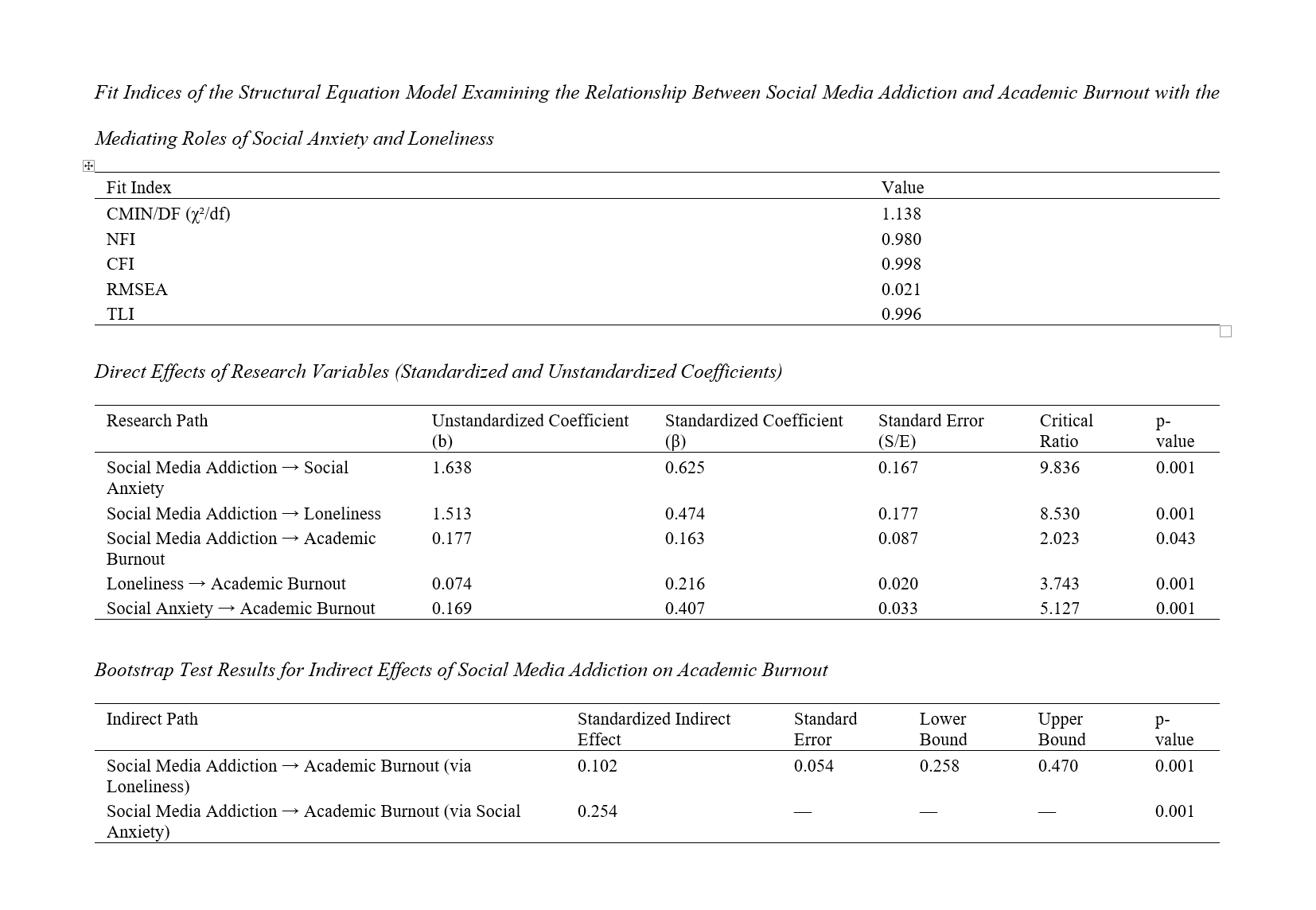
Findings: Structural equation modeling indicated that social media addiction had a significant direct positive effect on academic burnout (β = 0.163, p < 0.05). Social media addiction also significantly predicted social anxiety (β = 0.625, p < 0.001) and loneliness (β = 0.474, p < 0.001). Both social anxiety (β = 0.407, p < 0.001) and loneliness (β = 0.216, p < 0.001) had significant positive effects on academic burnout. Bootstrap analysis confirmed significant indirect effects of social media addiction on academic burnout through social anxiety (β = 0.254) and loneliness (β = 0.102). The total effect of social media addiction on academic burnout reached 0.519. The model demonstrated good fit (χ²/df = 1.138, CFI = 0.998, NFI = 0.980, RMSEA = 0.021), explaining 41% of the variance in academic burnout.
Conclusion: The findings indicate that social media addiction contributes to academic burnout both directly and indirectly through increased social anxiety and loneliness. These results highlight the importance of addressing students’ emotional and interpersonal vulnerabilities alongside regulating social media use in order to reduce academic burnout and promote psychological well-being in adolescents.
Downloads
References
Agajanloo, F. (2025). Prediction of social media addiction based on social anxiety, loneliness with the mediating role of emotion regulation in high school students in Tehran. Ethics Committee in Research. https://ethics.atu.ac.ir/article_18973.html
Amelia, R. N. (2022). Literature review of academic burnout. American Research Journal of Humanities & Social Science, 5(02), 6-13. https://www.arjhss.com/wp-content/uploads/2022/02/B520613.pdf
American Psychiatric, A. (2013). Diagnostic and statistical manual of mental disorders. American Psychiatric Association. https://doi.org/10.1176/appi.books.9780890425596
Amirthalingam, J., & Khera, A. (2024). Understanding social media addiction: A deep dive. Cureus, 16(10). https://doi.org/10.7759/cureus.72499
Andreassen, C. S., Billieux, J., Griffiths, M. D., Kuss, D. J., Demetrovics, Z., Mazzoni, E., & Pallesen, S. (2016). The relationship between addictive use of social media and video games and symptoms of psychiatric disorders: A large-scale cross-sectional study. Psychology of Addictive Behaviors, 30(2), 252. https://doi.org/10.1037/adb0000160
Badri Gargari, R., Mesrabadi, J., Palangi, M., & Fathi, R. (2012). Factor structure of academic burnout questionnaire using confirmatory factor analysis in high school students. Educational Measurement Quarterly, 3(7), 171-188. https://jem.atu.ac.ir/article_5629.html
Deeb, G. R., Braun, S., Carrico, C., Kinser, P., Laskin, D., & Golob Deeb, J. (2018). Burnout, depression and suicidal ideation in dental and dental hygiene students. European Journal of Dental Education, 22(1), e70-e74. https://doi.org/10.1111/eje.12259
Demerouti, E., & Bakker, A. B. (2025). Revitalising burnout research. Work & Stress, 39(2), 153-161. https://doi.org/10.1080/02678373.2025.2473385
Feng, T., Wang, B., Mi, M., Ren, L., Wu, L., Wang, H., & Wang, X. (2025). The relationships between mental health and social media addiction, and between academic burnout and social media addiction among Chinese college students: A network analysis. Heliyon, 11(3). https://doi.org/10.1016/j.heliyon.2025.e41869
Gierveld, J. D. J., Van Tilburg, T. G., & Dykstra, P. (2018). Loneliness and social isolation. In Cambridge Handbook of Personal Relationships, second edition. Cambridge University Press. https://research.vu.nl/en/publications/new-ways-of-theorizing-and-conducting-research-in-the-field-of-lo/
Griffiths, M. (2005). A 'components' model of addiction within a biopsychosocial framework. Journal of Substance Use, 10(4), 191-197. https://doi.org/10.1080/14659890500114359
Griffiths, M. D. (2018). Adolescent social networking: How do social media operators facilitate habitual use? Education and Health, 36(3), 66-69. https://irep.ntu.ac.uk/id/eprint/35779/
Hawkley, L. C., Hughes, M. E., Waite, L. J., Masi, C. M., Thisted, R. A., & Cacioppo, J. T. (2008). From social structural factors to perceptions of relationship quality and loneliness: the Chicago health, aging, and social relations study. The Journals of Gerontology Series B: Psychological Sciences and Social Sciences, 63(6), S375-S384. https://doi.org/10.1093/geronb/63.6.S375
Heu, L. C., Hansen, N., van Zomeren, M., Levy, A., Ivanova, T. T., Gangadhar, A., & Radwan, M. (2021). Loneliness across cultures with different levels of social embeddedness: A qualitative study. Personal Relationships, 28(2), 379-405. https://doi.org/10.1111/pere.12367
Iqbal, A., Yaseen, F. S., & Kashif, M. F. (2025). Impact of Social Media Usage on Academic Burnout of Students among Undergraduate Students. Annals of Human and Social Sciences, 6(3), 142-155. https://ojs.ahss.org.pk/journal/article/view/1024
Kadhum, M., Ayinde, O. O., Wilkes, C., Chumakov, E., Dahanayake, D., Ashrafi, A., & Molodysnki, A. (2022). Wellbeing, burnout and substance use amongst medical students: A summary of results from nine countries. International Journal of Social Psychiatry, 68(6), 1218-1222. https://doi.org/10.1177/00207640221094955
Kermani Mamazandi, Z., & Abotorabi, R. (2024). The role of loneliness, social anxiety and sensation seeking in predicting students' internet addiction. Social Psychology Research, 14(55), 101-112. https://www.socialpsychology.ir/article_211346.html?lang=fa
Khodaei, A., Shokri, O., & Paklek, M. (2011). Factor structure and psychometric properties of the Adolescent Social Anxiety Scale. Journal of Behavioral Sciences, 5(3), 7-8. https://www.sid.ir/paper/479293/
Leichsenring, F., & Leweke, F. (2017). Social anxiety disorder. New England Journal of Medicine, 376(23), 2255-2264. https://doi.org/10.1056/NEJMcp1614701
Lim, M. H., Eres, R., & Vasan, S. (2020). Understanding loneliness in the twenty-first century: an update on correlates, risk factors, and potential solutions. Social Psychiatry and Psychiatric Epidemiology, 55(7), 793-810. https://doi.org/10.1007/s00127-020-01889-7
Madigan, D. J., & Curran, T. (2021). Does burnout affect academic achievement? A meta-analysis of over 100,000 students. Educational psychology review, 33(2), 387-405. https://doi.org/10.1007/s10648-020-09533-1
Malakcioglu, C. (2024). Emotional loneliness, perceived stress, and academic burnout of medical students after the COVID-19 pandemic. Frontiers in psychology, 15, 1370845. https://doi.org/10.3389/fpsyg.2024.1370845
Moradi, S., & Hasanzadeh Baghi, N. (2024). The mediating role of alexithymia in the relationship between social anxiety and academic burnout in students. Modern Advances in Psychology, Educational Sciences and Education, 75(7), 26-42. https://www.noormags.ir/view/fa/articlepage/2188615/
Naderi, F., & Haghshenas, F. (2009). The relationship between impulsivity and loneliness with the amount of mobile phone use in students. New Findings in Psychology (Social Psychology), 4(12), 111-121. https://www.sid.ir/paper/175115/fa
Pourehsan, S., Tajrobehkar, M., & Shamsinejad, M. (2022). Prediction of academic burnout based on anxiety sensitivity, loneliness and fear of intimacy in students of Kerman University of Medical Sciences. Education Strategies (Educational Strategies in Medical Sciences), 15(1), 38-45. https://www.sid.ir/paper/1017114/
Rahmani, Z., & Amani, A. (2025). Investigating the relationship between academic burnout and internet addiction through the mediating role of conformity communication pattern among high school students. Social Psychology Research, 15(57), 137-152. https://www.socialpsychology.ir/article_219121.html
Safarzaie, H., Nastiezaie, N., & Jenaabadi, H. (2017). The relationship of academic burnout and academic stress with academic self-efficacy among graduate students. The New Educational Review, 49, 65-76. https://doi.org/10.15804/tner.2017.49.3.05
Sahin, C. (2018). Social media addiction scale-student form: the reliability and validity study. Turkish Online Journal of Educational Technology-TOJET, 17(1), 169-182. https://eric.ed.gov/?id=EJ1165731
Salmela-Aro, K., Kiuru, N., Leskinen, E., & Nurmi, J. E. (2009). School burnout inventory (SBI) reliability and validity. European Journal of Psychological Assessment, 25(1), 48-57. https://doi.org/10.1027/1015-5759.25.1.48
Salmela-Aro, K., & Näätänen, P. (2005). Nuorten koulu-uupumusmittari BBI-10. https://doi.org/10.1027/1016-9040.10.4.259
Santos, L. C. D. O., & Alves, M. M. (2025). Social Media Burnout and Internet Addiction: The Role of Extroversion and Social Self-Concept in a Brazilian Sample. Psychological Reports, 128(3), 1356-1370. https://doi.org/10.1177/00332941231174390
Schaufeli, W. B., Martinez, I. M., Pinto, A. M., Salanova, M., & Bakker, A. B. (2002). Burnout and engagement in university students: A cross-national study. Journal of Cross-Cultural Psychology, 33(5), 464-481. https://doi.org/10.1177/0022022102033005003
Schou Andreassen, C., & Pallesen, S. (2014). Social network site addiction-an overview. Current pharmaceutical design, 20(25), 4053-4061. https://doi.org/10.2174/13816128113199990616
Shahbazian Khonigh, A., Mesrabadi, J., & Farid, A. (2018). The role of academic procrastination and loneliness in students' academic burnout. Rooyesh-e-Ravanshenasi, 7(10), 183-198. https://frooyesh.ir/article-1-762-fa.html
Singh, L. B., Kumar, A., & Srivastava, S. (2021). Academic burnout and student engagement: a moderated mediation model of internal locus of control and loneliness. Journal of International Education in Business, 14(2), 219-239. https://doi.org/10.1108/JIEB-03-2020-0020
Twohig-Bennett, C., & Jones, A. (2018). The health benefits of the great outdoors: A systematic review and meta-analysis of greenspace exposure and health outcomes. Environmental research, 166, 628-637. https://doi.org/10.1016/j.envres.2018.06.030
Uyaroğlu, A. K., Ergin, E., Tosun, A. S., & Erdem, Ö. (2022). A cross-sectional study of social media addiction and social and emotional loneliness in university students in Turkey. Perspectives in psychiatric care, 58(4), 2263-2271. https://doi.org/10.1111/ppc.13056
Yang, G. H., Cao, X. X., Fu, Y. Y., Wang, N. D., & Lian, S. L. (2024). Mobile phone addiction and academic burnout: the mediating role of technology conflict and the protective role of mindfulness. Frontiers in Psychiatry, 15, 1365914. https://doi.org/10.3389/fpsyt.2024.1365914
Yao, W., Hou, H., Yang, P., & Ni, S. (2025). The co-occurrence of adolescent smartphone addiction and academic burnout: The role of smartphone stress and digital flourishing. Education and Information Technologies, 30(4), 4987-5007. https://doi.org/10.1007/s10639-024-13017-y
Downloads
Additional Files
Publication Timeline
- Submitted
- Revised
- Accepted