Deep Learning Classification of Suicidal Ideation from Electronic Health Records
DOI:
https://doi.org/10.61838/kman.jayps.5153Keywords:
Suicidal Ideation, Deep Learning, Electronic Health Records, Natural Language Processing, Multimodal Fusion, Predictive ModelingAbstract
Objective: To develop, validate, and evaluate the performance of multimodal deep learning architectures in the automated classification and early detection of suicidal ideation utilizing comprehensively extracted electronic health record data.
Methods and Materials: This retrospective observational cohort study utilized a dataset of unique patient electronic health records from Armenian healthcare facilities spanning to . Data extraction included both structured clinical variables (demographics, diagnosis codes) and unstructured clinical narratives (progress notes). Unstructured text was processed using advanced Natural Language Processing pipelines. Model development involved an / train-test split, employing the Synthetic Minority Over-sampling Technique (SMOTE) to mitigate class imbalance. We evaluated multiple architectures, including Bidirectional Long Short-Term Memory networks, standalone clinical Transformers, and a multimodal Deep Neural Network integrated with a Transformer via late fusion.
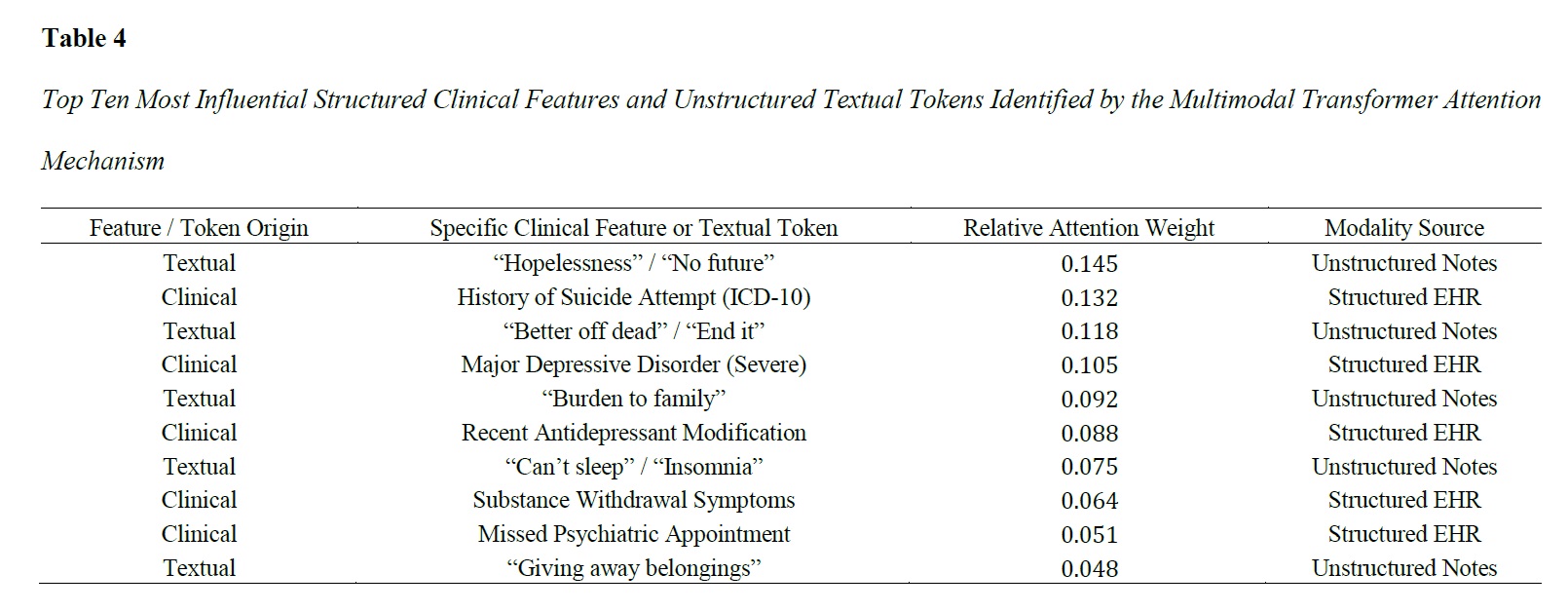
Findings: The overall prevalence of suicidal ideation within the cohort was ( out of records), with significant baseline differences ( ) observed in psychiatric history and demographic distributions between the ideation and non-ideation groups. The multimodal DNN+Transformer model demonstrated superior predictive performance, achieving an Area Under the Curve (AUC) of , an overall accuracy of , and an F1-score of . By comparison, the standalone text-based Transformer achieved an AUC of . Model attention mechanisms revealed that textual tokens such as “hopelessness” and structured features including Major Depressive Disorder and prior suicide attempts were the most heavily weighted predictive variables.
Conclusion: The integration of structured clinical data and unstructured clinical narratives through multimodal deep learning architectures significantly outperforms single-modality approaches in classifying suicidal ideation. This validates the use of advanced computational modeling within existing electronic health record systems as a proactive, highly accurate tool for early clinical decision support.
Downloads
References
Boylan, K., Duncan, L., Wang, L., Manion, I., Bennett, K., Colman, I., & Georgiades, K. (2025). Prevalence and Correlates of Non-Suicidal Self-Injuring Youth Who Do Not Endorse Suicidal Ideation: Prévalence Et Corrélation De L’automutilation Non Suicidaire Chez Des Jeunes Qui N’ont Pas D’idées Suicidaires. The Canadian Journal of Psychiatry, 70(7), 574-582. https://doi.org/10.1177/07067437251337609
Chamizo‐Nieto, M. T., & Rey, L. (2023). Cybervictimization and Suicidal Ideation in Adolescents: A Prospective View Through Gratitude and Life Satisfaction. Journal of Health Psychology, 28(7), 620-632. https://doi.org/10.1177/13591053221140259
Chong, M. K., Hickie, I. B., Ottavio, A., Rogers, D. C., Dimitropoulos, G., LaMonica, H. M., Borgnolo, L. J., McKenna, S., Scott, E., & Iorfino, F. (2024). A Digital Approach for Addressing Suicidal Ideation and Behaviors in Youth Mental Health Services: Observational Study. Journal of medical Internet research, 26, e60879. https://doi.org/10.2196/60879
Extremera, N., Quintana-Orts, C., Mérida-López, S., & Rey, L. (2018). Cyberbullying Victimization, Self-Esteem and Suicidal Ideation in Adolescence: Does Emotional Intelligence Play a Buffering Role? [Original Research]. Frontiers in psychology, 9. https://doi.org/10.3389/fpsyg.2018.00367
Fan, Q., Li, Y., Gao, Y., Nazari, N., & Griffiths, M. D. (2022). Self-Compassion Moderates the Association Between Body Dissatisfaction and Suicidal Ideation in Adolescents: A Cross-Sectional Study. Int J Ment Health Addict, 1-18. https://doi.org/10.1007/s11469-021-00727-4
Farella Guzzo, M., & Gobbi, G. (2021). Parental Death During Adolescence: A Review of the Literature. OMEGA - Journal of Death and Dying, 87(4), 1207-1237. https://doi.org/10.1177/00302228211033661
Fearon, D., Luther, A. W., Browne, D. T., Colman, I., Dubin, J. A., Duncan, L., & Ferro, M. A. (2025). Morbidity, Suicidal Ideation and Suicide Attempts Among Youth in Canada: A Nationally-Representative Study: Morbidité, Idées Suicidaires Et Tentatives De Suicide Chez Les Jeunes Au Canada : Une Étude Représentative À L’échelle Nationale. The Canadian Journal of Psychiatry. https://doi.org/10.1177/07067437251343292
Gitonga, B., & Muthoni, S. (2024). Suicidal Ideation Among Kenyan Youth: A Qualitative Analysis of Online Life Stories. OMEGA - Journal of Death and Dying. https://doi.org/10.1177/00302228241264040
Kaur, A., & Kang, T. K. (2019). Relationship of mental health with suicidal ideation among adolescents. International Journal of Education and Management Studies, 9(3), 150-154. https://search.proquest.com/openview/934e8ba1424bc8e6295a9c16ab472dbf/1?pq-origsite=gscholar&cbl=2032132
Khatcherian, E., Zullino, D., De Leo, D., & Achab, S. (2022). Feelings of loneliness: understanding the risk of suicidal ideation in adolescents with internet addiction. A theoretical model to answer to a systematic literature review, without results. International journal of environmental research and public health, 19(4), 2012. https://doi.org/10.3390/ijerph19042012
Kwon, M., Kim, S. A., & Lee, Y. J. (2023). Factors Related to Suicidal Ideation in Adolescents According to Types of Stress. Iranian Journal of Public Health. https://doi.org/10.18502/ijph.v52i11.14034
Liu, L., & Wang, W. (2024). Suicide attempts of friends and family during adolescence and long-term suicidal ideation and attempts: Findings from the 25-year Add Health study. Journal of affective disorders, 358, 377-382. https://doi.org/10.1016/j.jad.2024.05.053
Long, K. Q., Yên, N. T., Anh, H. T. N., Park, K., Takeuchi, M., Lam, N. T., Nga, P. T., Anh, L. P., Tuấn, L. V., Bao, T. Q., Van, N. H. N., Thanh, P. Q., Phi, N. H., Anh, L. D. M., Phương, N. H., & Minh, H. V. (2021). Relationships Between Parental Involvement and Suicidal Ideation Among in-School Adolescents in Vietnam: A Multilevel Analysis of the Global School-Based Student Health Survey 2019. https://doi.org/10.1101/2021.03.11.21253432
Love, H. A., & Durtschi, J. A. (2021). Suicidal ideation and behaviors in young adults: A latent profile analysis. Journal of Family Psychology, 35(3), 345-355. https://doi.org/10.1037/fam0000786
Marconi, E., Monti, L., Marfoli, A., Kotzalidis, G. D., Janiri, D., Cianfriglia, C., & Chieffo, D. P. R. (2023). A systematic review on gender dysphoria in adolescents and young adults: focus on suicidal and self-harming ideation and behaviours. Child and adolescent psychiatry and mental health, 17(1), 110. https://doi.org/10.1186/s13034-023-00654-3
Mohseni, S. (2020). The impact of suicide prevention using machine learning models on reducing suicidal ideation among Iranian adolescents. Journal of Mental Health, 27(3), 112-125.
Nam, K. A., & Cho, H. H. (2022). Factors Affecting Suicidal Ideation in Multicultural Adolescents: The Mediating Role of Happiness. Journal of Korean Academy of Community Health Nursing, 33(2), 228. https://doi.org/10.12799/jkachn.2022.33.2.228
Primananda, M., Phetrasuwan, S., Putdivarnichap, W., & Vongsirimas, N. (2024). Predictive Power of the Social Determinants of Health on Suicidal Ideation Among Indonesian Adolescents. Multidisciplinary Science Journal, 7(4), 2025218. https://doi.org/10.31893/multiscience.2025218
Raffagnato, A., Iannattone, S., Fasolato, R., Parolin, E., Ravaglia, B., Biscalchin, G., Traverso, A., Zanato, S., Miscioscia, M., & Gatta, M. (2022). A Pre-Adolescent and Adolescent Clinical Sample Study About Suicidal Ideation, Suicide Attempt, and Self-Harming. European Journal of Investigation in Health Psychology and Education, 12(10), 1441-1462. https://doi.org/10.3390/ejihpe12100100
Still, D. (2020). Romantic Relationship Quality and Suicidal Ideation in Young Adulthood. Society and Mental Health, 11(2), 134-148. https://doi.org/10.1177/2156869320929386
Tan, L., Chen, J., Xia, T., & Hu, J. (2018). Predictors of Suicidal Ideation Among Children and Adolescents: Roles of Mental Health Status and Meaning in Life. Child & Youth Care Forum, 47(2), 219-231. https://doi.org/10.1007/s10566-017-9427-9
Uddin, R., Burton, N. W., Maple, M., Khan, S. R., & Khan, A. (2019). Suicidal ideation, suicide planning, and suicide attempts among adolescents in 59 low-income and middle-income countries: a population-based study. The Lancet Child & Adolescent Health, 3(4), 223-233. https://www.thelancet.com/journals/lanchi/article/PIIS2352-4642(18)30403-6/fulltext
Xiao, Y. (2025). Addictive Screen Use Trajectories and Suicidal Behaviors, Suicidal Ideation, and Mental Health in US Youths. JAMA. https://doi.org/10.1001/jama.2025.7829
Xie, Y., Yang, Q., & Lei, F. (2023). The Relationship of Internet Gaming Addiction and Suicidal Ideation Among Adolescents: The Mediating Role of Negative Emotion and the Moderating Role of Hope. International journal of environmental research and public health. https://doi.org/10.3390/ijerph20043375
Xu, L., Zhang, H., Zhou, C., Zhang, Z., Li, G., Lu, W., & Lin, K. (2023). Deficits in psychological resilience and problem-solving ability in adolescents with suicidal ideation. Child and adolescent psychiatry and mental health, 17(1), 31. https://doi.org/10.1186/s13034-023-00577-z
Yıldız, M. (2020). Stressful life events and adolescent suicidality: An investigation of the mediating mechanisms. Journal of adolescence, 82(1), 32-40. https://doi.org/10.1016/j.adolescence.2020.05.006
Downloads
Additional Files
Publication Timeline
- Submitted
- Revised
- Accepted