Comparing the Effectiveness of Mentalization-Based Therapy and Dialectical Behavior Therapy on Time Perception and Self-Forgiveness in Adolescents with Self-Injurious Behaviors
DOI:
https://doi.org/10.61838/Keywords:
Mentalization-Based Therapy, Dialectical Behavior Therapy, Time Perception, Self-Forgiveness, Self-Injurious Behavior, AdolescentsAbstract
Objective: The present study aimed to determine the differences in the effectiveness of Mentalization-Based Therapy and Dialectical Behavior Therapy on time perception and self-forgiveness in adolescents with self-injurious behaviors.
Methods and Materials: This applied study employed a quasi-experimental design with a pretest–posttest control group and a two-month follow-up. The statistical population consisted of adolescent girls aged 13–18 years with self-injurious behaviors who were referred to counseling centers in Tehran during the second half of 1403. A total of 45 participants were selected through purposive sampling and randomly assigned into two experimental groups (Mentalization-Based Therapy and Dialectical Behavior Therapy) and one control group (15 participants per group). The experimental groups received 12 sessions of their respective interventions, while the control group remained on a waiting list. Data were collected using the Self-Forgiveness Scale and the Adolescent Time Perspective Questionnaire. Data analysis was conducted using SPSS-26 at both descriptive and inferential levels, including multivariate analysis of variance, repeated measures ANOVA, and Bonferroni post hoc tests, after verifying statistical assumptions.
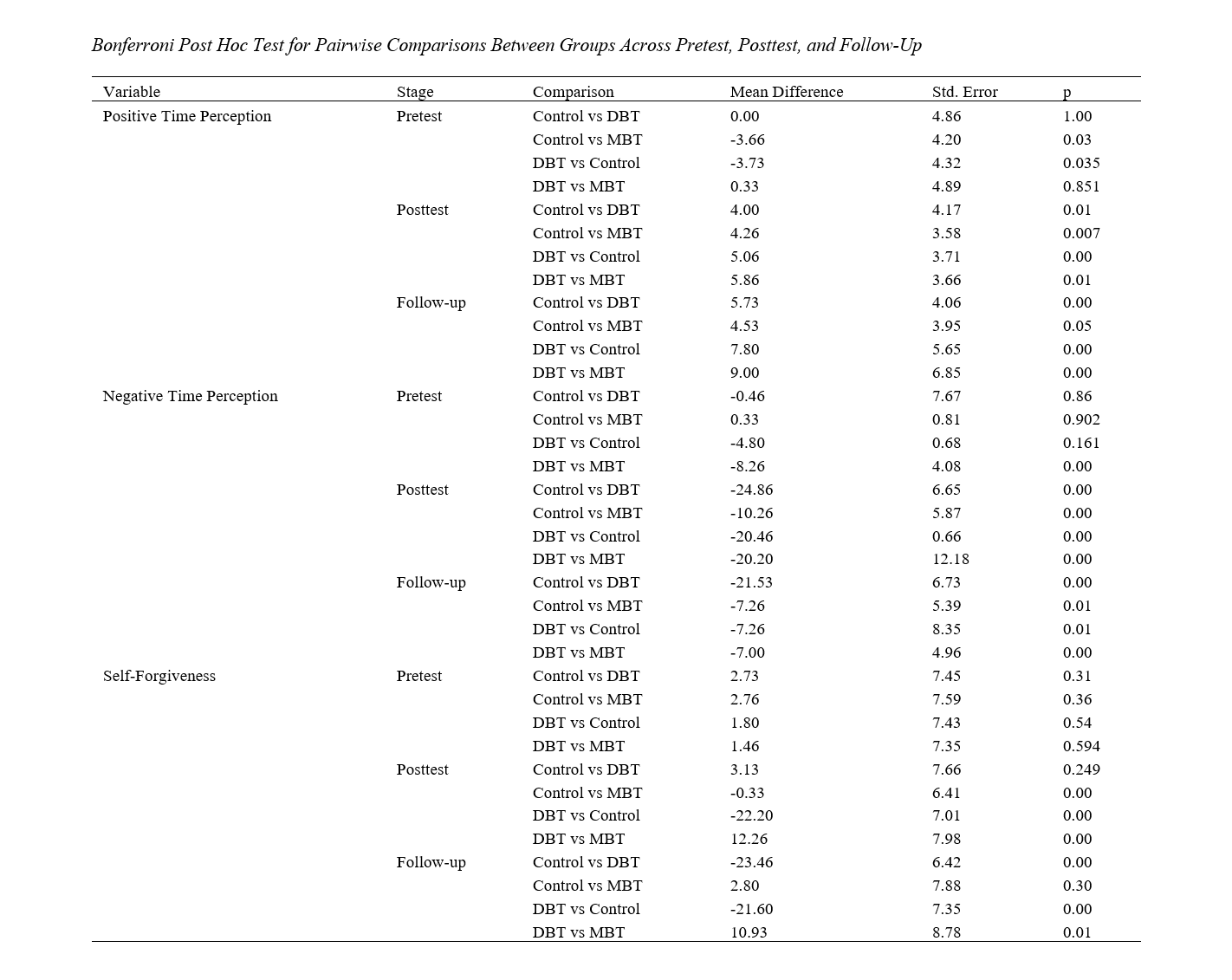
Findings: The results of repeated measures ANOVA indicated significant main effects of time and group, as well as significant interaction effects between time and group for positive time perception, negative time perception, and self-forgiveness (p < 0.001). Bonferroni post hoc tests revealed that both experimental groups showed significant improvements compared to the control group at posttest and follow-up (p < 0.05). Specifically, positive time perception and self-forgiveness increased significantly, while negative time perception decreased significantly in both intervention groups. Furthermore, the Mentalization-Based Therapy group demonstrated significantly greater improvements than the Dialectical Behavior Therapy group in most variables, particularly at follow-up (p < 0.05), indicating stronger and more sustained effects.
Conclusion: The findings suggest that both Mentalization-Based Therapy and Dialectical Behavior Therapy are effective interventions for improving time perception and self-forgiveness and reducing maladaptive cognitive-emotional patterns in adolescents with self-injurious behaviors; however, Mentalization-Based Therapy appears to have relatively greater and more enduring effects, highlighting its potential as a preferred intervention in this population.
Downloads
References
Alaeinejad, N., Torkan, H., & Yousefi, Z. (2025). Development of a mentalization-based communication skills training package for adolescent girls with self-injurious behaviors. Mental Health and Lifestyle Journal, 3(3), 1-14. https://doi.org/10.61838/mhlj.3.3.1
Azizi, N., Rezaei, F., & Kazemi, L. (2023a). The effectiveness of mentalization-based therapy on difficulties in emotion regulation and self-injurious urges in youth with borderline traits. Journal of Psychotherapy Research, 8(1), 43-65. https://www.suicideinfo.ca
Azizi, N., Rezaei, F., & Kazemi, L. (2023b). The Effectiveness of Mentalization-Based Therapy on Emotion Dysregulation and Tendency to Self-Harm in Young Adults with Borderline Features. Psychotherapy Research Journal, 8(1), 43-65.
Bateman, A. W. (2022). Theory and Practice of Mentalization-Based Treatment. In Gabbard?s Textbook of Psychotherapeutic Treatments. American Psychiatric Association Publishing. https://doi.org/10.1176/appi.books.9781615375233.gg04
Beck, E., Bo, S., Jørgensen, M. S., Gondan, M., Poulsen, S., Storebø, O. J., Fjellerad Andersen, C., Folmo, E., Sharp, C., Pedersen, J., & Simonsen, E. (2020). Mentalization-based treatment in groups for adolescents with borderline personality disorder: a randomized controlled trial. Journal of Child Psychology and Psychiatry, 61(5), 594-604. https://doi.org/10.1111/jcpp.13152
Choi, S.-S., & Kweon, H. (2023). The Mediating Effects of Mentalization in the Effect of Chilhood Attachment Trauma on Self-Injury in Female Adolescent. The Association of Korea Counseling Psychology Education Welfare, 10(6), 237-249. https://doi.org/10.20496/cpew.2023.10.6.237
Farjami, M., Farjami, Z., Shakibaeinejad, A., & Paeezy, L. (2024). Developing a Model of Self-Harm Behaviors Based on Childhood Trauma Experience and Alexithymia with the Mediation of Mentalization in Adolescents. Journal of psychiatric nursing, 12(1). https://ijpn.ir/article-1-2356-en.html
Hozh, A., Mahmud Alilu, M., & Esmailpour, K. (2024). The Effectiveness of Emotion Regulation Techniques and Mindfulness-Based Dialectical Behavior Therapy in Reducing Substance Abuse and Self-Harm in Borderline Personality Disorder. Ibn Sina Journal, 22, 36. https://ebnesina.ajaums.ac.ir/article-1-1350-fa.html
Johnstone, O. K., Marshall, J. J., & McIntosh, L. G. (2022). A review comparing dialectical behavior therapy and mentalization for adolescents with borderline personality traits, suicide and self-harming behavior. Adolescent Research Review, 7(2), 187-209. https://doi.org/10.1007/s40894-020-00147-w
Jørgensen, M. S., Storebø, O. J., Bo, S., Poulsen, S., Gondan, M., Beck, E., Chanen, A. M., Bateman, A., Pedersen, J., & Simonsen, E. (2021). Mentalization-based treatment in groups for adolescents with Borderline Personality Disorder: 3- and 12-month follow-up of a randomized controlled trial. European Child & Adolescent Psychiatry, 30(5), 699-710. https://doi.org/10.1007/s00787-020-01551-2
Karimi, F., Farahbakhsh, K., Salimi Bajestani, H., & Motamedi, A. (2020). The effectiveness of a mentalization-based model on family relationship quality and self-harm behavior in adolescent girls. Journal of Sabzevar University of Medical Sciences, 2(27), 257-265. The effectiveness of a mentalization-based model on family relationship quality and self-harm behavior in adolescent girls
Kim, M., & Park, J. Y. (2022). The Effect of a Balanced Time Perspective on Growth After Adversity in Adolescence: Mediating Effect of Social Connectedness. The Korean Journal of Culture and Social Issues, 28(2), 163-186. https://doi.org/10.20406/kjcs.2022.5.28.2.163
Kuan, T. Y. J. (2023). The mediating role of thinking styles in the relationship between adolescent time perspective and subjective well‐being. Journal of adolescence, 95(3), 479-493. https://doi.org/10.1002/jad.12130
Midgley, N., Ensink, K., Lindqvist, K., & Muller, N. (2021). Mentalization-based therapy for adolescents with self-harm: A review of recent developments. Child and Adolescent Mental Health, 26(2), 100-107.
Moradi, E., Torbati, H. S., Jabbarizadegan, S., Kazlou, H., & Rafieyan, M. (2023). The Effectiveness of Family Therapy on Self-Forgiveness and Quality of Life in Self-Harming Adolescents. International Journal of Health Studies, 9(4), 40-48. https://doi.org/10.22100/ijhs.v9i4.1072
Norouzi, S., Bashardoust, S., & Mojtabaie, M. (2023). Presenting a structural model for predicting mental disturbance based on time perspective with the mediation of psychological coherence and cognitive flexibility in male and female students. Journal of Adolescent and Youth Psychological Studies (JAYPS), 4(1), 90-102. https://doi.org/10.61838/kman.jayps.4.1.10
Oyanadel, C., Worrell, F. C., Pinto-Vigueras, J., Betancur, S., Véliz Tapia, T., Au-Castro, M., & Peñate, W. (2023). Time balance and family functioning: the role of time perspective in the cohesion and adaptability of families with adolescents. European Journal of Investigation in Health, Psychology and Education, 14(1), 117-132. https://doi.org/10.3390/ejihpe14010008
Raziee, Z., Fattahi Andabil, A., & Dokaneheeifard, F. (2023). The relationship between time perspective and happiness with the mediating role of lifestyle in female adolescents. Rooyesh, 11(11), 103-114. https://doi.org/20.1001.1.2383353.1401.11.11.10.7
Rossouw, T. I., & Fonagy, P. (2012). Mentalization-Based Treatment for Self-Harm in Adolescents: A Randomized Controlled Trial. Journal of the American Academy of Child & Adolescent Psychiatry, 51(12), 1304-1313. https://doi.org/10.1016/j.jaac.2012.09.018
Samadi, B., Seyed, A., Razjouyan, & Shahabizadeh. (2023). Comparison of the effectiveness of behavioral activation therapy and dialectical behavior therapy on self-harming and self-critical behaviors in adolescents with bipolar disorder. Journal of the Faculty of Medicine, Mashhad University of Medical Sciences, 66(2), 394-408. https://stoptransingkids.wordpress.com
Samadi, F., Bahrinian, S. A., Razjouyan, K., & Shahabizadeh, F. (2023). The effectiveness of dialectical behavior therapy on aggression, self-criticism, and self-harming behaviors in adolescents aged 12-18 with bipolar disorder. Royesh Psychology, 12(3), 55-66. http://frooyesh.ir/article-1-4633-en.html
Simon, G. E., Shortreed, S. M., Rossom, R. C., Beck, A., Clarke, G. N., Whiteside, U., Richards, J. E., Penfold, R. B., Boggs, J. M., & Smith, J. (2022). Effect of Offering Care Management or Online Dialectical Behavior Therapy Skills Training vs Usual Care on Self-harm Among Adult Outpatients With Suicidal Ideation: A Randomized Clinical Trial. JAMA, 327(7), 630-638. https://doi.org/10.1001/jama.2022.0423
Skolnick, V. G., Lynch, B. A., Smith, L., Romanowicz, M., Blain, G., & Toussaint, L. (2023). The association between parent and child ACEs is buffered by forgiveness of others and self-forgiveness. Journal of Child & Adolescent Trauma, 16, 995-1003. https://doi.org/10.1007/s40653-023-00552-y
Stagaki, M., Nolte, T., Feigenbaum, J., King‐Casas, B., Lohrenz, T., Fonagy, P., & Montague, P. R. (2021). The Mediating Role of Attachment and Mentalising in the Relationship Between Childhood Trauma, Self-Harm and Suicidality. https://doi.org/10.31234/osf.io/d6j89
Yang, L. (2025). Childhood Maltreatment and Non-Suicidal Self-Injury: The Mediating Role of Mentalization and Depression. European Journal of Psychotraumatology, 16(1). https://doi.org/10.1080/20008066.2025.2466279
Downloads
Additional Files
Publication Timeline
- Submitted
- Revised
- Accepted