Machine‑Learning Prediction of Non‑Suicidal Self‑Injury Based on Emotion Dysregulation Facets, Alexithymia, Impulsivity, and Online Social Interaction Patterns
DOI:
https://doi.org/10.61838/kman.jayps.5226Keywords:
Non-suicidal self-injury, Machine Learning, Emotion Dysregulation, Alexithymia, Impulsivity, Online Social InteractionAbstract
Objective: This study aimed to develop and validate a high-accuracy machine-learning model to predict non-suicidal self-injury (NSSI) by integrating psychological variables (emotion dysregulation, alexithymia, impulsivity) and digital behavior patterns.
Methods and Materials: A cross-sectional study was conducted with one thousand two hundred forty-eight individuals ( ) aged fifteen to twenty-nine. Participants completed validated self-report measures assessing NSSI (Inventory of Statements About Self-Injury), emotion dysregulation (DERS), alexithymia (TAS-20), impulsivity (UPPS-P), and online social interaction patterns. The dataset was partitioned into training ( ) and testing ( ) sets. Three machine-learning models (Support Vector Machines, Random Forest, and XGBoost) were trained and evaluated, with feature importance analyzed using SHapley Additive exPlanations (SHAP).
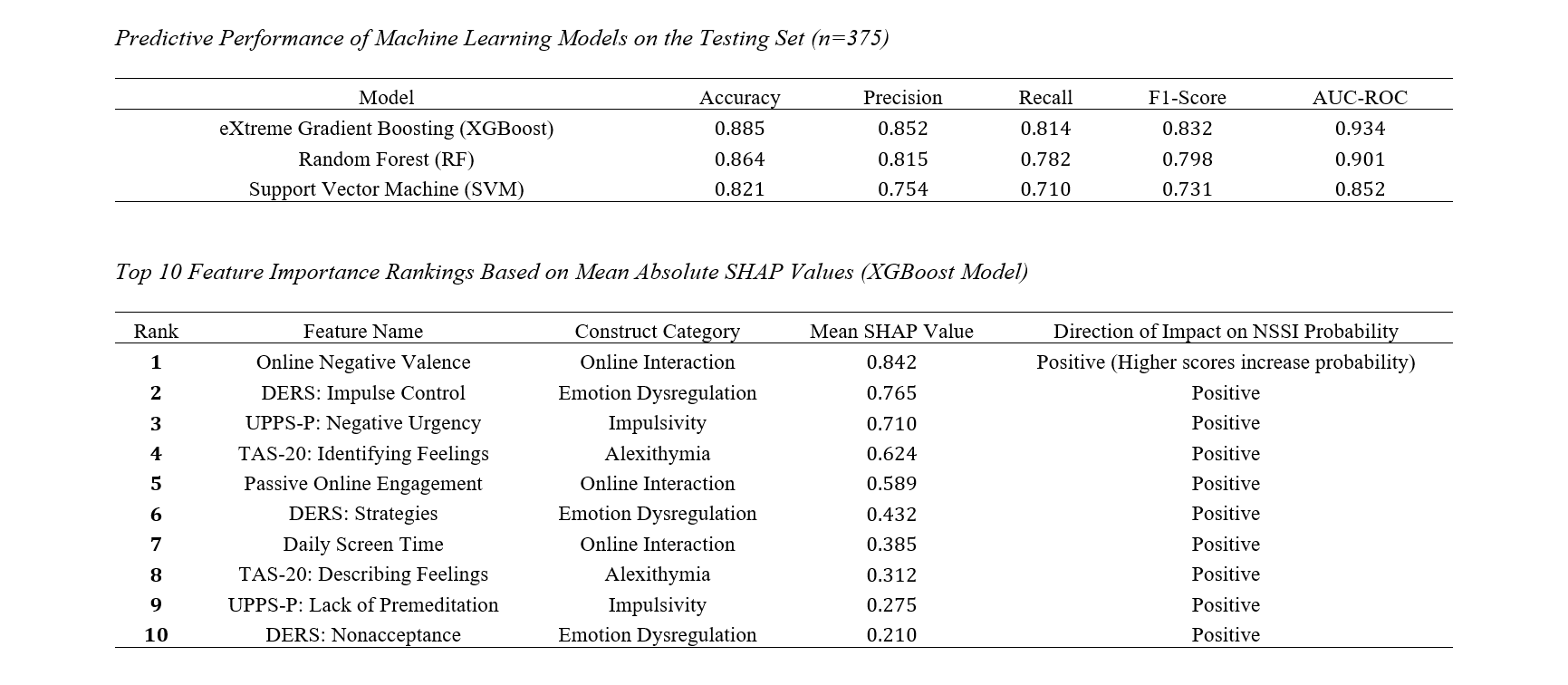
Findings: The prevalence of lifetime NSSI was ( ). The eXtreme Gradient Boosting (XGBoost) model demonstrated superior predictive performance on the testing set, achieving an accuracy of and an Area Under the Receiver Operating Characteristic Curve (AUC-ROC) of . SHAP analysis identified the most influential predictors of NSSI as the negative emotional valence of online interactions ( ), impulse control difficulties ( ), and negative urgency ( ).
Conclusion: Machine-learning models can accurately predict non-suicidal self-injury, highlighting the critical role of digital emotional distress and impulsivity as primary risk factors.
Downloads
References
Ahn, C.-Y., Lee, J.-S., Kim, J., Kim, S., Kim, J.-W., Na, J.-J., & Seo, D. G. (2025). The Impact of Negative Emotions on Adolescents’ Nonsuicidal Self-Injury Thoughts: An Integrated Application of Machine Learning and Multilevel Logistic Models. https://doi.org/10.1101/2025.02.15.25322355
Anastasi, G. (2026). Inflammation and suicide risk in adolescents with self-injury: Expanding the role of mental health nursing. World journal of psychiatry, 16(1). https://doi.org/10.5498/wjp.v16.i1.113965
Boylan, K. (2024). Self-Injury, substance use, and risk of borderline personality disorder in young patients. JAMA Network Open, 7(11), e2444196. https://doi.org/10.1001/jamanetworkopen.2024.44196
Boylan, K., Duncan, L., Wang, L., Manion, I., Bennett, K., Colman, I., & Georgiades, K. (2025). Prevalence and Correlates of Non-Suicidal Self-Injuring Youth Who Do Not Endorse Suicidal Ideation: Prévalence Et Corrélation De L’automutilation Non Suicidaire Chez Des Jeunes Qui N’ont Pas D’idées Suicidaires. The Canadian Journal of Psychiatry, 70(7), 574-582. https://doi.org/10.1177/07067437251337609
Chung, J. J., & Kaufman, E. A. (2024). Borderline Personality Features and Self-Injurious Urges: The Roles of Self-Concept Clarity and Bedtime Self-Critical Rumination. Identity, 24(3), 243-256. https://doi.org/10.1080/15283488.2024.2345707
Gao, Y., Wang, Y., Wang, Z., Ma, M., Li, H., Wang, J., Liu, J., Qian, H., Ping, Z., & Xu, X. (2024). Family Intimacy and Adaptability and Non-Suicidal Self-Injury: A Mediation Analysis. BMC psychiatry, 24(1). https://doi.org/10.1186/s12888-024-05642-1
Gonçalves, S., Vieira, A. I., Machado, B. C., & Bessa, C. (2024). Non-suicidal self-injury in Portuguese college students: relationship with emotion regulation, resilience and self-compassion. Current Psychology, 43(9), 7877-7886. https://doi.org/10.1007/s12144-023-04985-4
González-Arrimada, A., Martínez, R., & López, M. (2025). Lifestyle habits, problem behaviors, and non-suicidal self-injury in adolescents: A systematic review and meta-analysis. Child and Adolescent Social Work Journal, 42(1), 257-273. https://link.springer.com/article/10.1007/s40894-025-00257-3
Guo, J., Wang, C., & You, J. (2024). Patterns and transitions of nonsuicidal self-injury outcome expectancies and their associations with nonsuicidal self-injury among adolescents. Journal of youth and adolescence, 53(4), 895-909. https://doi.org/10.1007/s10964-023-01900-9
Guo, Y., Yin, X., Xu, J., Chen, F., Zhang, F., Liu, Y., Sun, P., Hong, J., & Hu, Y. (2024). The Relationship Between Sedentary Behavior and Non-Suicidal Self-Injury Behavior Among Adolescents in China. Frontiers in Psychiatry, 15. https://doi.org/10.3389/fpsyt.2024.1489707
He, K., Chen, L., Fan, H., Sun, L., Yang, T., Liu, H., & Wang, K. (2025). Effects of Rumination and Emotional Regulation on Non-Suicidal Self-Injury Behaviors in Depressed Adolescents in China: A Multicenter Study. Psychology research and behavior management, 18, 271-279. https://doi.org/10.2147/PRBM.S483267
Herdaetha, A., Matius Dimas Reza Dana, I., & Suwito, J. (2025). Factors Influence Non-Suicidal Self-Injury Behavior Among Young Adults. Iseth, 909-915. https://doi.org/10.23917/iseth.5481
Hu, R., Peng, L. L., Du, Y., Feng, Y. W., Xie, L. S., Shi, W., & Zhao, L. (2024). Reciprocal effect between non-suicidal self-injury and depressive symptoms in adolescence. Frontiers in Public Health, 11, 1243885. https://doi.org/10.3389/fpubh.2023.1243885
Lei, H., Yang, Y., Zhu, T., Zhang, X., & Dang, J. (2024). Network analysis of the relationship between non-suicidal self-injury, depression, and childhood trauma in adolescents. https://doi.org/10.21203/rs.3.rs-3804909/v1
Levkovich, I., & Stregolev, B. (2024). Non-Suicidal Self-Injury Among Adolescents: Effect of Knowledge, Attitudes, Role Perceptions, and Barriers in Mental Health Care on Teachers’ Responses. Behavioral Sciences, 14(7), 617. https://doi.org/10.3390/bs14070617
Ma, X., He, L., Yu, M., Li, S., Liu, Y., XuYou, & Yu, L. (2026). Relationship between cyberbullying victimization and nonsuicidal self-injury behavior in vocational college students in China: a cross-sectional study. Current Psychology, 45(3), 280. https://doi.org/10.1007/s12144-025-08671-5
McArthur, B. A. (2026). Suicidality and Nonsuicidal Self-Injury in Transgender and Gender Diverse Youth. JAMA Pediatrics, 180(2), 144. https://doi.org/10.1001/jamapediatrics.2025.5274
Muehlenkamp, J. J., Brausch, A. M., & Littlefield, A. (2023). Concurrent changes in nonsuicidal self-injury and suicide thoughts and behaviors. Psychological medicine, 53(11), 4898-4903. https://doi.org/10.1017/S0033291722001763
Nelson, B. W., Pollak, O. H., Clayton, M. G., Telzer, E. H., & Prinstein, M. J. (2023). An RDoC-based Approach to Adolescent Self-Injurious Thoughts and Behaviors: The Interactive Role of Social Affiliation and Cardiac Arousal. Development and Psychopathology, 36(3), 1005-1015. https://doi.org/10.1017/s0954579423000251
Ni, X., Liang, Q., Liao, X., Wang, H., & Yu, C. (2024). How does emotional insecurity affect non-suicidal self-injury among Chinese early adolescents: a longitudinal study. Child and adolescent psychiatry and mental health, 18(1), 148. https://doi.org/10.1186/s13034-024-00839-4
Oh, S. (2024). Unintentional Nonsuicidal Self-Injury in an Adolescent With Perfectionism. Precision and Future Medicine, 8(3), 112-115. https://doi.org/10.23838/pfm.2024.00114
Park, Y. S., & Yoo, J. Y. (2024). The Effect of Delinquent Experience on Self-Injury Behavior in Adolescents: Moderated Mediating Effect of Negative Self-Perception by Depression. Correct Welf Soc Korea, 87, 57-85. https://doi.org/10.35422/cwsk.2024.87.57
Rachma, A., & Hendrawan, D. (2025). Pathway Linking Executive Function Problems and Non-Suicidal Self-Injury Among Adolescents: The Mediating Role of Emotion Dysregulation. Psikohumaniora Jurnal Penelitian Psikologi, 10(1), 43-58. https://doi.org/10.21580/pjpp.v10i1.23353
Reichl, C., Schär, S., Lerch, S., Hedinger, N., Brunner, R., Koenig, J., & Kaess, M. (2024). Two-year course of non-suicidal self-injury in an adolescent clinical cohort: The role of childhood adversity in interaction with cortisol secretion. Psychoneuroendocrinology, 107093. https://doi.org/10.1016/j.psyneuen.2024.107093
Shi, Y., Song, Y., Wang, L., Liu, J., & Chen, I. J. (2023). Early maladaptive schemas and the risk of nonsuicidal self-injury in college students: A retrospective study. Medicine, 102(47), e35584. https://doi.org/10.1097/MD.0000000000035584
Sun, Y. (2023). Research on the Effect of Attentional Bias on Non-Suicidal Self-Injury. Theoretical and Natural Science, 23(1), 34-39. https://doi.org/10.54254/2753-8818/23/20231018
Swerdlow, B. A., Pearlstein, J. G., Sandel, D. B., & Johnson, S. L. (2024). Negative Affect and Nonsuicidal Self-Injury. The Oxford Handbook of Nonsuicidal Self-Injury, 226. https://books.google.com/books?hl=en&lr=&id=LhcBEQAAQBAJ&oi=fnd&pg=PA226&dq=23.+Claes,+L.,+Jimenez-Murcia,+S.,+Ag%C3%BCera,+Z.,+Castro,+R.,+S%C3%A1nchez,+I.,+Mench%C3%B3n,+J.+M.,+%26+Fern%C3%A1ndez-Aranda,+F.+(2020).+Mood+and+anxiety+disorders+precede+the+onset+of+an+eating+disorder:+A+longitudinal+study.+Journal+of+Clinical+Medicine,+9(6),+1840.&ots=hTqayuMwBO&sig=K3f2WIWdUugGnwQWl3eGeN72bs8
Vafaei, T., Samavi, S. A., Whisenhunt, J., & Najarpourian, S. (2023). An Investigation of Self-Injury in Female Adolescents: A Qualitative Study. Quality & Quantity, 57(6), 5599-5622. https://doi.org/10.1007/s11135-023-01632-9
Wan, Z., Fang, S., & Zhao, C. (2025). The Effect of Interparental Conflict on Non-Suicidal Self-Injury in Middle School Students: A Moderated Mediation Model of Self-Esteem and Regulatory Emotional Self-Efficacy. BMC psychology, 13(1). https://doi.org/10.1186/s40359-025-02681-5
Wang, Q. (2024). Childhood Trauma and Non-Suicidal Self-Injury Among Chinese Adolescents: The Chain-Mediated Role of Alexithymia and Rumination. Psychiatry Investigation, 21(7), 726-735. https://doi.org/10.30773/pi.2024.0041
Wang, Y., Liu, Y., & Zhou, J. (2023). Cyberbullying Victimization and Nonsuicidal Self-Injury in Early Adolescents: A Moderated Mediation Model of Social Anxiety and Emotion Reactivity. Cyberpsychology Behavior and Social Networking, 26(6), 393-400. https://doi.org/10.1089/cyber.2022.0346
Wei, C., B, L., Wang, Y., Wang, Y., & Xu, Q. (2024). The Roles of Psychological Needs Satisfaction and Impulsivity to Parent-Child Conflict and Non-Suicidal Self-Injury. Frontiers in Psychiatry, 15. https://doi.org/10.3389/fpsyt.2024.1501983
Wei, H., Zhang, Y., Sun, N., Wang, Y., & Li, Y. (2024). The Correlation Between Non-Suicidal Self-Injury and Mobile Phone Social Media Dependence in Adolescents. https://doi.org/10.21203/rs.3.rs-4280256/v1
Wen, J., Xu, Q., Jiang, Y., & Li, M. (2024). The effects of student bullying on non-suicidal self-injurious behavior in rural adolescents: the chain-mediated effects of alexithymia and ruminate thinking. Frontiers in psychology, 15, 1483408. https://doi.org/10.3389/fpsyg.2024.1483408
Yang, L. (2025). Childhood Maltreatment and Non-Suicidal Self-Injury: The Mediating Role of Mentalization and Depression. European Journal of Psychotraumatology, 16(1). https://doi.org/10.1080/20008066.2025.2466279
Yu, W., Li, S., Xiao, W., Li, X., Wang, R., Liu, J., Zhang, S., & Wan, Y. (2023). Childhood maltreatment and non-suicidal self-injury among Chinese college students: The moderating roles of social phobia and perceived family economic status. Child abuse & neglect, 139, 106113. https://www.sciencedirect.com/science/article/pii/S0145213423000947
Yuan, G. F., Zhong, S., Liu, C., Liu, J., & Yu, J. (2025). The influence of family resilience on non-suicidal self-injury among Chinese adolescents: The mediating roles of mindfulness and individual resilience. Archives of Psychiatric Nursing. https://doi.org/10.1016/j.apnu.2025.01.003
Zheng, X., Liu, Z., Liu, T., & Mu, S. (2025). Childhood Maltreatment and Non-Suicidal Self-Injury Among Chinese College Students: Roles of Parent-Child Attachment and Negative co-Rumination. Journal of family violence, 1-4. https://doi.org/10.1007/s10896-025-00854-9
Zheng, Y., Wang, J., Jiang, Q., Liao, M., & Huang, F. (2023). Non-Suicidal Self-Injury and Suicidal Ideation Among Adolescents: The Chain-Mediating Role of Rumination and Decentering. Frontiers in Psychiatry, 14. https://doi.org/10.3389/fpsyt.2023.1179518
Downloads
Additional Files
Publication Timeline
- Submitted
- Revised
- Accepted