The Relationship Between Schema Modes, Psychological Flexibility, and Alexithymia with Subjective Well-Being Among Students in Qazvin
DOI:
https://doi.org/10.61838/kman.jayps.5266Keywords:
Subjective Well-Being, Schema Modes, Psychological Flexibility, Alexithymia, University StudentsAbstract
Objective: The present study aimed to investigate the relationship between schema modes, psychological flexibility, and alexithymia with subjective well-being among university students in Qazvin.
Methods and Materials: This study was a fundamental, descriptive-correlational research conducted among students of Imam Khomeini International University during the 2022–2023 academic year. A total of 305 participants were selected using multistage cluster random sampling. Data were collected using the Satisfaction with Life Scale (SWLS), the Positive and Negative Affect Schedule (PANAS), the Schema Mode Questionnaire, the Psychological Flexibility Questionnaire, and the Toronto Alexithymia Scale (TAS-20). After obtaining informed consent, questionnaires were administered, and data were analyzed using descriptive statistics, Pearson correlation coefficients, and multiple regression analysis via SPSS.
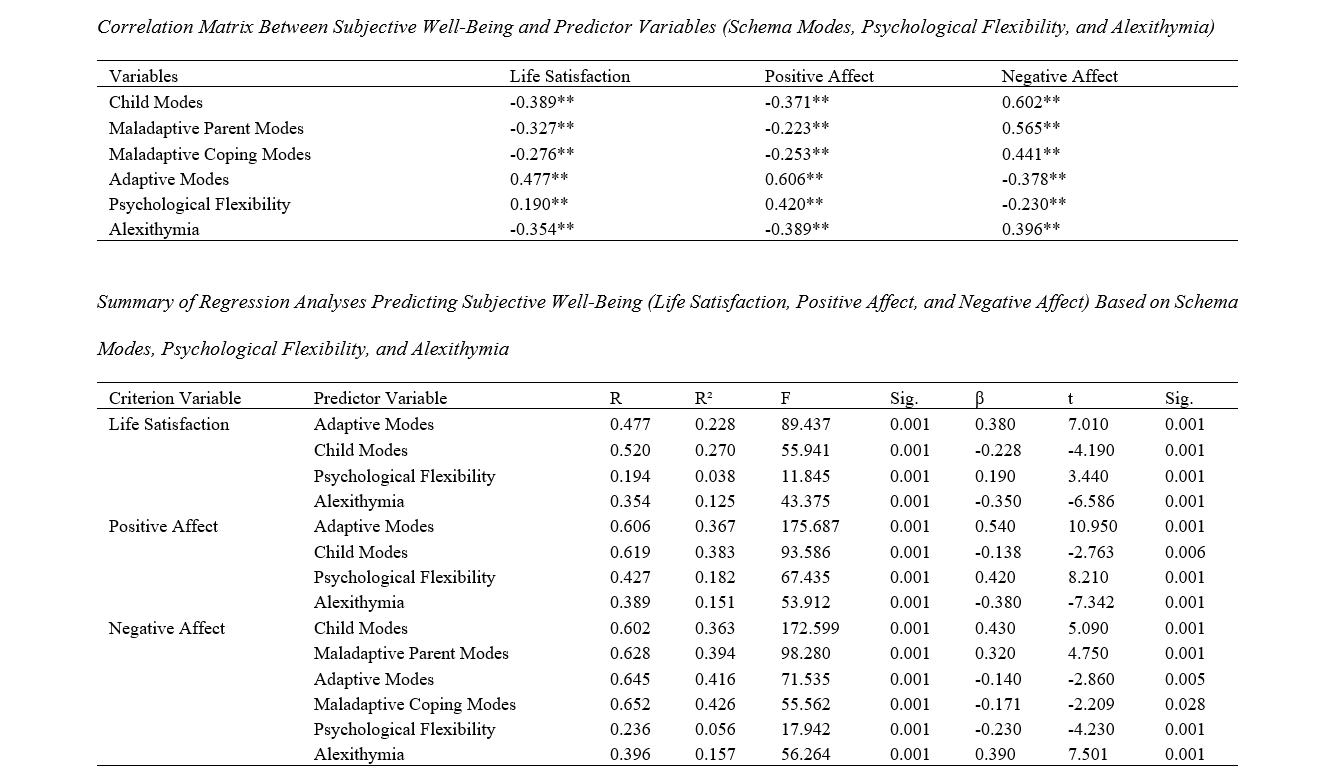
Findings: The results indicated that maladaptive schema modes (child modes, maladaptive parent modes, and maladaptive coping modes) were significantly negatively correlated with life satisfaction and positive affect and positively correlated with negative affect (p < .01). In contrast, adaptive schema modes showed significant positive correlations with life satisfaction and positive affect and negative correlations with negative affect (p < .01). Psychological flexibility was positively associated with life satisfaction (β = 0.19, p < .001) and positive affect (β = 0.42, p < .001), and negatively associated with negative affect (β = -0.23, p < .001). Alexithymia demonstrated significant negative relationships with life satisfaction (β = -0.35, p < .001) and positive affect (β = -0.38, p < .001), and a positive relationship with negative affect (β = 0.39, p < .001). Regression analyses further revealed that schema modes accounted for the largest proportion of variance in subjective well-being components, followed by alexithymia and psychological flexibility.
Conclusion: The findings suggest that maladaptive schema modes and alexithymia are significant risk factors for reduced subjective well-being, whereas adaptive schema modes and psychological flexibility function as protective factors.
Downloads
References
Arslan, G. (2024). Unlocking the Power of Self-Compassion and Psychological Flexibility: Enhancing Emotional Health, Subjective Wellbeing, and Quality of Life in College Students. Studia psychologica, 66(1), 50-65. https://doi.org/10.31577/sp.2024.01.890
Dalokay, E. B., & Aydin, A. (2023). The relationship between alexithymia, communication skills and mental well-being of nurses' in Turkey: A cross-sectional study. Archives of Psychiatric Nursing, 43, 81-86. https://doi.org/10.1016/j.apnu.2022.12.020
Ding, Y., Huang, H., Zhang, Y., Peng, Q., Yu, J., Lu, G., Wu, H., & Chen, C. (2022). Correlations Between Smartphone Addiction and Alexithymia, Attachment Style, and Subjective Well-Being: A Meta-Analysis. Frontiers in psychology, 13. https://doi.org/10.3389/fpsyg.2022.971735
Faghih, F., Hadipour, M., Arce, E., Simmons, A. N., Stein, M. B., Winkielman, P., Hitchcock, C., & Paulus, M. P. (2024). A model for predicting the quality of life of veterans based on schematic mindsets, moral injury, and existential anxiety Association between individual differences in self-reported emotional resilience and the affective perception of neutral faces. Military medicine, 26(2), 2238-2247. https://doi.org/https://doi.org/10.1016/j.jad.2008.08.015
Henry, J. D., Phillips, Louise H, Maylor, Elizabeth A, Hosie, Judith, Milne, Alan B, Meyer, Caroline. (2006). A new conceptualization of alexithymia in the general adult population: implications for research involving older adults. Journal of psychosomatic research, 60(5), 535-543. https://doi.org/10.1016/j.jpsychores.2005.09.008
İme, Y. (2025). The link between bullying victimization and mental well-being: Self-compassion and emotional flexibility as mediators among adolescents. Current Psychology, 44(5), 3033-3043. https://doi.org/10.1007/s12144-025-07378-x
Kahya, Y., & Uluç, S. (2023). Maternal Childhood Trauma and Postpartum Well-Being in a Turkish Sample: The Path From Attachment to Alexithymia. Klinik Psikoloji Dergisi, 7(1), 1-10. https://doi.org/10.57127/kpd.26024438m000076x
Khodabandelow, S., Najafi, M., & Rahimian Boogar, I. (2017). Effectiveness of Schema Therapy with a Mindset Approach on Reducing Symptoms of Narcissism in Patients with Narcissistic Personality Disorder. Journal of Behavioral Science Research, 15(3), 321-330. https://rbs.mui.ac.ir/article-1-548-fa.html
Khosravi Pour, Z., Toosi, D., & Mazaheri Pour, F. (2024). The Relationship Between Positive School Orientation and Academic Well-being of Students with the Mediating Role of Cognitive Flexibility. Applied Psychological Research, 15(3), 97-112. https://journals.ut.ac.ir/article_98012.html
Kiye, S., & Çiçek Habeş, E. (2024). The mediating role of cognitive emotion regulation in the relationship between cognitive flexibility and psychological well-being. INUJFE, 25(3), 1292-1310. https://doi.org/10.17679/inuefd.1481952
Maral, S., Bilmez, H., & Satıcı, S. A. (2024). Positive Childhood Experiences and Spiritual Well-Being: Psychological Flexibility and Meaning-Based Coping as Mediators in Turkish Sample. Journal of religion and health, 63(4), 2709-2726. https://doi.org/10.1007/s10943-024-02079-4
Mateen, A. (2025). Employee Well-Being in Hybrid Work Environments: Balancing Productivity, Preventing Digital Burnout, and Promoting Mental Health in the Era of Remote and Flexible Work. Ijss, 4(4), 67-81. https://doi.org/10.63544/ijss.v4i4.180
Mohseni, F., & Bibak, F. (2023). The Effectiveness of Schema Therapy Focused on Mindset on Self-Esteem and Impulsivity in Individuals with Narcissistic Personality Disorder. Health Nexus, 1(3), 114-121. https://doi.org/10.61838/kman.hn.1.3.15
Moien, M., & Farahani Far, M. (2024). The effectiveness of schema therapy with an emphasis on schema mindsets on rumination and perfectionism in individuals with treatment-resistant obsessive-compulsive disorder. Psychology Growth, 13(4), 144-135. https://frooyesh.ir
Ong, C. W., Barthel, A. L., & Hofmann, S. G. (2024). The relationship between psychological inflexibility and well-being in adults: A meta-analysis of the Acceptance and Action Questionnaire. Behavior therapy, 5(1), 26-41. https://doi.org/10.1016/j.beth.2023.05.007
Sabkzei, A., Nastizaei, N., Shahmardi, S., Pour Ebrahim, T., & Habibi, M. B. (2023). The relationship of meaning in life, spiritual well-being, and ego strength with coronavirus anxiety Structural equation modeling of emotional alexithymia based on family emotional climate and attachment styles, mediated by differentiation and body image of married individuals. Unknown, 19(3), 439. https://doi.org/10.52547/rbs.19.3.439
Wielgus, B., Urban, W., Patriak, A., & Cichocki, Ł. (2020). Examining the Associations between Psychological Flexibility, Mindfulness, Psychosomatic Functioning, and Anxiety during the COVID-19 Pandemic: A Path Analysis. International journal of environmental research and public health, 17(23).
Zandi, N., Ahmadian, H., & Goodarzi, M. (2024). Structural Modeling of the Relationships Between Family of Origin Health, Alexithymia, and Communication Beliefs with Couples' Mental Well-being: The Mediating Role of Forgiveness. Disability Studies Journal(14), 1-11. https://www.magiran.com/paper/2781137/modeling-the-structural-relationships-between-the-original-family-health-alexithymia-and-communication-beliefs-with-the-mental-wellbeing-of-couples-the-mediating-role-of-forgiveness?lang=en
Ziadni, M. S., Jasinski, M. J., Labouvie-Vief, G., & Lumley, M. A. (2021). Alexithymia, defenses, and ego strength: Cross-sectional and longitudinal relationships with psychological well-being and depression. Journal of Happiness Studies, 18(6), 1799-1813. https://pubmed.ncbi.nlm.nih.gov/29375250/
Downloads
Additional Files
Publication Timeline
- Submitted
- Revised
- Accepted