The Effectiveness of Systems Thinking Training and Creative Problem-Solving on Social-Emotional Skills in University Students
DOI:
https://doi.org/10.61838/Keywords:
Systems thinking, creative problem-solving, social-emotional skills, emotional intelligence, university students, social-emotional learningAbstract
Objective: The present study aimed to investigate the effectiveness of systems thinking and creative problem-solving training on social-emotional skills among first-year undergraduate students at Shahid Chamran University of Ahvaz.
Methods and Materials: This study employed a quasi-experimental design with a pretest–posttest structure and a control group. The statistical population consisted of first-year undergraduate students at Shahid Chamran University of Ahvaz during the 2025–2026 academic year. Using purposive sampling, 60 students were selected and randomly assigned into experimental and control groups, with 30 participants in each group. The experimental group participated in a systems thinking and creative problem-solving training program consisting of twelve 90-minute sessions conducted twice weekly, while the control group received no intervention. Data were collected using the Social Emotional Competence Questionnaire developed by Zhou and Ee (2012), which assesses self-awareness, social awareness, self-management, relationship management, and responsible decision-making. Data analysis was performed using IBM SPSS Statistics version 27 through descriptive statistics, multivariate analysis of covariance, and adjusted mean comparisons.
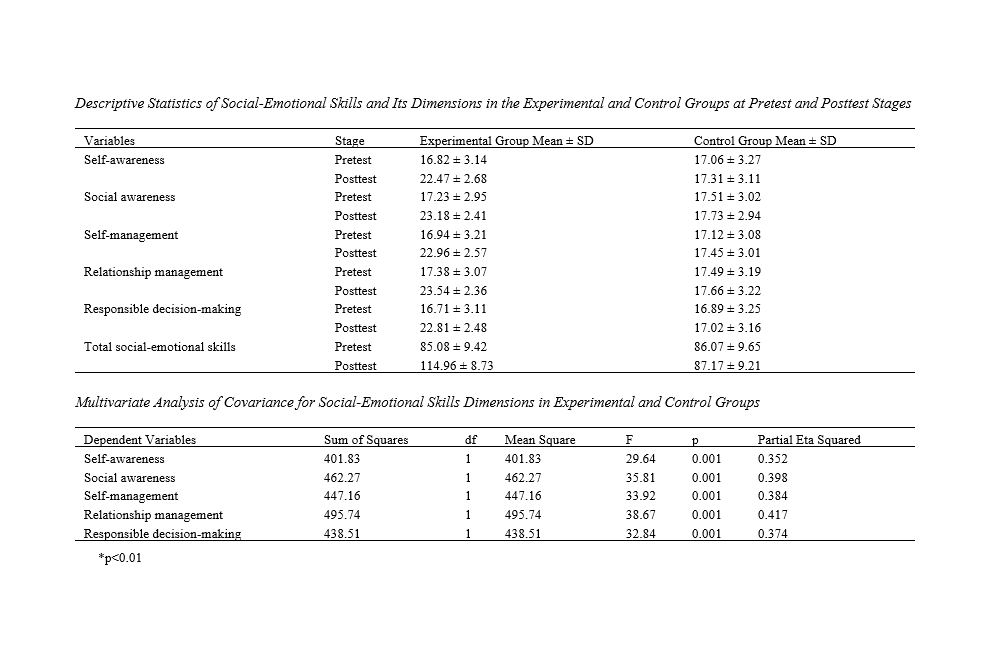
Findings: The findings demonstrated a statistically significant difference between the experimental and control groups in overall social-emotional skills after controlling for pretest scores (Wilks’ Lambda = 0.214, F = 34.72, p = 0.001, partial η² = 0.786). Significant improvements were observed in all dimensions of social-emotional skills, including self-awareness (F = 29.64, p = 0.001), social awareness (F = 35.81, p = 0.001), self-management (F = 33.92, p = 0.001), relationship management (F = 38.67, p = 0.001), and responsible decision-making (F = 32.84, p = 0.001). The adjusted mean scores indicated that the experimental group achieved substantially higher posttest scores than the control group across all measured dimensions.
Conclusion: The results suggest that systems thinking and creative problem-solving training significantly improve social-emotional skills among university students. The intervention enhanced students’ emotional awareness, interpersonal understanding, emotional regulation, communication abilities, and responsible decision-making capacities.
Downloads
References
Angwaomaodoko, E. A. (2025). Examining the Place and Role of Emotional Intelligence in Effective School Leadership and Administration. SSRN Electronic Journal. https://doi.org/10.2139/ssrn.5068936
Antinienė, D., Lekavičienė, R., Rūtelionė, A., & Šeinauskienė, B. (2022). Emotional Intelligence Training as an Intervention to Diminish Consumer Materialism. Journal of Entrepreneurship and Sustainability Issues, 10(1), 328-343. https://doi.org/10.9770/jesi.2022.10.1(17)
Antón, L. J. M., Valdivieso, J. A., García-Alonso, J.-C., Carbonero, M. Á., & Manzanares, M. C. S. (2024). Situational Evaluation of Teachers’ Social-Emotional Competence: Spanish Version of the Test of Regulation in and Understanding of Social Situations in Teaching (TRUST). Social Psychology of Education, 27(5), 2857-2882. https://doi.org/10.1007/s11218-024-09927-x
Aponte, M. L., Sánchez, A. D. V., & Vásquez, M. R. (2025). The Effects of Emotional Intelligence Training Programs on Educators: A Systematic Review. F1000research, 14, 842. https://doi.org/10.12688/f1000research.166190.1
Bakare, J., Ohanu, I. B., & Shodipe, T. O. (2023). Hypothesized Model of the Relationship Between Affective Behaviour, Emotional Intelligence and Success of Out-of-School Youths in Cell Phone Maintenance Enterprise. Rajagiri Management Journal, 17(3), 254-277. https://doi.org/10.1108/ramj-06-2022-0102
Başer, L. M. (2024). Trainees' Intrapsychic Attunement in the Process of Psychotherapy Training. Epiphany, 16(1), 132. https://doi.org/10.21533/epiphany.v16i1.424
Cristóvão, A. M., Valente, S., Rebelo, H., & Ruivo, A. F. (2023). Emotional Education for Sustainable Development: A Curriculum Analysis of Teacher Training in Portugal and Spain. Frontiers in Education, 8. https://doi.org/10.3389/feduc.2023.1165319
Denham, S. A. (2023). Preschool Teachers’ Emotional Intelligence and Beliefs: Informing Emotion Socialization in the Classroom. Environment and Social Psychology, 8(3). https://doi.org/10.54517/esp.v8i3.1822
Domínguez-Marquez, P., & Pizà-Mir, B. (2023). Emotional Intelligence and Empathy in Pre-Primary Teachers: A Pilot Test. International Journal of Education and Teaching, 2(2). https://doi.org/10.51483/ijedt.2.2.2022.1-8
Drigas, A., Papoutsi, C., & Skianis, C. (2023). Being an Emotionally Intelligent Leader Through the Nine-Layer Model of Emotional Intelligence—The Supporting Role of New Technologies. Sustainability, 15(10), 8103. https://doi.org/10.3390/su15108103
Edara, I. R. (2023). Analysis of Students’ Emotional Patterns Based on an Educational Course on Emotions Management. Education Sciences, 13(7), 757. https://doi.org/10.3390/educsci13070757
Grădinariu, T., & Diac, G. (2023). 6. New Perspectives in Developing Teachers’ Social-Emotional Skills to Prevent Bullying: The Role of Forum Theatre. Review of Artistic Education, 25(1), 137-147. https://doi.org/10.2478/rae-2023-0020
Harris, V. W., Anderson, J., & Visconti, B. (2022). Social Emotional Ability Development (SEAD): An Integrated Model of Practical Emotion-Based Competencies. Motivation and Emotion, 46(2), 226-253. https://doi.org/10.1007/s11031-021-09922-1
Henriksen, D., Creely, E., Gruber, N., & Leahy, S. (2025). Social-Emotional Learning and Generative AI: A Critical Literature Review and Framework for Teacher Education. Journal of Teacher Education, 76(3), 312-328. https://doi.org/10.1177/00224871251325058
Hoffmann, J. D., France, K. D., & McGarry, J. A. (2022). Creativity and Connection: The Impact of inspirED With Secondary School Students. Journal of Intelligence, 11(1), 8. https://doi.org/10.3390/jintelligence11010008
Hsu, W.-C., Fuh, L. J., & Liao, S.-C. (2024). Tickling the Heart: Integrating Social Emotional Learning Into Medical Education to Cultivate Empathetic, Resilient, and Holistically Developed Physicians. Frontiers in Medicine, 11. https://doi.org/10.3389/fmed.2024.1368858
Hulda, G., & Zhu, X. (2023). The Effects of Emotional Intelligence on Teachers’ Job Satisfaction: A Scoping Review. https://doi.org/10.20944/preprints202306.0533.v1
Kalogeratos, G., & Anastasopoulou, E. (2023). Enhancing Emotional Intelligence in Pervasive Developmental Disorders. The Autism Paradigm. Technium Education and Humanities, 6, 61-69. https://doi.org/10.47577/teh.v6i.9769
Kausar, H., & Ajmal, F. (2024). Meta-Analysis Study: Expectations of 21st Century Teaching From Pre-Service Teacher Education Programs. Journal of Research in Social Sciences, 12(2), 1-14. https://doi.org/10.52015/jrss.12i2.268
Li, X., Pu, R., & Phakdeephirot, N. (2024). The Interrelationships Between Emotional Intelligence, Achievement Motivation and Students’ Employability: Exploring the Mediating Effect of Self-Efficacy. Education + Training, 66(7), 738-754. https://doi.org/10.1108/et-12-2021-0464
Melita, N. (2023). Emotional Intelligence, Distancing, and Learning a New Skill as Strategies to Combat the Deleterious Effects of Emotional Labor on Attorney Wellbeing. Frontiers in Behavioral Neuroscience, 17. https://doi.org/10.3389/fnbeh.2023.1221145
Mitsea, E., Drigas, A., & Skianis, C. (2023a). Virtual Reality Mindfulness for Meta-Competence Training Among People With Different Mental Disorders: A Systematic Review. Psychiatry International, 4(4), 324-353. https://doi.org/10.3390/psychiatryint4040031
Mitsea, E., Drigas, A., & Skianis, C. (2023b). VR Gaming for Meta-Skills Training in Special Education: The Role of Metacognition, Motivations, and Emotional Intelligence. Education Sciences, 13(7), 639. https://doi.org/10.3390/educsci13070639
Nasir, M. A. M., Ali, N. A. M., Aziz, A., Ismail, S., & Faudzi, F. N. M. (2023). An Investigation of Emotional Intelligence and Counselling Self-Efficacy Among Counsellors-in-Training. International Journal of Evaluation and Research in Education (Ijere), 12(3), 1222. https://doi.org/10.11591/ijere.v12i3.24476
Palma, M., Martín, N. L. S., & Cornejo, C. O. (2025). Emotional Intelligence and Critical Thinking: Relevant Factors for Training Future Teachers in a Chilean Pedagogy Program. Journal of Intelligence, 13(2), 17. https://doi.org/10.3390/jintelligence13020017
Pratiwi, S. R., Sukmayadi, Y., & Nugraheni, T. (2023). Art Learning for Children as a Social Emotional Learning Program. Jurnal Obsesi Jurnal Pendidikan Anak Usia Dini, 7(5), 5883-5894. https://doi.org/10.31004/obsesi.v7i5.5227
Roy, A. (2023). Interpersonal Emotion Regulation and Emotional Intelligence: A Review. International Journal of Research Publication and Reviews, 04(02), 623-627. https://doi.org/10.55248/gengpi.2023.42002
Sauli, F., Wenger, M., & Fiori, M. (2022). Emotional Competences in Vocational Education and Training: State of the Art and Guidelines for Interventions. Empirical Research in Vocational Education and Training, 14(1). https://doi.org/10.1186/s40461-022-00132-8
Smith, I., & Kamm, B. (2024). Emotional Intelligence Training. Creative Education, 15(05), 958-973. https://doi.org/10.4236/ce.2024.155058
Tuomi, I. (2022). Artificial Intelligence, 21st Century Competences, and Socio‐emotional Learning in Education: More Than High‐risk? European Journal of Education, 57(4), 601-619. https://doi.org/10.1111/ejed.12531
Ulutaş, İ., Engin, K., & Polat, E. B. (2021). Strategies to Develop Emotional Intelligence in Early Childhood. https://doi.org/10.5772/intechopen.98229
Valente, S., Lourenço, A. A., & Domínguez‐Lara, S. (2022). Teachers in the 21st Century: Emotional Intelligence Skills Make the Difference. https://doi.org/10.5772/intechopen.103082
Zach, S., & Rosenblum, H. (2021). The Affective Domain—A Program to Foster Social-Emotional Orientation in Novice Physical Education Teachers. International journal of environmental research and public health, 18(14), 7434. https://doi.org/10.3390/ijerph18147434
Downloads
Additional Files
Publication Timeline
- Submitted
- Revised
- Accepted