The Effectiveness of Anger Management Skills Training and Assertive Behavior Training on Interpersonal Relationships and Tendency Toward Drug Use Among Female High School Students
DOI:
https://doi.org/10.61838/Keywords:
interpersonal relationships, tendency toward drug use, anger management, assertive behaviorAbstract
Objective: The study aimed to investigate the effectiveness of anger management skills training and assertive behavior training on interpersonal relationships and tendency toward drug use among female high school students in Qaem Shahr.
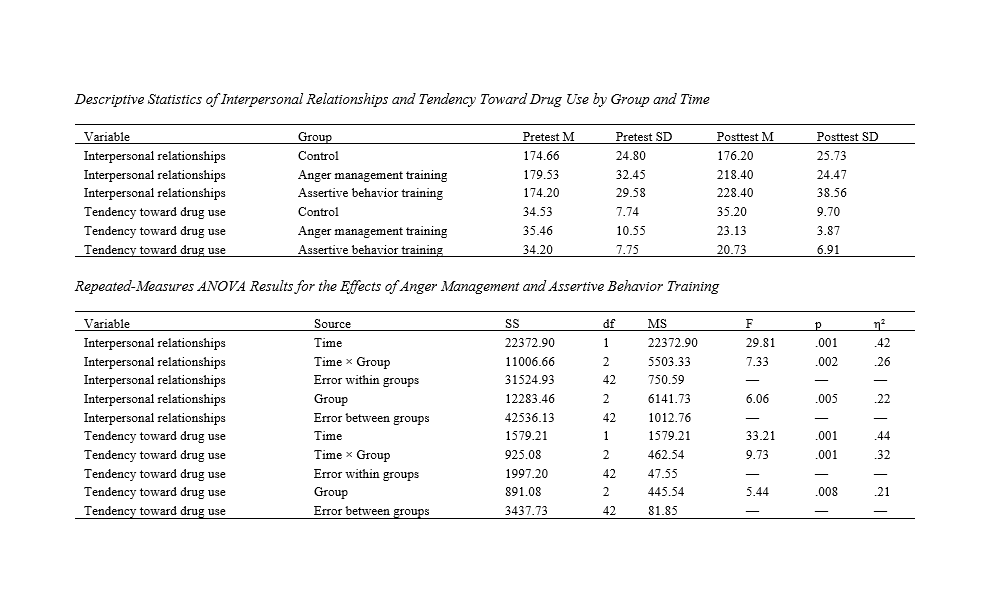
Methods and Materials: This study employed an applied quasi-experimental design with a pretest–posttest format and a control group. The statistical population consisted of all female high school students in Qaem Shahr during the 2024–2025 academic year (N = 15,435). Using convenience and voluntary sampling, 45 eligible students were selected and randomly assigned into three groups: anger management training (n = 15), assertive behavior training (n = 15), and control (n = 15). The anger management intervention was conducted in 12 weekly 90-minute sessions, whereas the assertive behavior intervention was implemented in 10 weekly 60-minute sessions. The control group received no intervention. Data were collected using the FIRO Interpersonal Relationship Scale and the Mirhashemi Tendency Toward Drug Use Questionnaire. Data analysis was performed using SPSS through descriptive statistics, repeated-measures analysis of variance, and Bonferroni post-hoc tests.
Findings: The repeated-measures analysis of variance revealed a significant effect of time on interpersonal relationships, F(1, 42) = 29.81, p = .001, and a significant time × group interaction, F(2, 42) = 7.33, p = .002. Significant between-group differences were also observed, F(2, 42) = 6.06, p = .005. In addition, significant effects were found for tendency toward drug use, including the effect of time, F(1, 42) = 33.21, p = .001, and the time × group interaction, F(2, 42) = 9.73, p = .001, with significant between-group differences, F(2, 42) = 5.44, p = .008. Bonferroni post-hoc comparisons indicated that both intervention groups differed significantly from the control group in interpersonal relationships and tendency toward drug use; however, no statistically significant difference was found between anger management training and assertive behavior training.
Conclusion: The findings demonstrated that both anger management skills training and assertive behavior training were effective in improving interpersonal relationships and reducing tendency toward drug use among female adolescents.
Downloads
References
Adinehvand, H., & Davoodi Shamsi, M. (2021). The effectiveness of anger control training on resilience and reducing aggression in working adolescents. Second National Conference on Psychology and Educational Sciences, Tehran.
Araban, K., & Salehi, A. (2021). The effectiveness of anger management skills training using the Internal Family Systems approach on cognitive flexibility, personal and social adjustment, and relationships with parents in aggressive adolescents Payame Noor University of Isfahan Province, Isfahan Payame Noor Center].
Deffenbacher, J. L., Oetting, E. R., & DiGiuseppe, R. (2021). Principles of anger management: A cognitive-behavioral perspective. Journal of Rational-Emotive & Cognitive-Behavior Therapy, 39(2), 112-125.
Fallahzadeh, A. (2021). Addiction Prevention. Joint Publications of the Welfare Organization and Literacy Movement of Khuzestan Province.
Gaines, S. O., Carter, D. B., & Benson, J. (2022). Interpersonal relationships and psychological well-being. American Journal of Community Psychology, 69(3-4), 289-304.
Ghasemi, S. (2024). Investigating the effect of emotion control and anger control skills training on addiction readiness in students. Quarterly Journal of New Ideas in Psychology, 22(26).
Ghiyasi, M. (2021). Investigating the relationship between modern mobile phone technology (Instagram) and interpersonal relationships among adolescents Islamic Azad University].
Johnston, L. D., Miech, R. A., O'Malley, P. M., Bachman, J. G., & Schulenberg, J. E. (2023). Monitoring the Future national survey results on drug use, 1975-2022: Overview of key findings on adolescent drug use.
Ninkron, P., & Khuntiterakul, P. (2025). Creating mental immunity to reduce the risk associated with substance abuse among junior high school students in Nakhon Pathom Province, Thailand. Children and Youth Services Review, 169, 108092.
Poursalman, S., & Asgharnejad Farid, A. (2020). The effectiveness of life skills training on anger management and resilience in adolescents. Applied Family Therapy Quarterly, 1(2), 105-124.
Rezaei, S., & Karimi, M. (2023). The effect of assertiveness skills training on the quality of interpersonal relationships in adolescent girls. Modern Psychology Quarterly, 15(3), 52-70.
Southwick, S. M., & Charney, D. S. (2023). Resilience: The Science of Mastering Life's Greatest Challenges (3rd ed.). Cambridge University Press.
Speed, B. C., Goldstein, B. L., & Goldfried, M. R. (2022). Assertiveness training: A forgotten evidence-based treatment. Clinical Psychology: Science and Practice, 29(1), 45-60.
Tamang, R., Velayudhan, B., Bhandari, S. S., Jose, T. T., Lakshmi, V. L. R., & Valsaraj, B. P. (2024). Effectiveness of school-based Scaling up Teen Mental Health Program through peer synergy (SUTMP) on mental health promotion, mental health literacy, and resilience among senior secondary students of Sikkim, India: A cluster randomized controlled trial protocol. Mental Health & Prevention, 36, 200370.
Downloads
Additional Files
Publication Timeline
- Submitted
- Revised
- Accepted