The Relationship Between Maladaptive Perfectionism and Academic Burnout with Students’ Mental Health: The Mediating Role of Spiritual Intelligence
DOI:
https://doi.org/10.61838/Keywords:
Maladaptive perfectionism, academic burnout, mental health, spiritual intelligence, studentsAbstract
Objective: The present study aimed to investigate the relationship between maladaptive perfectionism and academic burnout with students’ mental health through the mediating role of spiritual intelligence.
Methods and Materials: This study was conducted using a descriptive-correlational design based on structural equation modeling. The statistical population included all high school students in Tehran during the 2025–2026 academic year. A total of 412 students were selected through multistage cluster random sampling. Data were collected using the Frost Multidimensional Perfectionism Scale, Maslach Burnout Inventory–Student Survey, General Health Questionnaire-28, and Spiritual Intelligence Self-Report Inventory. Descriptive statistics and Pearson correlation coefficients were calculated using SPSS-27 software, and structural equation modeling was performed using AMOS-24. The significance of indirect effects was examined using the bootstrap method.
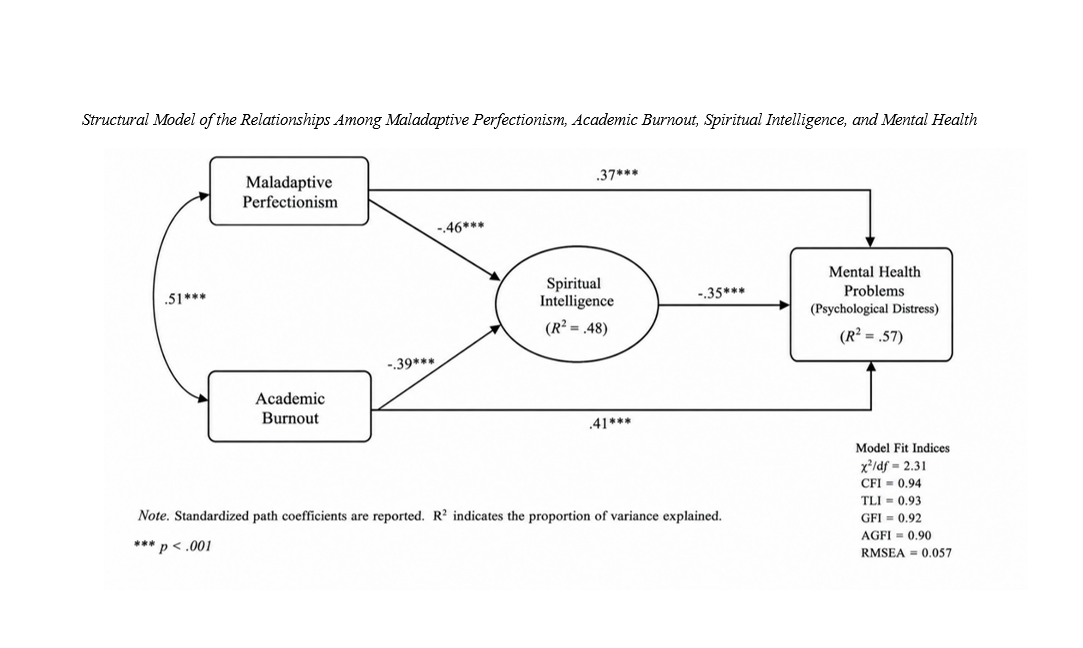
Findings: The findings demonstrated that maladaptive perfectionism had a significant positive relationship with academic burnout (r = 0.51, p < 0.01) and mental health problems (r = 0.58, p < 0.01). Academic burnout was also positively associated with mental health problems (r = 0.61, p < 0.01). In contrast, spiritual intelligence showed significant negative relationships with maladaptive perfectionism (r = -0.46, p < 0.01), academic burnout (r = -0.49, p < 0.01), and mental health problems (r = -0.55, p < 0.01). Structural equation modeling indicated that maladaptive perfectionism directly predicted mental health problems (β = 0.37, p < 0.001), while academic burnout also had a significant direct effect on mental health problems (β = 0.41, p < 0.001). Spiritual intelligence significantly mediated the relationships between maladaptive perfectionism, academic burnout, and mental health. The proposed model demonstrated acceptable fit indices (χ²/df = 2.31, CFI = 0.94, TLI = 0.93, RMSEA = 0.057).
Conclusion: The findings suggest that maladaptive perfectionism and academic burnout are important psychological risk factors negatively influencing students’ mental health, whereas spiritual intelligence serves as a protective psychological resource that reduces emotional distress and improves psychological well-being.
Downloads
References
Aalto, E. P., Pons, J., Alcaraz, S., Zamora‐Solé, R., & Ramis, Y. (2024). Psychological and Social Factors Associated With Mental Health of European Dual Career Athletes: A Systematic Review. European Journal of Sport Science, 24(12), 1844-1864. https://doi.org/10.1002/ejsc.12218
Al-Na’she, M., Massad, A., Khraisat, L. A., Rafai, M. A., Albashtawi, Y., Almohtasib, S., Alhayek, A., Elheet, A. M., Alaqtash, R., & Jaber, R. M. (2024). Prevalence of Obsessive-Compulsive Personality Disorder in Medical Students. Jordan Medical Journal, 58(1). https://doi.org/10.35516/jmj.v58i1.2397
Azim, S. R., Yusoff, M. S. B., & Roslan, N. S. (2025). Mapping the Multidimensional Factors of Medical Student Resilience Development: A Scoping Review. BMC Medical Education, 25(1). https://doi.org/10.1186/s12909-025-07290-9
Bamine, V., & Tanaka, K. (2025). Help-Seeking in Nursing and Medical Students: A Concept Analysis. Journal of Research in Nursing, 30(2), 125-138. https://doi.org/10.1177/17449871241268451
Cascio, A. L., Sandri, E., Benedictis, A. D., Marchetti, A., Petrucci, G., Dsoke, S., Pucciarelli, G., Alvaro, R., Marinis, M. G. D., & Piredda, M. (2025). The Impact of Spiritual Well-Being on Multidimensional Perfectionism in University Students: A Nationwide Survey. European Journal of Investigation in Health Psychology and Education, 15(10), 211. https://doi.org/10.3390/ejihpe15100211
Dobos, B., Mellor, D., & Pikó, B. (2024). Exploring Fear of Happiness Among University Students: The Role of Perfectionism, Academic Burnout, Loneliness, and Hopelessness. Scandinavian journal of psychology, 65(3), 559-567. https://doi.org/10.1111/sjop.13001
Fadhlurrahman, F. R., Rahayuningsih, T., & Anggreiny, N. (2024). Peran Perfeksionisme Terhadap Academic Burnout Pada Mahasiswa Kedokteran: Pengujian Perfeksionisme Model 2 X 2. Insan Jurnal Psikologi Dan Kesehatan Mental, 9(1), 82-107. https://doi.org/10.20473/jpkm.v9i12024.82-107
Fatima, S. (2023). A Study of Perfectionism and Self-Harm in Medical and Nursing Students: The Mediating Role of Perceived Social Support. Journal of Postgraduate Medical Institute, 37(2), 125-129. https://doi.org/10.54079/jpmi.37.2.3145
Flett, G. L., & Hewitt, P. L. (2022). Keys to Understanding Perfectionistic Children. 79-95. https://doi.org/10.1037/0000289-006
Gaudreau, P., & Benoît, A. (2024). Be Careful What You Wish For: The Double-Edged Sword of Perfectionism During Graduate Studies. https://doi.org/10.31234/osf.io/zxqvf
Gaudreau, P., & Benoît, A. (2025). Distinguishing Perfectionism and Excellencism in Graduate Students: Contrasting Links With Performance Satisfaction, Research Self‐efficacy, Burnout, and Dropout Intentions. British Journal of Psychology, 116(4), 907-929. https://doi.org/10.1111/bjop.12798
Imad, M., Reder, M., & Rose, M. (2023). Recasting the Agreements to Re-Humanize STEM Education. Frontiers in Education, 8. https://doi.org/10.3389/feduc.2023.1193477
Jiang, X. (2025). A Comparative Study Investigating the Impact of Group Singing on Social-Emotional Competencies and Academic Burnout in College Students. Sage Open, 15(1). https://doi.org/10.1177/21582440251329113
Klein, H. J., & McCarthy, S. M. (2022). Student Wellness Trends and Interventions in Medical Education: A Narrative Review. Humanities and Social Sciences Communications, 9(1). https://doi.org/10.1057/s41599-022-01105-8
Larionow, P. (2024). How Are Different Perfectionism Traits Related to Mental Health in Students? Behavioral Sciences, 14(3), 187. https://doi.org/10.3390/bs14030187
Lee, Z., Prihadi, K. D., & Rachma, E. N. (2022). Personal Standards and Evaluative Concerns Perfectionism on Mattering Among Gen-Z. International Journal of Public Health Science (Ijphs), 11(4), 1448. https://doi.org/10.11591/ijphs.v11i4.21611
Mahsood, N., Mahboob, U., Asim, M., & Shaheen, N. (2025). Assessing the Well-Being of PhD Scholars: A Scoping Review. BMC psychology, 13(1). https://doi.org/10.1186/s40359-025-02668-2
Mehr, F. M., Afrooz, G. A., & Davaee, M. (2023). Explain of Students Creativity Based on Spiritual Happiness With Mediating Role of Perfectionism. Jayps, 4(1), 28-37. https://doi.org/10.61838/kman.jayps.4.1.4
Prasetya, R. L., Dwidiyanti, M., & Dewi, N. S. (2022). The Kind of Mindfulness Intervention for Anxiety in Undergraduate Nursing Students: A Literature Review. Nurse and Health Jurnal Keperawatan, 11(1), 111-123. https://doi.org/10.36720/nhjk.v11i1.352
Qin, L., Lü, J., Zhou, Y., Wijaya, T. T., Huang, Y., & Fauziddin, M. (2022). Reduction of Academic Burnout in Preservice Teachers: PLS-SEM Approach. Sustainability, 14(20), 13416. https://doi.org/10.3390/su142013416
Tenhulzen, K. A., Claridge, A. M., Baker, K., & Carlson, K. (2023). There Is No “One Right Way”: Perfectionism, Imposterism, and Well-Being in Child Life Training and Practice. The Journal of Child Life Psychosocial Theory and Practice, 4(2). https://doi.org/10.55591/001c.88114
Terry, T. (2022). Resilience and Mental Health in UK Urology Trainees. Journal of Clinical Urology, 17(5), 449-455. https://doi.org/10.1177/20514158221142683
Wan, D. W. J., Goh, L. S. H., Teo, M. Y. K., Loh, C. J. L., Yak, G. H. K., Lee, J., Ravindran, N., Rahman, N. D. A., Chiam, M., Ong, E. K., Somasundaram, N., Lim, Y. Y., Phua, G. L. G., & Krishna, L. K. R. (2024). Enhancing Self-Care Education Amongst Medical Students: A Systematic Scoping Review. BMC Medical Education, 24(1). https://doi.org/10.1186/s12909-023-04965-z
Wang, Q., & Wu, H. (2022). Associations Between Maladaptive Perfectionism and Life Satisfaction Among Chinese Undergraduate Medical Students: The Mediating Role of Academic Burnout and the Moderating Role of Self-Esteem. Frontiers in psychology, 12. https://doi.org/10.3389/fpsyg.2021.774622
Warnock, S. (2021). Primary Teacher Burnout: Through the Lens of Theory and Experience. https://doi.org/10.26686/wgtn.14417660.v1
Yalim, A. C., Daly, K., Bailey, M., Kay, D., Zhu, X., Patel, M., Neely, L. C., Díaz, D. A., Asencio, D. M. C., Rosario, K., Cowan, M., & Pasarica, M. (2024). Wellness and Stress Management Practices Among Healthcare Professionals and Health Professional Students. American Journal of Health Promotion, 39(2), 204-214. https://doi.org/10.1177/08901171241275868
Zheng, G., Sheng, J., Wang, H., & Xu, Z. (2025). Mindfulness and Work Addiction Among Young Employees: The Mediating Roles of Cognitive Reappraisal and Perfectionism. Frontiers in Psychiatry, 16. https://doi.org/10.3389/fpsyt.2025.1631792
Кравец, О. В., Yekhalov, V., Stanin, D. M., Криштафор, Д. А., & Martynenko, D. A. (2023). Perfectionism in the Anesthesiological Environment. https://doi.org/10.21203/rs.3.rs-3197234/v1
Downloads
Additional Files
Publication Timeline
- Submitted
- Revised
- Accepted