Designing a Positive Psychological Self-Care Educational Package for Male Adolescents with High-Risk Behaviors
DOI:
https://doi.org/10.61838/Keywords:
Positive psychological self-care, high-risk behaviors, male adolescents, educational packageAbstract
Objective: The present study aimed to design and validate a positive psychological self-care educational package for male adolescents with high-risk behaviors.
Methods and Materials: This study was conducted using a qualitative applied research design based on grounded theory and thematic analysis. The study population included psychologists with direct professional experience working with adolescents with high-risk behaviors, theoretical and empirical literature related to positive psychology and psychological self-care, and university experts in psychology. Twenty-two psychologists working in counseling centers affiliated with the Department of Education in Tehran were selected through purposive sampling and participated in semi-structured interviews until theoretical saturation was achieved. In addition, domestic and international scientific sources related to positive psychology, self-care, emotion regulation, coping self-efficacy, and adolescent high-risk behaviors were reviewed and analyzed. Data collection tools included semi-structured interviews, a researcher-made content validity form, and an inter-rater agreement form. Data were analyzed through open, axial, and selective coding. After the educational package was developed, six faculty experts evaluated its content validity and overall quality.
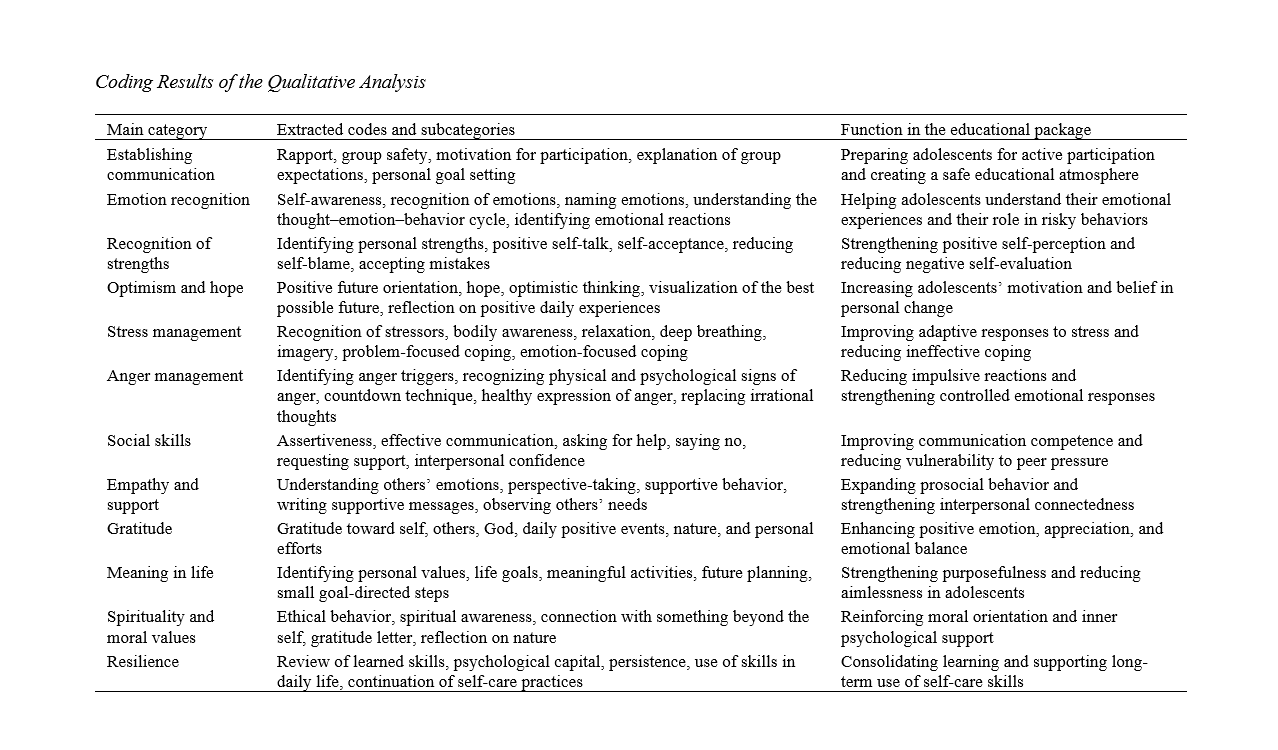
Findings: The qualitative analysis resulted in the extraction of 60 initial codes, which were organized into 12 main categories, including communication establishment, emotion recognition, recognition of strengths, optimism, stress management, anger management, social skills, empathy, gratitude, meaning in life, spirituality, and resilience. These categories formed the conceptual and structural foundation of the final 12-session positive psychological self-care educational package. The package integrated emotional, cognitive, interpersonal, and resilience-oriented components designed to improve adolescents’ psychological self-care capacities and coping resources. Content validity analysis showed that all extracted components achieved acceptable content validity ratios and were confirmed as essential by the expert panel. The inter-rater agreement coefficient also demonstrated a high level of expert consensus regarding the appropriateness, coherence, and applicability of the package.
Conclusion: The findings suggest that positive psychological self-care for male adolescents with high-risk behaviors should be conceptualized as a multidimensional process integrating emotional regulation, adaptive coping, interpersonal competence, optimism, meaning, spirituality, and resilience.
Downloads
References
Arabacı, L. B., Dіkeç, G., Taş, G., Bilaç, Ö., Uzunoğlu, G., & Dağlı, D. A. (2022). Analysis of Substance Use and Mental Disorder Diagnoses in Adolescents With a History of Delinquency: A Cross-Sectional Study. International journal of mental health and addiction, 22(1), 146-161. https://doi.org/10.1007/s11469-022-00864-4
Boxmeyer, C. L., Miller, S., Romero, D. E., Powell, N. P., Jones, S. L., Qu, L., Tueller, S., & Lochman, J. E. (2021). Mindful Coping Power: Comparative Effects on Children’s Reactive Aggression and Self-Regulation. Brain Sciences, 11(9), 1119. https://doi.org/10.3390/brainsci11091119
Chen, Y. (2024). Psychological Factors Contributing to Juvenile Delinquency: Exploring the Impact of Family Dynamics, Peer Influence, and Psychological Disorders, Implications for Factor Interactions and Intervention and Prevention Strategies. Lecture Notes in Education Psychology and Public Media, 44(1), 225-237. https://doi.org/10.54254/2753-7048/44/20230149
Chhabria, A., & Khar, P. (2023). Aggression, Suicide, and Self-Harm in Children and Adolescents. Journal of Indian Association for Child and Adolescent Mental Health, 19(1), 53-59. https://doi.org/10.1177/09731342231190715
Christensen, J. B., Jones, M. S., & Hoffmann, J. P. (2024). Bullying Victimization and Youth’s Likelihood of Carrying a Handgun. Journal of interpersonal violence, 40(9-10), 2031-2054. https://doi.org/10.1177/08862605241270006
Ciurbea, F.-E., Cavanna, M., & Rada, C. (2021). Predictors of Adolescent Involvement in Cliques and Gangs. Anthropological Researches and Studies, 1(11), 24-48. https://doi.org/10.26758/11.1.3
Delgado, G. G., Rojo, A. P., Mireles, J. E. R., Carmona-Moreno, F. d. J., Salcedo, C. C. F., & Romero, A. (2024). Suicide Risk Factors in High School Students. International journal of environmental research and public health, 21(8), 1055. https://doi.org/10.3390/ijerph21081055
Dray, J. (2021). Child and Adolescent Mental Health and Resilience-Focussed Interventions: A Conceptual Analysis to Inform Future Research. International journal of environmental research and public health, 18(14), 7315. https://doi.org/10.3390/ijerph18147315
Dumornay, N. M., Finegold, K. E., Chablani, A., Elkins, L., Krouch, S., Baldwin, M., Youn, S. J., Marques, L., Ressler, K. J., & Moreland‐Capuia, A. (2022). Improved Emotion Regulation Following a Trauma-Informed CBT-based Intervention Associates With Reduced Risk for Recidivism in Justice-Involved Emerging Adults. Frontiers in Psychiatry, 13. https://doi.org/10.3389/fpsyt.2022.951429
Girard, C., & Almeida, T. C. (2025). Tracing the Impact of Adverse Childhood Experiences: Emotional Regulation and Substance Use Among French Prisoners and the General Population. Crime & Delinquency. https://doi.org/10.1177/00111287251335006
Goulter, N., & Fleming, G. E. (2023). Psychosocial Interventions for Children and Adolescents With Conduct Problems. https://doi.org/10.31234/osf.io/xta3y
Gubbels, J., Assink, M., & Claudia, E. v. d. P. (2023). Protective Factors for Antisocial Behavior in Youth: What Is the Meta-Analytic Evidence? Journal of youth and adolescence, 53(2), 233-257. https://doi.org/10.1007/s10964-023-01878-4
Guo, Y., Yang, Y., Deveaux, L., Dinaj-Koci, V., Schieber, E., Herbert, C., Lee, J.-A., & Wang, B. (2023). Exploring Effects of Multi-Level Factors on Transitions of Risk-Taking Behaviors Among Bahamian Middle-to-Late Adolescents. International Journal of Behavioral Development, 47(3), 210-220. https://doi.org/10.1177/01650254221148117
Herd, T., Jacques, K., Brieant, A., Noll, J. G., King‐Casas, B., & Kim‐Spoon, J. (2023). Parenting, Emotion Regulation, and Externalizing Symptomatology as Adolescent Antecedents to Young Adult Health Risk Behaviors. Journal of Research on Adolescence, 33(2), 632-640. https://doi.org/10.1111/jora.12831
Hill, L., Barnett, J., Ward, J., Morton, A. R., & Schmidt, A. (2023). Trauma‐Informed Care for Justice‐Involved Youth: A Narrative Review and Synthesis. Juvenile and Family Court Journal, 74(2), 21-33. https://doi.org/10.1111/jfcj.12236
İsmail, R., Shafurdin, N. S., Shukor, M. S., Nawi, A. M., Manaf, M. R. A., Ibrahim, N., Rasdi, R. M., Lyndon, N., Amit, N., Hassan, S. A., Hanafi, N., Ibrahim, F., Nahla, F., & Wahab, S. (2024). Predictors of Drug and Substance Abuse Among School-Going Adolescents Living in Drug Hotspot in Malaysia. PLoS One, 19(6), e0305460. https://doi.org/10.1371/journal.pone.0305460
Jangam, K. V., Ganie, A. U. R., Purushothaman, K., Nambiar, P. P., & Kommu, J. V. S. (2022). Family Support and Well-Being Programme (FSWP): A Specialized Family Strengthening Psychosocial Services for Parents of Children in Conflict With Law. Journal of Family Medicine and Primary Care, 11(11), 7196-7203. https://doi.org/10.4103/jfmpc.jfmpc_957_22
Joulaei, H., Fathi, F., Rakhshani, T., Nazari, M., Hosseinkhani, Z., Fatemi, M., & Foroozanfar, Z. (2022). Gender Differences in the Effect of Resilience Training on Emotional Intelligence in at-Risk Students in Shiraz, Iran. International Journal High Risk Behaviors & Addiction, 11(2). https://doi.org/10.5812/ijhrba-121942
Magram, J., Ackerman, E., Stafford, C., & Kennedy, T. D. (2025). Systematic Review: Intervention Strategies for Treating Relational Aggression in Female Juvenile Offenders and at-Risk Female Youth. Jaacap Open, 3(1), 56-72. https://doi.org/10.1016/j.jaacop.2024.04.003
Mahapatro, M., Roy, S., Nayar, P., & Garikai, M. E. (2025). A Perspective on Interventional Practices and Engagement of Adolescents for Their Overall Development and Well-Being. Journal of Indian Association for Child and Adolescent Mental Health, 21(2), 113-121. https://doi.org/10.1177/09731342251314587
María del Mar Simón, M., Gea, S. F., María del Mar Molero, J., Moreno, P. M., & María del Carmen Pérez, F. (2025). Addictions and Risk Behaviors in Adolescence: A Systematic Review and Qualitative Analysis. Frontiers in psychology, 16. https://doi.org/10.3389/fpsyg.2025.1646746
Mazza, M., Lisci, F. M., Marzo, E. M., Masi, V. D., Abate, F., & Marano, G. (2025). Why Do They Do It? The Psychology Behind Antisocial Behavior in Children and Adolescents. Pediatric Reports, 17(2), 26. https://doi.org/10.3390/pediatric17020026
Ojonuba, H. S., Rahman, H. A., Zaremohzzabieh, Z., & Zulkefli, N. A. M. (2023). The Effectiveness of an Empowerment Education Intervention for Substance Use Reduction Among Inner-City Adolescents in Nigeria. International journal of environmental research and public health, 20(4), 3731. https://doi.org/10.3390/ijerph20043731
Paulus, F. W., Ohmann, S., Möhler, E., Plener, P. L., & Popow, C. (2021). Emotional Dysregulation in Children and Adolescents With Psychiatric Disorders. A Narrative Review. Frontiers in Psychiatry, 12. https://doi.org/10.3389/fpsyt.2021.628252
Rabaglietti, E., Molinengo, G., Roggero, A., Ermacora, A., Marinaro, L., & Beccaria, F. (2021). My Health Diary, a School-Based Well-Being Program: A Randomized Controlled Study. Adolescents, 1(1), 21-35. https://doi.org/10.3390/adolescents1010003
Reyes, M. Q. (2025). Family and Personal Factors Predisposing Adolescents to Substance Abuse in High-Risk Urban Areas. PLoS One, 20(11), e0334072. https://doi.org/10.1371/journal.pone.0334072
Shalchi, B., Beigzadeh, M. N., Shafiee‐Kandjani, A. R., Shahrokhi, H., & Khanmiri, B. H. (2024). Childhood Maltreatment and Vulnerability to Substance Use Disorders: The Mediating Role of Psychological Security. Health Promotion Perspectives, 14(2), 193-201. https://doi.org/10.34172/hpp.42525
Shanahan, L., Steinhoff, A., Ribeaud, D., & Eisner, M. (2024). The Role of Early Adolescence in Subsequent Risk and Resilience. The Journal of Early Adolescence, 44(9), 1097-1123. https://doi.org/10.1177/02724316241271381
Sparks, L. A., Trentacosta, C. J., Hicks, M. R., Kernsmith, P. D., & Smith‐Darden, J. (2021). Hope as a Protective Factor: Relations to Adverse Childhood Experiences, Delinquency, and Posttraumatic Stress Symptoms. Journal of Child and Family Studies, 30(12), 3005-3015. https://doi.org/10.1007/s10826-021-02119-7
Tello, C. M. V. (2025). Illicit Substance Use and Delinquency Among Argentine Adolescents: A Latent Class Analysis. Journal of Contemporary Criminal Justice. https://doi.org/10.1177/10439862251384576
Wong, D. F. K., Cheung, Y. C. H., Huang, Y. T., Tam, H.-l., Chan, W. M. H., & Yeung, K. K. W. (2022). Quasi-Experimental Study Comparing CBT, MBCT, Activity-Based Supportive Counselling for Hong Kong Delinquent Youth. Research on Social Work Practice, 32(5), 567-582. https://doi.org/10.1177/10497315221077651
Zettler, H. (2020). Much to Do About Trauma: A Systematic Review of Existing Trauma-Informed Treatments on Youth Violence and Recidivism. Youth Violence and Juvenile Justice, 19(1), 113-134. https://doi.org/10.1177/1541204020939645
Zhuang, X., Lau, Y. Y., Huang, Y. T., Tam, H.-l., Chan, W. M. H., Yeung, K. K. W., Ng, T. K., & Wong, D. F. K. (2021). Efficacy of Low-Intensity Cognitive Behavior Intervention for Chinese Delinquent Youth. Research on Social Work Practice, 32(2), 155-167. https://doi.org/10.1177/10497315211013897
Downloads
Additional Files
Publication Timeline
- Submitted
- Revised
- Accepted