LightGBM Classification of Academic Procrastination Risk Among Adolescents Based on Executive Function, Motivation, Smartphone Use, and Learning Strategy Variables
DOI:
https://doi.org/10.61838/kman.jayps.5445Keywords:
Academic procrastination, Adolescents, Executive function, Motivation, Smartphone use, Learning strategiesAbstract
Objective: The objective of this study was to develop and evaluate a LightGBM machine learning model for predicting academic procrastination risk among adolescents using cognitive, motivational, behavioral, and learning strategy variables.
Methods and Materials: A total of 1,248 adolescents aged 13–18 years from public secondary schools in Germany participated in this cross-sectional study. Participants completed standardized self-report instruments assessing executive function (Behavior Rating Inventory of Executive Function–Self-Report), academic motivation (Academic Motivation Scale), smartphone use patterns (Smartphone Addiction Scale–Short Version), and learning strategies (Motivated Strategies for Learning Questionnaire). Demographic information, including age, gender, grade, parental education, and academic achievement, was also collected. The dataset was preprocessed to handle missing data, outliers, and standardization, and academic procrastination scores were categorized into low, moderate, and high-risk groups. A LightGBM classification model was trained on 80% of the data using stratified sampling and five-fold cross-validation, with hyperparameter tuning performed to optimize model performance. Model evaluation was conducted on the remaining 20% of the data using accuracy, precision, recall, F1-score, AUC-ROC, and interpretability analysis via SHAP values.
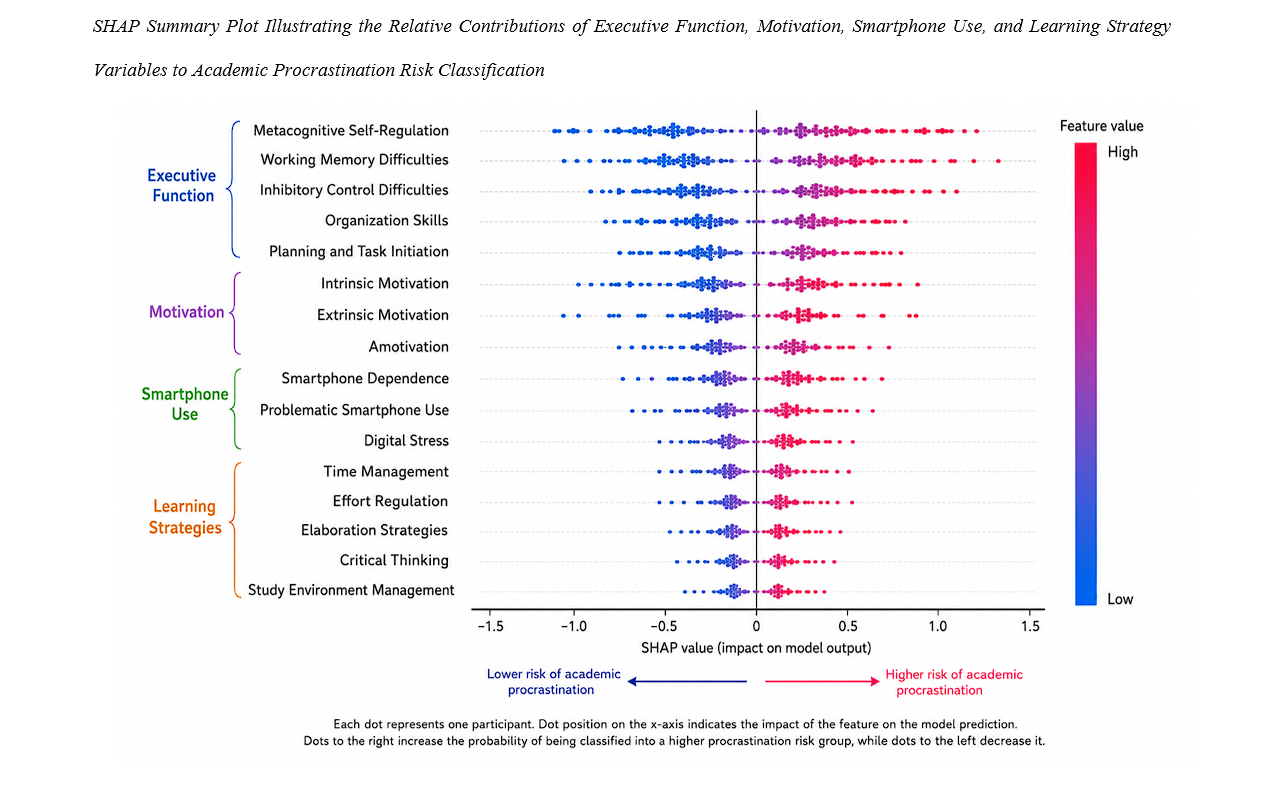
Findings: Executive function difficulties, low academic motivation, problematic smartphone use, and ineffective learning strategies were significant predictors of academic procrastination. Metacognitive self-regulation, working memory difficulties, intrinsic motivation, smartphone dependence, and time management emerged as the most influential features. The LightGBM model achieved an overall accuracy of 88.7%, macro-averaged F1-score of 0.877, and an AUC-ROC of 0.931. Misclassifications primarily occurred between adjacent risk categories, indicating the model’s robustness in distinguishing different levels of procrastination risk. SHAP analysis confirmed the relative contributions of cognitive, motivational, behavioral, and learning strategy factors in shaping predicted risk levels.
Conclusion: The study demonstrates that an interpretable LightGBM model can accurately classify adolescents according to academic procrastination risk based on executive function, motivation, smartphone use, and learning strategy variables, highlighting the critical roles of cognitive self-regulation, motivation, and digital behavior in academic outcomes.
Downloads
References
Asheri, M., Ghodsi, P., & Ghasemi, M. (2024). Examining the Effects of Impulsivity, Intolerance of Uncertainty, and Smartphone Management Styles on Smartphone Addiction With the Mediating Role of Warm Executive Functions. Jayps, 5(4), 147-157. https://doi.org/10.61838/kman.jayps.5.4.16
Atasever, A. N., Çelik, L., & Eroğlu, Y. (2023). Mediating Effect of Digital Addiction on the Relationship Between Academic Motivation and Life Satisfaction in University Students. Participatory educational research, 10(1), 17-41. https://doi.org/10.17275/per.23.2.10.1
Bottaro, R., & Faraci, P. (2022). The Use of Social Networking Sites and Its Impact on Adolescents’ Emotional Well-Being: A Scoping Review. Current Addiction Reports, 9(4), 518-539. https://doi.org/10.1007/s40429-022-00445-4
Cherrier, S., Wattelez, G., Ferrière, S., & Borst, G. (2023). NeuroStratE: An Educational Neuroscience Intervention to Reduce Procrastination Behavior and Improve Executive Planning Function in Higher Students. Frontiers in Education, 8. https://doi.org/10.3389/feduc.2023.1149817
Crowhurst, S., & Hosseinzadeh, H. (2024). Risk Factors of Smartphone Addiction: A Systematic Review of Longitudinal Studies. Public Health Challenges, 3(2). https://doi.org/10.1002/puh2.202
Cui, G., Yin, Y., Li, S., Chen, L., Liu, X., Tang, K., & Li, Y. (2021). Longitudinal Relationships Among Problematic Mobile Phone Use, Bedtime Procrastination, Sleep Quality and Depressive Symptoms in Chinese College Students: A Cross-Lagged Panel Analysis. BMC psychiatry, 21(1). https://doi.org/10.1186/s12888-021-03451-4
Deng, M. (2025). The Relationship Between Mobile Phone Addiction, Bedtime Procrastination, and Campus-Based Physical Activity: A Longitudinal Follow-Up Study Based on a College Student Population. Frontiers in psychology, 16. https://doi.org/10.3389/fpsyg.2025.1690574
Doulou, A., Drigas, A., & Skianis, C. (2022). Mobile Applications as Intervention Tools for Children With ADHD for a Sustainable Education. Technium Sustainability, 2(4), 44-62. https://doi.org/10.47577/sustainability.v2i4.7344
Guan, J., Ma, W., & Liu, C. (2023). Fear of Missing Out and Problematic Smartphone Use Among Chinese College Students: The Roles of Positive and Negative Metacognitions About Smartphone Use and Optimism. PLoS One, 18(11), e0294505. https://doi.org/10.1371/journal.pone.0294505
Guo, C. (2026). Smartphone Addiction and Nursing Students' Learning Engagement: Insomnia and Self-Control Mediation. Journal of nursing education, 1-11. https://doi.org/10.3928/01484834-20260120-02
Kabir, H., Sarker, J., & Islam, M. R. (2023). The Impact of Mobile Phone Addiction on Education, Mental and Physical Health Among University Students in Bangladesh. Eximia, 11, 271-286. https://doi.org/10.47577/eximia.v11i1.305
Lardinoix, J., Neumann, I., Wartberg, L., & Lindenberg, K. (2023). Procrastination Predicts Future Internet Use Disorders in Adolescents but Not Vice Versa: Results From a 12-Month Longitudinal Study. Healthcare, 11(9), 1274. https://doi.org/10.3390/healthcare11091274
Liu, B., Xu, H., Wei, H., & Song, Y. G. (2025). Why Can Parents’ Phubbing Affect Mobile Phone Addiction? Perspective of the I-Pace Model. Frontiers in Psychiatry, 15. https://doi.org/10.3389/fpsyt.2024.1470306
Liu, Y. K., Lin, Y., Zhao, S., Wang, F., Yuan, Q., & Tong, Y. (2025). Mobile Phone Addiction and Academic Procrastination in Adolescents: The Serial Mediating Roles of Self‐Regulation and Psychological Resilience and the Moderating Role of the Parent‐Child Relationship. Brain and Behavior, 16(1). https://doi.org/10.1002/brb3.71169
Lobos, K., Sáez-Delgado, F., Bruna, D., Cobo‐Rendón, R., & Mújica, A. D. (2021). Design, Validity and Effect of an Intra-Curricular Program for Facilitating Self-Regulation of Learning Competences in University Students With the Support of the 4Planning App. Education Sciences, 11(8), 449. https://doi.org/10.3390/educsci11080449
Mao, Z., Yang, Y., & Jiang, Y. (2025). The Effect of Adolescents’ Ego-Identity on Problematic Short Video Use in an Online Learning Environment: The Role of Psychological Resilience and Academic Procrastination. Youth & Society, 57(7), 1346-1366. https://doi.org/10.1177/0044118x251324949
Özbay, Ö. (2026). ‘Brain Rot’ Among University Students in the Digital Age: A Phenomenological Study. Current psychiatry reports, 28(1). https://doi.org/10.1007/s11920-025-01658-w
Parmaksız, İ. (2022). The Effect of Phubbing, a Behavioral Problem, on Academic Procrastination: The Mediating and Moderating Role of Academic Self‐efficacy. Psychology in the Schools, 60(1), 105-121. https://doi.org/10.1002/pits.22765
Ren, L., Liu, B., Wei, X., Liu, C., Fang, X., Liao, J., Li, Z., Zhao, C., & Zhang, G. (2025). Digital Stress and Mental Health in Generation Z: A Longitudinal Network Analysis of Problematic Smartphone Use and Depression in High and Low Risk Profile. Stress and Health, 41(6). https://doi.org/10.1002/smi.70126
Rodríguez, F. M. M., Lozano, J. M. G., Mingorance, P. L., & Pérez‐Mármol, J. M. (2020). Influence of Smartphone Use on Emotional, Cognitive and Educational Dimensions in University Students. Sustainability, 12(16), 6646. https://doi.org/10.3390/su12166646
Rogowska, A. M., & Cincio, A. (2024). Procrastination Mediates the Relationship Between Problematic TikTok Use and Depression Among Young Adults. Journal of clinical medicine, 13(5), 1247. https://doi.org/10.3390/jcm13051247
Sánchez-Fernández, M., & María de las Mercedes Borda, M. (2022). Problematic Smartphone Use and Specific Problematic Internet Uses Among University Students and Associated Predictive Factors: A Systematic Review. Education and Information Technologies, 28(6), 7111-7204. https://doi.org/10.1007/s10639-022-11437-2
Shuai, L., He, S., Zheng, H., Wang, Z., Qiu, M., Xia, W., Cao, X., Lu, L., & Zhang, J. (2021). Influences of Digital Media Use on Children and Adolescents With ADHD During COVID-19 Pandemic. Globalization and Health, 17(1). https://doi.org/10.1186/s12992-021-00699-z
Tagliaferri, G., Vilar, M. M., Frisari, F. V., Quaglieri, A., Mari, E., Burrai, J., Giannini, A. M., & Cricenti, C. (2025). Connected by Boredom: A Systematic Review of the Role of Trait Boredom in Problematic Technology Use. Brain Sciences, 15(8), 794. https://doi.org/10.3390/brainsci15080794
Throuvala, M. A., Griffiths, M. D., Rennoldson, M., & Kuss, D. J. (2021). Perceived Challenges and Online Harms From Social Media Use on a Severity Continuum: A Qualitative Psychological Stakeholder Perspective. International journal of environmental research and public health, 18(6), 3227. https://doi.org/10.3390/ijerph18063227
Wang, C.-H., Salisbury‐Glennon, J. D., Dai, Y., Lee, S., & Dong, J. (2022). Empowering College Students to Decrease Digital Distraction Through the Use of Self-Regulated Learning Strategies. Contemporary Educational Technology, 14(4), ep388. https://doi.org/10.30935/cedtech/12456
Xu, J., Marjia, M., Ahluwalia, K., Zada, D. K., Tavakolizaeh, N., & Dao, M. (2021). Interventional Procrastination Strategies for Young Adults in Virtual Settings: A Systematic Review. https://doi.org/10.31234/osf.io/cgvdb
Ying, Z., & Wang, J. (2022). Internet-Based Self-Help Intervention for Procrastination: Randomized Control Group Trial Protocol. https://doi.org/10.21203/rs.3.rs-2328114/v1
Zhu, L., Hou, J. L., Zhou, B., Xiao, X., Wang, J., & Jia, W. (2023). Physical Activity, Problematic Smartphone Use, and Burnout Among Chinese College Students. Peerj, 11, e16270. https://doi.org/10.7717/peerj.16270
Zhu, Z., Yu, J., & Luo, Y. (2026). Scaffolding Metacognition With GenAI: Exploring Design Opportunities to Support Task Management for University Students With ADHD. https://doi.org/10.48550/arxiv.2602.09381
Ziye, L. (2025). Influence of Short Video Usage on Adolescent’s Learning Strategies: Investigation on Teenagers in HeBei North China. Scientific reports, 16(1). https://doi.org/10.1038/s41598-025-30713-y
Downloads
Additional Files
Publication Timeline
- Submitted
- Revised
- Accepted