Random Forest Classification of Non-Suicidal Self-Injury Risk among Adolescents Using Trauma History, Shame, Impulsivity, and Peer Victimization Variables
DOI:
https://doi.org/10.61838/kman.jayps.5455Keywords:
Non-suicidal self-injury, Adolescents, Random Forest, Trauma History, Shame, Impulsivity, Peer VictimizationAbstract
Objective: The objective of this study was to develop and evaluate a Random Forest classification model to identify adolescents at elevated risk of non-suicidal self-injury (NSSI) using trauma history, shame, impulsivity, and peer victimization as predictors.
Methods and Materials: A cross-sectional study was conducted in Chile with 1,248 adolescents aged 13–18 years (mean = 15.67, SD = 1.42) recruited from public and private schools. Participants completed validated self-report measures assessing trauma history, shame, impulsivity, peer victimization, and NSSI behaviors. The dataset was split into training (80%) and testing (20%) subsets. A Random Forest classification algorithm was applied to predict NSSI risk, and hyperparameters were optimized using grid search with five-fold cross-validation. Performance metrics included accuracy, precision, recall, F1-score, and area under the receiver operating characteristic curve (AUC). Feature importance was calculated to determine the relative contribution of each predictor variable.
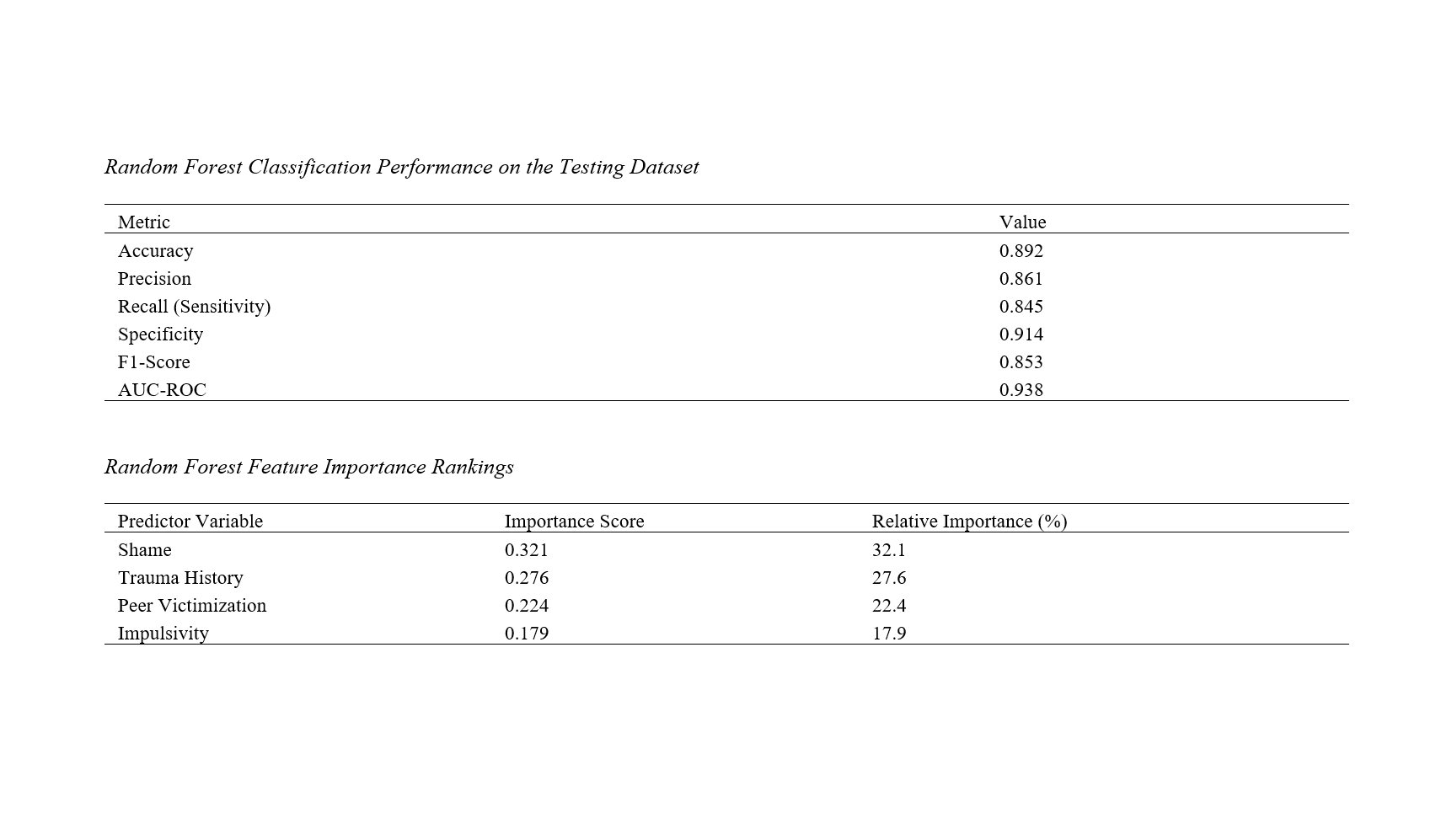
Findings: Inferential analyses revealed that adolescents classified as high-risk for NSSI reported significantly higher levels of trauma history, shame, impulsivity, and peer victimization compared with low-risk peers. The Random Forest model achieved an overall accuracy of 89.2%, precision of 86.1%, recall of 84.5%, F1-score of 85.3%, and AUC of 0.938. Feature importance rankings indicated that shame was the strongest predictor, followed by trauma history, peer victimization, and impulsivity. These results suggest that emotional, developmental, interpersonal, and behavioral factors jointly contribute to adolescent self-injury risk.
Conclusion: The findings demonstrate that Random Forest algorithms can accurately classify adolescents at elevated risk for NSSI, highlighting the importance of integrating trauma history, shame, impulsivity, and peer victimization into early identification and prevention efforts. Interventions should target emotional regulation, trauma recovery, and social support to reduce the likelihood of self-injurious behaviors.
Downloads
References
AghaMohammadi, S., Mazaheri, M. A., Fata, L., Mootabi, F., & Moghadasiyan, B. (2023). The Experience of Hurt in the Deepest Part of Self; A phenomenological Study in Young People With Non-Suicidal Self-Injury (NSSI). Qualitative Research Journal, 24(3), 233-244. https://doi.org/10.1108/qrj-06-2023-0107
Babaeifard, M., Akbari, M., Mohammadkhani, S., Hasani, J., Shahbazian, R., & Selby, E. A. (2024). Early Maladaptive Schemas, Distress Tolerance and Self-Injury in Iranian Adolescents: Serial Mediation Model of Transdiagnostic Factors. BJPsych Open, 10(3). https://doi.org/10.1192/bjo.2024.708
Bernacki, C. G. (2024). Fundamentals of Nonsuicidal Self-Injury in Pediatric Patients. Pediatric Annals, 53(8). https://doi.org/10.3928/19382359-20240605-02
Blay, M., Duarte, M., Dessouli, M.-A., Durpoix, A., Rüfenacht, E., Weibel, S., Speranza, M., & Perroud, N. (2024). Proposition of a Transdiagnostic Processual Approach of Emotion Dysregulation Based on Core Triggers and Interpersonal Styles. Frontiers in Psychiatry, 15. https://doi.org/10.3389/fpsyt.2024.1260138
Chiappini, S., Sampogna, G., Ventriglio, A., Menculini, G., Ricci, V., Pettorruso, M., Volpe, U., & Martinotti, G. (2025). Exploring Emerging Psychopathological Characteristics and Challenges of Novel Depression Subtypes: Insights From the Literature. Frontiers in Psychiatry, 16. https://doi.org/10.3389/fpsyt.2025.1613251
Choi, J. Y., & Song, D. H. (2025). Self-Harm in Sexually Abused Adolescents: The Role of Posttraumatic Symptoms, Emotional Impulsivity, and Negative Cognition. Psychological Trauma Theory Research Practice and Policy, 17(5), 1057-1065. https://doi.org/10.1037/tra0001706
Dai, Y., Yang, P., Ji, W., Diao, L., & Lu, H. (2025). The Correlation Between Non-Suicidal Self-Injury in Adolescents, Parenting Styles, and Borderline Personality Traits. Frontiers in Psychiatry, 16. https://doi.org/10.3389/fpsyt.2025.1620872
Gupta, N., Gupta, M., Madabushi, J. S., & Zubiar, F. (2023). Integrating Psychosocial Risks With Emerging Evidence for Borderline Personality Disorders in Adolescence: An Update for Clinicians. Cureus. https://doi.org/10.7759/cureus.40295
Hennefield, L., Donohue, M. R., Hoyniak, C. P., Whalen, D. J., Thompson, R. J., Tillman, R., Luby, J. L., & Barch, D. M. (2025). Characteristics Differentiating Preadolescents With Suicidal Ideation From Those Who Display Suicidal Behaviors. Suicide and Life-Threatening Behavior, 55(4). https://doi.org/10.1111/sltb.70040
Holst-Schumacher, I., Núñez-Rivas, H. P., Campos-Saborío, N., & Solano-Moncada, G. (2022). Highlights in Suicidal Ideation and Non-Suicidal Self-Injury in Costa Rica Children and Adolescents. Psychology, 13(05), 767-781. https://doi.org/10.4236/psych.2022.135050
Iswanti, D. I., Lai, L. L., Saifudin, I. M. M. Y., Kandar, K., Dewi, R. K., & Cahyaningrum, D. D. (2024). The Predictor of Non-Suicidal Self-Injury Behavior Among Adolescents: A Cross-Sectional Study. Jurnal Ners, 19(2), 125-133. https://doi.org/10.20473/jn.v19i2.54610
Jiao, C. (2024). The Relationship Between Childhood Traumatic Experience and Borderline Personality, Prognosis and Treatment of Borderline Personality Disorder. Applied & Educational Psychology, 5(3). https://doi.org/10.23977/appep.2024.050318
Kothadia. (2022). Risk Factors for Nonsuicidal Self-Injury: A Review of the Evidence. Cp, 21(8). https://doi.org/10.12788/cp.0251
Lansing, A. E., Park, J., & Beck, A. N. (2023). Cumulative Trauma, Adversity, and Loss Among Juvenile Justice–involved Girls: Implications for Health Disparities. Journal of Traumatic Stress, 36(6), 1015-1030. https://doi.org/10.1002/jts.22981
Lu, J., Li, S., Fan, T., Ni, X., Zhang, L., Chen, H., Chen, X., Tang, H., Ye, Y., Zhou, J., & Shen, Y. (2025). Childhood Maltreatment, Bullying, and Internet Addiction in Relation to Suicidal Ideation Among Adolescents: Cross-Sectional Mediation and Network Analysis. Journal of medical Internet research, 27, e79858-e79858. https://doi.org/10.2196/79858
Marqués-Feixa, L., Moya, J., Romero, S., Santamarina-Pérez, P., Rapado‐Castro, M., Zorrilla, E. P., Martín, M., Anglada, E., Lobato, M. J., Ramírez, M., Moreno, N., Mayoral, M., Vila, M. M., Arias, B., & Fañanás, L. (2021). Risk of Suicidal Behavior in Children and Adolescents Exposed to Maltreatment: The Mediating Role of Borderline Personality Traits and Recent Stressful Life Events. Journal of clinical medicine, 10(22), 5293. https://doi.org/10.3390/jcm10225293
McQuaid, G. A., Strang, J. F., & Jack, A. (2024). Borderline Personality as a Factor in Late, Missed, and Mis-Diagnosis in Autistic Girls and Women: A Conceptual Analysis. Autism in Adulthood, 6(4), 401-427. https://doi.org/10.1089/aut.2023.0034
Moore, J. (2022). Understanding Nonsuicidal Self-Injury. Journal of Christian Nursing, 39(2), 98-103. https://doi.org/10.1097/cnj.0000000000000939
Paulus, F. W., Ohmann, S., Möhler, E., Plener, P. L., & Popow, C. (2021). Emotional Dysregulation in Children and Adolescents With Psychiatric Disorders. A Narrative Review. Frontiers in Psychiatry, 12. https://doi.org/10.3389/fpsyt.2021.628252
Predescu, E., Calugar, I., & Șipoș, R. (2024). Cyberbullying and Non-Suicidal Self-Injury (NSSI) in Adolescence: Exploring Moderators and Mediators Through a Systematic Review. Children, 11(4), 410. https://doi.org/10.3390/children11040410
Puzio, D., Bobeff, E. J., Bliźniewska-Kowalska, K., Lewandowska, A., & Gałecki, P. (2025). What Differentiates Adolescents Who Have Attempted Suicide From Those Without Suicidal History? A Retrospective Psychiatric Inpatient Study. BMC psychiatry, 25(1). https://doi.org/10.1186/s12888-025-06505-z
Raffagnato, A., Iannattone, S., Fasolato, R., Parolin, E., Ravaglia, B., Biscalchin, G., Traverso, A., Zanato, S., Miscioscia, M., & Gatta, M. (2022). A Pre-Adolescent and Adolescent Clinical Sample Study About Suicidal Ideation, Suicide Attempt, and Self-Harming. European Journal of Investigation in Health Psychology and Education, 12(10), 1441-1462. https://doi.org/10.3390/ejihpe12100100
Rizk-Hildbrand, M., Semple, T. J., Preisig, M., Haeberling, I., Smigielski, L., Pauli, D., Walitza, S., Kleim, B., & Berger, G. (2025). The Body as a Battleground: A Qualitative Study of the Impact of Violence, Body Shaming, and Self-Harm in Adolescents With a History of Suicide Attempts. International journal of environmental research and public health, 22(6), 859. https://doi.org/10.3390/ijerph22060859
Serafini, G., Aguglia, A., Amerio, A., Canepa, G., Adavastro, G., Conigliaro, C., Nebbia, J., Franchi, L., Flouri, E., & Amore, M. (2021). The Relationship Between Bullying Victimization and Perpetration and Non-Suicidal Self-Injury: A Systematic Review. Child Psychiatry & Human Development, 54(1), 154-175. https://doi.org/10.1007/s10578-021-01231-5
Steil, R., Schneider, A., & Schwartzkopff, L. (2021). How to Treat Childhood Sexual Abuse Related PTSD Accompanied by Risky Sexual Behavior: A Case Study on the Use of Dialectical Behavior Therapy for Posttraumatic Stress Disorder (DBT-PTSD). Journal of Child & Adolescent Trauma, 15(2), 471-478. https://doi.org/10.1007/s40653-021-00421-6
Wahyuni, S., Pranata, S., Kurniawan, W., Setyowati, R., Heni, H., Wianti, A., Agustini, A., & Hijriani, H. (2024). Discovering the Impact of Bullying on Adolescents Through Bibliometric Analysis. Scripta Medica, 55(2), 219-229. https://doi.org/10.5937/scriptamed55-47959
Wang, P., Li, C., Bella-Fernández, M., Martín-Moratinos, M., Castaño, L. M., Sol-Calderón, P. d., Hernando, M., & Blasco‐Fontecilla, H. (2022). Comparing Differences Between Two Groups of Adolescents Hospitalized for Self-Harming Behaviors With and Without Personality Disorders. Journal of clinical medicine, 11(24), 7263. https://doi.org/10.3390/jcm11247263
Wang, Y., Chen, A., & Ni, H. (2021). The Relationship Between Cybervictimization and Non-Suicidal Self-Injury in Chinese Adolescents: A Moderated-Mediation Model. Frontiers in psychology, 11. https://doi.org/10.3389/fpsyg.2020.572100
Wu, O., Zhu, M., Yeo, K. J., Xu, W., Wu, Y. F., & Lu, X. (2025). Navigating Emotions: The Role of Self-Talk in Preventing Adolescent Self-Injury. Health Education & Behavior. https://doi.org/10.1177/10901981251363168
Xu, T., & Bi, S. (2025). The Association Between Bullying Victimization and Non-Suicidal Self-Injury Among Adolescents: A Longitudinal Mediation Role of Self-Control. https://doi.org/10.21203/rs.3.rs-6720266/v1
Yan, H., & Yue, W. (2023). Risk Factors, Theoretical Models, and Biological Mechanisms of Nonsuicidal Self-Injury: A Brief Review. Interdisciplinary Nursing Research, 2(2), 112-120. https://doi.org/10.1097/nr9.0000000000000023
Zhang, J., Liu, Y. D., Zhang, H., Huang, Z. H., Wang, F., Yang, J.-J., Wang, S., Jia, F.-j., & Hou, C. L. (2021). Bullying, Present Romantic Relationship and Depression as Predictive Factors of Non-Suicidal Self-Injury in Adolescent Psychiatric Patients. https://doi.org/10.21203/rs.3.rs-1080316/v1
Zhang, J., Liu, Y. D., Zhang, H., Huang, Z. H., Wang, F., Yang, J.-J., Wang, S., Jia, F. J., & Hou, C. L. (2022). Correlates of Non-Suicidal Self-Injury in Adolescent Psychiatric Patients in China. Frontiers in Psychiatry, 13. https://doi.org/10.3389/fpsyt.2022.864150
Zhao, K., Tong, S., Yang, S., Yang, W., Xu, Y., Fan, Z., Hong, L., Zheng, J., Yao, K., & Zheng, T. (2023). Childhood Trauma, Peer Victimization, and Non-Suicidal Self-Injury Among Chinese Adolescents: A Latent Variable Mediation Analysis. https://doi.org/10.21203/rs.3.rs-2445042/v1
Zhou, M., Wang, S., Zheng, D., Li, J., & Yang, Y. (2025). Gender-Differentiated Pathways From Childhood Trauma to Self-Injury: Rumination as a Mediator in Depressed Adolescents. https://doi.org/10.21203/rs.3.rs-6987106/v1
Zhou, X., Li, R., Gao, Q., Wang, x., Cheng, P., & Zhu, H. (2024). Injury Risk and Influencing Factors of Substance Use and Problematic Internet Use Among Emerging Adults in Beijing, China. https://doi.org/10.21203/rs.3.rs-4934481/v1
Downloads
Additional Files
Publication Timeline
- Submitted
- Revised
- Accepted