Explainable Deep Learning Models of Adolescent Eating Disorders Based on Appearance Comparison, Influencer Exposure, Emotion Dysregulation, Self-Criticism, and Weight Stigma
DOI:
https://doi.org/10.61838/kman.jayps.5457Keywords:
Eating disorders, Adolescents, Explainable artificial intelligence, Deep learning, Appearance comparison, Emotion dysregulation, Self-criticism, Weight stigma, Influencer exposure, Social mediaAbstract
Objective: The present study aimed to develop and interpret explainable deep learning models for predicting adolescent eating disorder symptoms based on appearance comparison, influencer exposure, emotion dysregulation, self-criticism, and weight stigma.
Methods and Materials: This study employed a cross-sectional predictive design using explainable artificial intelligence approaches among 1,219 Canadian adolescents aged 14 to 18 years recruited from secondary schools in Ontario, British Columbia, and Quebec. Participants completed standardized measures assessing eating disorder symptoms, appearance comparison, influencer exposure, emotion dysregulation, self-criticism, and weight stigma through an online survey platform. Data were analyzed using TensorFlow, Keras, and Scikit-learn libraries. The dataset was divided into training, validation, and testing subsets, and a multilayer explainable deep neural network was developed. SHapley Additive exPlanations (SHAP) and Local Interpretable Model-Agnostic Explanations (LIME) were used to enhance model interpretability and identify the relative contribution of predictors. Model performance was compared with logistic regression, support vector machine, and random forest algorithms.
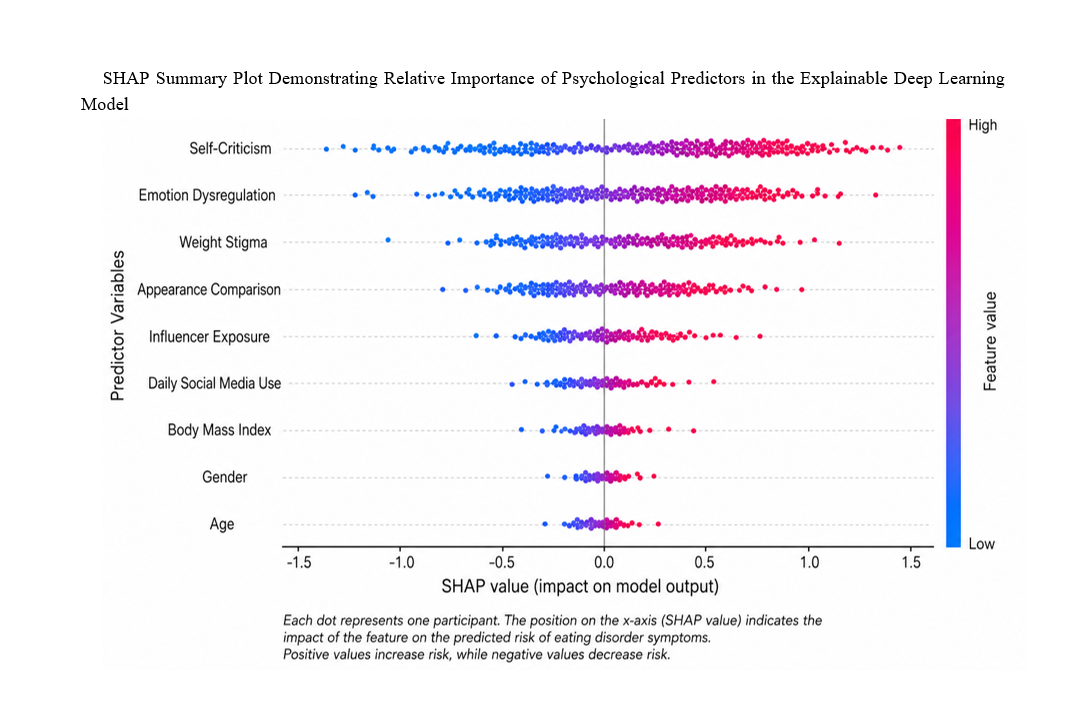
Findings: Significant positive associations were observed among all study variables and eating disorder symptoms. Self-criticism demonstrated the strongest association with eating pathology, followed by emotion dysregulation and weight stigma. The explainable deep learning model achieved the highest predictive performance compared to alternative machine learning models, with superior accuracy, precision, recall, F1-score, and area under the receiver operating characteristic curve values. SHAP analyses identified self-criticism as the strongest predictor, followed by emotion dysregulation, weight stigma, appearance comparison, and influencer exposure. Interaction analyses further demonstrated that the predictive effects of appearance comparison and weight stigma intensified when combined with elevated self-criticism and emotional dysregulation.
Conclusion: The findings suggest that adolescent eating disorders are shaped by complex interactions among emotional vulnerabilities, maladaptive self-evaluative processes, and digitally reinforced appearance pressures. Explainable deep learning models provide a powerful and interpretable framework for identifying multidimensional psychological risk patterns associated with eating pathology and may support more personalized prevention and intervention strategies for adolescents.
Downloads
References
Albert, S. L., Massar, R. E., Cassidy, O., Fennelly, K., Jay, M., Massey, P. M., & Bragg, M. A. (2024a). Body Positivity, Physical Health, and Emotional Well-Being Discourse on Social Media: Content Analysis of Lizzo’s Instagram. Jmir Formative Research, 8, e60541. https://doi.org/10.2196/60541
Albert, S. L., Massar, R. E., Cassidy, O., Fennelly, K., Jay, M., Massey, P. M., & Bragg, M. A. (2024b). Body Positivity, Physical Health, and Emotional Well-Being Discourse on Social Media: Content Analysis of Lizzo’s Instagram (Preprint). https://doi.org/10.2196/preprints.60541
Anastasiadou, D., Tárrega, S., Fornieles-Deu, A., & Sánchez‐Carracedo, D. (2025). Family-Based Weight Stigma and Psychological Well-Being of Adolescents: A Longitudinal Analysis of Recent vs. Cumulative Exposure. Frontiers in Psychiatry, 16. https://doi.org/10.3389/fpsyt.2025.1623411
Bharti, J. (2026). The Psychological Impact of Societal Beauty Standards: A Systematic Review of Body Image Issues, Awareness Campaigns and the Role of Palliative Care in the Digital Era. Indian Journal of Palliative Care, 32, 26-32. https://doi.org/10.25259/ijpc_111_2025
Clark, O. E., Lee, M. M., Jingree, M. L., O’Dwyer, E., Yue, Y., Marrero, A., Taméz, M., Bhupathiraju, S. N., & Mattei, J. (2021). Weight Stigma and Social Media: Evidence and Public Health Solutions. Frontiers in Nutrition, 8. https://doi.org/10.3389/fnut.2021.739056
Czepczor‐Bernat, K., Zembura, M., & Matusik, P. (2025). Analysis of Blame, Guilt, and Shame Related to Body and Body Weight and Their Relationship With the Context of Psychological Functioning Among the Pediatric Population With Overweight and Obesity: A Systematic Review. Nutrients, 17(11), 1763. https://doi.org/10.3390/nu17111763
Dane, A., & Bhatia, K. (2023). The Social Media Diet: A Scoping Review to Investigate the Association Between Social Media, Body Image and Eating Disorders Amongst Young People. Plos Global Public Health, 3(3), e0001091. https://doi.org/10.1371/journal.pgph.0001091
Hendy, A., Soliman, S. M., Tantawi, H. R., Salman, S., Ibrahim, R. K., Hendy, A. S., Fattah, H. A. A., Al‐Mugheed, K., Sayed, S., Alabdullah, A. A. S., Abdelaliem, S. M. F., & Zaher, A. (2025). The Weight of Words: Investigating the Role of Weight Stigma and Body Mass Index in Shaping Children and Youth’s Emotional Experiences. Journal of eating disorders, 13(1). https://doi.org/10.1186/s40337-025-01248-4
Horovitz, O. (2025). Advancements in the Diagnosis and Treatment of Eating Disorders in Children and Adolescents: Challenges, Progress, and Future Directions. Nutrients, 17(10), 1744. https://doi.org/10.3390/nu17101744
Ioannidis, K., & Chamberlain, S. R. (2021). Digital Hazards for Feeding and Eating: What We Know and What We Don't. Current psychiatry reports, 23(9). https://doi.org/10.1007/s11920-021-01271-7
Ispas, A. G., Forray, A. I., Lacurezeanu, A., Petreuș, D., Gavrilaș, L. I., & Cherecheș, R. M. (2025). Eating Disorder Risk Among Adolescents: The Influence of Dietary Patterns, Physical Activity, and BMI. Nutrients, 17(6), 1067. https://doi.org/10.3390/nu17061067
Keski‐Rahkonen, A. (2024). Eating Disorders: Etiology, Risk Factors, and Suggestions for Prevention. Current Opinion in Psychiatry, 37(6), 381-387. https://doi.org/10.1097/yco.0000000000000965
Khalid, R., Lister, N. B., Paxton, S. J., Maguire, S., Libesman, S., Seidler, A. L., Cooper, K., Quigley, F., Yourell, J., Baur, L. A., & Jebeile, H. (2024). Potential Pathways to the Onset and Development of Eating Disorders in People With Overweight and Obesity: A Scoping Review. Obesity Reviews, 26(1). https://doi.org/10.1111/obr.13840
Kilby, R., & Mickelson, K. D. (2025). Combating Weight-Stigmatization in Online Spaces: The Impacts of Body Neutral, Body Positive, and Weight-Stigmatizing TikTok Content on Body Image and Mood. Frontiers in Psychiatry, 16. https://doi.org/10.3389/fpsyt.2025.1577063
Leonard, S. I., Sharma, Y., Hughes, T. L., Jackman, K. B., & Bruzzese, J. M. (2024). Weight Stigma and Mental and Emotional Health Among Sexual and Gender Minority Individuals: A Scoping Review. LGBT Health, 11(7), 496-513. https://doi.org/10.1089/lgbt.2023.0025
Marano, G. (2025). The Body as a Battlefield: Identity Development and Psychosomatic Expression in Eating Disorders Across Childhood and Adolescence. Children, 12(11), 1465. https://doi.org/10.3390/children12111465
Merino, M., Tornero-Aguilera, J. F., Rubio-Zarapuz, A., Villanueva-Tobaldo, C. V., Martín-Rodríguez, A., & Clemente‐Suárez, V. J. (2024). Body Perceptions and Psychological Well-Being: A Review of the Impact of Social Media and Physical Measurements on Self-Esteem and Mental Health With a Focus on Body Image Satisfaction and Its Relationship With Cultural and Gender Factors. Healthcare, 12(14), 1396. https://doi.org/10.3390/healthcare12141396
Murphy, R., Bailey‐Straebler, S., Grave, R. D., Calugi, S., Osborne, E. L., & Cooper, Z. (2025). Evolving Perspectives on CBT-E for Eating Disorders: Clarifying Ten Key Points – Misconceptions and Communication Gaps Explored. The Cognitive Behaviour Therapist, 18. https://doi.org/10.1017/s1754470x25100299
Muzacz, A. K., Houston, S. K., Renwick, A. S., & Carew, C. M. (2023). Sizeism in Education: What School Counselors Need to Know. Professional School Counseling, 27(1). https://doi.org/10.1177/2156759x231212892
Ndour, A., & Foulkes, L. (2025). The Romanticisation of Mental Health Problems in Adolescents and Its Implications: A Narrative Review. European Child & Adolescent Psychiatry, 34(8), 2297-2326. https://doi.org/10.1007/s00787-025-02701-0
O’Hara, L., Alajaimi, B. A., & Alshowaikh, B. (2023). “I Was Bullied for Being Fat in Every Situation, in Every Outfit, at Every Celebration”: A Qualitative Exploratory Study on Experiences of Weight-Based Oppression in Qatar. Frontiers in Public Health, 11. https://doi.org/10.3389/fpubh.2023.1015181
Osterbauer, M. (2025). Weight Talk and Body Weight Perception Through the Lens of Attachment Theory: A Literature Review. The Family Journal, 33(3), 479-486. https://doi.org/10.1177/10664807241312199
P., G., & K., P. (2024). Relationship Between Body Image and Self Esteem Among Young Adults and Adolescents. International Journal for Multidisciplinary Research, 6(2). https://doi.org/10.36948/ijfmr.2024.v06i02.19239
Paul, B. (2025). The Impact of Social Media on Health Behaviors, a Systematic Review. Healthcare, 13(21), 2763. https://doi.org/10.3390/healthcare13212763
Paula Victoria Sozza Silva, G., Penelo, E., Laus, M. F., Sánchez‐Carracedo, D., Almeida, S. S., & Costa, T. M. B. (2025). Adaptation and Validation of the Modified Weight Bias Internalization Scale (WBIS-M) in Brazilian Adults. PLoS One, 20(7), e0328176. https://doi.org/10.1371/journal.pone.0328176
Roberts, K. J., & Polfuss, M. (2022). Weight Stigma in Children and Adolescents. Nursing, 52(6), 17-24. https://doi.org/10.1097/01.nurse.0000829904.57766.58
Sabol, M. A., & Duell, N. (2024). Effects of Social Media Use on Body Image and Disordered Eating in Adolescents. https://doi.org/10.31234/osf.io/fxh6m
Schmidt, U., Claudino, A. M., Fernández‐Aranda, F., Giel, K. E., Griffiths, J., Hay, P., Kim, Y. R., Marshall, J., Micali, N., Monteleone, A. M., Nakazato, M., Steinglass, J., Wade, T., Wonderlich, S. A., Zipfel, S., Allen, K., & Sharpe, H. (2025). The Current Clinical Approach to Feeding and Eating Disorders Aimed to Increase Personalization of Management. World Psychiatry, 24(1), 4-31. https://doi.org/10.1002/wps.21263
Siqueira, B. B., Assumpção, M. C., Barroso, S. M., Japúr, C. C., & Fernanda Rodrigues de Oliveira, P. (2021). Weight Stigma and Health – Repercussions on the Health of Adolescents and Adults: Integrative Review of the Literature. Jornal Brasileiro de Psiquiatria, 70(2), 162-178. https://doi.org/10.1590/0047-2085000000324
Smith, D. V. (2024). Loving the Skin, You’re In: A Deconstruction of Children’s Literature That Focus on Body (Size) Issues. English Teaching Practice & Critique, 23(2), 245-260. https://doi.org/10.1108/etpc-09-2023-0120
Tang, C. J., Zhang, X., Zhou, C.-L., Li, K., & Cai, Y. (2025). The Effects of Weight Self-Stigma on Psychological Distress in Adolescents: The Chain-Mediated Roles of Fear of Negative Appearance Evaluation and Social Appearance Anxiety. Frontiers in psychology, 16. https://doi.org/10.3389/fpsyg.2025.1619694
Vacca, M., Cerolini, S., Zegretti, A., Zagaria, A., Mocini, E., & Lombardo, C. (2025). A School-Based Intervention Program to Reduce Weight Stigma in Adolescents. Children, 12(9), 1208. https://doi.org/10.3390/children12091208
Wang, Y., Chen, Y., Lu, C., Kwan, A. T., McIntyre, R. S., Yang, F., & Cao, B. (2024). The Psychological Factors Mediating/Moderating the Association Between Body‐image Disturbance and Depression: A Systematic Review. PsyCh Journal, 13(4), 527-540. https://doi.org/10.1002/pchj.754
Zulkifli, C. N., Latif, N. A. A., & Idris, M. P. (2023). Body Shaming Among University Students: Awareness and Implications on the Body Image. International Journal of Academic Research in Business and Social Sciences, 13(2). https://doi.org/10.6007/ijarbss/v13-i2/16359
Downloads
Additional Files
Publication Timeline
- Submitted
- Revised
- Accepted