LightGBM-Based Prediction of Academic Burnout among High School Students from Perfectionism, Test Anxiety, Academic Self-Efficacy, and School Climate Indicators
DOI:
https://doi.org/10.61838/kman.jayps.5458Keywords:
Academic burnout, Perfectionism, Test anxiety, Academic self-efficacy, School climate, Machine learning, LightGBM, AdolescentsAbstract
Objective: To develop and evaluate a machine learning model using LightGBM to predict academic burnout among high school students based on psychological and school environment factors.
Methods and Materials: A total of 1,248 high school students from Denmark participated in this cross-sectional study. Data were collected on perfectionism, test anxiety, academic self-efficacy, and perceptions of school climate using validated self-report instruments. Academic burnout was measured with the Maslach Burnout Inventory–Student Survey. Demographic data including age, gender, grade level, and school type were also obtained. Data were cleaned, standardized, and analyzed using Python and LightGBM algorithms. The dataset was divided into training (80%) and testing (20%) sets, and five-fold cross-validation was employed for model optimization. Model performance was assessed using accuracy, precision, recall, F1-score, ROC-AUC, and feature importance via SHAP values.
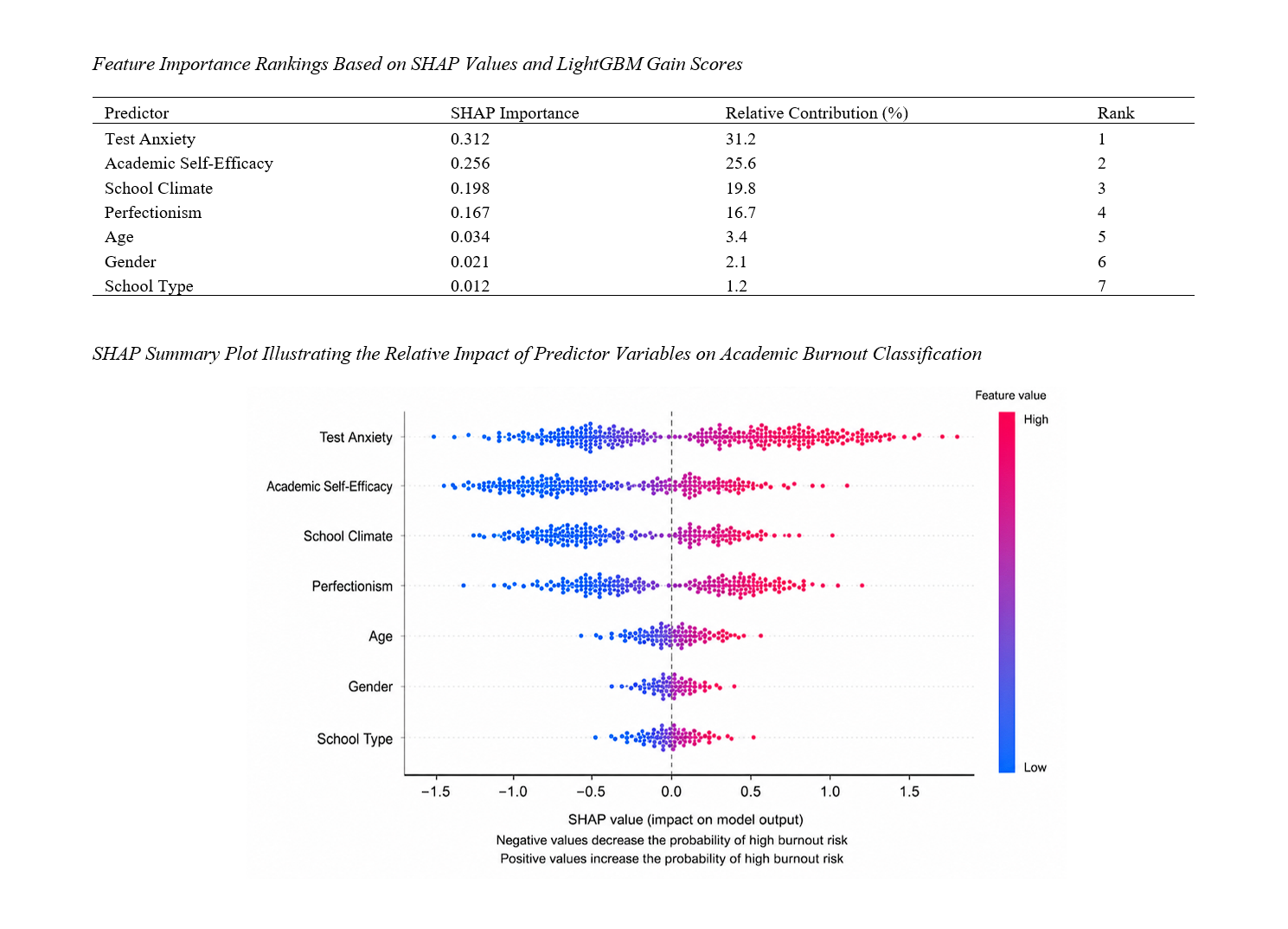
Findings: The LightGBM model accurately classified students into low- and high-risk burnout categories with 89.1% accuracy on the testing dataset. Test anxiety emerged as the strongest predictor, followed by academic self-efficacy, school climate, and perfectionism. Higher test anxiety and perfectionism were associated with increased burnout risk, whereas higher self-efficacy and more positive school climate perceptions were protective. The SHAP summary plot revealed the individual contributions of each predictor and indicated heterogeneity in their effects across students. Demographic variables contributed minimally to predictive performance.
Conclusion: This study demonstrates the effectiveness of a LightGBM-based model for predicting academic burnout using psychological and environmental factors. Findings emphasize the importance of addressing test anxiety, promoting academic self-efficacy, and fostering supportive school climates to reduce burnout risk among adolescents. Machine learning approaches can inform targeted interventions and early identification of at-risk students.
Downloads
References
Aalto, E. P., Pons, J., Alcaraz, S., Zamora‐Solé, R., & Ramis, Y. (2024). Psychological and Social Factors Associated With Mental Health of European Dual Career Athletes: A Systematic Review. European Journal of Sport Science, 24(12), 1844-1864. https://doi.org/10.1002/ejsc.12218
Al-Awad, F. A. (2024). Academic Burnout, Stress, and the Role of Resilience in a Sample of Saudi Arabian Medical Students. Medical Archives, 78(1), 39. https://doi.org/10.5455/medarh.2024.78.39-43
Azim, S. R., Yusoff, M. S. B., & Roslan, N. S. (2025). Mapping the Multidimensional Factors of Medical Student Resilience Development: A Scoping Review. BMC Medical Education, 25(1). https://doi.org/10.1186/s12909-025-07290-9
Blondeau, L. A. (2024). The Impostor Phenomenon’s Relation to Achievement at School and Work. 111-130. https://doi.org/10.1037/0000397-006
Cengiz, S., & Peker, A. (2024). Antecedents of School Burnout: A Longitudinal Mediation Study. Social Psychology of Education, 27(4), 1901-1919. https://doi.org/10.1007/s11218-024-09887-2
Chasetareh, F., Barabadi, E., Khajavy, G. H., & Flett, G. L. (2022). Perfectionism and L2 Achievement: The Mediating Roles of Motivation and Self-Regulated Learning Among Iranian High School Students. Journal of Psychoeducational Assessment, 41(1), 3-21. https://doi.org/10.1177/07342829221096916
Choi, H.-j., Cho, S., Kim, J., Kim, E. J., Chung, J., & Lee, S. M. (2022). The Mediating Effect of Introjected Motivation on the Relation Between Perfectionism and Academic Burnout. Journal of Psychologists and Counsellors in Schools, 32(2), 207-219. https://doi.org/10.1017/jgc.2020.8
Chung, Y., & Shin, J. Y. (2024). Profiles of Perfectionism and Their Relations to Task Disengagement, Test Anxiety, and Depression in South Korean High School Students: The Mediating Role of Achievement Goals. European Journal of Education, 60(1). https://doi.org/10.1111/ejed.12894
Cully, S., Hatinova, K., Jakob Clason van de, L., & Björnsdotter, M. (2025). Factors Associated With Symptom Severity in Stress-Induced Exhaustion Disorder: Cohort Characterization and Cross-Sectional Correlations. Frontiers in Psychiatry, 16. https://doi.org/10.3389/fpsyt.2025.1548967
Dobos, B., Mellor, D., & Pikó, B. (2024). Exploring Fear of Happiness Among University Students: The Role of Perfectionism, Academic Burnout, Loneliness, and Hopelessness. Scandinavian journal of psychology, 65(3), 559-567. https://doi.org/10.1111/sjop.13001
Faiman, H. B., & Strouse, G. A. (2025). Perfectionism and Academic Burnout in High-Achieving Undergraduate Students. Gifted Child Quarterly, 69(3), 269-284. https://doi.org/10.1177/00169862251326467
Flett, G. L., & Hewitt, P. L. (2022). Perfectionism and Problems in Learning, Performance, and Achievement. 173-199. https://doi.org/10.1037/0000289-009
Gaudreau, P., & Benoît, A. (2024). Be Careful What You Wish For: The Double-Edged Sword of Perfectionism During Graduate Studies. https://doi.org/10.31234/osf.io/zxqvf
Gaudreau, P., & Benoît, A. (2025). Distinguishing Perfectionism and Excellencism in Graduate Students: Contrasting Links With Performance Satisfaction, Research Self‐efficacy, Burnout, and Dropout Intentions. British Journal of Psychology, 116(4), 907-929. https://doi.org/10.1111/bjop.12798
Hawkins, S., & Mackinnon, S. P. (2024). Perfectionism and Stress as Predictors of Academic Self-Efficacy, Self-Concept, and Burnout: A Test of the Vulnerability Stress Model. https://doi.org/10.31234/osf.io/g2r95
Hawkins, S., & Mackinnon, S. P. (2025). Does Perfectionism Moderate the Relationship Between Postsecondary Student Stress and Academic Self-Efficacy, Self-Concept, and Burnout? Canadian Journal of Behavioural Science/Revue canadienne des sciences du comportement. https://doi.org/10.1037/cbs0000466
Journault, A. A., Bilodeau-Houle, A., Duplessis-Marcotte, F., Plante, I., Giguère, C. É., & Lupien, S. (2023). Beyond Individual Factors: Contextual Factors Matter for Students’ Test Anxiety_Preprint. https://doi.org/10.31219/osf.io/y45h9
Kim, S. (2022). Students’ Perceptions of the Learning Environment at a Medical School in Korea: Comparisons of the Most Recent 4 Years’ Results Using the Dundee Ready Education Environment Measure (DREEM). Kosin Medical Journal, 37(4), 299-310. https://doi.org/10.7180/kmj.22.129
Klein, H. J., & McCarthy, S. M. (2022). Student Wellness Trends and Interventions in Medical Education: A Narrative Review. Humanities and Social Sciences Communications, 9(1). https://doi.org/10.1057/s41599-022-01105-8
Lin, J., & Guo, W. (2024). The Research on Risk Factors for Adolescents’ Mental Health. Behavioral Sciences, 14(4), 263. https://doi.org/10.3390/bs14040263
Liu, C., & Berzenski, S. R. (2022). College Academic Perfectionism Scale: Development and Validation. Journal of Psychoeducational Assessment, 40(4), 465-481. https://doi.org/10.1177/07342829211069799
Ma, Y. (2021). Analysis on the Reasons of Academic Burnout Among Chinese Adolescents. https://doi.org/10.2991/assehr.k.211217.002
Mahsood, N., Mahboob, U., Asim, M., & Shaheen, N. (2025). Assessing the Well-Being of PhD Scholars: A Scoping Review. BMC psychology, 13(1). https://doi.org/10.1186/s40359-025-02668-2
Ménard, A. D., & Chittle, L. (2023). The Impostor Phenomenon in Post‐secondary Students: A Review of the Literature. Review of Education, 11(2). https://doi.org/10.1002/rev3.3399
Ok, F., Karip, B., & Baydili, K. N. (2025). Impostor Syndrome and Its Association With Anatomical Self‐efficacy in Medical Students in Turkiye. Anatomical Sciences Education. https://doi.org/10.1002/ase.70116
Osenk, I., Johnson, C., & Wade, T. (2022). A Pragmatic Randomized Controlled Trial Targeting Perfectionism in Young Adolescents. School Mental Health, 15(1), 151-164. https://doi.org/10.1007/s12310-022-09540-3
Pereira, A. T., Brito, M. J., Cabaços, C., Carneiro, M., Carvalho, F., Manão, A. A., Araújo, A. I., Pereira, D., & Macedo, A. (2022). The Protective Role of Self-Compassion in the Relationship Between Perfectionism and Burnout in Portuguese Medicine and Dentistry Students. International journal of environmental research and public health, 19(5), 2740. https://doi.org/10.3390/ijerph19052740
Qin, L., Lü, J., Zhou, Y., Wijaya, T. T., Huang, Y., & Fauziddin, M. (2022). Reduction of Academic Burnout in Preservice Teachers: PLS-SEM Approach. Sustainability, 14(20), 13416. https://doi.org/10.3390/su142013416
Ramadhana, D., Basthomi, Y., & Zen, E. L. (2023). Correlation Analysis of Academic Perfectionism, Self-Efficacy, and Burnout Among English Department Learners. Voices of English Language Education Society, 7(2), 300-311. https://doi.org/10.29408/veles.v7i2.18309
Sanseverino, D., Molinaro, D., Spagnoli, P., & Ghislieri, C. (2023). The Dynamic Between Self-Efficacy and Emotional Exhaustion Through Studyholism: Which Resources Could Be Helpful for University Students? International journal of environmental research and public health, 20(15), 6462. https://doi.org/10.3390/ijerph20156462
Setiyowati, A. J., Rachmawati, I., Wiyono, B. B., Indreswari, H., & Laksana, E. P. (2024). Analysis of the Structural Relationship Emotional Regulation, Academic Procrastination, and Academic Burnout. International Journal of Evaluation and Research in Education (Ijere), 13(3), 1895. https://doi.org/10.11591/ijere.v13i3.26778
Yaacob, Z., Zakaria, N., Mokhtar, M., Jalal, S. F., Pati, K. M. I., & Rahmat, N. H. (2023). Exploring Students’ Fatigue: Is There a Relationship Between Outcome With Effort and Performance? International Journal of Academic Research in Business and Social Sciences, 13(9). https://doi.org/10.6007/ijarbss/v13-i9/17731
Yin, Y., Parpala, A., & Toom, A. (2024). International Students’ Burnout and Self-Efficacy Profiles and Their Relation to Writing Conceptions. Research in Comparative and International Education, 19(2), 175-196. https://doi.org/10.1177/17454999241232241
Zhang, L., Liu, L., Wang, P., Wu, X., & Wang, W. (2025). Parents’ Behavioural Control Affects Chinese College Students’ School Burnout and Perceived Employment Stress: Different Effects via Self-Oriented, Other-Oriented, and Socially Prescribed Perfectionism. Emerging Adulthood, 13(2), 395-409. https://doi.org/10.1177/21676968241312263
Downloads
Additional Files
Publication Timeline
- Submitted
- Revised
- Accepted