The Effectiveness of Schema Mode Therapy on Resilience and Self-Control in Adolescent Girls with a History of Non-Suicidal Self-Injury
DOI:
https://doi.org/10.61838/Keywords:
schema modes, resilience, self-control, adolescentsAbstract
Objective: The present study aimed to investigate the effectiveness of schema mode therapy on resilience and self-control in adolescent girls with a history of non-suicidal self-injury.
Methods and Materials: The present study employed a quasi-experimental design with a pretest–posttest format and a control group. The statistical population consisted of adolescent girls aged 12 to 18 years with a history of non-suicidal self-injury in Isfahan during 2024. A total of 30 participants were selected using purposive sampling and randomly assigned to experimental and control groups, with 15 participants in each group. Data collection instruments included the Connor and Davidson Resilience Scale (CD-RISC) and the Tangney Self-Control Questionnaire (SCQ). The experimental group participated in 10 weekly 90-minute sessions of schema mode therapy, while the control group received no intervention. Data were analyzed using multivariate analysis of covariance (MANCOVA) in SPSS-26 software.
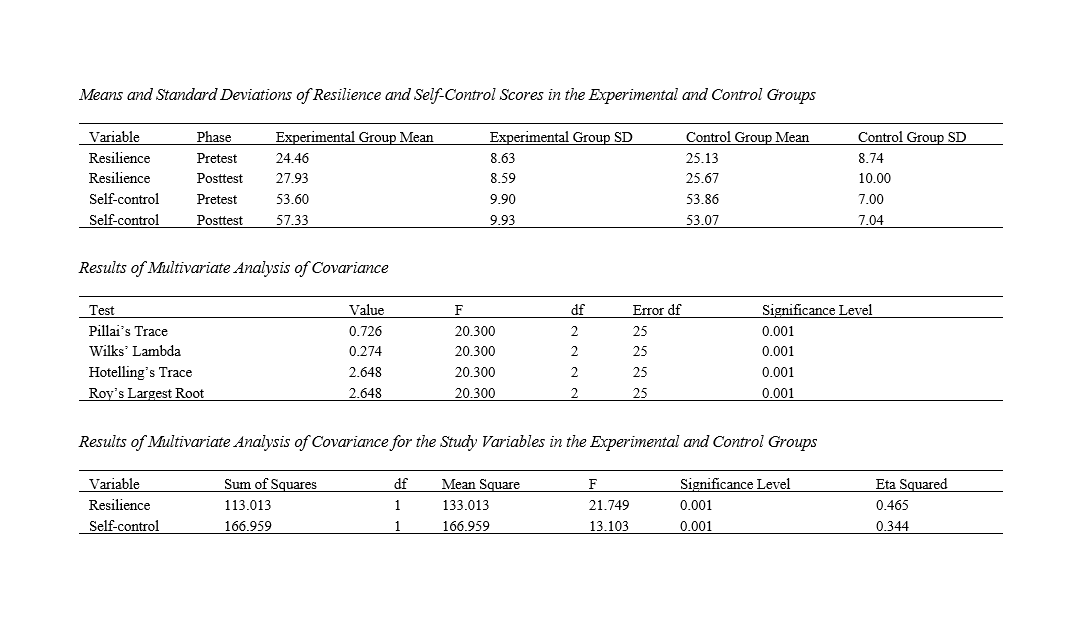
Findings: The findings demonstrated that schema mode therapy had a statistically significant effect on both resilience and self-control in adolescent girls with a history of non-suicidal self-injury. The results of multivariate covariance analysis indicated a significant difference between the experimental and control groups in at least one dependent variable at the posttest stage (p < 0.05). Univariate covariance analysis further revealed that resilience significantly increased in the experimental group compared to the control group (F = 21.749, p = 0.001, η² = 0.465). Additionally, self-control scores significantly improved following the intervention (F = 13.103, p = 0.001, η² = 0.344).
Conclusion: The findings of the present study indicate that schema mode therapy is an effective intervention for improving resilience and self-control among adolescent girls with a history of non-suicidal self-injury. By targeting maladaptive schemas, dysfunctional coping modes, and emotional dysregulation, schema mode therapy can enhance adaptive psychological functioning and reduce vulnerability to self-injurious behaviors in adolescents.
Downloads
References
Abbasi Rad, A., Bahrami Hidaji, M., Tajeri, B., Mohammadi Shirmohalleh, F., & Ranjbaripour, T. (2023). The Effectiveness of Schema Mode-Based Therapy on Emotional Dysregulation and Integrative Self-Knowledge in Self-Harming Delinquent Adolescents. Rooyesh-e-Ravanshenasi, 12(7), 93-102. http://frooyesh.ir/article-1-4531-fa.html
Afsar, M., Hassani, F., Farzad, V., & Golshani, F. (2021). Comparing the Effectiveness of Emotion-Focused Therapy and Mode-Focused Schema Therapy on Perceived Rejection in Women with Borderline Personality Disorder. Journal of Mashhad University of Medical Sciences, 64(3), 3167-3177.
Aghili, S. M., Kalteh, M., & Babaei, E. (2023). The Effectiveness of Dialectical Behavior Therapy on Self-Concealment, Self-Compassion, and Self-Injurious Behaviors in Female Students. Journal of Sabzevar University of Medical Sciences, 30(6), 742-755.
Amini, F., Farahbakhsh, K., & Nikouzadeh Kord Mirza, E. (2012). A Comparative Study of Life Satisfaction, Resilience, and Job Burnout among Nurses in Intensive Care Units and Other Wards. Nursing Management Quarterly, 1(4), 86-95.
Andover, M. S., Schatten, H. T., & Morris, B. W. (2017). An Intervention for Nonsuicidal Self-Injury in Young Adults: A Pilot Randomized Controlled Trial. Journal of consulting and clinical psychology, 85(6), 620-631.
Aspeqvist, E., Andersson, H., Korhonen, L., Dahlstrom, O., & Zetterqvist, M. (2024). Measurement and Stratification of Nonsuicidal Self-Injury in Adolescents. BMC psychiatry, 24(1), 107.
Boat, R., Williams, R. A., Dring, K. J., Morris, J. G., Nevill, M. E., & Cooper, S. B. (2024). Associations of Self-Control with Physical Activity, Physical Fitness, and Adiposity in Adolescents. Behavioral Medicine, 50(1), 82-90.
Cobb-Clark, D. A., Dahmann, S. C., Kamhofer, D., & Schildberg-Horisch, H. (2019). Self-Control: Determinants, Life Outcomes and Intergenerational Implications.
de Oliveira, B. N., Lopes, M. V. V., da Costa, B. G. G., de Mello, G. T., Maciel, G. P., & Silva, K. S. (2025). Bullying in Adolescents across Three Years in the Context of the COVID-19 Pandemic: A Repeated Cross-Sectional and Prospective Analysis. BMC public health, 25(1), 163. https://doi.org/10.1186/s12889-025-21391-6
Edwards, D. J. A. (2022). Using Schema Modes for Case Conceptualization in Schema Therapy: An Applied Clinical Approach. Frontiers in psychology, 12, 763670.
Farrell, J., & Shaw, I. A. (2022). Schema Therapy: Conceptualization and Treatment of Personality Disorders. https://doi.org/10.1037/0000310-013
Fletcher, D., & Sarkar, M. (2013). Psychological Resilience: A Review and Critique of Definitions, Concepts, and Theory. European Psychologist, 18(1), 12-15.
Halpin, S. A., & Duffy, N. M. (2020). Predictors of Non-Suicidal Self-Injury Cessation in Adults Who Self-Injured during Adolescence. Journal of Affective Disorders Reports, 1, 100017.
Heidari, Z., & Torkan, H. (2023). The Effectiveness of Cognitive-Behavioral Therapy on Nonsuicidal Self-Injury, Internalized Stigma, Positive Affect, Negative Affect, and Manic Symptoms in Bipolar Patients. Quarterly Journal of Clinical Psychology, 15(1), 79-91.
Izakian, S., Mirzaian, B., & Hosseini, S. H. (2018). Investigating the Prevalence of Nonsuicidal Self-Injury in Iranian Adolescents and Youth. Clinical Excellence, 8(2), 14-25.
Jalili, B., & Heidari, M. (2018). Comparison of Spiritual Intelligence and Self-Control Subscales in Group-Fight Offenders and Non-Offenders: A Case Study of Group-Fight Offenders in Isfahan Central Prison. Knowledge and research in applied psychology, 19(2), 106-114.
Kamal, A. A., Shahabizadeh, F., & Ahi, G. (2022). The Effectiveness of Combined Dialectical Behavior Therapy and Schema Therapy in Emotion Dysregulation and Reducing Self-Injurious Behaviors. Tehran.
Kausch-Blecken von Schmeling, A. (2024). Linking Self-Control to Interoceptive Prediction: A Behavioral Study and a Functional Magnetic Resonance Imaging Study
Latafati Beris, R., Ghamari Kivi, H., Kiani, A. R., & Sheikh Eslami, A. (2021). Comparing the Effectiveness of Schema Mode Therapy and Emotion-Focused Therapy on Conflict Resolution Styles among Newly Married Couples with Conflict. Rooyesh-e-Ravanshenasi, 10(9), 186-192.
Latino, F., Tafuri, D., & Tafuri, F. (2025). Understanding the Psycho-Physiological Impact of Bullying on Adolescents: A Focus on Movement-Based Educational Interventions. Education Sciences, 15(5), 521. https://doi.org/10.3390/educsci15050521
Lopez-Fernandez, F. J., Morales-Hidalgo, P., Canals, J., Marzo, J. C., Garcia-Lopez, L. J., & Piqueras, J. A. (2024). Psychometric Properties of the Connor-Davidson Resilience Scale (CD-RISC) in Spanish Adolescents. The Spanish journal of psychology, 27, e3.
Martean, L. (2013). Schema Therapy in Practice: An Introductory Guide to the Schema Mode Approach by Arnoud Arntz and Gitta Jacob. The Psychiatrist, 37(6), 216-216.
Moeini, M. (2023). A Comparative Review of Resilience Models among Elementary School Students. A New Approach to Children's Education, 5(2), 147-155.
Rahnama, A., Afshari, F., Afrouz, F., & Bijari, A. (2023). The Role of Childhood Maltreatment in Adolescent Self-Control: The Moderating Role of Gender and Self-Compassion. Positive Psychology Research, 9(1), 47-63.
Reinhardt, M., Rice, K. G., Duran, B. S., & Kokonyei, G. (2022). A Person-Centered Approach to Adolescent Nonsuicidal Self-Injury: Predictors and Correlates in a Community Sample. Journal of youth and adolescence, 51(9), 1760-1773.
Shahbazi, A., NasrEsfahani, N., & Yousefi, Z. (2026). Effectiveness of Dialectical Behavior Therapy on Feelings of Rejection and Inferiority in Bereaved Adolescent Girls. Journal of Adolescent and Youth Psychological Studies, 7(1), 1-11. http://dx.doi.org/10.61838/kman.jayps.4833
Shen, Y., Zhou, Y., Ren, S., Li, Y., Liu, Y., Zhou, R., & Xie, G. (2025). Relations between Peer Bullying and Adolescent Depression: The Mediating Effect of Cellphone Usage. Frontiers in Psychiatry, 16, 1486628. https://doi.org/10.3389/fpsyt.2025.1486628
Situmorang, B. A., & Widodo, Y. H. (2024). The Relationship between Resilience and Overthinking in Adolescents. Afeksi: Jurnal Penelitian dan Evaluasi Pendidikan, 5(1), 124-130.
Tangney, J., Baumeister, R. F., & Boone, A. L. (2004). High Self-Control Predicts Good Adjustment, Less Pathology, Better Grades, and Interpersonal Success. Journal of personality, 72, 271-324.
Tilton-Weaver, L., Latina, D., & Marshall, S. K. (2023). Trajectories of Nonsuicidal Self-Injury during Adolescence. Journal of adolescence, 95(3), 437-453.
Yas Fard, G., Ranjgar, B., & Shirzadi, A. (2019). The Effectiveness of Dialectical Behavior Therapy on Self-Esteem, Cognitive Emotion Regulation, and Nonsuicidal Self-Injury in Adolescent Girls. Thought and Behavior in Clinical Psychology, 14(54), 47-56.
Young, J. E., Klosko, S., & Weishaar, M. E. (2003). Schema Therapy: A Practitioner's Guide. The Guilford Press.
Zhao, H., Gong, X., Huebner, E. S., Yang, X., & Zhou, J. (2022). Cyberbullying Victimization and Nonsuicidal Self-Injury in Adolescents: Testing a Moderated Mediating Model of Emotion Reactivity and Dispositional Mindfulness. Journal of affective disorders, 299, 256-263.
Downloads
Additional Files
Publication Timeline
- Submitted
- Revised
- Accepted