Comparing Sleep Disorders, Procrastination, and Cognitive Intelligence in Male and Female Upper Secondary Students in Rudsar
DOI:
https://doi.org/10.61838/Keywords:
Sleep disorders, Procrastination, Cognitive intelligence, Gender differences, Secondary studentsAbstract
Objective: This study aimed to compare sleep disorders, procrastination, and cognitive intelligence among male and female upper secondary students in Rudsar.
Methods and Materials: This descriptive-analytical causal-comparative study was conducted on 400 upper secondary students, including 200 girls and 200 boys, selected through two-stage cluster random sampling from a population of 1,958 students in Rudsar during the 2024–2025 academic year. Data were collected using the Lynch et al. Sleep Disorders Questionnaire, Lay’s Procrastination Scale, and Raven’s Progressive Matrices. Data were analyzed using SPSS-26 through descriptive statistics, Levene’s test, multivariate and univariate analysis of variance, and Mann–Whitney and Wilcoxon tests for cognitive intelligence due to non-normal distribution.
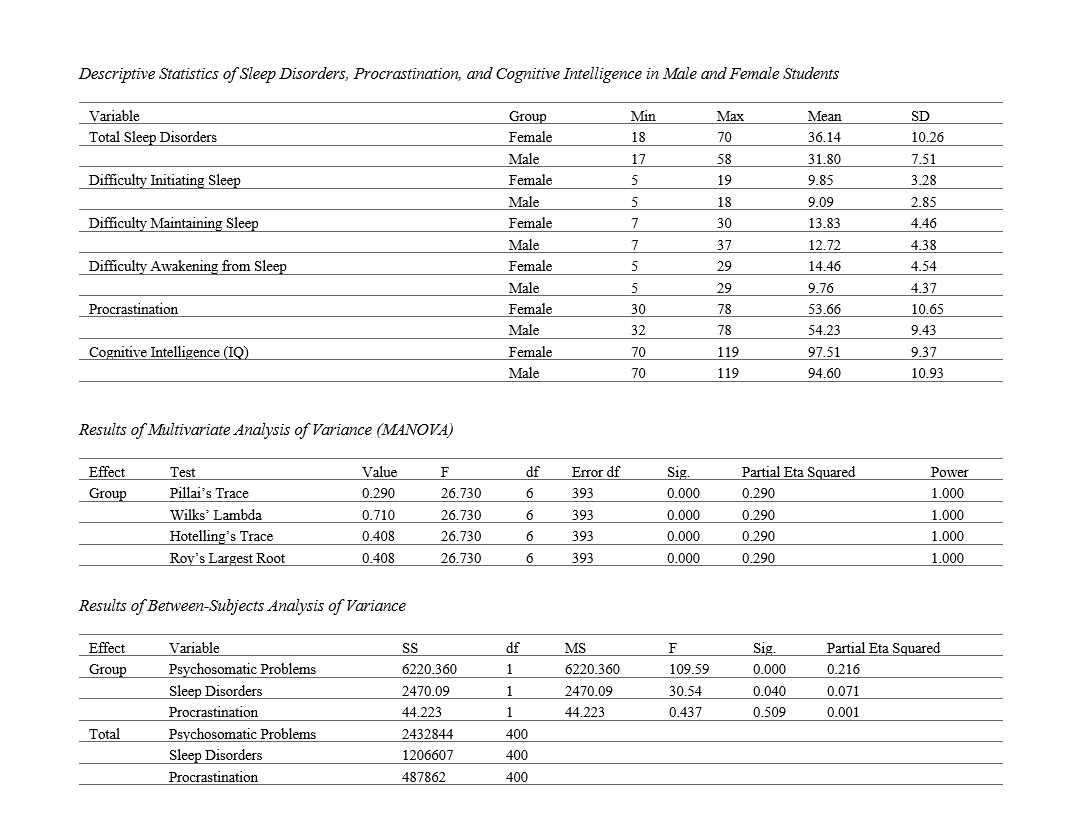
Findings: The multivariate analysis showed a significant overall difference between male and female students across the studied variables (Wilks’ Lambda = 0.710, F = 26.730, p < 0.001, η² = 0.290). Significant gender differences were found in sleep disorders (F = 30.54, p = 0.04, η² = 0.071) and cognitive intelligence (p = 0.002). Girls obtained higher mean scores than boys in both sleep disorders and cognitive intelligence. However, no significant difference was observed between the two groups in procrastination (F = 0.437, p = 0.509, η² = 0.001), although boys had a slightly higher mean procrastination score.
Conclusion: The findings indicate that gender is associated with significant differences in sleep disorders and cognitive intelligence among upper secondary students, while procrastination does not differ significantly between girls and boys. These results highlight the need for gender-sensitive school-based screening and intervention programs targeting sleep health and cognitive-academic functioning.
Downloads
References
Aluja, A., Colom, R., Abad, F. J., & Juan-Espinosa, M. (2000). Sex Differences in General Intelligence Defined as g Among Young Adolescents. Personality and individual differences, 28(4), 813-820.
Ashrafi, H., Ansarin, K., Hassanzadeh, M., & Jouyban, A. (2017). A Review of Sleep Disorders and Their Treatment. Medical Journal of Tabriz University of Medical Sciences and Health Services, 40(2), 95-105.
Balkis, M., & Duru, E. (2017). Gender Differences in the Relationship Between Academic Procrastination, Satisfaction with Academic Life and Academic Performance. Electronic Journal of Research in Educational Psychology, 15(1), 105-125.
Breda, M., Belli, A., Esposito, D., Di Pilla, A., Melegari, M. G., DelRosso, L., Malorgio, E., Doria, M., Ferri, R., & Bruni, O. (2023). Sleep Habits and Sleep Disorders in Italian Children and Adolescents: A Cross-Sectional Survey. Journal of Clinical Sleep Medicine, 19(4), 659-672.
Copeland, C. F. (2005). Adapting the Structure of Intellect Programme for Use in Urban South African Schools [Dissertation, University of Johannesburg].
Crowley, S. J., Acebo, C., & Carskadon, M. A. (2007). Sleep, Circadian Rhythms, and Delayed Phase in Adolescence. Sleep Medicine, 8(6), 602-612.
Farhane-Medina, N. Z., Luque, B., Tabernero, C., & Castillo-Mayen, R. (2022). Factors Associated with Gender and Sex Differences in Anxiety Prevalence and Comorbidity: A Systematic Review. Science progress, 105(4), 00368504221135469.
Ghadiri Sourmanabadi, F., & Abdolmohammadi, K. (2023). Executive Functions in Adolescents with Sleep Disorders. Shefa Khatam Neuroscience Journal, 11(2), 32-40.
Giofre, D., Allen, K., Toffalini, E., Mammarella, I. C., & Caviola, S. (2022). Decoding Gender Differences: Intellectual Profiles of Children with Specific Learning Disabilities. intelligence, 90, 10-16.
Gohil, E. (2014). Procrastination and Self-Esteem: A Gender-Based Study. Global Journal of Interdisciplinary Social Sciences, 3(3), 91-95.
Gono, D. B. (2024). Re-Evaluating the Concept of Procrastination and the Reasons Why Students Procrastinate: A Theoretical Appraisal. Sagbaman Academic Journal of Arts & Humanities, 2(1), 11-21.
Hale, L., & Guan, S. (2015). Screen Time and Sleep Among School-Aged Children and Adolescents: A Systematic Literature Review. Sleep Medicine Reviews, 21, 50-58.
Halpern, D. F. (2012). Sex Differences in Cognitive Abilities (4 ed.). Psychology Press.
Hosseini, F. S., & Khayer, M. (2009). Prediction of Behavioral and Decision-Making Procrastination Based on Metacognitive Beliefs in Students. Iranian Journal of Psychiatry and Clinical Psychology, 15(58), 265-273.
Hosseini, S. A., Ghadermarzi, H., Almasi, M., & Ghaderi, M. S. (2014). Effectiveness of Cognitive Hope Enhancement Training on Reducing Academic Procrastination in Male Upper Secondary School Students. Educational and School Studies, 3(4), 49-65.
Hyde, J. S. (2005). The Gender Similarity Hypothesis. American psychologist, 60, 581-592.
Imanpour, F., & Imanpour, F. (2023). Prevalence and Gender Differences in Academic Procrastination Among Students in Multigrade Lower Secondary Classes: A Case Study of South Khorasan. Pouyesh in Humanities Education, 9(30), 183-200.
Jalil Abkenar, S. S., & Ashouri, M. (2016). The Relationship of Cognitive Intelligence and Emotional Intelligence with Academic Achievement in Sixth-Grade Elementary Students. Empowering Exceptional Children, 7(4), 52-59.
Jia, N., Zhu, Z., Liu, Y., Yin, X., Man, L., Hou, W., Zhang, H., Yu, Q., & Hui, L. (2025). From Single Nucleotide Variations to Genes: Identifying the Genetic Links Between Sleep and Psychiatric Disorders. Sleep, 48(1), zsae209.
Johnson, J. G., Cohen, P., Kasen, S., First, M. B., & Brook, J. S. (2004). Association Between Television Viewing and Sleep Problems During Adolescence and Early Adulthood. Archives of pediatrics & adolescent medicine, 158(6), 562-568.
Johnson, W., Carothers, I., & Deary, I. J. (2008). Sex Differences in Variability in General Intelligence: A New Look at the Old Question. Perspectives on Psychological Science, 3, 518-531.
Keshavarz, L., & Roozbehani, Z. (2016). Explaining the Communication Model of Emotional Intelligence, Social Intelligence, and Cognitive Intelligence of Physical Education Managers at Iranian Universities. New Approaches in Sport Management, 4(14), 69-81.
Khanshan, M., & Tamanaeifar, M. R. (2023). The Relationship Between Parenting Styles and Attachment Styles with Adolescent Sleep Disorders: The Mediating Role of Internet Addiction. Rooyesh-e-Ravanshenasi Journal, 11(1), 185-198.
Kieling, C., Buchweitz, C., Caye, A., Silvani, J., Ameis, S. H., Brunoni, A. R., Cost, K. T., Courtney, D. B., Georgiades, K., Merikangas, K. R., & Henderson, J. L. (2024). Worldwide Prevalence and Disability from Mental Disorders Across Childhood and Adolescence: Evidence from the Global Burden of Disease Study. JAMA Psychiatry, 81(4), 347-356.
Kryger, M. H., & Roth, T. (2017). Principles and Practice of Sleep Medicine (6 ed.). Elsevier.
Latipah, E., Adi, H. C., & Insani, F. D. (2021). Academic Procrastination of High School Students During the Covid-19 Pandemic: Review from Self-Regulated Learning and the Intensity of Social Media. Dinamika Ilmu, 21(2), 293-308.
Levkovich, I., Yatzkar, U., & Shenaar-Golan, V. (2025). Age and Gender Differences in Emotional and Behavioral Functioning Among Youth Referred to a Psychiatric Outpatient Clinic at a Public Hospital. Children, 12(6), 683.
Lu, D., He, Y., & Tan, Y. (2022). Gender, Socioeconomic Status, Cultural Differences, Education, Family Size and Procrastination: A Sociodemographic Meta-Analysis. Frontiers in psychology, 12, 71-94.
Lynn, R. (1994). Sex Differences in Intelligence and Brain Size: A Paradox Resolved. Personality and individual differences, 17(2), 257-271.
Lynn, R. (2021). Sex Differences in Verbal Abilities in the Wechsler Tests: A Review. Mankind Quarterly, 61(3), 688-706.
Mauliana, R., Zahara, C. I., & Suzanna, E. (2024). Difference Procrastination Academic Reviewed from Type Sex on Student School MTsN 2 Aceh North. Proceedings of Malikussaleh International Conference on Psychology and Multidisciplinary Behavioral Studies,
Mohammadi, M., Ghalebaghi, B., Bandi, M. G., Amintehrani, E., Khodaie, S., & Shoaee, S. (2007). Sleep Patterns and Sleep Problems Among Preschool and School-Aged Group Children in a Primary Care Setting. Iranian Journal of Pediatrics, 17(3), 213-221.
Mokari, H., Khaleghparast, S., & Samani, L. N. (2016). Impact of Puberty Health Education on Anxiety of Adolescents. International Journal of Medical Research & Health Sciences, 5(5), 284-291.
Mollahshahi, Z., & Rezaei, N. (2023). Supporting Students' Mental Health and Well-Being in Schools. Conference on Management and Humanities Research in Iran,
Mousavi, S. Z., Karimi Manjermoei, H., Azizi, A., & Dashti Chahgahi, S. (2023). Investigating the Effect of the Relationship Between Emotional Intelligence and Cognitive Intelligence on Students' Learning. Modern Advances in Psychology, Educational Sciences, and Education, 6(61), 50-66.
Nie, Y., & Liem, G. A. (2013). Extending Antecedents of Achievement Goals: The Double-Edged Sword Effect of Social-Oriented Achievement Motive and Gender Differences. Learning and Individual Differences, 23, 249-255.
Nikyar, H., Zakeri, B., & Sharafeddin, F. (2024). Prevalence and Associated Factors of Sleep Disorders in Recovered COVID-19 Patients. Iranian Biomedical Journal, 28, 68-68.
Olds, T., Ridley, K., & Dollman, J. (2006). Screenieboppers and Extreme Screenies: The Place of Screen Time in the Time Budgets of 10-13-Year-Old Australian Children. Australian and New Zealand Journal of Public Health, 30(2), 137-142.
Parantika, I. W., Suniasih, N. W., & Kristiantari, M. R. (2020). Differences in Academic Procrastination Attitude Between Fifth Grade Male and Female Students. Journal of Psychology and Instruction, 4(1), 10-15.
Perkinson-Gloor, N., Lemola, S., & Grob, A. (2013). Sleep Duration, Positive Attitude Toward Life, and Academic Achievement: The Role of Daytime Tiredness, Behavioral Persistence, and School Start Times. Journal of adolescence, 36(2), 311-318.
Piri, M. (2024). The Relationship Between Academic Motivation and Procrastination in Elementary School Students. Academic Motivation in Educational Systems, 1(2).
Rahmani, J. (2006). Reliability, Validity, and Norming of Raven's Advanced Progressive Matrices Test Among Students of Islamic Azad University, Khorasgan Branch. Knowledge and research in applied psychology, 9(34), 61-74.
Rasouli-Fashtami, A., Hashemi, T., Kiamarsi, A., & Ghaffari, A. (2023). Comparison of Boys' and Girls' Intelligence on Dimensions of Family Efficiency. Family and Health, 13(2), 1-14.
Raven, J. (2000). The Raven's Progressive Matrices: Change and Stability Over Culture and Time. Cognitive Psychology, 41(1), 1-48.
Roustaei, M., Abarshi, Z., Bolandghamat, R., & Mohammadi, M. (2014). Prevalence of Academic Procrastination in Third- to Sixth-Grade Girls and Boys with Learning Disabilities in Mashhad. Third National Conference on Mental Health and Well-Being, Quchan, Iran.
Sadoughi, M. (2017). The Relationship Between Problematic Mobile Usage and Academic Performance Among Students: The Mediating Role of Sleep Quality. Education Strategies in Medical Sciences, 10(2), 123-132.
Scott, A. J., Webb, T. L., Martyn-St James, M., Rowse, G., & Weich, S. (2021). Improving Sleep Quality Leads to Better Mental Health: A Meta-Analysis of Randomised Controlled Trials. Sleep Medicine Reviews, 60, 101556.
Sirois, F. M. (2007). I'll Look After My Health, Later: A Replication and Extension of the Procrastination-Health Model with Community-Dwelling Adults. Personality and individual differences, 43(1), 15-26.
Souri, A., Aghayousefi, A., & Dortaj, F. (2024). Explaining the Phenomenon of Academic Burnout in Students Based on the Role of Academic Procrastination and Parental Perfectionism: A Study of Secondary School Students in Qom. Sociology of Education, 10(3), 98-108.
Tamadoni, M. (2010). Procrastination in Developmental Psychology Students. Iranian Psychologists, 6(24), 337-344.
Tavakoli, M. A. (2013). Prevalence of Academic Procrastination Among University Students and Its Relationship with Demographic Characteristics, Preferred Study Time, and Purpose of Entering University. Educational Psychology Quarterly, 9(28), 100-122.
YousefGomrokchi, M., Shafipoor, S., Paryad, E., & AtrkarRoshan, Z. (2009). A Study of Sleep Habits of the Students of Primary Schools of Rasht City from Parents' Point of View. Two Quarterly Nursing and Midwifery Schools in Guilan Province, 19(62), 40-45.
Zaidi, S. F., Hanif, S. N., Yusuf, S., & Mubin, N. N. (2021). Gender Differences and Prevalence of Sleeping Disorder Among Arts Students in Higher Learning Institutions. The Asian Journal of Professional & Business Studies, 2(1).
Zettergren, P., & Bergman, L. R. (2014). Adolescents with High IQ and Their Adjustment in Adolescence and Midlife. Research in Human Development, 11(3), 186-203.
Downloads
Additional Files
Publication Timeline
- Submitted
- Revised
- Accepted