The Effectiveness of Cognitive Behavioral Therapy on Social Anxiety and Academic Procrastination in Adolescents
DOI:
https://doi.org/10.61838/Keywords:
Cognitive Behavioral Therapy, Social Anxiety, Academic Procrastination, AdolescentsAbstract
Objective: The present study aimed to determine the effectiveness of cognitive behavioral therapy on social anxiety and academic procrastination among adolescents.
Methods and Materials: The present study employed a quasi-experimental design with a pretest–posttest structure and a control group. The statistical population consisted of adolescents who were referred to counseling and psychological services clinics in Tehran during 2025. Using convenience sampling, 30 adolescents were selected and randomly assigned into experimental and control groups, with 15 participants in each group. Data were collected using the Social Anxiety Scale for Adolescents and the Academic Procrastination Scale. After the pretest assessment, the experimental group participated in eight 90-minute sessions of cognitive behavioral therapy, while the control group continued their routine daily activities without intervention. At the completion of the intervention, both groups completed the posttest measures. Data were analyzed using descriptive statistics and analysis of covariance (ANCOVA) through IBM SPSS Statistics.
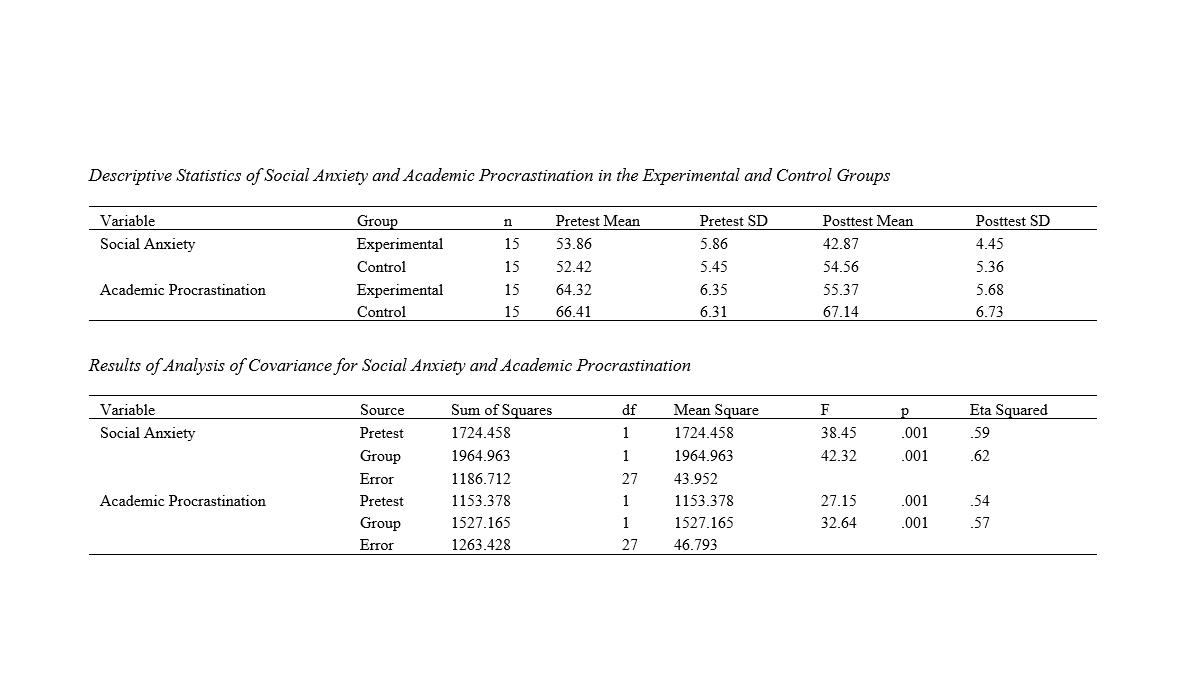
Findings: The findings indicated that cognitive behavioral therapy had a significant effect on reducing social anxiety and academic procrastination among adolescents. After controlling for pretest scores, the results of analysis of covariance showed that the group effect on posttest social anxiety scores was statistically significant, F(1, 27) = 42.32, p < .001, η² = .62. Additionally, the group effect on academic procrastination scores was significant, F(1, 27) = 32.64, p < .001, η² = .57. The obtained effect sizes demonstrated that cognitive behavioral therapy produced substantial improvements in both psychological and academic functioning among participants in the experimental group compared to the control group.
Conclusion: The results of the present study demonstrated that cognitive behavioral therapy is an effective intervention for reducing social anxiety symptoms and academic procrastination among adolescents.
Downloads
References
Alden, L. E., & Fung, K. (2021). Social anxiety disorder and emotional solitude. In R. J. Coplan, J. C. Bowker, & L. J. Nelson (Eds.), The handbook of solitude: Psychological perspectives on social isolation, social withdrawal, and being alone (pp. 364-377). Wiley Blackwell.
Beck, J. S. (2020). Cognitive behavior therapy: Basics and beyond (3 ed.). Guilford Press.
Bjaasted, J. F., Lillevoll, K., Hoffart, A., Nilsen, T. S., Kjoteroe, J., & Prescott, P. (2025). The effect of behavioral rehearsal in the training of clinical psychology students in cognitive therapy for social anxiety disorder: A randomized controlled trial. Behaviour Research and Therapy, 193, 104849. https://doi.org/10.1016/j.brat.2025.104849
Bountress, K. E., Gilmore, A. K., Metzger, I. W., Aggen, S. H., Tomko, R. L., Danielson, C. K., & Amstadter, A. B. (2020). Impact of disaster exposure severity: Cascading effects across parental distress, adolescent PTSD symptoms, as well as parent-child conflict and communication. Social Science and Medicine, 264, 113293.
Garke, M. Å., Hentati Isacsson, N., Kolbeinsson, Ö., Hesser, H., & Månsson, K. N. (2025). Improvements in emotion regulation during cognitive behavior therapy predict subsequent social anxiety reductions. Cognitive behaviour therapy, 54(1), 78-95.
Ghasemi, E. (2023). The effectiveness of cognitive-behavioral therapy on academic procrastination in adolescents of divorce. 18th International Conference on Psychology, Counseling, and Educational Sciences,
Ghasemi Tabaq, F., Torabi Zanouz, S., Mahmood Aliloo, M., & Pak, R. (2021). The relationship between symptoms of social anxiety disorder and psychological well-being with the mediation of fear of negative evaluation and quality of life. Behavioral Sciences (Abhar)(47), 69-90.
Granero, R., Fernandez-Aranda, F., Mestre-Bach, G., Steward, T., & Bano, M. (2017). Cognitive behavioral therapy for compulsive buying behavior: Predictors of treatment outcome. European Psychiatry, 39(11), 57-65.
Gregory, V. L., Jr. (2021). Cognitive-behavioral therapy for relationship distress: Meta-analysis of RCTs with social work implications. Journal of Evidence-Based Social Work, 8(1), 49-70.
Hamzepour Matoughi, F., Tavoli, A., & Salmanian, M. (2023). Comparison of sleep problems and self-efficacy in individuals with symptoms of major depression, social anxiety, and normal individuals in 2022: A descriptive study. Journal of Rafsanjan University of Medical Sciences, 22(7), 691-706.
Henriqueta, F. (2021). Cognitive behavioral therapy and promotion of marital satisfaction: An integrative review. Revista Brasileira De Terapias Cognitivas, 17(1), 16-22.
Hofmann, S. G., Asnaani, A., Vonk, I. J., Sawyer, A. T., & Fang, A. (2021). The efficacy of cognitive behavioral therapy: A review of meta-analyses. Cognitive therapy and research, 45(3), 569-584.
Kafi Nia, F., & Farhadi, H. (2019). The effectiveness of group cognitive-behavioral therapy on communication skills and internet addiction among second-cycle secondary school students. Cognitive Analytical Psychology Quarterly, 10(39), 87-98.
Kavousian, J., & Karimi, K. (2018). The effectiveness of metacognitive skills training on academic procrastination and delay of academic gratification among students. Journal of Cognitive Psychology, 6(4), 14-24.
Kennedy, B., Ruoqing, C., Valdimarsdottir, U., Montgomery, S., Fang, F., & Fall, K. (2018). Childhood bereavement and increased sensitivity to stress in late adolescence.
Kenny, M. (2021). A psychiatrist's experience of mindfulness-based cognitive therapy. The Humanistic Psychologist, 49(1), 162-178.
Kourki, M., Hashemi, A., Mehrabizadeh Honarmand, M., & Peymannia, B. (2023). The effectiveness of integrating psychodrama with group cognitive-behavioral therapy on dimensions of interpersonal sensitivity and social anxiety in adolescent girls. Clinical Psychology, 15(1), 13-25.
Mehri Nejad, A., Sadri, N., Ramezan Saatchi, L., & Ghaffari, Z. (2019). The effectiveness of life skills training on self-esteem and parent-adolescent conflict among first-cycle secondary school girls in Tehran. New Educational Thoughts, 15(1), 187-206.
Mollazamani, M., & Mardoukhi, M. S. (2023). The effectiveness of cognitive-behavioral therapy on psychological flexibility, quality of life, and social anxiety in mothers of children with learning disorder Payame Noor University, Alborz Province, Karaj Center].
Parsons, C. A., & Biesanz, J. C. (2021). Influencing emotion: Social anxiety and comparisons on Instagram. Emotion, 21(7), 1427-1437.
Shibani, H., Mikaeili, N., & Narimani, M. (2020). Comparison of the effectiveness of cognitive-behavioral therapy and emotion regulation training on irritability, depression, anxiety, stress, and emotion regulation in adolescents with disruptive mood dysregulation disorder. Clinical Psychology, 12(2), 41-50.
Sloan, E., Hall, K., Moulding, R., Bryce, S., Mildred, H., & Staiger, P. K. (2017). Emotion regulation as a transdiagnostic treatment construct across anxiety, depression, substance, eating and borderline personality disorders: A systematic review. Clinical psychology review, 57(10), 141-163.
Tarakçıoğlu, M. C. (2024). Can Cognitive Behavioral Therapy Be Effective for Social Anxiety Disorder With Dissociative and Self-Harm Behaviors in a 15-Year-Old Adolescent? Medical Research Reports, 7(2), 114-119. https://doi.org/10.55517/mrr.1419278
Wakelin, K. E., Perman, G., & Simonds, L. M. (2022). Effectiveness of self-compassion-related interventions for reducing self-criticism: A systematic review and meta-analysis. Clinical Psychology and Psychotherapy, 29(1), 1-25.
Wati, L. D. K., Murtadho, A., Ernaeny, W., & Haque, A. A. I. (2025). The Role of Cognitive Behavior Therapy (CBT) Counseling in Managing Anxiety Disorders in Adolescents. International Journal of Research and Innovation in Social Science, IX(III), 2654-2661. https://doi.org/10.47772/ijriss.2025.90300208
Won, S., & Yu, S. L. (2018). Relations of perceived parental autonomy support and control with adolescents' academic time management and procrastination. Learning and Individual Differences, 61, 205-215.
Downloads
Additional Files
Publication Timeline
- Submitted
- Revised
- Accepted